- 660 pages
- English
- ePUB (mobile friendly)
- Available on iOS & Android
eBook - ePub
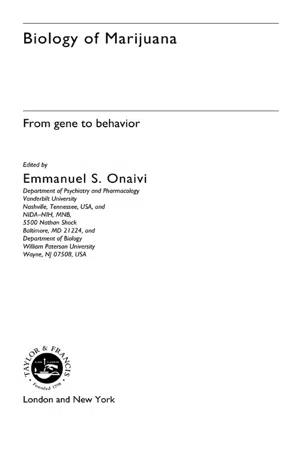
About this book
Marijuana is the prototypical cannabinoid, and is one of the most widely used drugs in the world. Interestingly, cannabinoids are molecules found naturally in the human body and brain as well as in cannabis.
This book provides an extensive reference on the biology of marijuana and the role of molecular techniques in elucidating neuropharmaco
Information
Topic
MedicineSubtopic
PharmacologyChapter 1
Cannabinoid receptor genetics and behavior
Emmanuel S. Onaivi, Hiroki Ishiguro, Zhicheng Lin, Babatunde E. Akinshola, Ping-Wu Zhang and George R. Uhl
ABSTRACT
The last decade has seen more rapid progress in marijuana research than any time in the thousands of years that marijuana has been used by humans. cDNA and genomic sequences encoding G-protein coupled cannabinoid receptors (Cnrs) from several species are now cloned. Endogenous cannabinoid (endocannabinoid) ligands for these receptors, synthetic and hydrolyzing enzymes and transporters that define cannabinoid neurochemically-specificbrain pathways have been identified. Endocannabinoid lipid signaling molecules alter activity at G-protein coupled receptors and possibly even anandamide-gated ion channels, such as vanilloid receptors. Availability of increasingly-specific CB1 and CB2 antagonists and of CB1 and CB2 receptor knockout mice increases our understanding of these cannabinoid systems and provides tantalizing evidence for even more GPCR-Cnrs. Initial studies of Cnr gene structure, regulation and polymorphisms whet our appetite for more data about these interesting genes, their variants, and roles in vulnerabilities to addictions and other neuropsychiatric disorders. Behavioral studies of cannabinoids document the complex interactions between rewarding and adverse effects of these drugs. Pursuing cannabinoid-related molecular, pharmacological and behavioral leads will add greatly to our understanding of endogenous brain neuromodulator systems, abused substances and potential therapeutics. The studies of CB1 and CB2 receptor genes reviewed in this chapter provide a basis for many of these studies.
Key Words: marijuana, genes, cannabinoids, endocannabinoids, mRNA, behavior
INTRODUCTION
Cannabinoids are the constituents of the marijuana plant (Cannabis sativa) of which the principal psychoactive ingredient is Δ9-tetrahydrocannabinol (Δ9-THC). Marijuana has remained one of the most widely used and abused drugs in the world. Although research on the molecular and neurobiological bases of the physiological and neurobehavioral effects of marijuana use was slowed by the lack of specific tools and technology for many decades, much progress has been achieved in cannabinoid research in the last decade. A central feature of this progress has been the elucidation of the cDNAs and genes that encode G-protein coupled (GPCR) cannabinoid receptors (Cnrs). This has facilitated discoveries of endogenous ligands, (endocannabinoids) which has led in turn to use of these endocannabinoids to help define other potential GPCR and even ligand-gated channel cannabinoid receptors. Even understanding the currently-understoodCB1 and CB2 GPCR Cnrs has documented their importance for mediating most of the psychoactive effects of marijuana, other neurobehavioral alterations, and the bulk of the cellular, biochemical and physiological effects of cannabinoids (Martin, 1986).
Two cannabinoid receptor GPCR subtypes have been cloned to date. These are designated as CNR1 and CNR2 or CB1 and CB2. They belong to the large superfamily of receptors that couple to guanine-nucleotide-nucleotide-binding proteins and that thread through cell membranes seven times (heptahelical receptors). The CB1 Cnr is predominantly expressed in brain and spinal cord, and thus, is often referred to as the brain Cnr. The CB2 Cnr is, at times, referred to as the peripheral Cnr because of its largely-peripheral expression in immune cells. cDNA sequences encoding the rat (Matsuda et al., 1990), human (Gerard et al., 1991; Munro et al., 1993), murine (Chakrabarti et al., 1995; Abood et al. , 1997), bovine (Wessner, Genebank submission, 1997), feline (Gebremedhin et al. , Genebank submission, 1997), puffer fish (Yamaguchi et al., 1996), leech (Stefano et al., 1997), and newt (Soderstrom et al., Genebank submission, 1999), CB1 or CB2 like receptors have been reported. The CB1 Cnr is highly conserved across species, whereas the CB2 receptor shows more cross-species variation. Human CB1 and CB2 receptors share 44% overall amino acid identity. Although this might suggest significant overall evolutionary divergence, the receptors’ amino acid identities range from 35% to as high as 82% in different CB1 transmembrane regions (Shire et al., 1999).
CB1 and CB2 receptor gene products are expressed in relative abundance in specific tissues and cell types (Herkenham et al., 1991; Bouaboula et al., 1993; Matsuda et al., 1993). The CB1 Cnr is expressed at relatively high levels in brain regions such as hippocampus and cerebellum, and expressed at low levels in peripheral tissues including spleen, testis, and leucocytes. Das et al. (1995) demonstrated that the CB1 mRNA but not CB2 mRNA was expressed in the mouse uterus, where endocannabinoids can also be synthesized. CB2 is not expressed in even moderate abundance in any brain region, but is expressed in peripheral tissues including white blood cells (Munro et al., 1993; Facci et al., 1995).
The identification of endogenous ligands for Cnrs has focused on modified eicosanoid-like fatty acids. Devane et al. (1992) named anandamide after the Sanskrit word for “bliss”. The second principal endocannabanoid ligand 2-arachidonylgly-cerol(2-AG) was identified by Mechoulam et al., 1995 and Sugiura et al., 1995. Di Marzo et al. (this volume) review the biosynthesis, pharmacological, physiological functions of anandamide and other endocannabinoids. Potent synthetic can-nabinoidagonists and antagonists have also been developed (Shire et al., 1999).
This chapter discusses the current state of description of the genes encoding Cnrs, from their identification by chance to their at least partial elucidation in many species (Table 1.1). The chapter also defines some of the limitations of current knowledge. The pharmacology of the Cnrs is still less well understood than that of many GPCRs. Only scant information describes how these genes are regulated. A moderate store of data describes some of the signal transduction pathways engaged by cannabinoid receptor activation (see for example Hillard and Auchampach, 1994; Glass and McAllister, in this volume). However, many topics including the ways in which the abundant CB1 receptors could alter activities mediated through other coexpressed GPCRs by sequestering G-proteins and other means are still in their infancy. As we discuss these GPCR receptors, we also need to be aware of the possible ligand gated ion channels influenced by canna-binoids.We need to bear in mind the data suggesting that cannabinoids can exert receptor-independent effects on biological (Hillard et al., 1985; Makriyannis et al. , 1989) and enzyme systems such as protein kinase C. Despite these caveats, it is impressive to review the large amount of data about GPCR cannabinoid receptors amassed over the last decade.
Table 1.1 Molecular biological characteristics of G-protein coupled cannabinoid receptors
Cannabinoid research and the use of cannabis products continue to attract significant attention. The current dramatic advances in molecular biology and technology, which increased scientific knowledge in cannabinoid research, will certainly contribute to a better policy on the medical use of marijuana. For example, preliminary studies with Cnr antagonists have contributed to resolving the long-standing debate about addiction to marijuana. Specifically, the controversial question of physical dependence on psychoactive cannabinoids has now been addressed, using the antagonist SR 141716A [N-(piperidin-1-yl)5-(4-chloro-phenyl)-(2,4-dichlorophenyl)-4-methyl-1H-pyrazole-3carboxamidehydrochloride, to precipitate withdrawal reactions in rats injected with increasing doses of Δ9-THC. Aceto et al. (1995) reported a precipitated withdrawal syndrome that was absent in control animals, providing evidence that Δ9-THC could produce physical dependence. In general, it had been claimed that the psychoactivity and euphoria induced by cannabinoids limit their use in the clinic for numerous therapeutic applications for which they are currently being evaluated. Potential therapeutic applications include anti-emetic, appetite stimulant, glaucoma, epilepsy, multiple sclerosis, hepatitis C, Tourett’s syndrome, migraine etc. In some cases, the issue of euphoria induced by cannabinoids does not outweigh the overall quality of life in the terminally ill patients. In many cases, there are however, a number of medical uses that can certainly benefit from the dissociation of the psychoactivity induced by marijuana and cannabinoids from their therapeutic actions. This chapter discusses the evidence for the existence of genes encoding Cnrs in the mammalian systems and the cloning of the rat CB1 Cnr cDNA followed by the cloning of the genes from other species (Table 1.1). The synthesis of cannabinoid agonist and antagonist along with the discovery of endocannabinoids were pivotal to these current advances. With the availability of these genes, gene products and other Cnr research tools, it is speculated that the properties of these genes and regulation will be intensely studied as to reveal, how the psychoactivity can be dissociated from the therapeutic properties of marijuana and cannabinoids, or could it be that certain therapeutic actions of marijuana and cannabinoids cannot be separated from their psychoactivity?
Cannabinoid receptor (Cnr) genes
In this section, the expression of Cnr genes in different species and in many tissues of the mammalian system is reviewed along with the functional implication of selective Cnr subtype gene knockout by homologous recombination. Even with the significant advancements in cannabinoid research and the availability of molecular probes the cloning of the first Cnr gene was fortunate.
Genes encoding rat cannabinoid receptors
The rat CB1 cDNA was identified from brain distribution data concerning an orphan G-protein coupled receptor cDNA. Matsuda et al. reported the identification in 1990. They identified the orphan GPCR cDNA in a rat cerebral cortex cDNA library, probed with a 56-base pair oligonucleotide probe, complementary to sequences encoding the second transmembrane domain of the bovine GPCR substance-P receptor. When in situ hybridization data paralleled the distribution of CB1 receptor autoradiograms developed in an adjacent laboratory, the identity of the orphan cDNA was suspected and rapidly confirmed pharmacologically. Like other GPCRs, the Cnrs contain an N-terminal extracellular domain that possesses glycosy-lationsites, seven transmembrane segments and a C-terminal intracellular domain that may be coupled to a G-protein complex. One distinguishing feature of the CB1 receptor is its long N-terminal putative extracellular segment (Shire et al., 1995).
The rat CB2 cDNA was described following description of the murine CB2 gene (Shire et al., 1996; see below). Griffin et al. (1999) used primers homologous to the predicted translation initiation and termination sites of the mouse CB2 gene and PCR amplifications to generate a ~1.1kb fragment from rat genomic DNA that allowed subsequent identification of the rat CB2 receptor. Table 1.1 shows that sequence analysis of the coding region of the rat CB2 receptor clone indicate 90% nucleic acid identity (93% amino acid identity) between rat and mouse and 81% nucleic acid identity (81% amino acid identity) between rat and human (Griffin et al., 1999).
Genes encoding human cannabinoid receptors
The human CB1 cDNA was isolated by Gerard et al. (1991) from a human brain stem cDNA library using a 600 bp DNA probe and polymerase chain reaction. The deduced amino acid sequences of the rat and human receptors showed that they encode protein residues of 473 and 472 amino acids respectively with 97.3% homology. These protei...
Table of contents
- COVER PAGE
- TITLE PAGE
- COPYRIGHT PAGE
- FIGURES
- CONTRIBUTORS
- PREFACE
- CHAPTER 1: CANNABINOID RECEPTOR GENETICS AND BEHAVIOR
- CHAPTER 2: CANNABINOID THERAPEUTIC POTENTIAL IN MOTIVATIONAL PROCESSES, PSYCHOLOGICAL DISORDERS AND CENTRAL NERVOUS SYSTEM DISORDERS
- CHAPTER 3: MARIJUANA ADDICTION AND CNS REWARD-RELATED EVENTS
- CHAPTER 4: EFFECTS OF MARIJUANA ON HUMAN PERFORMANCE AND ASSESSMENT OF DRIVING IMPAIRMENT
- CHAPTER 5: BIOLOGY OF ENDOCANNABINOIDS
- CHAPTER 6: CANNABINOIDS AND ENDOCANNABINOIDS: BEHAVIORAL AND DEVELOPMENTAL ASPECTS
- CHAPTER 7: MARIJUANA AND MOVEMENT DISORDERS
- CHAPTER 8: EFFECTS OF MARIJUANA ON BRAIN: FUNCTION AND STRUCTURE
- CHAPTER 9: MARIJUANA AND CANNABINOID EFFECTS ON IMMUNITY AND AIDS
- CHAPTER 10: MARIJUANA AND COGNITIVE FUNCTION
- CHAPTER 11: MARIJUANA AND ENDOCRINE FUNCTION
- CHAPTER 12: MBRYONIC CANNABINOID RECEPTORS ARE TARGETS FOR NATURAL AND ENDOCANNABINOIDS DURING EARLY PREGNANCY
- CHAPTER 13: ANTIEMETIC ACTION OF Δ9-TETRAHYDROCANNABINOL AND SYNTHETIC CANNABINOIDS IN CHEMOTHERAPY-INDUCED NAUSEA AND VOMITING
- CHAPTER 14: CANNABIS AND PROSTAGLANDINS: AN OVERVIEW
- CHAPTER 15: CANNABINOID MEDIATED SIGNAL TRANSDUCTION
- CHAPTER 16: DEREGULATION OF MEMBRANE AND RECEPTOR MEDIATED SIGNALING BY THC – THERAPEUTIC IMPLICATIONS
- CHAPTER 17: CANNABINOID RECEPTORS: THE RELATIONSHIP BETWEEN STRUCTURE AND FUNCTION
- CHAPTER 18: ENDOCANNABINOID PROTEINS AND LIGANDS
- CHAPTER 19: ELECTROPHYSIOLOGICAL ACTIONS OF MARIJUANA
- CHAPTER 20: The vascular pharmacology of endocannabinoids
- CHAPTER 21: THE CANNABINOID RECEPTORS AND THEIR INTERACTIONS WITH SYNTHETIC CANNABINOID AGONISTS AND ANTAGONISTS
- CHAPTER 22: CANNABINOIDS AS ANALGESICS
- CHAPTER 23: EFFECTS OF ACUTE AND CHRONIC CANNABINOIDS ON MEMORY: FROM BEHAVIOR TO GENES
- CHAPTER 24: ADVERSE EFFECTS OF MARIJUANA
Trusted by 375,005 students
Access to over 1.5 million titles for a fair monthly price.
Study more efficiently using our study tools.
Frequently asked questions
Yes, you can cancel anytime from the Subscription tab in your account settings on the Perlego website. Your subscription will stay active until the end of your current billing period. Learn how to cancel your subscription
No, books cannot be downloaded as external files, such as PDFs, for use outside of Perlego. However, you can download books within the Perlego app for offline reading on mobile or tablet. Learn how to download books offline
Perlego offers two plans: Essential and Complete
- Essential is ideal for learners and professionals who enjoy exploring a wide range of subjects. Access the Essential Library with 800,000+ trusted titles and best-sellers across business, personal growth, and the humanities. Includes unlimited reading time and Standard Read Aloud voice.
- Complete: Perfect for advanced learners and researchers needing full, unrestricted access. Unlock 1.5M+ books across hundreds of subjects, including academic and specialized titles. The Complete Plan also includes advanced features like Premium Read Aloud and Research Assistant.
We are an online textbook subscription service, where you can get access to an entire online library for less than the price of a single book per month. With over 1.5 million books across 990+ topics, we’ve got you covered! Learn about our mission
Look out for the read-aloud symbol on your next book to see if you can listen to it. The read-aloud tool reads text aloud for you, highlighting the text as it is being read. You can pause it, speed it up and slow it down. Learn more about Read Aloud
Yes! You can use the Perlego app on both iOS and Android devices to read anytime, anywhere — even offline. Perfect for commutes or when you’re on the go.
Please note we cannot support devices running on iOS 13 and Android 7 or earlier. Learn more about using the app
Please note we cannot support devices running on iOS 13 and Android 7 or earlier. Learn more about using the app
Yes, you can access The Biology of Marijuana by Emmanuel S Onaivi in PDF and/or ePUB format, as well as other popular books in Medicine & Pharmacology. We have over 1.5 million books available in our catalogue for you to explore.