eBook - ePub
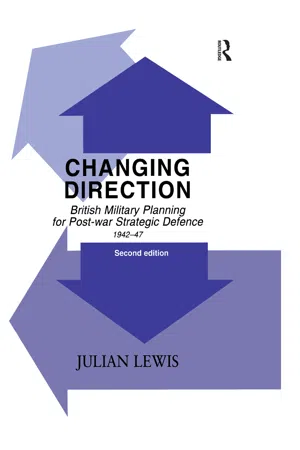
Changing Direction
British Military Planning for Post-war Strategic Defence, 1942-47
- 550 pages
- English
- ePUB (mobile friendly)
- Available on iOS & Android
eBook - ePub
About this book
This volume records the transition from planning against any post-war resurgence of German and Japanese militarism to preparations against a possible threat from the Soviet Union. It charts Foreign Office resistance to consideration of even the possibility of Soviet hostility after the war.
1
THE FOREIGN OFFICE ORIGINS OF POST-WAR STRATEGIC PLANNING 1942
1.
The Diplomatic Background and the Chiefs of Staff Machine
On 20 February 1942 General Sir Hastings Ismay, Chief Staff Officer to the Minister of Defence, circulated a letter from the Foreign Office with the following wry comment ‘I am afraid that it means more work for the Joint Planners, but I do not see how we can get out of it’1 What it contained was the first formal request to the British Chiefs of Staff for post-war strategic guidance. The issue which underlay this request was, however, by no means a recent one.
As far back as November 1940, shortly before his appointment as Acting Foreign Minister in the Norwegian government-in-exile, Trygve Lie had raised the question of a future Atlantic security system.2 By January 1941 his ideas had crystallised into a scheme for post-war British and American bases to be set up in Norway, with all three countries administering supplementary outposts in Greenland, Iceland and the Faroes.3 These proposals had received a certain amount of attention, including a vague and cautious welcome from the Admiralty, which really regarded post-war matters of this kind as far too speculative for practical evaluation.4 However, their impact had been largely stultified by the failure of the Ministerial Committee on Reconstruction Problems5 to devote time to their consideration on referral in March 1941, and by the sudden transformation three months later of the Soviet Union into an ally behind whose back no such scheme dare be considered.6
Subsequent revival of the bases plan was due partly to Lie’s persistence, notably in enlisting the support of his Dutch and Belgian counterparts;7 partly to American entry into the war, which made the notion of her future participation in post-war security arrangements seem less Utopian; and partly to a suggestion by the Soviet leader that:
We should have no objection to Great Britain having naval bases in Norway or Denmark, but we would like a guarantee by certain Powers as to the entrance to the Baltic Sea,8
which cleared the way at least for exploratory talks with Norway on the subject.
At a high-level meeting in the Foreign Office on 14 January 1942 it was suggested that the bases plan was one of only a few ideas for post-war arrangements with both practical value and a possibility of general acceptance. Consequently, just over a year after its initial formulation, a decision was taken to approach the Chiefs of Staff for strategic guidance on the scheme.9 The question was, how could they reasonably be expected to furnish it in the middle of a war? It was obvious that the Service chiefs themselves would have little or no time to devote to the preparation of post-war strategic appreciations for the Foreign Office. What they could be expected to do, however, was to arrange for such matters to be dealt with by an appropriate inter-Service body:
As such a body will certainly be required for the consideration of other similar post-war strategic problems as and when they arise, a decision to set it up might usefully be taken in connection with this particular question.
In the view of the permanent head of the Foreign Office, Sir Alexander Cadogan, ‘if some special committee could set out the case succinctly, it ought not to give the Chiefs of Staff much trouble to pronounce on the desirability or otherwise of the scheme in one form or another’.10 Yet, instead of openly suggesting the creation of such a committee, the eventual approach by the Foreign Office was to be couched in rather more cautious terms.
The Cabinet Office tradition of informal civil-military liaison on organisational matters had for some time been reflected in important links between the Foreign Office and the Chiefs of Staff machine. The latter had come into being on an integrated basis in 1924, as a result of the recommendation of the Salisbury Committee on National and Imperial Defence that
In addition to the functions of the Chiefs of Staff as advisers on questions of sea, land or air policy respectively, to their own Board or Council, each of the three Chiefs of Staff will have an individual and collective responsibility for advising on defence policy as a whole, the three constituting as it were a Super-Chief of a War Staff in Commission.11
From April 1940 onwards the workload of the main body had been shared with a Vice-Chiefs of Staff Committee which acted as its alter ego, the other principal branches of the organisation being its Joint Planning Staff, set up as a sub-committee in 1927, and its Joint Intelligence Sub- Committee, dating from 1936.
The key figure concerned in any approach on post-war planning arrangements would clearly be General Ismay, who had retained his position of Deputy Secretary (Military) to the War Cabinet on joining the Chiefs of Staff Committee as an additional member in May 1940; but the Foreign Office also had the advantage of a direct involvement at two levels in the C.O.S. machine. The J.I.C. and J.P.S. were, respectively, composed of the Directors of Intelligence and Directors of Plans of the three Service Departments, coming together in committee—on the model of the Chiefs of Staff—to initiate and pronounce upon the reports produced by their subordinate inter-Service staffs. It was the Foreign Office which supplied the chairman of the J.I.C.—William Cavendish- Bentinck, who was one of two full members of the sub-committee from Civil Departments. There was also liaison with the J.P.S. at the staff-officer level, the Foreign Office representative being Clifford Norton, through whom, on this occasion, the opening moves were made.
On 12 February 1942 Norton met Ismay informally for advice on how best to frame the request for considered inter-Service views on long-term strategic questions. Ismay agreed that ‘it was undesirable at this stage of the war to put in official minutes the fact that this sort of work was in our minds, necessary though it may be,’ and it was at his suggestion that Cadogan’s formal approach to the Chiefs of Staff a week later was rather more delicately phrased.12 Instead of requesting the establishment of a special committee to consider the ‘long-term problems of a mixed political and strategic nature’ beginning to confront it, the Foreign Office merely asked for permission to approach the Joint Planning Staff directly for such advice. ‘I should add,’ wrote Cadogan, ‘that we could regard their work as purely exploratory until the time came when it was necessary for one reason or another to ask the Chiefs of Staff, and probably ultimately the Cabinet, to give the matter their attention.’13
Ismay saw to it that copies of this letter were circulated privately to the Chiefs of Staff, instead of being given normal distribution as an incoming paper to the committee. On 26 February authority was duly given for the Foreign Office to ‘hold discussions’ with the Joint Planners on what the minutes of the C.O.S. meeting described as ‘long-term foreign policy’.14 In notifying Cadogan of this decision, however, Brigadier Leslie Hollis—the principal secretary to the committee—advised him that, though very ready to agree to his request, the Chiefs of Staff hoped he ‘would understand that such problems must of necessity take a relatively low priority in the work of the Joint Planning Staff’.15
The subdivision of the J.P.S earmarked by Ismay to handle post-war planning was the Future (Operational) Planning Section. It had come into existence some eighteen months previously as a direct result of the Prime Minister’s strengthening of the Joint Planning Staff. It was founded to prepare long-term plans for the defeat of the Axis well in advance of their becoming practical possibilities. In December 1940 Churchill had installed the then Major Oliver Stanley, M.P., as its chairman in order that ‘by virtue of a broad outlook and background and detachment from current day to day problems’ he might assist its members to plan for the future on profitable lines.16 By the beginning of 1942, however, as the Directors of Plans pointed out in a note to the Chiefs of Staff, conditions had changed significantly ‘since 1940 when almost any operation was beyond our resources’.17 The original task given to the F.O.P.S. was well-nigh complete. The plans it had drawn up were no longer distant dreams but medium-and short-term possibilities. As such, they were passing into the province of current planners in the Strategical and Executive Planning Sections of the J.P.S. on the one hand, and of commanders in the field on the other. Conversely, pressure of work on the ‘S’ and ‘E’ sections was steadily increasing, and the Directors of Plans felt that these sections would benefit considerably from the winding-up of the F.O.P.S. and the distribution of its personnel between them. Whilst declining to permit this, at their meeting on 10 February the Chiefs of Staff sought to integrate the work of the F.O. P.S. more closely with that of the strategic planners by broadening its functions and transferring its personnel from Richmond Terrace to the main office at Storey’s Gate.18 Thus, at the very time that Norton was broaching the Foreign Office request for strategic guidance on a longer-term basis than any yet attempted, Colonel Stanley and his colleagues were shifting their emphasis in the opposite direction. Nevertheless, the diplomats had succeeded in getting a foot in the door and the way was now clear for post-war planning to begin.
2.
First Steps in Strategic Planning: the F.O.P.S. and the Bases Plan
Although a strategic questionnaire on the bases proposal had been approved by the Foreign Secretary for submission to the Chiefs of Staff on 18 February, and their permission for J.P.S. involvement obtained just over a week later, its transmission to the Joint Planners did not occur until 13 March.19 The reason for this delay was an internal Foreign Office debate as to whether the military planners should be asked to examine the Norwegian proposals in isolation, or whether the possibility of bases in Belgium and the Netherlands should also be considered.20 Even before this, Anthony Eden had warned his officials that Churchill and Attlee had deprecated the general idea of post-war bases in Cabinet, and he had suggested that it would be ‘wiser to leave this task until we see our Russian way a little clearer’. This objection had been overcome by Cadogan only on the basis of the need to prepare a reply in view of the Norwegian approach.21 Nevertheless, when the Foreign Office memorandum was eventually despatched, the covering letter by the head of the Northern Department, Christopher Warner, advised the J.P.S. to keep it in mind that the particular question of international bases in Norway, Iceland, Greenland and the Faroes was part of a larger question:
viz. whether it might not be desirable that a wider scheme of international bases should form an important part of the post-war security system in Europe. Thus conceivably bases might be established in Denmark, Belgium and Holland as part of the system for controlling the North Atlantic approaches and the North Sea, … and the same system might p...
Table of contents
- Cover Page
- Title Page
- Copyright Page
- Note on Formerly Withheld Documents
- List of Plates
- List of Maps
- Foreword
- Acknowledgements
- Abbreviations
- Preface to the First Edition
- Introduction to the Second Edition
- 1: The Foreign Office Origins of Post-war Strategic Planning 1942
- 2: The Military Sub-committee 1942–43
- 3: The Post-hostilities Planning Sub-committee 1943–44
- 4: The Post-hostilities Planning Staff 1944–45
- 5: The Joint Technical Warfare Committee and the Future Nature of Warfare 1945–46
- 6: The Joint Planning Staff and an Approved Defence Strategy 1945–47
- Conclusions
- Appendix 1
- Appendix 2
- Appendix 3
- Appendix 4
- Appendix 5
- Appendix 6
- Appendix 7
- Appendix 8
- Sources
- References
Trusted by 375,005 students
Access to over 1.5 million titles for a fair monthly price.
Study more efficiently using our study tools.
Frequently asked questions
Yes, you can cancel anytime from the Subscription tab in your account settings on the Perlego website. Your subscription will stay active until the end of your current billing period. Learn how to cancel your subscription
No, books cannot be downloaded as external files, such as PDFs, for use outside of Perlego. However, you can download books within the Perlego app for offline reading on mobile or tablet. Learn how to download books offline
Perlego offers two plans: Essential and Complete
- Essential is ideal for learners and professionals who enjoy exploring a wide range of subjects. Access the Essential Library with 800,000+ trusted titles and best-sellers across business, personal growth, and the humanities. Includes unlimited reading time and Standard Read Aloud voice.
- Complete: Perfect for advanced learners and researchers needing full, unrestricted access. Unlock 1.5M+ books across hundreds of subjects, including academic and specialized titles. The Complete Plan also includes advanced features like Premium Read Aloud and Research Assistant.
We are an online textbook subscription service, where you can get access to an entire online library for less than the price of a single book per month. With over 1.5 million books across 990+ topics, we’ve got you covered! Learn about our mission
Look out for the read-aloud symbol on your next book to see if you can listen to it. The read-aloud tool reads text aloud for you, highlighting the text as it is being read. You can pause it, speed it up and slow it down. Learn more about Read Aloud
Yes! You can use the Perlego app on both iOS and Android devices to read anytime, anywhere — even offline. Perfect for commutes or when you’re on the go.
Please note we cannot support devices running on iOS 13 and Android 7 or earlier. Learn more about using the app
Please note we cannot support devices running on iOS 13 and Android 7 or earlier. Learn more about using the app
Yes, you can access Changing Direction by Julian Lewis in PDF and/or ePUB format, as well as other popular books in History & Military & Maritime History. We have over 1.5 million books available in our catalogue for you to explore.