- 480 pages
- English
- ePUB (mobile friendly)
- Available on iOS & Android
eBook - ePub
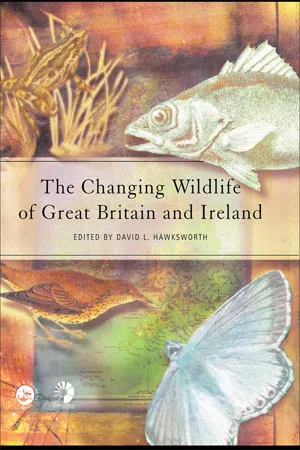
The Changing Wildlife of Great Britain and Ireland
About this book
Periodic comprehensive overviews of the status of the diverse organisms that make up wildlife are essential to determining trends, threats and future prospects. Just over 25 years ago, leading authorities on different kinds of wildlife came together to prepare an assessment of their status of a wide range of organisms in Great Britain and Ireland i
Information
Chapter 1
Fifty years of statutory nature conservation in Great Britain
Earl of Cranbrook
ABSTRACT
In Great Britain, many strands have combined to forge public policy for nature conservation. Of these, three stand out: the influence of the voluntary sector, the role of Parliament and, latterly, a shift to European and international institutions as policy setters.
Government first recognised the need for national policies for nature conservation in the 1940s, in the context of planning for post-war reconstruction. The voluntary movement was involved from the beginning, setting out the case in 1941 with a conference on ‘Nature Preservation’, and contributing decisively to the proceedings of the Wild Life Conservation Special Committee and its report, Cmd 7122 (1947). The pre-legislative process of the 1940s also instituted the division between landscape preservation and public access, and the conservation of wildlife and natural features. As a consequence, the 1949 Act created two bodies: the National Parks Commission (later the Countryside Commission) and the Nature Conservancy (NC). This separation of responsibilities persisted until legislation of the 1990s brought together the two functions in Scotland and Wales.
Parliamentary interest has been continuous since the first Select Committee enquiry of 1957. Further measures were introduced, with the focus on species conservation and particular British preoccupations: the rolling tide of Protection of Birds Acts, 1954, 1964, 1967; the Deer Act, 1963; Conservation of Seals, 1970; Badgers, 1973; Conservation of Wild Creatures and Wild Plants, 1975. Government amended the status of the Nature Conservancy in 1973. None of these measures remedied the fundamental flaws in the 1949 Act: the lack of any legal obligation on owners or occupiers and absence of restriction on existing land use. The Wildlife and Countryside Act of 1981 was intended to remedy this deficiency and, for the first time, imposed obligations on owners and occupiers; a practical weakness was remedied by the 1985 amending Act. Through the 1980s, SSSI renotification consumed a major part of NCC’s resources, and also engendered huge controversies. There was scepticism over the capability of available measures to conserve wildlife in the face of threats, natural or anthropogenic.
But, from the 1970s, the UK was also negotiating international measures that affected domestic policies. The source of political initiative began to move. Ratification of the Convention on International Trade in Endangered Species (CITES) in 1973 required new national law, duly enacted in 1976. The terms of the Council of Europe’s Berne and Bonn Conventions had to be met and, after joining the EEC, emerging Directives had to be implemented by domestic legislation.
Scottish law required separate enactment of nature conservation legislation, and the special standing of Scotland was always recognised administratively within the NC/NCC. The creation of three country agencies by the 1990 Act intensified that division. In Scotland and Wales, for the first time, responsibility for countryside and access issues was merged with nature conservation. New approaches have developed, and devolution may accentuate the divergence in application of the broad intention of the law. However, the basic content of UK conservation legislation is now largely determined by international or European obligations. The role of Parliament has diminished; for instance, the EC Habitats and Species Directive was translated into UK law in 1994 simply by a Regulation, and its implementation is subject to the scrutiny of Brussels. Within the emerging mix of devolved administrations, in the application of policies for nature conservation a reliable mechanism will be needed to ensure that the UK nationally meets its EU and international obligations.
1 Introduction
It is now over 50 years since the Nature Conservancy was founded. The earliest of a cluster of demi-centennial dates to celebrate was the announcement in Parliament, on 21 April 1948, of the intention to form a national nature conservation service; Cyril Diver was appointed the first Director General on 1 November 1948; by an Order in Council on 4 March 1949, the objects of the Privy Council Committee for Agricultural Research were extended to include nature conservation, and the Nature Conservancy was constituted; the first meeting of Conservancy members (with the statutory Scottish Committee) was held on 11 March, and the Conservancy’s Royal Charter was dated 23 March 1949.
Looking back after 40 years, Sir William Wilkinson recognised four phases: the Royal Charter period, 1949–65, the Research Council years, 1965–73, the pre-Wildlife and Countryside Act, 1973–81, and the post-1981 period (NCC 1990). To that framework, the phase of the country agencies must now be added. In this first half-century of the statutory nature conservation bodies, from the original, partially realised vision of a national nature conservancy and biological service to the present devolved structure, two external sources of initiative have also influenced public policy for the conservation of wildlife and natural features in Great Britain: voluntary conservation organisations (VCOs) and Parliamentarians. Over the same period, we have witnessed a progressive transition from national issues to international conventions and European legislation as the dominant target setters. These influences form recurrent themes in my short history.
This remains a personal account. Space is limited, so I have perforce been selective, and partial, openly taking advantage of my own involvement in parts of the story without, I hope, detriment to the rounded picture.
2 The inspiration
The crucial initiative represented a triumph for the persistence of VCOs. The chance was seized in the unlikely context of mid-World War national planning for reconstruction (Stamp 1969; Nicholson 1970; Sheail 1976; NCC 1984; Adams 1986; Evans 1997). In 1941, seeing an opportunity to implement its longstanding aspirations, the Society for the Promotion of Nature Reserves (SPNR) – founded in 1912 by Charles Rothschild (Rothschild and Marren 1997) – marshalled some 15 voluntary organisations in a conference on Nature Preservation. Thus prompted, the Government formed a Nature Reserves Investigation Committee whose conclusions were fed into the crossministerial (Scott) Committee on Land-use in Rural Areas. Scott led to John Dower’s (1945) report on National Parks; in response, in July 1945, the Government set up the Committee on National Parks, chaired by Sir Arthur Hobhouse. The vision of the era was expressed by a participant:
As, one after another, our cities were bombed, plans were put in hand for their rebuilding. They were to have a green ring of rural land, productively used but not urbanized. There were to be large tracts set aside for quiet enjoyment. But enjoyment of what? Clearly the natural or semi-natural vegetation of mountain, moorland and coast, and with it the wild life…Gradually, the concept of nature conservation began to fit in as part of the picture of our land for the future. Naturalists met town and country planners; they did not clash.
(Stamp 1969: xiv)
Dower had conceded that the objectives of national parks were not sufficient to deliver a national nature conservation policy. Hobhouse endorsed this divergence by creating two committees: one to cover access and related countryside issues; the other the Wild Life Conservation Special Committee (England and Wales) (WLCSC) chaired successively by Julian Huxley and Arthur Tansley. These produced separate reports, appearing in 1947 as Cmd 7121 and 7122 respectively. Parallel action in Scotland provided Cmd 6631 and 7235 in the same year, and Cmd 7814 in 1949. From this dichotomy sprang the institutional separation of the statutory bodies covering, respectively, conservation of wildlife and natural features and the wider countryside objectives of landscape preservation and access. The partition of responsibility for different, but related, aspects of land use survived more than 40 years before legislation of the 1990s reversed it in Wales and Scotland. National parks were not accepted in Scotland at the time but, 50 years later, this designation is now considered appropriate for a few large areas which are of national importance for their outstanding natural heritage and for the opportunities they provide for public enjoyment (SNH 1998b).
The WLCSC was dominated by scientists and academics who, not unnaturally, saw research and education as the foundations of an effective conservation policy. Members made field visits to 56 sites; the Committee was also represented on a tour of the Swiss National Park and nature reserves, and took evidence on the US national park system. The vision of Cmd 7122 reflects these influences, calling for a national biological service with five main purposes: conservation, biological survey and research, experiment, education and amenity, for ‘the peaceful contemplation of nature’ (Huxley 1947: 19). These purposes would require the selection of suitable sites, under variable degrees of control. Six categories were proposed: National Nature Reserves; Conservation Areas (biological, physiographical, geological or landscape); National Parks; Geological Monuments (paralleling Ancient Monuments, for which model legislation already existed); Local Nature Reserves; and Local Educational Reserves. The service should be staffed by professionals, ‘working on a sound long-term programme of research into the fundamental factors affecting wild life’ (ibid.: 37) and be supervised by a Board, ‘within the scientific organisation for which the Lord President of the Council is the responsible Minister.’ In order to gain support from an existing body, the Committee recommended attachment to the Agricultural Research Council (ibid.: 55).
Some of WLCSC’s views were new at the time. The introduction of the term ‘conservation’ was in itself a break with the prevailing tradition of nature ‘preservation’. The Committee undertook a review of sites proposed for National Nature Reserves (NNR) in previous compilations, and produced a list of 73 for England and Wales (total estimated area approximately 70 000 acres). For these NNRs, the necessary safe-keeping would be satisfied either through Government custody (by compulsory purchase in the last resort) or through ownership by conservation bodies – at that time, represented only by the National Trust, the Corporation of the City of London, a couple of county naturalist trusts and the SPNR (Huxley 1947: 89). The role of human intervention in the creation and perpetuation of semi-natural environments was recognised: ‘a conservation policy directed to maintaining any particular biological equilibrium entails constant vigilance and a fine-scale “management” of a kind comparable to the most highly developed farming’ (ibid.: 21); also accepted was the futility of policies ‘which are not widely understood and backed by public opinion’ (ibid.: 41). These notions have a firm contemporary resonance.
The task facing the proposed institution was evaluated. Some serious future perturbations, resulting from introduced organisms, were unpredictable at that time (for example myxomatosis); others were lurking, their potential for damage unanticipated (Dutch elm disease, grey squirrels and feral muntjac). Only dimly discerned were the scale and impact of new agricultural practices. On farmland, it was appreciated that risk ‘springs from efforts to bring under temporary cultivation an increasing quantity of marginal land, with the result that sites of the greatest scientific and cultural value are irrevocably destroyed’; ‘developments in modern agricultural techniques and machinery are capable of producing very drastic changes in the landscape within short periods’; dangers ‘follow upon ill-informed or indiscriminate destruction (for instance …by the improper use of insecticides) of species whose interrelations with others have not yet been ascertained’. Consideration of potential conflicts with landowners or occupiers dwelt chiefly on pest-control and sporting rights. The value of grazing in the maintenance of conservation interest was recognised, but the slow creep of neglect and its malign effects were not anticipated. Conflict with the policies of the Forestry Commission was foreseen.
3 The Nature Conservancy: Royal Charter to Research Council
The aspirations of Cmd 7122 were more than could be accepted in full by the Government of that time, which was uncertain about the principles and worried about the cost of the proposals. Notwithstanding, eight years after the Conference on Nature Preservation, the Nature Conservancy (NC) was eventually constituted with the status of a research council reporting to the Lord President, under a Royal Charter dated 23 March 1949 requiring it:
to provide scientific advice on the conservation and control of the natural flora and fauna of Great Britain; to establish, maintain and manage nature reserves in Great Britain, including the maintenance of physical features of scientific interest, and to organise and develop the research and scientific services related thereto.
Soon after its formation, further important functions were given to NC by the National Parks and Access to the Countryside Act 1949. These included the duty to notify ‘sites of special interest’ (SSSIs) to the local planning authority, and two useful powers, still operative: (S. 21) to join with local authorities in designating Local Nature Reserves (LNR), and (S. 16) to enter into management agreements with owners or managers of National Nature Reserves. Sir Arthur Tansley (at the age of 78) was appointed first Chairman. With him, there were five FRSs on the 18-person Council.
Initial Government funding was cautious: grant in aid of £100 000 for the first year, 1949–50 (equivalent to £2 million in 1998 terms). But within four years, finance became the main limiting factor to the NC’s ambition for growth. Plus ça change! Only different, in the context of prevailing constraints, was the tactfully worded protest in the Annual Report 1953–54:
The Nature Conservancy fully recognise the stringency imposed on the national budget by rearmament and other factors and wish, if they may be allowed to do so, to place on record their appreciation of the consistently helpful and understanding attitude which Her Majesty’s Government have shown. The Conservancy also fully appreciate that the potential value of their scientific, educational and Reserve management activities is as yet understood and accepted only by an informed minority. At this early stage there is still a need to demonstrate this value by tangible results and to bring it home to wider circles by simple and effective publications and illustrations.
Science was an important policy driver of the nascent Nature Conservancy, but the function of giving advice on management and control was also taken very seriously (Poore 1987). A Scientific Policy Committee assumed responsibility for determining the relative priorities in the work programme, and other matters ‘likely to have more than a local bearing upon the protection and control of species and upon conservation generally’ (NC 1953). An immediate priority was the establishment of research stations, with Merlewood and Furzebrook being the first, along with field stations on Nature Reserves, of which Moor House and Anacaun (Ben Eighe) were both operational by 1953 (NC 1954). Procedures were also set up to allocate research grants and studentships. Looking back, Ratcliffe (1977) identified research themes which contributed to fundamental scientific knowledge while also providing answers to practical problems:
- Floristic surveys of grasslands, building on the pioneering work of Tansley himself in the 1920s, provided a baseline from which to assess changes following the introduction of myxomatosis among rabbits in 1954, and to develop appropriate strategies to counter alterations in grazing regime by domestic stock;
- Participation in the International Biological Programme (IBP), aimed at studying the biological basis of productivity and human welfare, provided knowledge of the natural limits to organic production and potential management processes for nature conservation;
- Grouse-moor research, prompted by concern among landowners and shooting tenants about decline in stock of Red Grouse, demonstrated the complexity of population dynamics;
- Studies beginning in the 1960s on the effects of pesticides (synthetic insecticides, herbicides and fungicides) in terrestrial, freshwater and marine habitats demonstrated the pervasive effects of pollutants, the complexity of pathways and the potentially catastrophic effects on vulnerable species – notably the top carnivores, raptorial birds and otters.
Myxomatosis was revealed as a dramatic tool for rabbit control in Australia in 1950, affected wild populations in France in 1952 and reached Britain in 1953 (Fenner and Ratcliffe 1965). The NC introduced monitoring programmes locally at first, more intensively in 1955 when it became clear that the reduction of rabbit grazing greatly affected the growth of herbaceous and woody plants on heaths, downs and other seminatural grasslands. Allied research investigated transmission of the disease, and the effects on a predator, the buzzard. The disappearance of rabbits starkly revealed their role in maintaining semi-natural heath and grassland swards. Release of the sycamore as a woodland weed received less attention, but had a permanent impact across lowlan...
Table of contents
- Cover Page
- Title Page
- Copyright Page
- Changing Wildlife of Great Britain and Ireland
- The Systematics Association Special Volume Series
- Contributors
- Foreword
- Chapter 1: Fifty years of statutory nature conservation in Great Britain
- Chapter 2: Flowering plants
- Chapter 3: Ferns and allied plants
- Chapter 4: Mosses, liverworts and hornworts
- Chapter 5: Larger fungi
- Chapter 6: Microscopic fungi
- Chapter 7: Lichens
- Chapter 8: Terrestrialand freshwater eukaryotic algae
- Chapter 9: Cyanobacteria (blue-green algae)
- Chapter 10: Diatoms
- Chapter 11: Viruses
- Chapter 12: Protozoa
- Chapter 13: Freshwater invertebrates
- Chapter 14: Nematodes
- Chapter 15: Mites and ticks
- Chapter 16: Flies
- Chapter 17: True bugs, leaf- and planthoppers, and their allies
- Chapter 18: Butterflies and moths
- Chapter 19: Grasshoppers, crickets and allied insects
- Chapter 20: Dragonflies and damselflies
- Chapter 21: Land slugs and snails
- Chapter 22: Birds
- Chapter 23: Mammals
- Chapter 24: Fishes
- Chapter 25: Tracking future trends the Biodiversity Information Network
- Chapter 26: Prospects for the next 25 years
- Systematics Association publications
Trusted by 375,005 students
Access to over 1.5 million titles for a fair monthly price.
Study more efficiently using our study tools.
Frequently asked questions
Yes, you can cancel anytime from the Subscription tab in your account settings on the Perlego website. Your subscription will stay active until the end of your current billing period. Learn how to cancel your subscription
No, books cannot be downloaded as external files, such as PDFs, for use outside of Perlego. However, you can download books within the Perlego app for offline reading on mobile or tablet. Learn how to download books offline
Perlego offers two plans: Essential and Complete
- Essential is ideal for learners and professionals who enjoy exploring a wide range of subjects. Access the Essential Library with 800,000+ trusted titles and best-sellers across business, personal growth, and the humanities. Includes unlimited reading time and Standard Read Aloud voice.
- Complete: Perfect for advanced learners and researchers needing full, unrestricted access. Unlock 1.5M+ books across hundreds of subjects, including academic and specialized titles. The Complete Plan also includes advanced features like Premium Read Aloud and Research Assistant.
We are an online textbook subscription service, where you can get access to an entire online library for less than the price of a single book per month. With over 1.5 million books across 990+ topics, we’ve got you covered! Learn about our mission
Look out for the read-aloud symbol on your next book to see if you can listen to it. The read-aloud tool reads text aloud for you, highlighting the text as it is being read. You can pause it, speed it up and slow it down. Learn more about Read Aloud
Yes! You can use the Perlego app on both iOS and Android devices to read anytime, anywhere — even offline. Perfect for commutes or when you’re on the go.
Please note we cannot support devices running on iOS 13 and Android 7 or earlier. Learn more about using the app
Please note we cannot support devices running on iOS 13 and Android 7 or earlier. Learn more about using the app
Yes, you can access The Changing Wildlife of Great Britain and Ireland by David L. Hawksworth in PDF and/or ePUB format, as well as other popular books in Biological Sciences & Ecology. We have over 1.5 million books available in our catalogue for you to explore.