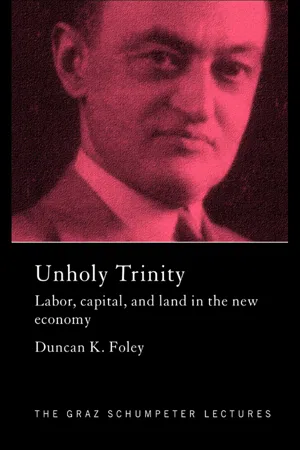
- 112 pages
- English
- ePUB (mobile friendly)
- Available on iOS & Android
eBook - ePub
About this book
Many of the central results of Classical and Marxian political economy are examples of the self-organization of the capitalist economy as a complex, adaptive system far from equilibrium.An Unholy Trinity explores the relations between contemporary complex systems theory and classical political economy, and applies the methods it develops to the pro
1 Complexity, self-organization, and political economy
Introduction
My theme in this book is the capacity of the methods of the Classical political economists, Adam Smith, Thomas Malthus, David Ricardo, and their critic, Karl Marx, to reveal the self-organizing character of the capitalist economy regarded as a complex, adaptive, non-equilibrium system.
From one point of view this is an exercise in anachronism, since the language of complex systems theory and its application to economic problems is only about forty years old, and it is implausible to claim that Smith or Ricardo or Marx thought about the problems of the economy using the conceptual tools of complexity science. On the other hand, I will argue that the language and vision of the Classical political economists incorporates many insights of contemporary complex systems theory. There are also indirect but important intellectual pathways that connect the Classical political economists of the eighteenth and nineteenth centuries to the twentieth century emergence of complexity science. I also will argue that complexity theory sheds some light on the extraordinary effectiveness of the Classical political economists’ methods and the depth of their analytical results. I believe that contemporary economists still have much to learn from these methods and results about the capitalist economy and its evolution.
What is a complex system?
Complexity theory represents an ambitious effort to analyze the functioning of highly organized but decentralized systems composed of very large numbers of individual components. The basic processes of life, involving the chemical interaction of thousands of proteins, the living cell, which localizes and organizes these processes, the human brain in which thousands of cells interact to maintain consciousness, ecological systems arising from the interaction of thousands of species, the process of biological evolution from which new species emerges, and the capitalist economy, which arises from the interaction of millions of human individuals, each of them already a complex entity, are leading examples. Some introductions to the concepts of complex systems theory are Cowan et al. (1994), Kauffman (1995), Albin and Foley (1998), Wolfram (2002). A good introduction to the mathematics of complexity theory is Casti (1992, ch. 9).
Complexity theory starts from the bold and controversial conjecture that these diverse systems have important features in common that transcend their apparent differences in scale, material components, and organizing laws of motion. What these systems share are a potential to configure their component parts in an astronomically large number of ways (they are complex), constant change in response to environmental stimulus and their own development (they are adaptive), a strong tendency to achieve recognizable, stable patterns in their configuration (they are self-organizing), and an avoidance of stable, self-reproducing states (they are non-equilibrium systems). The task complexity science sets itself is the exploration of the general properties of complex, adaptive, self-organizing, non-equilibrium systems.
The methods of complex systems theory are highly empirical and inductive. The complex systems scientist tends to study the properties of particular simplified and abstract models of complex systems. These models often involve the study of the interaction of large numbers of highly stylized and simplified components in computer simulations, with the aim of identifying generalizable properties of adaptability and self-organization common to a wide range of complex systems. A characteristic of these stylized complex systems is that their components and rules of interaction, though they are often very much simpler than real neurons or proteins or capitalist firms, are non-linear, that is, that they exhibit qualitative differences in their behavior in response to stimulus of different intensities and scales. The computer plays a critical role in this research, because it becomes impossible to say much directly about the dynamics of non-linear systems with a large number of degrees of freedom using classical mathematical analytical methods.
There are many potential pitfalls in this research project. Most of these arise from the difficulty of verifying the general character of the specific phenomena observed in particular models. A pattern of self-organization, for example, may turn out to reflect a particular symmetry of interaction implicit in the model system, and thus not to appear in similar systems that lack this symmetry. Skeptics question the premise that complex systems share any general determinable properties. The record of complexity research has not put these doubts to rest. Its triumphs remain largely in the realm of brilliant insights connected to particular models, and a unified synthesis remains an elusive goal. Nonetheless, the methods of complex systems science have had a growing impact on research in a wide range of fields, not least in economics. The vision of explaining complex and adaptive order as emerging from the interaction of large numbers of relatively simple components according to relatively simple laws presents a compelling challenge to many researchers.
The Classical political economic vision
The great theme of the Classical political economists was that individual economic actions have unintended social consequences. Economic life in the large is thus organized and coherent in a way that no single economic actor envisions or controls.
Smith
The most powerful example of this effect is the Classical conception of competition, enunciated, if not originated, in Adam Smith’s Wealth of Nations (1937). Smith observes that each owner of “stock” (capital) will seek to maximize its potential rate of growth, that is, its profit rate, by investing in the line of production he judges to be most promising. Capital, according to Smith’s vision, will be disinvested from lines of production with relatively low profit rates, and moved to lines of production with relatively high profit rates. The intention of wealth-owners in reallocating capital in this way is to maximize their own rate of profit, but the effect of their actions is to equalize profit rates tendentially between different lines of production. This equalization of profit rates, which is of no particular interest to individual capitalists, is also the condition for maximizing the profit rate of the aggregate national capital, that is, the wealth of the nation.
Smith and the Classical political economists who followed him did not believe that this competitive process would lead to an actual equalization of realized or prospective profit rates at any moment in time. The movement of capital from one line of production to another would upset the conditions of other lines of production, which, together with disturbances from outside the national economy, would always prevent the realization of a state of equalization of profit rates. They expected to see a ceaseless fluctuation of prices and profit rates as the outcome of the competitive process, rather than the achievement of a state of “equilibrium” in which prices settled down to levels (“natural prices”) at which profit rates would be equalized. Nonetheless, the concept of this equilibrium state (which has come to be referred to as “long-period” equilibrium) plays a natural and important part in the analysis of the real economy. The competitive dynamic, even if it is not stable in the mathematical sense of pushing the system to an equilibrium of equal profit rates, will prevent prices and profit rates from wandering indefinitely far from their equilibrium values. This idea is expressed by arguing that observed market prices tend to gravitate around the natural prices at which profit rates would be equalized. The abstract concept of long-period equilibrium natural prices plays a crucial analytical role in understanding the concrete fluctuations of observable market prices.
This sophisticated method of reasoning contrasts sharply, and, in my opinion, favorably with the tendency of neoclassical economists to identify observed values of prices with their equilibrium levels in abstract models. The neoclassical vision requires an implausible degree of foresight and coordination of individual plans in its assertion of the attainment of equilibrium as a picture of the operation of the real economy. Furthermore, stable equilibrium systems cannot exhibit complex dynamic behavior, so the neoclassical vision remains blind to the evolutionary, path-dependent, and adaptive character of economic institutions. The Classical vision, on the other hand, is consistent with the complex systems view of the world. It does not insist that each and every component of the economy achieve its own equilibrium as part of a larger master equilibrium of the system as a whole. In fact, it is precisely from the disequilibrium behavior of individual households and firms that the Classical vision of competition sees the orderliness of gravitation of market prices around natural prices as arising. In the language of complex systems theory, Classical gravitation is a self-organized outcome of the competitive economic system. From the Classical point of view, competition need not be “perfect” in order to bring about the tendency to self-organization. The self-organization of complex systems is robust in the sense that it does not depend on any particular detail of the evolution of the system, and will reassert itself even when some of the mechanisms supporting it are frustrated.
Smith characterizes the capitalist restlessly seeking the highest profit rate on his capital as a “public benefactor” (1937, ch. III), and the coordinated (or, more precisely, self-organized) outcome for the economy as the result of the operation of an “Invisible Hand.” But the force of Smith’s argument here has often been misunderstood. There is no reason in general why one individual in capitalist society benefits from another individual’s increase in wealth. The benefits from individual accumulation lie in the growth of the national wealth, which Smith saw as the foundation of its military and diplomatic power. Presumably this effect arises in part because the wealth of individual capitalists is the foundation of the state’s taxing power.
But Smith has another, more important, reason for regarding the accumulating capitalist as a public benefactor. Smith argued that the driving force of economic development was the division of labor that arises as a result of the widening extent of the market. It is precisely the accumulation of capital, in Smith’s view, that drives the extent of the market, both by increasing the wealth and income of the population, and increasing population itself. The individual accumulating capitalist enriches himself, which is his intention, but in increasing the market for other capitalists’ products, he also indirectly and unintentionally fosters an increase in the division of labor. The ensuing increase in the productivity of labor does benefit the other capitalists and, potentially, workers. The accumulation of capital is thus part of a “virtuous cycle” in Smith’s vision. Accumulation increases population, wealth, and income, thus increasing the size of the market, which in its turn fosters a wider and deeper division of labor, increasing labor productivity, profit rates, and accumulation. This self-reinforcing cycle is the basic metabolism of capitalist economic development, responsible both for its creative triumphs and its destructive paroxysms. Smith’s endorsement of laissez-faire policies is at its root an affirmation that this process will in the end be good for humanity.
The neoclassical tradition interprets Smith’s concepts in quite a different way. Neoclassical analysis identifies the Invisible Hand and laissez-faire policies with the tendency for unfettered competition to achieve an efficient allocation of resources, rather than with the tendency for unfettered capital accumulation to produce a widening division of labor. Smith’s notion of a widening division of labor leading to increased labor productivity translates into neoclassical language as increasing returns to the application of labor and capital to land. But pervasive increasing returns is incompatible with the establishment of a neoclassical competitive equilibrium except under special analytical assumptions. Thus, the feature of economic life that Smith puts at the center of his vision is a feature that is actually inconsistent with the neoclassical vision of achieving an efficient allocation of resources through competition.
But Smith’s vision of the widening and self-reinforcing division of labor is remarkably consistent with the systems theory conception of a complex, self-organizing, non-equilibrium process. Growth and development as irreversible processes are characteristic of complex systems. While particular self-organizing aspects of complex systems may have strong homeostatic properties that lead them to seek recognizable organized states (e.g. like the individual cell in an animal), the systems themselves are open, adaptable, and indeterminate (like the life history of an animal), and not typically subject to simple equilibrium analysis. We know that the wolf, for example, must maintain nutritional balance with her environment to live, but this observation does not allow us to predict her life cycle, where she will migrate, mate, or, eventually, die. Smith’s vision of capitalist economic development is analogous: he can explain the metabolic processes, accumulation and competition, that support the evolution of the capitalist economy, but not its history, the specific development of its technology, or its sociology.
Malthus and Ricardo
Smith’s great immediate successors were Thomas Malthus and David Ricardo. Their characteristic discoveries were in fact in opposition to Smith’s open-ended optimism about the prospects for capitalist economic development, but their methods grow out of Smith’s arguments, and reflect the same preoccupation with unintended consequences of human actions.
Malthus (1985) argued that human societies tend to reach a demographic equilibrium in which high mortality from disease and malnutrition, especially infant mortality, balanced high fertility. His analysis of this problem centers on a stable feedback mechanism, in the language of modern systems theory. If mortality were to fall below the equilibrium level, the high rate of fertility would increase population. Malthus believed that an increasing population would encounter diminishing returns in the face of limited land and other natural resources, so that the standard of living would fall, increasing the incidence of mortality through malnutrition and disease. Malthus’ theory has turned out to be spectacularly inappropriate to understanding the actual process of capitalist development over the succeeding three hundred years. But it is interesting to note that his method of reasoning depends on the same notions of unintended consequences and self-organization as Smith’s. Malthus’ procreators have no way of knowing that the indirect consequence of their fertility decisions will be a demographic equilibrium. They themselves are not in any kind of “equilibrium” according to Malthus’ argument. The limitations of land and natural resources impose themselves as a pervasive system-wide phenomenon which shapes the uncoordinated decisions of individuals into the demographic equilibrium.
Ricardo (1951) extended and elaborated Malthus’ notion of demographic equilibrium to a picture of a stationary state in which the pressure of capital and labor resources on limited land would force the return to capital, the profit rate, close to zero, and choke off the process of Smithian accumulation. Ricardo’s vision rests, like Malthus’ on the implicit assumption of diminishing returns to population and capital in the face of limited land resources. But his account of the equalization of profit rates, which underlies the mechanisms that enforce the stationary state, is the same gravitational mechanism we find in Smith. The individual capitalist does not see the rise in rents and in money wages that squeeze his profit rate as connected to his own accumulation. The process of accumulation does not necessarily follow any predetermined path toward the stationary state. Ricardo’s arguments are powerful because he shows how any path of accumulation will run itself into the stationary state, given only the general phenomenon of diminishing returns associated with limited land resources. In the stationary state itself some capitalists may be making profits and accumulating, while others are making losses and decumulating. Ricardo’s stationary state is not a reflection of a microeconomic equilibrium in which each agent finds itself, but a self-organizing state of a complex system that continues to adapt and change, even as it reproduces the stationary state as a macroeconomic average.
Marx
Karl Marx took the Classical political economy of Smith, Malthus, and Ricardo as the basis of his critical reconstruction of the theory of the capitalist economy. Marx instinctively and unquestioningly adopted the mode of argument of the political economists, which sought to discover aggregate regularities in the capitalist economy that did not depend on the detailed behavior of individuals. The power of his methods of analysis, which has been the frequent subject of admiring comment, rests on this foundation. Marx can reach powerful, general, analytical conclusions about the course and patterns of capitalist economic development without limiting himself to particular implausible and limited “models,” and without claiming to predict the actual behavior of particular individuals.
Marx brought to political economy the language of “dialectics” that pervaded Continental philosophical thought, particularly through the writing of Hegel, in his youth. In my view, dialectics can be usefully understood as an attempt to find a precise language to discuss the phenomena of system complexity and self-organization.
From one point of view, complex systems are “determined” by the propensities and tendencies of their constituent parts (e.g. the chemical properties of proteins in the cell, or the behavioral tendencies of households and firms in a capitalist economy). But the aggregate behavior of complex systems is far from a simple reflection of these tendencies at the aggregate level. In fact, complex systems paradoxically tend to exhibit features that are in many respects the opposite of the tendencies of their components. The resolute pursuit of profit by individual capitalists, for example, may lead to a falling average rate of profit in the system as a whole. Dialectical language promotes this observation to the (contested) status of a “law.”
Despite its features of self-organization, a complex, adaptive system is in a constant process of development and change. Self-organizing aspects of the system emerge because they are independent to a very considerable degree from the detailed function of any particular part of the system. Complex systems tend to be able to continue to function recognizably even when some of their constituent subsystems are disrupted. Randomly wired computers, for example, organize themselves in ways that cannot be destroyed by cutting a few links, while we know that even the smallest failure of a single component completely disables conventional computing machines. Thus the self-organization of a complex system appears to be “over-determined” in dialectical language, in that the destruction of one or even several pathways through which the feature reproduces itself may not succeed in altering the self-organization of the system as a whole.
While complex adaptive systems are “determinate” in the sense that it is in principle possible to trace the interactions among their myriad components that are responsible for their aggregate behavior, they are not “predetermined” in the sense that we can hope to figure out the exact path of their future evolution. Complex systems share this lack of predeterminacy and predictability with chaotic systems, since it arises from the extremely large number of degrees of freedom that characterize both systems. Chaotic systems, however, are so unstable that they break down self-organizing structures very rapidly, while complex systems can sustain self-organizing structures over long periods. Curiously, the disorder of chaotic systems makes them statistically predictable, while complex systems create irregular statistical patterns that are impossible to extrapolate. Dialectics acknowledges this lack of predeterminacy in complex systems by insisting that the future is genuinely open, though constantly being shaped by the actions of constituent particles in the present. This is a key point of difference between the conceptual worlds of equilibrium and self-organizing complex systems. Equilibrium systems tend to return to predetermined states, while complex systems undergo open-ended evolution.
Marx frequently refers to Ricardo, and uses Ricardo’s arguments as the basis of his own reformulations of the discoveries of Classical political economy. In part this is due to Marx’s appreciation (shared by many other readers) of the analytical power and sharpness of Ricardo’s mind. But in substance Marx is a Smithian much more than a Ricardian. The crucial point here is the role of diminish...
Table of contents
- Cover Page
- Title Page
- Copyright Page
- Foreword
- Acknowledgments
- 1: Complexity, self-organization, and political economy
- 2: Innovative capitalism and the distribution of income
- 3: Can political economy save us from global warming?
- 4: The new economy and the population of the Earth
- 5: Concluding observations
- Bibliography
Trusted by 375,005 students
Access to over 1.5 million titles for a fair monthly price.
Study more efficiently using our study tools.
Frequently asked questions
Yes, you can cancel anytime from the Subscription tab in your account settings on the Perlego website. Your subscription will stay active until the end of your current billing period. Learn how to cancel your subscription
No, books cannot be downloaded as external files, such as PDFs, for use outside of Perlego. However, you can download books within the Perlego app for offline reading on mobile or tablet. Learn how to download books offline
Perlego offers two plans: Essential and Complete
- Essential is ideal for learners and professionals who enjoy exploring a wide range of subjects. Access the Essential Library with 800,000+ trusted titles and best-sellers across business, personal growth, and the humanities. Includes unlimited reading time and Standard Read Aloud voice.
- Complete: Perfect for advanced learners and researchers needing full, unrestricted access. Unlock 1.5M+ books across hundreds of subjects, including academic and specialized titles. The Complete Plan also includes advanced features like Premium Read Aloud and Research Assistant.
We are an online textbook subscription service, where you can get access to an entire online library for less than the price of a single book per month. With over 1.5 million books across 990+ topics, we’ve got you covered! Learn about our mission
Look out for the read-aloud symbol on your next book to see if you can listen to it. The read-aloud tool reads text aloud for you, highlighting the text as it is being read. You can pause it, speed it up and slow it down. Learn more about Read Aloud
Yes! You can use the Perlego app on both iOS and Android devices to read anytime, anywhere — even offline. Perfect for commutes or when you’re on the go.
Please note we cannot support devices running on iOS 13 and Android 7 or earlier. Learn more about using the app
Please note we cannot support devices running on iOS 13 and Android 7 or earlier. Learn more about using the app
Yes, you can access Unholy Trinity by Duncan K. Foley in PDF and/or ePUB format, as well as other popular books in Business & Business General. We have over 1.5 million books available in our catalogue for you to explore.