- 112 pages
- English
- ePUB (mobile friendly)
- Available on iOS & Android
eBook - ePub
About this book
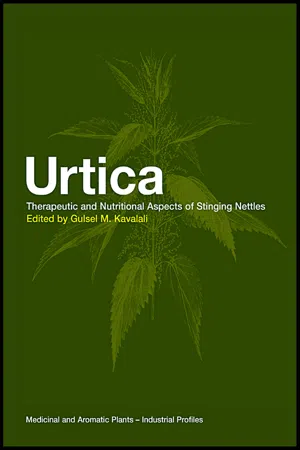
Plants from the genera Urtica, often better known as the stinging nettle, can be distinguished by their stinging hairs, and in some species, their serrated leaf edges. Historical records of the various uses of Urtica date back to at least the Bronze Age (3000-2000 BC). Nettles have traditionally been used as a nutritious food source particularly in
Information
1 An introduction to Urtica (botanical aspects)
Gulsel Kavalali
Introduction
Urtica L., the stinging nettle (Urticaceae), is an annual and perennial herb, distinguished with stinging hairs. The leaves are opposite, and the flowers are green with yellow stamens. The male and female flowers are on separate plants. The fruits are achene. These are the characteristics of the Urtica genus which belong to the family Urticaceae. The main varieties identified under the Urtica species are U. dioica L., U. urens L., U. pilulifera L., U. cannabina L., U. membranacea Poiret., U. haussknechtii Boiss., U. atrovirens Req., U. rupestris Guss., U. chamaedryoides Pursh., U. ferox Forst.
Among these, U. dioica and U. urens have been known for a long time as medicinal plants. They are used as an expectorant, purgative, diuretic, haemostatic, vermifuge and for the treatment of eczema, rheumatism, haemorrhoids, hyperthyroidism, bronchitis and cancer. These plants have been consumed without any report of serious adverse effects. They are also healthy vegetables and potential organic fertilizer for herbs. The commercially available drug preparations known as Urtica folium/herb and Urtica radix – which are obtained from the U. dioica and U. urens – are produced in Europe.
The generic name ‘Urtica’ comes from the latin word ‘Uro’ meaning ‘to burn’. ‘Nettle’ comes from the Anglo-Saxon word ‘Netele’ referring to the sharp stings or the use of the fibrous nettle stems in cloth-making.
Botanical aspects of Urtica
Description of genus
The genus Urtica L. belongs to the family Urticaceae, under the division Spermatophyta, subdivision of Angiospermae, class Dicotyledonae, group Apetalae, order Urticales.
The family Urticaceae
The family Urticaceae comprises some 40 genera and more than 700 species of monoecious or dioecious plants which mostly grow in tropical and subtropical regions of the world. The plants are generally fibrous herbs, rarely subshrubs, softwooded small trees or climbers. Some have stinging hairs on their stems and leaves. These are silicified epidermal outgrowths containing an irritating cell sap. Latex is absent, cystoliths of various shapes are present in the epidermal cell. The leaves are alternate or opposite, usually stipulate. Inflorescences are axiliary, basically a bracteate cyme, sometimes a head or reduced to a single flower. The flowers are unisexual, small, mostly green, actinomorphic, (tri-) tetra- and pentamerous. The perianth is of (three) four to five distinct or connate segments. The male flowers have (one) four to five stamens; the filaments are bent inwards in the bud and spring back elastically at the anthesis, releasing pollen in a sudden burst. The female flowers have a single pistil, an ovary unilocular with a solitary ovule, and a stigma which is often brushlike. The fruit is a dry achene or more rarely a drupe, which is often enclosed by the persistent perianth. The seeds have an oily endosperm and a straight embryo (Lawrence, 1951; Hess et al., 1967; Chaurasia, 1987). Important characteristics of the family including: mostly herbaceous habit; usually stipulate leaves, often with cystoliths and stinging hairs; unisexual and monochlamydeous small flowers with inwardly bent stamens, a brushlike stigma, and a solitary basal orthotropous ovule.
Five tribes are recognized in this family (Hegnauer, 1973): Urticeae, Procrideae, Boehmerieae, Parietarieae, Forskohleae. Stinging hairs are only present in Urticeae. Economically the family is important because of the fibre yielded by some of the members. The most important is Ramie (Boehmeria nivea var. tenacissima), native of East Asia, also cultivated today in other tropical and subtropical regions of the world. The fibre of the U. dioica is also important, because of its high tensile strength and non-lignified walls. Another importance of the family comes from the leaves of the Urtica and Parietaria species which are used in folk medicine....
Table of contents
- Cover Page
- Medicinal and aromatic plants – industrial profiles
- Title Page
- Copyright Page
- Tables
- Contributors
- Preface to the series
- Preface
- Acknowledgements
- 1: An introduction to Urtica (botanical aspects)
- 2: Historical and modern uses of Urtica
- 3: The chemical and pharmacological aspects of Urtica
- 4: Various therapeutic uses of Urtica
- 5: The therapeutic uses of Urtica in benign prostatic hyperplasia
- 6: Nutritional evaluation of Urtica species
- 7: Urtica products
Trusted by 375,005 students
Access to over 1.5 million titles for a fair monthly price.
Study more efficiently using our study tools.
Frequently asked questions
Yes, you can cancel anytime from the Subscription tab in your account settings on the Perlego website. Your subscription will stay active until the end of your current billing period. Learn how to cancel your subscription
No, books cannot be downloaded as external files, such as PDFs, for use outside of Perlego. However, you can download books within the Perlego app for offline reading on mobile or tablet. Learn how to download books offline
Perlego offers two plans: Essential and Complete
- Essential is ideal for learners and professionals who enjoy exploring a wide range of subjects. Access the Essential Library with 800,000+ trusted titles and best-sellers across business, personal growth, and the humanities. Includes unlimited reading time and Standard Read Aloud voice.
- Complete: Perfect for advanced learners and researchers needing full, unrestricted access. Unlock 1.5M+ books across hundreds of subjects, including academic and specialized titles. The Complete Plan also includes advanced features like Premium Read Aloud and Research Assistant.
We are an online textbook subscription service, where you can get access to an entire online library for less than the price of a single book per month. With over 1.5 million books across 990+ topics, we’ve got you covered! Learn about our mission
Look out for the read-aloud symbol on your next book to see if you can listen to it. The read-aloud tool reads text aloud for you, highlighting the text as it is being read. You can pause it, speed it up and slow it down. Learn more about Read Aloud
Yes! You can use the Perlego app on both iOS and Android devices to read anytime, anywhere — even offline. Perfect for commutes or when you’re on the go.
Please note we cannot support devices running on iOS 13 and Android 7 or earlier. Learn more about using the app
Please note we cannot support devices running on iOS 13 and Android 7 or earlier. Learn more about using the app
Yes, you can access Urtica by Gulsel M. Kavalali in PDF and/or ePUB format, as well as other popular books in Biological Sciences & Pharmacology. We have over 1.5 million books available in our catalogue for you to explore.