eBook - ePub
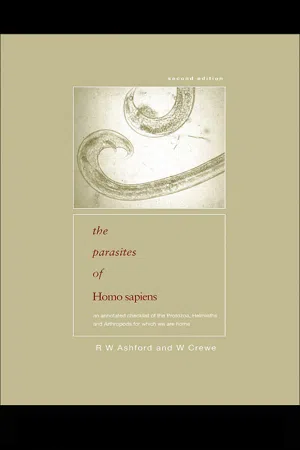
Parasites of Homo sapiens
An Annotated Checklist of the Protozoa, Helminths and Arthropods for which we are Home
- 152 pages
- English
- ePUB (mobile friendly)
- Available on iOS & Android
eBook - ePub
Parasites of Homo sapiens
An Annotated Checklist of the Protozoa, Helminths and Arthropods for which we are Home
About this book
Homo sapiens rank among the most parasitized of all animals. In part this is because we know so much about all aspects of the biology of our species, but in addition, our varied habitat and diet and our global distribution exposes us to more infections than any other species. Whereas some familiar parasitic infections are responsible for much human
Information
PART 1:
PROTOZOA
CHROMISTA: Bigyra
Blastocystis hominis
Status: 6. Widespread and abundant in most populations Dist: Cosmopolitan Hab: Lumen of intestine Hosts: Identical forms in many mammals; also in birds, reptiles and invertebrates Trans: (Faeco—oral contamination) Zoo stat: 3 Boreham and Stenzel 1998 FUNGI?: Microsporidia
Brachiola algerae
Syn: Nosema algerae Status: 1. A single confirmed case Dist: NEA—Mexico Hab: Cornea Hosts: Normally a parasite of mosquitoes Trans: Risk: Patient was immunocompetent Zoo stat: 1 Visvesvara et al. 1999; Lowman et al. 2000 Brachiola connori
Syn: Nosema connori Status: 1. A single confirmed case Dist: NEA—USA Hab: Widely disseminated Hosts: Known from man only Trans: Risk: Immunosuppressed host Zoo stat: 1 Beaver et al. 1984; Deluol and Cenac 1994; Canning 1998; Curry 1999 Brachiola vesicularum
Status: 1. A single case Dist: Hab: Muscle Hosts: Trans: Risk: Zoo stat: 1 Curry 1999 Encephalitozoon cuniculi
Status: 1. Twice in children and a few times in AIDS patients, but up to 8% seropositivity for Encephalitozoon sp. Dist: PAL; AETH; NEA; (Cosmopolitan) Hab: Widely disseminated Hosts: A wide range of mammals, especially rabbit and dog; rabbit may be main source of human infection Trans: Transplacental transmission occurs in carnivore hosts, causing fading-puppy syndrome Risk: Immunosuppressed host Zoo stat: 1 Hollister et al. 1989, 1996; Deluol and Cenac 1994; Canning 1998; Canning 2001 Encephalitozoon hellem
Status: 1. ‘Rarely diagnosed’; only in AIDS patients Dist: (Cosmopolitan) Hab: Ocular; extensively in viscera, including kidneys Hosts: Man, budgerigar Melopsittacus undulatus Trans: May enter through respiratory system Risk: Immunosuppressed host Zoo stat: 2 Deluoi and Cenac 1994; Hollister et al. 1996; Canning 1998; Didier et al. 1998; Canning 2001 Encephalitozoon intestinalis
Syn: Septata intestinalis Status: 1. Extremely rare, only in AIDS patients, but may be confused with E.bieneusi; much higher prevalence suspected Dist: (Cosmopolitan) Hab: Primarily in the intestine, but spreads widely to other organs Hosts: Dog, pig, cow, goat, donkey Trans: Risk: Immunosuppressed host Zoo stat: 2 Deluol and Cenac 1994; Hartsheerl et al.1995; Canning 1998; Curry 1999 Enterocytozoon bieneusi
Status: 2. Rare: several hundred cases by 1994, but rapidly ‘emerging’. Reaches 30% in AIDS patients. Dist: Cosmopolitan Hab: Primarily in the intestine, but spreads widely to other organs Hosts: Man, pig, non-human primates: Macaca spp., dog, cat Trans: Risk: Immunosuppressed host Zoo stat: 3 Deluol and Cenac 1994; Canning 1998; Didier et al. 1998, Curry 1999 Canning (2001) suggests that pigs and monkeys cannot be sources of human infection, and that this is a ‘shared’ species.
‘Microsporidium’ africanum
Syn: Nosema africana Status: 1. A single case Dist: AETH—Botswana Hab: Cornea Hosts: Known from man only Trans: Zoo stat: 1 Deluol and Cenac 1994; Canning 1998; Curry 1998 ‘Microsporidium’ ceylonensis
Syn: Nosema ceylonensis Status: 1. A single case Dist: OR—Sri Lanka Hab: Cornea Hosts: Known from man only Trans: Zoo stat: 1 Deluol and Cenac 1994; Canning 1998; Curry 1998 Nosema ocularum
Status: 1. A single case described Dist: NEA—USA Hab: Cornea Hosts: Known from man only Trans: Risk: Case was an athymic infant Zoo stat: 1 Desportes-Livage 1996; Canning 1998 Pleistophora sp.
Most, but not all ‘Pleistophora’ records may refer to Trachipleistophora spp.
 Status: 1. Dist: Hab: Muscles Hosts: Known from man only Trans: Risk: Immunosuppressed host Zoo stat: 1 Canning 1998
Thelohania? sp.
Status: 1. Two cases to 1998 Dist: Hab: Cardiac muscle, liver, brain, kidney Hosts: Known from man only Trans: Risk: Both cases had HIV infection Zoo stat: 1 Didier et al. 1998 Trachipleistophora anthropophthera
Status: 1. Two patients to date Dist: NEA—USA Hab: Brain; widely disseminated elsewhere Hosts: Known from man only Risk: Immunosuppressed host Trans: Zoo stat: 2 Curry 1999 Trachipleistophora hominis
Most, but not all ‘Pleistophora’ infections may refer to this species Status: 1. A single known case Dist: AUS—Australia Hab: Muscles, cornea Hosts: Known from man only Risk: Immunosuppressed host Trans: Carnivory? Zoo stat: 1 Hollister et al. 1996; Canning 1998 Vittaforma corneae
Syn: Nosema corneum Status: 1. Two recorded cases Dist: NEA—USA Hab: Cornea; also widely dispersed in an AIDS patient Hosts: Known from man only Trans: Zoo stat: 1 Deluol and Cenac 1994; Canning 1998 METAMONADA: Intestinal flagellates
Chilomastix mesnili
Status: 4. May reach 10% Dist: Cosmopolitan Hab: Caecum and colon Hosts: Identical forms in monkeys and pig Trans: Faeco—oral contamination Zoo stat: 3, possibly 4, depending on taxonomy Beaver et al. 1984; Levine 1985 Enteromonas hominis
Status: 2. Nowhere common Dist: (Cosmopolitan) Hab: Intestine, especially caecum Hosts: Identical forms in primates, hamster, rat Trans: Faeco-oral contamination Zoo stat: 3 or 4, depending on taxonomy Beaver et al. 1984; Levine 1985 Giardia intestinalis
Syn: Giardia lamblia Giardia duodenalis Lamblia intestinalis Status: 6. Endemic in most populations, mainly in children Dist: Cosmopolitan Hab: Small intestine Hosts: Identical forms in primates, carnivores, ungulates, rodents Trans: Faeco-oral contamination Zoo stat: 3 Beaver et al. 1984 The human strains belong to two related ‘assemblages’ of genotypes, both shared with several other hosts (Thompson et al. 2000).
Retortamonas intestinalis
Status: 2. Rare Dist: PAL; OR; NEA; NEO; (Cosmopolitan) Hab: Caecum Hosts: Described from man only, but may equal species from monkeys, sheep, rabbits,guinea pigs (or insects) Trans: Zoo stat: 2 Beaver et al. 1984 PARABASALIA
Dientamoeba fragilis
Status: 5. Probably endemic everywhere but prevalence rarely>5%; frequently overlooked Dist: (Cosmopolitan) Hab: Lumen of caecum and upper colon Hosts: 2. Possibly primates P1? May be paratenic in Enterobius eggs Trans: Unproven, but may be transmitted in egg of Enterobius vermicularis; direct contamination unsuccessful Zoo stat: 4 (Apparently the only genus of parasites restricted to H.sapiens) Beaver et al. 1984 Pentatrichomonas hominis
Syn: Trichomonas hominis Status: 5. Endemic in most populations but prevalence rarely>10% Dist: Cosmopolitan Hab: Caecal area Hosts:...Table of contents
- COVER PAGE
- TITLE PAGE
- COPYRIGHT PAGE
- PREFACE
- INTRODUCTION
- PART 1: PROTOZOA
- PART 2: TREMATODA
- PART 3: CESTODA
- PART 4: NEMATODA
- PART 5: ACANTHOCEPHALA
- PART 6: ARTHROPODA
- EXCLUSIONS
- SUMMARY
- REFERENCES
Trusted by 375,005 students
Access to over 1.5 million titles for a fair monthly price.
Study more efficiently using our study tools.
Frequently asked questions
Yes, you can cancel anytime from the Subscription tab in your account settings on the Perlego website. Your subscription will stay active until the end of your current billing period. Learn how to cancel your subscription
No, books cannot be downloaded as external files, such as PDFs, for use outside of Perlego. However, you can download books within the Perlego app for offline reading on mobile or tablet. Learn how to download books offline
Perlego offers two plans: Essential and Complete
- Essential is ideal for learners and professionals who enjoy exploring a wide range of subjects. Access the Essential Library with 800,000+ trusted titles and best-sellers across business, personal growth, and the humanities. Includes unlimited reading time and Standard Read Aloud voice.
- Complete: Perfect for advanced learners and researchers needing full, unrestricted access. Unlock 1.5M+ books across hundreds of subjects, including academic and specialized titles. The Complete Plan also includes advanced features like Premium Read Aloud and Research Assistant.
We are an online textbook subscription service, where you can get access to an entire online library for less than the price of a single book per month. With over 1.5 million books across 990+ topics, we’ve got you covered! Learn about our mission
Look out for the read-aloud symbol on your next book to see if you can listen to it. The read-aloud tool reads text aloud for you, highlighting the text as it is being read. You can pause it, speed it up and slow it down. Learn more about Read Aloud
Yes! You can use the Perlego app on both iOS and Android devices to read anytime, anywhere — even offline. Perfect for commutes or when you’re on the go.
Please note we cannot support devices running on iOS 13 and Android 7 or earlier. Learn more about using the app
Please note we cannot support devices running on iOS 13 and Android 7 or earlier. Learn more about using the app
Yes, you can access Parasites of Homo sapiens by Richard Ashford,William Crewe in PDF and/or ePUB format, as well as other popular books in Medicine & Epidemiology. We have over 1.5 million books available in our catalogue for you to explore.