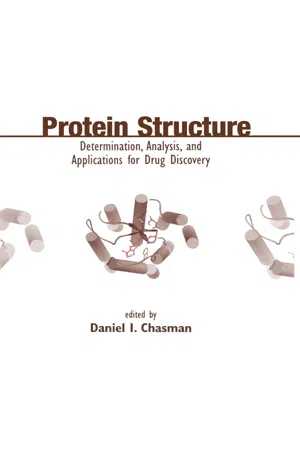
eBook - ePub
Protein Structure
Determination, Analysis, and Applications for Drug Discovery
- 576 pages
- English
- ePUB (mobile friendly)
- Available on iOS & Android
eBook - ePub
About this book
This text offers in-depth perspectives on every aspect of protein structure identification, assessment, characterization, and utilization, for a clear understanding of the diversity of protein shapes, variations in protein function, and structure-based drug design. The authors cover numerous high-throughput technologies as well as computational met
Information
1 Structural Biology and Structural Genomics: A Federal Agency Perspective
John C.Norvell
National Institutes of Health, Bethesda, Maryland, U.S.A.
Marvin Cassman
University of California, San Francisco, San Francisco, California,
U.S.A.
The first protein structure took about three decades to complete, and all protein structures solved in the early years required Herculean efforts. Most aspects of the process were difficult, time consuming, expensive, labor intensive, and problematic. But during the past decade, technological breakthroughs in protein production, crystallization (still the most trying step), data collection, structure solution, and refinement have dramatically altered this picture. Although it is difficult to pick the most significant advance, development of user-friendly synchrotron beamlines for protein crystallography is high on the list. Of course, many classes of proteins—notably, large protein complexes and membrane proteins—often still require years of intense effort and imagination to solve. On the other hand, many soluble globular proteins can now be solved almost routinely. The power of structural studies to advance biological understanding was obvious from the start. Three-dimensional structures have already provided unique insight into macromolecular function and mechanism. Structure has also become an important aid for targeted drug design. Additionally, a “complete” set of structures can provide insights into the architecture of proteins and its relationship to function, as well as protein folding and evolution.
An inspection of National Institute of General Medical Sciences (NIGMS) research grant programs reveals the growth of structural biology. The NIGMS and all the other institutes of the National Institutes of Health (NIH) provide research support through several mechanisms, especially investigator-initiated, hypothesis-driven individual research grants (the R01s). The success and maturation of structural biology over the past decade has resulted in major changes in the focus of these crystallographic grants. Initially, almost all of the crystallographic awards were made to “card-carrying” crystallographers, i.e., the experts in the field. Now the awards focus more on biological significance and less on crystallographic technique. The number of crystallographic-related grants (i.e., those that contain at least one major structure project) awarded to principal investigators that are not experienced crystallographers is now twice the number awarded to the expert crystallographers.
Sources of funding in structural biology have also changed over the years. In the early 1980s, NIGMS provided most of the research support for structural biology in the United States and about two-thirds of the total NIH support. Today, NIGMS contributes only about half of the NIH support for structural biology. As protein structure studies became more integral to the research mission of other institutes, the relative percentage of NIGMS funding decreased. Even so, about 15% of the institute’s current research budget is awarded to projects that involve high-resolution protein structure determination by crystallography or nuclear magnetic resonance (NMR) spectroscopy. Funding for protein crystallography by the Department of Energy (DOE), National Science Foundation (NSF), and other agencies and foundations has also grown significantly. The NSF and DOE support of user-based synchrotrons and numerous protein crystallographic beamlines has been essential to the growth of the field. In addition, the Howard Hughes Medical Institute has provided substantial support for many investigators in structural biology.
In about 1998, motivated by the successes and recent technical advances of structural biology and the results and demonstrated value of genome-sequencing projects, scientists began to consider national and international effort in structural genomics. The field of “structural genomics” can be defined many ways, and all of them are justified. In the broadest sense, it can be defined as high-throughput structure determination guided by genomic information to identify targets. Currently, there are federally funded structural genomics efforts under way in a number of countries, including the United States, Japan, Germany, Canada, France, the United Kingdom, and Italy. The U.S. effort, called the Protein Structure Initiative (PSI), is spearheaded by the NIGMS. In addition, numerous industrial efforts focus on high-throughput structure determination for targeted drug design.
The goals and approach of the Protein Structure Initiative vary significantly from many of the other structural genomics programs. The main goal of the PSI is to arrive at a complete description of protein structures. In contrast, the goal of many of the international programs and most of the private efforts is to obtain structures of select proteins based on medical interest or other biologically important issues. These programs do not have any explicit interest in completeness, nor do they address this goal in their target selection strategies, although both approaches rely on genomic data. This chapter will focus on the basic research goals and approaches of the NIGMS program. The PSI is a large-scale, high-throughput effort to increase the number of structures of unique, nonredundant proteins, permitting the study of a broad range of protein structures. The PSI is expected to provide a minimum of 10,000 selected structures in 10 years.
Many scientists had initially agreed on the value of a complete set of all protein structures found in nature, but such an undertaking seemed impossible. Since the numbers of proteins are (as we now know) much larger than the number of genes in an organism (perhaps by an order of magnitude), it is neither feasible nor affordable to consider one-by-one structure determination of the universe of protein structures. However, as many experts in the field have discussed, computational analyses of sequence data permit the classification of proteins into structural families and thus provide a “shortcut” method to reach for this completeness: experimentally determining the structure of a representative of each family, followed by modeling of the homologous proteins in the family. This approach should make the problem more manageable.
Although the production of protein structures is increasing at a dizzying rate (with over 15,000 structures now deposited in the Protein Data Bank), most of these structures are not unique—instead, they are many variants of the same structures and sequences. Such variants, while they are important for studying the details of biological mechanisms at the atomic level, do not significantly expand our knowledge of protein structure space. The goal and major rationale for an organized structural genomics project, specifically the NIGMS Protein Structure Initiative, is to focus on structures chosen as family representatives and on methodology development, leading to a comprehensive and efficient coverage of protein structure space. In other words, this effort would form an inventory of all the protein structures in nature. This inventory would be a public resource freely available to the scientific community.
However, unlike the Human Genome Project, defining completeness in a structural genomics project is not at all obvious. Completeness might be defined in terms of the number of structures that could be both experimentally determined and modeled by homology. This still leaves plenty of room for interpretation. A recent paper concludes that the goal is “obtaining a set (of protein structures) such that accurate atomic models can be built for almost all functional domains” (1). Other goals are possible, and completeness is likely to be understood as the project advances and our understanding increases of what the global array of structures looks like.
Experimental details and strategies of structural genomics have been discussed in numerous meetings and scientific articles over the past few years. An excellent collection of summary articles can be found in a recent review (2). The first major meeting to discuss large-scale structure determination was held at the Argonne National Laboratories in January 1998. organized by the DOE. This meeting was initiated because of a general feeling among a number of investigators and federal science administrators that the time was ripe to consider developing the same global understanding of protein structure that was being accomplished for gene sequence. Some small pilot programs had already been established at the DOE and the NIGMS. Although the discussants by no means uniformly approved of an organized national program, enough enthusiasm was generated to prompt further consideration. The enthusiasm arose from the importance of protein structures and the perceived benefits of a program of global structure discovery to biologists of all kinds.
Following the Argonne meeting, the NIGMS spent over a year examining the need for a national program in structural genomics. Three workshops and several advisory meetings were held that included many experts in the various fields involved, with representation from a wide range of backgrounds and opinions. These were designed to assess whether a large-scale effort of the kind proposed was timely and appropriate. The three workshops were held between April 1998 and February 1999. Participants concluded that the technology was available, the goals were feasible, and the benefits justified the effort. Attendance at these workshops included representatives not only from the U.S. research community but also from Europe, Israel, and Japan. It became clear that interest extended beyond the United States, and that the scale of the program required an international effort.
Several international meetings have addressed scientific and policy issues for this field. The First International Structural Genomics Meeting was held in the United Kingdom in April 2000, followed by a number of workshops and meetings, including an Organization for Economic and Cooperative Development conference in Florence, Italy, in June 2000; the International Conference on Structural Genomics in Yokohama, Japan, in November 2000; and the Second International Structural Genomics Meeting at the Airlie Center, Virginia, in April 2001. This last meeting focused on international cooperation and policies such as data release, publication, coordinate deposition, and intellectual property. Information on this and other meetings can be found at the NIGMS PSI website (3).
The first stage of the NIGMS PSI is the creation of several research centers that serve as pilots for a future production stage. Each research center must include all components of structural genomics so that it can test strategies for large-scale high-throughput structure determination by X-ray crystallography and/or NMR as well as new computational, experimental, and management approaches. Target selection is left to the individual groups, but it must be genome driven. The strategies must focus on obtaining the maximum number of novel structures as protein family representatives, but can also include other selection criteria: known function, unknown function, eukaryotic proteins, pathogenicity, phylogenetic relationships, minimal genomes, etc. Some classes of proteins, such as membrane proteins, are not suitable for high throughput at this time and are thus seldom considered for targets. This could change in the future, with technical improvements under way, including special projects in several PSI research centers.
Since these PSI grants are intended to prepare the way for a public resource, grant-related requirements are more stringent than with individual research grants. Data release and coordinate deposition cannot be delayed until publication but instead must be completed within four to six weeks of structure completion. In addition, the identity and status of target proteins must be made available on each center’s publicly available webpage. Employment of graduate students and postdoctoral must be justified. The centers do retain intellectual property rights, but only those consistent with the data release policy.
Seven PSI research center awards were announced in September 2000. These centers spent the first year organizing themselves into cohesive units and hired staff and acquired robotic equipment for protein production and sample preparation. Two additional research center awards were made in September 2001, bringing the institute’s support of these centers to $40 million annually. The NIGMS is planning further efforts in support of the PSI, including workshops on technical bottlenecks, a centralized target registration Website at the Protein Data Bank, electronic publication of structures, a facility for storage of resulting physical materials, and an experimental results database.
The NIGMS expects these research centers to provide guidance for the future of the project. The structures produced should provide a more realistic idea of what will be required to achieve complete coverage of protein structures in nature. One outcome is already apparent and should benefit all structural biologists—the development of new high throughput methods and automated equipment for protein production and crystallization. The institute hopes that this inventory of structures of protein family representatives will serve as a public resource for research scientists from both the public and private sectors and will be a crucial body of knowledge for studies of protein structure, folding, and evolution. The modeled structures should also serve for subsequent studies of the relationship of structure to function and as the starting place for studies of targeted drug design.
Because of its emphasis on large data sets and completeness, the PSI can be considered a branch of proteomics, which has been defined as “the analysis of complete complements of proteins” (4). For example, the incentive is not simply to increase the number of enzymes known, but rather to achieve in an organized manner a complete assessment of some biological systems, usually by itemizing their molecular components and defining their interactions. Why this interest in large-scale data collection, which had previously been denigrated as “fishing expeditions” or “stamp collecting”? The Human Genome Project clearly demonstrates the value of completeness in the understanding of biological systems. It is not merely the identification of new genes but the ability to view the architecture of the genome that has provided a novel understanding of the organization and evolutionary history of biological systems. Increasingly, it is the ability to contrast and compare entire genomes from different organisms, rather than just to examine the differences between a few individual genes, that underlies the project’s great new insights.
It is incumbent on us, however, to view the new enthusiasms for large-scale data collection with a grain of skepticism. From antipathy to such data-collection efforts in the early 1990s, we have now swung over to the view that any global data collection is worth doing. Although it is hard to argue that data are not, or may not be, useful, these undertakings are expensive in manpower and dollars, and need to submit to cost-benefit analyses. The primary issue that should govern any such effort is simple—who benefits? Large-scale programs should have large-scale benefits, both in the breadth of the scientific community that is affected and in the potential applicability to many biological questions of interest. The structural genomics programs are no exception. It is our belief that the compendium of complete protein structures that is planned by the NIGMS Protein Structure Initiative will be of value not only to structural biologists, but also to the increasing number of scientists in all branches of biology who find structural information essential in the course of their research.
REFERENCES
1. D Vitkup, E Melamud, J Moult, C Sander. Completeness in structural genomics. Nat Str Biol 8:559–566, 2001.
2. Nature Structural Biology, Supplement 7S, November 2001.
3. http://www.nigms.nih.gov/funding/psi.html.
4. S Fields. Proteomics in genomeland. Science 291:1221–1223, 2001.
2 Producing Proteins
Aled M.Edwards
Affinium Pharmaceuticals and University of Toronto, Toronto, Ontario,
Canada
Cheryl H.Arrowsmith
Affinium Pharmaceuticals and Ontario Center for Structural
Proteomics, Toronto, Ontario, Canada
Raymond Hui, Fabien Marino, and Ken Yamazaki
Affinium Pharmaceuticals, Toronto, Ontario, Canada
Alexei Savchenko
Ontario Center for Structural Proteomics, Toronto, Ontario, Canada
Adelinda Yee
Ontario Cancer Institute and Department of Medical Biophysics, University of Toronto, Toronto, Ontario, Canada
1 BACKGROUND
Genomics has both captivated and disenchanted the pharmaceutical industry: captivated in that the sequence information will doubtless provide molecular explanations and therapeutic targets for all human diseases, yet disenchanted in that it has proven to be difficult to translate th...
Table of contents
- COVER PAGE
- TITLE PAGE
- COPYRIGHT PAGE
- PREFACE
- CONTRIBUTORS
- 1. STRUCTURAL BIOLOGY AND STRUCTURAL GENOMICS: A FEDERAL AGENCY PERSPECTIVE
- 2. PRODUCING PROTEINS
- 3. CRYSTALLIZATION OF MEMBRANE PROTEINS
- 4. PROSPECTS FOR HIGH-THROUGHPUT STRUCTURE DETERMINATION BY X-RAY CRYSTALLOGRAPHY
- 5. PROSPECTS FOR HIGH-THROUGHPUT STRUCTURE DETERMINATION OF PROTEINS BY NMR SPECTROSCOPY
- 6. AUTOMATED MOLECULAR REPLACEMENT
- 7. COMPARATIVE PROTEIN STRUCTURE MODELING
- 8. RISING ACCURACY OF PROTEIN SECONDARY STRUCTURE PREDICTION
- 9. NOVEL FOLD AND AB INITIO METHODS FOR PROTEIN STRUCTURE GENERATION
- 10. IDENTIFYING ERRORS IN THREE-DIMENSIONAL PROTEIN MODELS
- 11. COMPARATIVE ANALYSIS AND EVOLUTIONARY CLASSIFICATION OF PROTEIN STRUCTURES
- 12. AUTOMATED GENOME FUNCTIONAL ANNOTATION FOR STRUCTURAL GENOMICS
- 13. THE IMPORTANCE OF STRUCTURE-BASED FUNCTION ANNOTATION TO DRUG DISCOVERY
- 14. THE PROTEIN DATA BANK
- 15. THE EUROPEAN BIOINFORMATICS INSTITUTE MACROMOLECULAR STRUCTURE DATABASE (E-MSD)
- 16. MOLECULAR DOCKING IN STRUCTURE-BASED DESIGN
- 17. USE OF PHARMACOPHORES IN STRUCTURE-BASED DRUG DESIGN
- 18. THE STRUCTURE OF HUMAN INTERFERON-β-1a (AVONEX®) AND ITS RELATION TO ACTIVITY: A CASE STUDY OF THE USE OF STRUCTURAL DATA IN THE ARENA OF PROTEIN PHARMACEUTICALS
- 19. G-PROTEIN-COUPLED RECEPTORS: DIVERSE FUNCTIONS AND SHARED MECHANISMS OF ACTION INTERPRETED THROUGH THE STRUCTURE OF RHODOPSIN
- 20. FUNCTIONAL ASSESSMENT OF AMINO ACID VARIATION CAUSED BY SINGLENUCLEOTIDE POLYMORPHISMS: A STRUCTURAL VIEW
Trusted by 375,005 students
Access to over 1.5 million titles for a fair monthly price.
Study more efficiently using our study tools.
Frequently asked questions
Yes, you can cancel anytime from the Subscription tab in your account settings on the Perlego website. Your subscription will stay active until the end of your current billing period. Learn how to cancel your subscription
No, books cannot be downloaded as external files, such as PDFs, for use outside of Perlego. However, you can download books within the Perlego app for offline reading on mobile or tablet. Learn how to download books offline
Perlego offers two plans: Essential and Complete
- Essential is ideal for learners and professionals who enjoy exploring a wide range of subjects. Access the Essential Library with 800,000+ trusted titles and best-sellers across business, personal growth, and the humanities. Includes unlimited reading time and Standard Read Aloud voice.
- Complete: Perfect for advanced learners and researchers needing full, unrestricted access. Unlock 1.5M+ books across hundreds of subjects, including academic and specialized titles. The Complete Plan also includes advanced features like Premium Read Aloud and Research Assistant.
We are an online textbook subscription service, where you can get access to an entire online library for less than the price of a single book per month. With over 1.5 million books across 990+ topics, we’ve got you covered! Learn about our mission
Look out for the read-aloud symbol on your next book to see if you can listen to it. The read-aloud tool reads text aloud for you, highlighting the text as it is being read. You can pause it, speed it up and slow it down. Learn more about Read Aloud
Yes! You can use the Perlego app on both iOS and Android devices to read anytime, anywhere — even offline. Perfect for commutes or when you’re on the go.
Please note we cannot support devices running on iOS 13 and Android 7 or earlier. Learn more about using the app
Please note we cannot support devices running on iOS 13 and Android 7 or earlier. Learn more about using the app
Yes, you can access Protein Structure by Daniel Chasman in PDF and/or ePUB format, as well as other popular books in Ciencias biológicas & Bioquímica en medicina. We have over 1.5 million books available in our catalogue for you to explore.