This book investigates the ways in which participants in political activities use micro-practices for solving issues of speaking, hearing and understanding as fundamental for the activities they engage in. Based on extensive video recordings of public meetings within a political grassroots project in the field of urbanism, it adopts a conversation analytic and ethnomethodological approach to social action, examining the use of interactional repair in processes of claiming, negotiating, contesting, distributing and establishing knowledge in public. As a study of the ways in which people interact in political meetings, address problems of intersubjectivity and manifest their understanding – or lack of understanding – of political talk, Establishing Shared Knowledge in Political Meetings sheds light on the relationship between interactional problems and political problems. It will thus appeal to scholars in sociology and political sciences with interests in ethnomethodology and conversation analysis, social interaction, social order, and political practice.

eBook - ePub
Establishing Shared Knowledge in Political Meetings
Repairing and Correcting in Public
- 242 pages
- English
- ePUB (mobile friendly)
- Available on iOS & Android
eBook - ePub
Establishing Shared Knowledge in Political Meetings
Repairing and Correcting in Public
About this book
Information
1 Introduction
Action, institutionality and public political meetings
They are unavoidable, they are inescapable;
there is no hiding place from their use;
no moratorium; no time out;
no room in the world
for relief.
It appears that democracy faces increasing challenges worldwide, including free and fair elections, freedom of the press, political rights and civil liberties. Alongside growing right-wing populist political movements with explicit anti-democratic agendas, “great power” governments are openly accused of interfering with national elections by, for example, spreading dubious information via unconventional platforms like social media. Moreover, notions like “information war” and “alternative facts” emerge as commonplace terms for questioning news coverage in conventional media in order to legitimately mobilize political opinion. In short, the access to and distribution of “adequate” information are increasingly recognized and debated as a practical problem for members of society. However, we tend to perceive and act in a world that comes to us in order, presume that people around us perceive the same world and trust our commonsense understanding regarding how things are.
To share a world in common is a social achievement and builds on situated, social practices for establishing intersubjectivity. The earlier quote features in a set of constraints that Garfinkel and Sacks formulate as the essential characteristics for discerning social practices, i.e. what makes action, context and natural language recognizable as such (1970:173). Their “unavoidability” is indicative of their reflexive, ceaseless reproduction. The occurring and recurring practices of natural language that compose intelligible social action are the same procedures that are used for identifying and solving emerging troubles with actions done into being. This allows members to establish intersubjectivity in a situated, emergent way in and through interaction. This research is interested in the practical procedures members of society engage in to establish emerging speech as official, publicly ratified knowledge. I examine how interactional repair, as a fundamental social practice for solving emerging troubles of speaking, hearing, understanding and accepting various aspects of social interaction, is used in a participatory democracy project in urbanism to produce shared knowledge.
The empirical study is based on extensive video recordings of a participatory democracy project in urbanism in Lyon, France. The political project ensued from the agglomerate city council’s purchase of an ancient military site in the center of the city. Grand Lyon eventually initiated a participatory project, inviting citizens to contribute to the reconceptualization of the military site into a public park. The project spanned over seven years and included a variety of participatory activities. The public meetings principally evolved around tasks related to distributing and exchanging information in order to have a common ground for discussing conceptual issues among the participants engaged in the project, including citizens, specialists, civil servants and politicians. In this way, it was not only a practical, interactional problem to establish and ensure intersubjectivity during the meetings but also an institutional, political problem. This book examines the interactional practices the participants use to manage the distribution of information among them, which directly concerns their demonstrable orientation to issues of access to and the distribution of knowledge as essential for the participatory democratic work they engage in. All public meetings that were organized for engaged citizens were video recorded within what later evolved into the Swiss National Science Foundation funded research project “Speaking in public: Social interactions within large groups.”
This chapter offers an overview of Ethnomethodology (EM) and Conversation Analysis (CA), which constitute the conceptual framework for this work. After reviewing the theoretical underpinnings for approaching social action as a scientifically legitimate and relevant topic of investigation, I discuss institutionality as a praxeological achievement and review relevant research on political meetings and public speech. I then present the data in detail and explain the methodological principles that allow for documenting and eventually reconstructing the orderliness of social action.
Turning to action
EM and CA, as cognate conceptual approaches to the study of social action, are concerned with the demonstrable orderliness of situated, recurrent practices that allow to construe social structures. The development of EM (Garfinkel 1967) is built on Parsons’ (1937) structural-functional sociological program and relates to the development of Schütz’s (1964) social phenomenology, later Wittgenstein’s (1958) interest in natural language and Goffman’s (1959) concern about face-to-face interaction as a topic of analysis in its own right. In contrast to social theories defending the view that the actions that members of society engage in are determined by “external” structures imposed on them (ranging from how they use natural language to how they engage in and with societal institutions), EM and CA are interested in just how members of a community construe social structures in emergent, situated and ordered ways (Heritage 1984b; Schegloff 1991b).
With the term ethnomethodology, Garfinkel (1967:11) refers to “[…] the investigation of the rational properties of indexical expressions and other practical actions as contingent ongoing accomplishments of organized artful practices of everyday life.” He recognizes that by treating their respective undertakings as accountable, intelligible and meaningful, participants to interaction reflexively establish their doings as rational “for all practical purposes.” These observations resulted in a praxeological approach to action as the situated foundation of social structures. The term ethnomethodology thus refers to the practices, or methods, that members of society deploy to ensure a reciprocal passable understanding of the actions they engage in. The term member does not refer to individuals but to persons that, when “[…] they are heard to be speaking a natural language, somehow are heard to be engaged in the objective production and objective display of commonsense knowledge of everyday activities as observable and report-able phenomena” (Garfinkel and Sacks 1986:160). Garfinkel’s interest in explaining the norms underpinning social order occasioned his renowned breaching experiments. By pursuing social conduct contravening implicit “rules” for how to behave in various interactional contexts, the experimenters provoked their subjects to explicate reasons for emerging conflict, providing “negative evidence” for what thereby was revealed as normative, common rules. The observations amounted to the conclusion that interactants orient to their respective and coordinated actions as accountable, meaning that they are observable-and-reportable (1967:1), inspected for their agreement with reflexively construed norms and occasioning sanctions if they depart from the norms. CA developed as a research program within this intellectual framework, prompted by an interest in the recurring conversational practices by which social order is produced within and across settings (Heritage 1984b; Sacks 1995; Sacks, Schegloff, and Jefferson 1974; Schegloff and Sacks 1973). A social practice is composed of various interactional resources and recognizably accomplishes specific actions by virtue of its formal properties – e.g. the action it accomplishes in a specific sequential position by a specific party with a specific format. What Sacks (1995) and Schegloff and Sacks (1973) treated as a fundamental question for participants to interaction – Why that now? – is explained by the essentially indexical concerns of What?, When?, Who? and How?. The initial work within EM and CA recognized natural language, including its whole range of embodied resources, as extensively used to accomplish social action. In their criticism of sociology’s continuous attempts to account for social phenomena through “objective description,” thus attempting to escape indexicality, Garfinkel and Sacks (1986) argue for recognizing the situated and contingent character of social action. By appreciating indexicality as an inextricable feature of natural language and consequentially of social actors’ practical accomplishments – including scientific undertakings – the “problem of indexicality” is dissolved. By showing that the glossing of an action, such as “formulating,” is an accountable practice of natural language, they reveal the impossibility of formulating members’ practices in a constructional way through “objective” description, since the members’ displayed understanding of the activity they engage in is irremediably indexical.1 Garfinkel and Sacks conclude that since members of society use natural language to achieve social action, natural language is not only a resource for acting, but reflexively constitutes a topic of investigation in its own right. Therefore, sociological reasoning cannot escape from the procedures by which natural language, with its indexical properties, is rendered intelligible by the members who use it (Garfinkel and Sacks 1986:157–158).
As Garfinkel points out, members – as firsthand analysts of unfolding social actions – are not “interested in” or continually conscious about just how ordinary social activities are accomplished. The practices that reflexively order social reality are essentially “seen but unnoticed” (1967:41–42). This observation of ordinary members’ ordinary approach to ordinary practical achievements contrasts with the scientific analyst’s ambition: “For members to be ‘interested’ would consist of their undertaking to make the ‘reflexive’ character of practical activities observable; to examine the artful practices of rational enquiry as organizational phenomena without thought for correctives or irony” (Garfinkel 1967:9).
Turning to actual phenomena allows an explanation of these conceptual underpinnings. Extract 1.1 is drawn from a public information meeting in the beginning of the participatory democracy project. When we join the interaction, invited specialists have just provided a presentation about the condition of the buildings on the site of the future park and the citizens are invited to make remarks and ask questions. When a citizen, Lemercier (LEM), requests the budgetary costs for demolishing buildings on the site (3–8) the invited urbanist Vezard (VEZ) and the civil servant and executive manager of the project, Navarro (NAV), refuse to respond, claiming that they don’t have the information (7–10). This, in turn, prompts the facilitator Prévost (PRE) to respond on behalf of them by publicly postponing the inquiry (11–12) and then to project sequence closure by reclaiming the microphone from Lemercier (14). The video recorded interaction is represented in the transcript, which renders linguistic and embodied interactional resources (see transcript conventions). The screenshots represent synchronized and composed video angles, whose occurrence in time is represented in the transcript. Lemercier is visible in the left image and Prévost, Navarro and Vezard in the right.
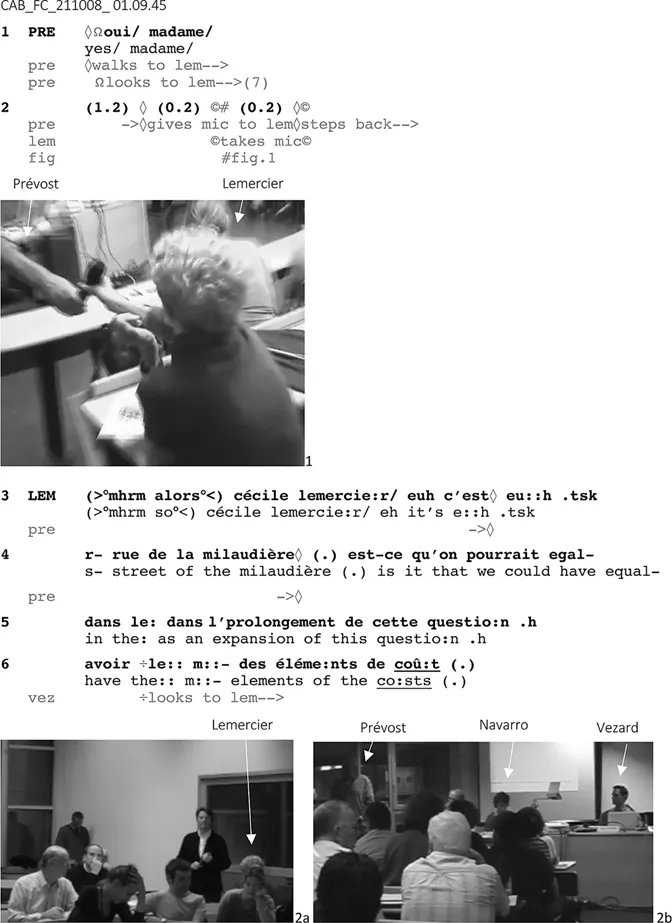
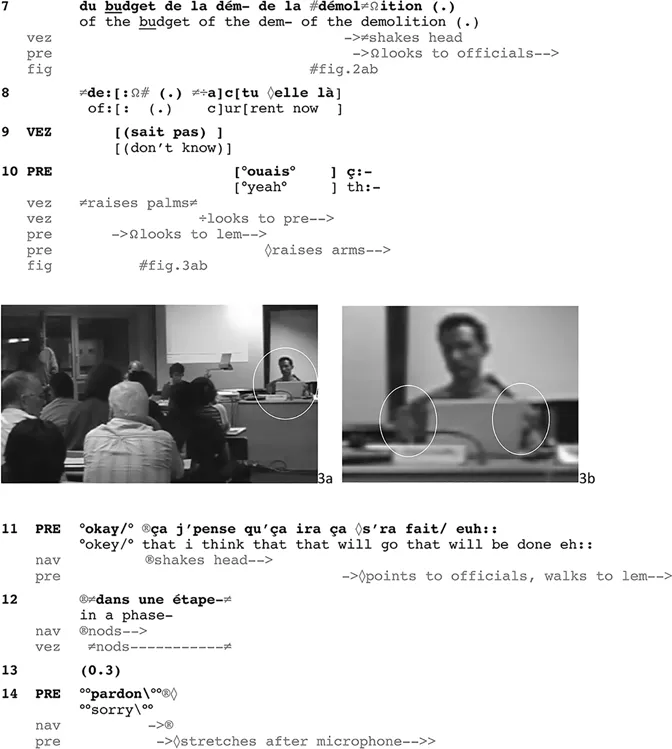
Extract 1.1 CAB_FC_211008_01.09.45.
In this extract, the citizen Lemercier explicates what she is doing by formulating it as an action in a series of actions, retrospectively anchoring it in the prior question and prospectively making relevant an answer (3–8). By explaining the contextual relevance of her intervention she claims what she is doing as justifiably inspect-able with regard to its presumed relevant aspects (Garfinkel and Sacks 1986; Schegloff 1988). Social interaction unfolds over time and interactants orient to actions’ sequential placement, that is when they emerge, as essential for their intelligibility (Schegloff 1996, 2007b; Schegloff and Sacks 1973). Lemercier’s request for the budgetary information is also sequentially accountable as her displayed understanding of when it is done, that is, subsequent to the facilitator’s public selection of her as the next speaker (1), which she acknowledges in an embodied way as she accepts the microphone he offers her (2, figure 1) and takes the turn (3). Lemercier initiates her contribution by providing her name (3) and address (4), complying with the institutional representatives’ explicit request at the beginning of the meeting to present oneself when engaging in public speech. By providing this particular account for as whom she is doing the request (as a citizen living close to the future park), a context in which that category is relevant to invoke is retrospectively acknowledged and prospectively established. That she chooses the inclusive pronoun on ‘we’ instead of je ‘I’ also indexes that she does not only speak – and request – on behalf of herself, but on behalf of an interactional party that is hearable as “the participating citizens.” This is also displayed in her embodied positioning. As oppos...
Table of contents
- Cover
- Half Title
- Series Page
- Title Page
- Copyright Page
- Table of Contents
- List of figures
- List of participants
- Transcript conventions
- Acknowledgments
- 1 Introduction: action, institutionality and public political meetings
- 2 Repairing interaction
- 3 Repairing for others: claiming a trouble of understanding
- 4 Repairing a possible trouble of hearing for others
- 5 Correcting for others
- 6 Conclusion: repair, knowledge and institutions
- References
- Index
Trusted by 375,005 students
Access to over 1.5 million titles for a fair monthly price.
Study more efficiently using our study tools.
Frequently asked questions
Yes, you can cancel anytime from the Subscription tab in your account settings on the Perlego website. Your subscription will stay active until the end of your current billing period. Learn how to cancel your subscription
No, books cannot be downloaded as external files, such as PDFs, for use outside of Perlego. However, you can download books within the Perlego app for offline reading on mobile or tablet. Learn how to download books offline
Perlego offers two plans: Essential and Complete
- Essential is ideal for learners and professionals who enjoy exploring a wide range of subjects. Access the Essential Library with 800,000+ trusted titles and best-sellers across business, personal growth, and the humanities. Includes unlimited reading time and Standard Read Aloud voice.
- Complete: Perfect for advanced learners and researchers needing full, unrestricted access. Unlock 1.5M+ books across hundreds of subjects, including academic and specialized titles. The Complete Plan also includes advanced features like Premium Read Aloud and Research Assistant.
We are an online textbook subscription service, where you can get access to an entire online library for less than the price of a single book per month. With over 1.5 million books across 990+ topics, we’ve got you covered! Learn about our mission
Look out for the read-aloud symbol on your next book to see if you can listen to it. The read-aloud tool reads text aloud for you, highlighting the text as it is being read. You can pause it, speed it up and slow it down. Learn more about Read Aloud
Yes! You can use the Perlego app on both iOS and Android devices to read anytime, anywhere — even offline. Perfect for commutes or when you’re on the go.
Please note we cannot support devices running on iOS 13 and Android 7 or earlier. Learn more about using the app
Please note we cannot support devices running on iOS 13 and Android 7 or earlier. Learn more about using the app
Yes, you can access Establishing Shared Knowledge in Political Meetings by Hanna Svensson in PDF and/or ePUB format, as well as other popular books in Social Sciences & Social Science Research & Methodology. We have over 1.5 million books available in our catalogue for you to explore.