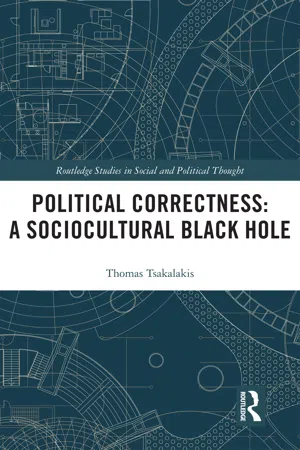
This book explores the nature of political correctness as but one of the faces of today's widespread sociocultural hypocrisy; it is a critique of a phenomenon that constitutes a threat to the Enlightenment hope that humanity might one day achieve maturity. The author identifies political correctness as a drive towards shallowness, anti-intellectualism and self-flagellation – and a culture in which perception is everything. With attention to the emergence and growth of political correctness in a country, Greece, where it can be observed from a bottom-up perspective, this volume demonstrates that although at first glance it appears as a well-intentioned social movement informed by values with which no moral and judicious person could disagree, political correctness actually represents, at best, a distraction from graver concerns; at worst, a manifestation of human foolishness and malevolence. A study of the destruction of honest and rational debate, characterized by trials of intention, often by social media, Political Correctness: A Sociocultural Black Hole will appeal to scholars of sociology and media studies with interests in contemporary political culture.
- 158 pages
- English
- ePUB (mobile friendly)
- Available on iOS & Android
eBook - ePub
Political Correctness: A Sociocultural Black Hole
About this book
Information
1 Introduction: A Lannister Always Dates His Pets
The subtitle of this introductory chapter is a play on words I came up with, an intentional spoonerism based on one of the catch-phrases, “A Lannister always pays his debts,” from the all-too-popular HBO series Game of Thrones. Be it clever or gay, and I use the latter adjective in its colloquial sense of “stupid,” this jeu d’esprit was intended to provoke the ineluctable, and more or less rhetorical, question: Could it (and, by extension, the one who thought of it) be regarded as politically incorrect? The answer is a resounding “yes,” perhaps even raised to the power of three, in view of what this pun was followed by as well: (i) my joke indubitably incurred the wrath of some of the animal rights warriors; (ii) I perpetrated the “microaggression” of proposing the word “gay” as one of the ways my play on words might be described; and (iii) I keep committing the academic faux pas of employing the singular first-person pronoun instead of displaying false modesty by conforming to the long-established norm whereby it is highly recommended that either the supposedly impartial third-person perspective or the plural first-person pronoun be used in scholarly texts. [Nonetheless, as the aphorism formulated by the peerless satirist Georg Lichtenberg goes: “All impartiality is artificial. Man is always partial and is quite right to be” (82).] Furthermore, even the die-hard fans of the aforementioned TV show may be affronted (or “triggered”) by my playful transposition of two of the phonemes in the Lannisters’ unofficial motto. Incidentally, if these fans happen to be proponents of political correctness – hereafter abbreviated as PC – as well, should they not also take issue with the fact that, due to the generic use of the masculine pronoun (“pays his debts”) in the show’s popular saying, it appears as if only male Lannisters were reputed to be reliable debtors?
It may well be argued that the fact that I am not a US citizen precludes my take on the matter at hand from consideration, given that PC is deemed a primarily American phenomenon. [Ironically, my study may be regarded as a case in which an “outsider,” a “barbarian,” is “carrying owls to Athens,” to borrow a phrase from Aristophanes; an equivalent metaphor used by the English is “bringing coals to Newcastle.” Yet it is an Athenian who offers his perspective on a subject that is perhaps already exhausted by the Americans, who have plenty of figurative owls of their own.] Conversely, it would also stand to reason that precisely because I come from Greece, and therefore not only am I afforded the opportunity to examine this phenomenon at a distance, ergo from a more objective angle, but I am also a member of a “minority group,” in the sense that my birthplace is a small and almost impoverished country that has been flirting with default and threatened with “Grexit” for more than a decade, I am somehow more entitled to voice an opinion on this issue than, say, a privileged American would be. If the advocates of PC – henceforth: PCers – who have read up to this point have already taken it for granted that I must be opposed to everything PC stands for, they will conveniently disregard my “minority status” and agree with the former argument; they may also feel that they ought to quit reading any further, irrespective of what irrefragable arguments I might be putting forward later on. Nevertheless, if a person is indeed anti-PC, this does not mean that said person should be neatly categorized as a downright bigoted reactionary (i.e., a heterosexist, a racist, a promoter of hate speech, a misogynist, and an evolution denier), a misinformed centrist, or a believer in stale Marxist dogmas that do not vigorously endorse the postmodern wide array of disparate idealistic causes – instead of common economic interests – such as multiculturalism, environmentalism, ethnic-racial identity affirmation, anti-sexism, LGBTQIAPD rights, and the umbrella term “social justice.”
The abovementioned initialism stands for: Lesbian, Gay, Bisexual, Transsexual, Queer (or Questioning), Intersex, Asexual, Pansexual and Demisexual; however, by the time this book is published, it may have already been extended considerably, perhaps even to the point of a reordering of the complete English alphabet. How about an “F” for foot fetishists, an “O” for objectum sexuals (people who are attracted to, and seek to have relationships with, inanimate objects), or an “E” for ecosexuals (those who engage in erotic encounters with various components of a natural ecosystem, such as the soil, a vegetable, or a waterfall)? Of course, many of the letters could appear more than once; for instance, why not an extra “I” for “incels,” a term coined by males who self-identify as “involuntary celibates” and who feel equally marginalized as those who belong to the established LGBT+ community, or a second “D” for digisexuals, that is, persons who forego erotic encounters with other humans because they prefer to have their sexual desires fulfilled exclusively by means of digital technologies and interactive media (online porn, sexting, robotic sex dolls equipped with artificial intelligence, virtual reality sex, and so forth)? The above could easily result in a new Orwellian “Newspeak,” while the incessant emergence of new sociocultural entities (or “tribes”), based either on often illegitimate grievances or on a legion of peculiarities, may lead Western democracies to consider designing a new social contract. If so, what exactly should this entail? These are a few of the controversial issues I shall be addressing in the following chapters.
PC does not have to be associated with factional strife, internecine fault lines, or interparty conflicts. In the words of the nonpareil stand-up comedian and social critic George Carlin: “The impulse behind political correctness is a good one. But like every good impulse in America it has been grotesquely distorted beyond usefulness,” and the people responsible for this are “liberal language vandals” and “failed campus revolutionaries” who, if “they’re not busy curtailing freedom of speech, they’re running around inventing absurd hyphenated names designed to make people feel better” (173). With this in mind, it is quite within the bounds of possibility for someone to be favorably disposed toward several of the ethical values [not principles] and underlying premises [not actualities] that inform PC, but in disagreement with its discourse, as well as with virtually all the tactics or practices adopted by doctrinaire PCers, and, at the same time, to be above the fray of paltry ideological wars and located outside the orbit of the traditional political framework, in the sense that s/he – I willfully play the “pronoun game” to mollify the PCers – does not have, or want to have, a dog in this fight. Accordingly, neither does this hypothetical someone engage in motivated reasoning (which, in a nutshell, is a confirmatory bias whereby you get to eat your heuristic cake and have it too: you look for, retain, and process only the kind of information that seems to buttress your deeply held assumptions and to satisfy your “feelings” as regards a particular problem), nor does s/he cling to unreasonable beliefs and prejudiced emotions strictly because they are in consonance with her/his in-group’s views, which is exactly what all the intransigent PCers do, as I shall try to demonstrate in this book. Otherwise stated, the polarizing topic of PC does not necessarily pertain to the constantly shifting ideological groupings within the political spectrum; instead, it could be explored through a lens that is, on the one hand, supra-political, to wit, focused on panhuman realities and universal verities that transcend the immediacy of specific ideologico-political investments, myths, battlegrounds, constellations, or conflicts of opinions (which are purportedly sublated so that a general consensus may eventually emerge) and, on the other, metaethical and metaepistemological, i.e., engaged with a second-order philosophical interrogation of both the normative bases and the practical applications of morality and knowledge.
More significantly, but still following the same line of reasoning as before, when it comes to PC (although it should be noted that the same applies to a whole series of equally challenging questions or highly charged subjects), why ought one to classify oneself in advance, sociopolitically, metaphysically, probably even in regard to one’s sexual orientation as well, in order to be “permitted” to enter the arena of public discourse and to make one’s assertions with respect to this topic? [Let us be forthright; the answer is clear: because virtually every book is aimed at a very specific target audience, one which the author is anxious to win over right off the bat.] One does not have to be familiar with Michel Foucault’s The History of Sexuality in order to have awakened to the fact that “Western societies have established the confession as one of the main rituals we rely on for the production of truth” (56), and that this “obligation to confess is now relayed through so many different points, is so deeply ingrained in us, that we no longer perceive it as the effect of a power that constrains us” (60). Indeed, there are many people who, wittingly or unwittingly, perform self-evaluations, exhaustively examine their emotions, their intentions, as well as their likes or dislikes, and then disclose their “findings” to the public under the illusion that this constitutes a “liberating” experience. What currently transpires in the realm of social media is a poignant case in point. The kicker is that this “transparency” is merely a simulation exercise conducted in an environment far removed from truth or from actual reality, and most “confessions” are anything but sincere. Nonetheless, even within the confines of a preprogrammed confessional culture, it is still puzzling why a lot of (self-proclaimed) liberal-minded academics subscribe to the notion that one should first give a direct or indirect account of one’s leanings or biases, and only then will said one’s ideas find their “rightful place” in the din of the unceasing, warlike debates between the perennially divided “Us” and “Them,” whatever in-group and out-group these last two may refer to.
Echoing Glenn C. Loury’s views, which are germane to the issue I have just raised, when I chose to investigate the topic of PC, I, too, was inclined, even if only for a moment, to “edit my writing so as to avoid conveying the ‘wrong’ (that is, unintended even if accurate) impression” and to “pander to the presumed prejudices of my audience,” as I was aware that both leftists and right-wingers with strong opinions on the matter would primarily (or exclusively) focus on assessing where I am “coming from,” what my “ulterior motives” are, if I am “for them or against them,” and, as a result, their evaluation of my writings could ultimately depend merely upon whether I would be viewed as a friend or as a foe (434). In Illiberal Education, one of the earliest explorations of PC (from a conservative point of view), Dinesh D’Souza appositely writes: “During my research for this book I discovered a tremendous curiosity, on the part of my sources, about my own background and where I was ‘coming from’” (22). However, in this case the question may have been literal, given the India-born D’Souza’s skin color. In any event, Richard Feldstein summarizes a currently popular – if not dominant, although I opine it is not valid always and for everyone – conjecture according to which “any attempt at interpretation tilts to the left or right,” there is “a politicized aim that precedes” someone’s investigation of a topic, and “all intellectual undertakings are bound by an ‘ideological captivity’” (49). Therefore, it should be no wonder that many readers consider it imperative to learn in advance where a critic is coming from. Along a line of thought similar to that of Loury’s, Howard S. Schwartz drives the point home decisively: “There is clearly an element of irrationality in political correctness. It is a form of censorship without a censor; we impose it on ourselves” (4). Jonathan Zimmerman, too, makes mention of the fact that an increasing number of academics, either conservative or progressive, “say that they self-censor for fear of repercussions” (9), and that they refrain from raising their objections to matters such as, say, “race-based affirmative action” (37) in order “to guard against ridicule or harm” (67). In a somewhat similar vein, Geoffrey Hughes states that several of the people he told that he was working on this subject asked him: “Will it get you into trouble?” (x). The foregoing are evidently indicative of the fact that even those who have no immediate involvement in the PC debate get a sense that one should exercise an abundance of caution – a phrase, lest we forget, which came into vogue during the Ebola virus epidemic – when one decides to venture an opinion on it, as if analyzing PC is tantamount to letting oneself become exposed to some kind of epistemological coronavirus … All the same, I write from the vantage point of a non-tenure track academic who is a citizen of a country that has been careening toward failed state status since 2009, and who, having practically nothing to lose (a salient point that I will be revisiting in more detail in the following chapters), does not feel overwhelmed by any need to sidestep addressing a problematic issue with as much unvarnished candor as feasible.
Absent any novel and comprehensive “emancipatory Grand Narrative,” PC found fertile ground for extending its reach beyond the academic world in several Western democracies, as it has come to play a crucial role in a lot more than just campus politics, speech codes, diversity, or multicultural curricula. PC now pervades virtually all aspects of both the public and the private sphere: art, the political arena, mainstream journalism and social media, international relations, but also everyday interactions, be they professional, social, or sexual. According to the psychiatrist Sally Satel, “not even medicine is immune,” since PC “is spreading into the clinical area” and “identity politics has taken precedence over clinical imperatives” (43), and this is due to what she dubs “indoctrinologists,” that is, social justice warriors whose “prescriptions for cure are ideology and social reform” (6); in fact, there are activists, self-described as “consumer-survivors,” who “claim that psychiatrists make them sick,” so they want to take over the institutions for the mentally ill, and their PC-inspired “movement” is often subsidized by “the federal government and state mental health agencies” (45–47). Satel has no qualm about closing her book with the exhortation to “inoculate medicine against the life-or-death consequences of political correctness” (233). PC is part and parcel of “the raging ‘culture war’ that has replaced the struggle over communism as the primary locus of partisan conflict in American intellectual life. Starting on the campuses—over issues like abortion, affirmative action, multicultural studies, environmentalism, feminism, and gay rights—the PC debate has spread into newsrooms, movie studios, and even the halls of Congress” (Loury 428–429); hence, as Schwartz succinctly puts it, “political correctness is everywhere” (2).
Furthermore, a compelling case could be made that a growing antipathy from many different sides toward PC was one of the reasons that Donald Trump got elected as POTUS. I would never dare to presume that I am that well versed in the extremely labyrinthine inner workings of American politics; however, after I first thought that maybe Trump’s rise to power was at least partly due to a right-wing populism spawned (anew) by “PC run amok” and by an overemphasis on identity politics, I conducted a cursory research on the matter, and it was enough to reveal that this point had already been made, plenty of times. Heidi Kitrosser, in an article that leans slightly in favor of PC, sums it up as follows: “Many observers attribute Donald Trump’s political rise to widespread anger over ‘the culture of political correctness’,” and then, in three consecutive footnotes, she cites six bibliographical sources that propose this hypothesis (1989). Significantly, the progressive – or at least certainly not a Republican – yet fervently anti-PC Bill Maher also frequently mentions something to this effect on his HBO political talk show Real Time with Bill Maher. Likewise, and not so paradoxically in my view, the vociferous opponent of radical leftism Jordan B. Peterson, to whom I devote a separate section in the third chapter, expressed virtually the same opinion during an interview (“There was plenty of motivation to take me out. It just didn’t work”), asserting that “this identity politics battle of ideas was a determining factor in the last American election; if Hillary wouldn’t have played identity politics, played cozy with the identity politics type, she would have kept the working class and she would be President now.” Additionally, several left-leaning and/or black political pundits have written articles that present PC as a hindrance to promoting progressive policies in the States; a good case in point is Briahna Joy Gray’s tellingly titled piece “How Identity Became a Weapon Against the Left,” in which the author, while discussing Kamala Harris’s possible candidacy for the 2020 presidential race (which Harris dropped out of in December 2019), stresses that “when used cynically, as a political weapon, a simplistic view of identity can allow people of a particular political faction to wrongly imply that they speak for all members of their racial or gender group,” that there are “both principled and pragmatic reasons why people on the ...
Table of contents
- Cover
- Half-Title
- Series
- Title
- Copyright
- Contents
- 1 Introduction: A Lannister Always Dates His Pets
- 2 PC in Greece: An Atypical, yet Revealing, Case Study
- 3 A Culture of Hypocrisy
- 4 The Story Thus Far: A Critical Review of the Literature on PC
- 5 Alceste . . . and the Rest: A Misanthropic Pessimist’s Outlook on PC
- 6 [In Lieu of a] Conclusion
- Works Cited
- Index
Trusted by 375,005 students
Access to over 1.5 million titles for a fair monthly price.
Study more efficiently using our study tools.
Frequently asked questions
Yes, you can cancel anytime from the Subscription tab in your account settings on the Perlego website. Your subscription will stay active until the end of your current billing period. Learn how to cancel your subscription
No, books cannot be downloaded as external files, such as PDFs, for use outside of Perlego. However, you can download books within the Perlego app for offline reading on mobile or tablet. Learn how to download books offline
Perlego offers two plans: Essential and Complete
- Essential is ideal for learners and professionals who enjoy exploring a wide range of subjects. Access the Essential Library with 800,000+ trusted titles and best-sellers across business, personal growth, and the humanities. Includes unlimited reading time and Standard Read Aloud voice.
- Complete: Perfect for advanced learners and researchers needing full, unrestricted access. Unlock 1.5M+ books across hundreds of subjects, including academic and specialized titles. The Complete Plan also includes advanced features like Premium Read Aloud and Research Assistant.
We are an online textbook subscription service, where you can get access to an entire online library for less than the price of a single book per month. With over 1.5 million books across 990+ topics, we’ve got you covered! Learn about our mission
Look out for the read-aloud symbol on your next book to see if you can listen to it. The read-aloud tool reads text aloud for you, highlighting the text as it is being read. You can pause it, speed it up and slow it down. Learn more about Read Aloud
Yes! You can use the Perlego app on both iOS and Android devices to read anytime, anywhere — even offline. Perfect for commutes or when you’re on the go.
Please note we cannot support devices running on iOS 13 and Android 7 or earlier. Learn more about using the app
Please note we cannot support devices running on iOS 13 and Android 7 or earlier. Learn more about using the app
Yes, you can access Political Correctness: A Sociocultural Black Hole by Thomas Tsakalakis in PDF and/or ePUB format, as well as other popular books in Politics & International Relations & Political Process. We have over 1.5 million books available in our catalogue for you to explore.