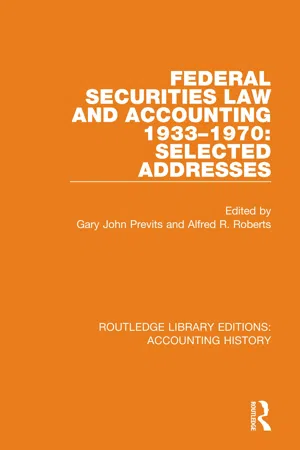
The articles in this book, first published in 1986, cover the developments of the first three decades of the Securities Acts, and examines appraisals of the U.S. Securities and Exchange Commission. With the rise in interest in the evolution of regulatory policy, these principal papers are key sources in the study of the history of accounting. Written by accountants close to the Commission, these papers will be of interest to accountants in public and private practice, and all students of accounting and its government regulation.
eBook - ePub
Federal Securities Law and Accounting 1933-1970: Selected Addresses
- 366 pages
- English
- ePUB (mobile friendly)
- Available on iOS & Android
eBook - ePub
Federal Securities Law and Accounting 1933-1970: Selected Addresses
#1 James M. Landis
October 30, 1933
Principles of Federal Securities Legislation
Abstract
Landis, an attorney who later became a member and chairman of the Securities and Exchange Commission (SEC) was Commissioner of the Federal Trade Commission at the time of this address. He emphasized the standards of conduct that would reduce the perils of liability under the Securities Act of 1933. The standards relate to three areas: (1) civil and criminal liabilities consequent upon misstatements or omissions of facts in a registration statement; (2) the idea of materiality; and (3) the fiduciary concept of reasonable care.
Considerable hesitation accompanied my first decision to accept your kind invitation to talk to you upon some phases of the Securities Act of 1933. You people represent a profession of competence in a field different than that of mine, and a field which, despite efforts of mine to understand, still remains much of a heathenish mystery. True, sometimes I have wondered whether you, just like the members of my profession, do not tend to make more mysterious your own knowledge so as to widen the gulf that separates you and us from the ordinary unsuspecting laymen. But after all, a profession must have some excuse to regard itself as such. Recognizing then that I have no ambition to speak to you from the accounting angle, I shall ask you to bear in mind that what I may say represents only the limitations of the lawyer having had some familiarity with the type of problems presented by financing.
Address before the New York State Society of Certified Public Accountants.
Misconceptions about the Securities Act and its effects seem to abound. Like the passions aroused by some of our causes celebre in this country, the Securities Act is tending to divide its opponents and adherents into separate camps. Studied and colorless consideration of the nature of the Act and the character of its effects has, in the main, been lacking. Such intemperate attitudes to this most complex problem of the control of corporate financing are nothing short of a tragedy. And if the issue develops, as it now threatens to develop, into one of the public against the bankers, instead of that of a consideration of the best interests of the public—a concept which still includes the banking group—what legislation will evolve out of such an emotional tempest is certain to be both unwise and impractical.
This attitude that now threatens is so different from that which prevailed as of the time of the birth and passage of the Securities Act. The Presidents message calling for federal security legislation and outlining the basic principles that should be embodied in such legislation has yet to find any critic. No opposition to the President’s aims was voiced at the hearings on the bill, which were wholly devoid of any sensationalism. Some five weeks of what might properly be termed unremitting labor by a subcommittee of the House were spent in working over the details of the legislation before the bill emerged from committee. With one exception, its passage through the House as well as the passage of the companion bill through the Senate evoked no dramatic speeches, no threat of retaliation against a class. No member of either House at any time voted against the passage of the bill, nor took occasion to criticize any provision that the bill contained. Those who had the opportunity to watch the progress of this bill at close range could not fail but to be impressed with the earnestness, sincerity and competence of those members of the House and of the Senate who had the bill in charge. I cite these facts merely as illustrative of a Congress with its emotions unaroused but deeply conscious of the evils which unrestrained exploitation of our capital resources had brought into existence.
One other characteristic of the framing of the Securities Act deserves notice. It is customary for some critics to regard the Act as the product of a single session of Congress, to attribute its authorship to individuals, to think of it as new and hastily drawn legislation. Nothing is farther from the facts. The experience of many years and of many nations is epitomized in the provisions of the Securities Act. Many of its features, with variations suitable to the form of financing in this country and to the constitutional limitations upon federal power, have been drawn from the English Companies Act, which represents the culmination of almost a hundred years of struggling with this problem abroad. Since 1911 most of our 48 states have been developing forms of security legislation and much of the experience of these states has gone into the federal act. More specifically, the work of the Capital Issues Committee during the War led to the introduction of a bill in Congress, known as the Taylor Bill, whose basic outlines are essentially similar to those of the Securities Act. Later, the Denison Bill, devised primarily to make more effective state security regulation, actually passed the House but failed of action in the Senate. In other words, the Securities Act embodied little that was novel in conception, nor did it emanate from a Congress that for the first time had been called upon to consider the problem of security regulation.
For this audience I need spend little time in outlining the principal features of the Securities Act. Rather I shall assume a knowledge of its basic features and use my time in discussing a problem that seems to give the most concern. This is the problem of civil liability. What liability there exists for damages for violation of the Act comes as a result of the provisions embodied in Sections 11 and 12, but I intend on this occasion to limit myself merely to a discussion of Section 11, the section that imposes liabilities consequent upon misstatements in a registration statement.
The suggestion has been made on occasion that civil liabilities arise also from a violation of Section 17, the first sub-section of which makes unlawful the circulation of falsehoods and untruths in connection with the sale of a security in interstate commerce or through the mails. But a reading of this section in the light of the entire Act leaves no doubt but that violations of its provisions give rise only to a liability to be restrained by injunctive action or, if wilfully done, to a liability to be punished criminally. That such a conclusion alone is justifiably to be drawn from its provisions is a matter upon which the Commission has already made a pronouncement, the authoritative quality of which I shall have occasion to consider later.
Turning now to Section 11, – the section from which liability arises as a result of misstatements in the registration statement -it is worth our while carefully to analyze its content from several angles; (1) the persons upon whom it imposes liability; (2) the standards of conduct that it insists these persons shall observe in order to be immune from liability; (3) the damages that flow from a violation of its provisions.
Broadly speaking, the persons upon whom liability may be imposed can be divided into five groups: (1) the issuer; (2) the directors of the company, whether or not they have signed the registration statement; (3) the chief officials of the company; (4) experts, such as accountants, engineers, appraisers, and any person whose profession gives authority to a statement made by him — a phrase which, as a matter of pride for the profession, would, I hope, include the lawyer; and (5) the underwriters of the issue, remembering always that the legal and not the dictionary meaning of that term is involved. Though all these persons may be liable for misstatements in a registration statement, it is utterly erroneous to assume that because there is a misstatement all these groups of persons are liable. To make that apothegm clear, it becomes necessary to examine the standards of conduct required to be observed by these groups of persons.
An understanding of that standard seems to me essential to a clear picture of this liability. It must be understood from three standpoints, or, in other words, three questions must separately be asked. The first is this: Was there the required misstatement or the required omission? No difficulty is raised in determining whether or not a misstatement has been made, but the requirements of the Act relative to omissions have been the source of much — I am tempted to say — ingenious confusion. Omissions in order to be a ground for liability must, in the language of the statute, be omissions to state facts required to be stated in the registration statement or necessary to make the statements in the registration statement not misleading. In non-technical language, this, as the history of the Act amply demonstrates, means simply that a half-truth is an untruth, a fact that Congress, in its wisdom and with some experience in such matters, thought best to put beyond the power of sophist lawyers and judges to dispute. It is impossible, especially in the light of the Federal Trade Commission’s exposition of this matter, to interpret this language to require an issuer at the peril of liability to state every fact which may be relevant to gauging the value of a security.
Cases of this character have commonly been put to develop the supposed dangers of that phraseology. Suppose that those associated with an issue are aware of a competitive process in the same field of manufacture as that of the issuer, but at the time reach a perfectly proper business judgment that the danger from the rival process is so slight that it can be ignored and therefore make no mention of that danger. A few years later it develops, however, that the competitive process proves its value and the issuer is driven to the wall. Is the business judgment of the directors and the officers to be reviewed some years hence by a jury viewing the situation from the hindsight of what happened rather than the foresight of what might happen? The answer to such and similar questions, whether fortunately so or not, is in the negative. Nothing in the registration statement calls for a statement of the position of the issuer in the general competitive structure of its industry and consequently omissions to state facts descriptive of this situation afford no basis for liability. The requirements of the registration statement alone are the basis for determining what statements must be made and therefore what omissions dare not be made. Beyond these requirements an issuer may, of course, go, but no requirement now calls for such statements to be made at the peril of liability.
I hope that during this discussion you have been aware that I have talked simply of misstatements and omissions of facts without reference to the question of their materiality. Indeed, I have purposely done so, because this question seems to me the second of those that should be asked in connection with the standards of conduct that the Act requires should be observed, namely, assuming that there was a misstatement of fact or the required omission, did such misstatement or omission relate to a material fact? Let me repeat the phrase “material fact” again. It embraces two conceptions, that of fact and that of materiality. It may seem to you that the problem of what is a fact is one that has been unanswered by philosophers since the days of Plato. Though some may be true of philosophy, law in its ignorance has been called upon from time memorial to distinguish between representations of fact and representation of opinion. The guiding line between these two conceptions rests upon the possibility of subjecting the conclusions in the respective realms of fact and opinion to definiteness of ascertainment. Much also depends upon the method of expression for what should appropriately be expressed as inferences or deductions from facts and hence as opinions, are too often expressed as facts themselves and hence for the purposes of legal liability, whether at common law or under the Act, become facts. It has been said, and very rightly in my humble opinion, that most of accounting is after all a matter of opinion. But though this may be true, I have still to see the case of a prospective invester being offered a balance sheet and having it carefully explained to him that this or that item is merely an opinion or deduction from a series of other opinions mixed in with a few acknowledged facts. Accounting, as distinguished from law, has generally been portrayed as an exact science, and its representations have been proffered to the unlearned as representations of fact and not of opinion. If it insists upon such fact representations, it is, of course, fair that it should be burdened with the responsibility attendant upon such a portrayal of its results.
I turn now to the problem of materiality, for it is obvious that liability under Section 11 does not follow as a result of every misstatement. The misspelling of a director’s name and other such matters could not conceivably carry liability. But what is material? Clearly materiality must be gauged with reference to purpose, and, recognizing that the purposes of the Act are the protection of the investing public, it does not become difficult to depict the standard of materiality. In other words, facts become material for the purpose of omissions and misstatements when, as a consequence of such omissions and misstatements, non-existent values are attributed to a security.
The third of the questions that I suggest must be asked in order to determine whether the standard of conduct prescribed by the Act predicates that answer to the other two questions has been in the affirmative. That is, assuming that there has been a misstatement or omission and that such a misstatement or omission has had reference to a material fact, is the person to be excused from liability because he exercised reasonable care under all the circumstances and entertained a reasonable belief that the statements he made were true? Reasonability, it should be borne in mind, will differ widely according to the person involved. Under some circumstances such a standard would require personal kowledge of the facts assumed to be true. Delegation to others of the duty to verify the facts would under other circumstances suffice to meet the requirement. A director, for example, would have little excuse for not having personal knowledge of what his stock holdings in the issuer and its subsidiaries were, but he should obviously be entitled to rely upon the statements of his fellow directors, as checked by the stock books, as to what their stockholdings were. Furthermore, the director, who is also chairman of the board or chairman of some special committee, will stand in a different relationship as to the knowledge which is the special concern of his committee. Or take the situation of the underwriters. The type of investigation which can reasonably be demanded of the sponsoring or principal underwriters is one thing; that which the Act requires of the small participating underwriter in order that he shall satisfy its requirements is another thing, while an even less standard of investigation would be demanded of the dealer selling on commission who, because of his relationship to the issuer, is considered as an underwriter by the Act.
These conceptions permitting a reasonable delegation of duties by the various parties connected with the flotation of an issue, are not interfered with by that provision of Section 11 which likens the standard of reasonableness to be applied, to that which the law commonly requires of a person occupying a fiduciary relationship. That section does not make these individuals fiduciaries in and of themselves, but simply refers to that standard which, briefly stated, requires the exercise of a degree of care that a prudent man would exercise in his own affairs, as a measure of the type of conduct that in decency can be expected of those soliciting other peoples’ money for investment.
Thus far we have discussed the persons made responsible for misstatements in the registration statement, and the standards of conduct that the Act calls upon them to observe. There remains the question of the nature of the damages for which these persons are responsible in the event that their liability otherwise is established. The first measure is what might be termed, somewhat inaccurately, the right of rescission. This is the duty to respond in damages equivalent to the price paid by the purchaser, never, however, exceeding the offering price, upon the tender of the security. Two illustrations will make this clear. The offering price of a bond is $100. Purchaser A buys it on the market at $75; purchaser B at $125. A, upon tendering back the bond, could only recover $75, whereas B could only recover $100.
The Act also grants another right, which might appropriately be termed the strict right to damages. This can only be availed of by a purchaser who has disposed of the security. It is a right derivative in nature from the right of rescission. To illustrate its operation, we may turn to the case originally put and assume that A and B have disposed of their bonds on the market at $60. A, who had paid $75 for his bond, could recover $15, whereas B who had paid $125 for his bond recovers not $65 but $40.
It should be observed that each person whose liability on the registration statement has been established is responsible in damages to any purchaser of the security, whether such person shall have purchased from him or from some other person. Theoretically this means that each person so liable can be held to a liability equivalent t that of the total offering price of the issue. Practically, of course, no such large liability exists. Several factors will operate to keep the liability within much smaller bounds. For one thing, the value of a carefully floated issue can hardly be assumed to reach zero. For another, every purchaser would hardly be likely to bring suit. Again, the issue of liability—generally, a complicated question of fact—would be retriable in every suit, and it beggars the imagination to assume that every jury faced with such an issue would come to the same conclusion. Furthermore, each person liable has a right of contribution against every other person liable, unless the one suing is guilty of fraud and the other is not. So that even eliminating the other practical factors that I have mentioned, it would be necessary for every other person liable on the registration statement to be insolvent in order that one of them would be affixed with the large theoretical responsibility.
In elaborating upon these damages—of which I shall have more to say—I have not, I believe, unduly minimized their character. But I have tried to look at them with some degree of reality rather than in the fanciful and unreal fashion that has characterized their exposition by some members of the legal profession in this and other cities. To pretend that they are insignificant is wrong; but as equally vicious is the practice, unfortunately too common, of conjuring up bogey men to frighten those who may wish to seek new financing through public issues. Not only does it discourage operation under the Act; but the bar when later faced with the task of defending those who may nevertheless register under the Act will be forced to do one of those volte-faces so humiliating to the legal profession. Its opinions upon matters such as this are too often dictated by the interests of its clients. In other words,—and here I voice a thought that I am afraid is likely to be misinterpreted, though the origins of this belief are of many years standing—the opinion of the bar reflects too accurately the condition of the capital market. Were it booming, were the bond market boiling, were there bankers eager to handle issues, the tendency of the bar, I suspect, would be to minimize the liabilities of the Securities Act. A leader of the New York bar, only recently dead, respected by all my generation for his refusal to think of his clients’ causes as just when they were not, once remarked: “When a client asks for my opinion he gets my opinion; if he wants a brief to uphold his interests, let him ask for a brief and not an opinion.” Were that attitude to characterize the legal advice now being given with respect to the Securities Act, many of the headaches of today and the heartaches of tomorrow might be avoided.
If, in the discussion of the question of damages, I have led you to believes that damages against the persons liable on the registration statement are compensatory in character, that is, that they compensate only for what damages may flow from the misstatements, let me disabuse you of that fact. Let me illustrate their non-compensatory character by a simple illustration. A careless misstatement of the quick asset position of a corporation justifies, let us say, the conclusion that had the facts been properly stated the offering price of a bond should have been 90 instead of the 100 at which it was actually offered. For reasons utterly foreign to this misstatement and even beyond the possibility of conjecture at the time of the offering, the price of the bond declines to 30. A purchaser who bought at 100 could nevertheless, if he sold the bond at 30, recover from those liable on the registration statement the difference between 100 and 30, or 70.
This result, you may say, is unjustifiable. To that let me answer first that it represents no extraordinary principle of legal liability. Suppose that I buy an ordinary chattel from you for $100 upon your representation that it has certain qualities. It does not possess these qualities but the difference between the type of chattel that I bought and the type that you represented to me I was buying, can be measured by the sum of $10. Because of conditions that neither of us could have foreseen and over which neither of us had control, the market value of these chattels falls to $30. I can, nevertheless, as a matter of law, tender you back the chattel and recover $100. I...
Table of contents
- Cover
- Half Title
- Title Page
- Copyright page
- Original Title Page
- Original Copyright Page
- Dedication Page
- Foreword
- Preface
- Table of Contents
- 1. James M. Landis • Principles of Federal Securities Legislation
- 2. George C. Mathews • Questions Relating to the 1934 Act
- 3. George C. Mathews • SEC Accounting Issues and Cases
- 4. William O. Douglas • Capitalism and Trusteeship
- 5. Robert E. Kline, Jr. • Accounting and the Commissions Enforcement Abstract Program
- 6. William W. Werntz • Independence and Cooperation
- 7. Andrew J. Cavanaugh • Standards of Disclosure in Financial Statements
- 8. James J. CafFrey • Plain Talk in Accounting
- 9. Harry A. McDonald • The Investor Looks at Accounting
- 10. Donald C. Cook • The Concept of Independence in Accounting
- 11. Ralph H. Demmler • Providing Funds for Our Enterprises by the Issue of Securities
- 12. Byron D. Woodside • Particular S.E.C. Merger Considerations
- 13. Sydney C. Orbach • Accounting Problems of First-Time Registration Statements
- 14. Byron D. Woodside • Government-Industry Relations
- 15. Manuel F. Cohen • Reporting for Diversified Companies
- 16. James J. Needham • Some General Remarks about the SEC and the Accounting Profession
- Appendix: Contents of S.E.C. Speech Files, Accounting History Research Center, Georgia State University
Trusted by 375,005 students
Access to over 1.5 million titles for a fair monthly price.
Study more efficiently using our study tools.
Frequently asked questions
Yes, you can cancel anytime from the Subscription tab in your account settings on the Perlego website. Your subscription will stay active until the end of your current billing period. Learn how to cancel your subscription
No, books cannot be downloaded as external files, such as PDFs, for use outside of Perlego. However, you can download books within the Perlego app for offline reading on mobile or tablet. Learn how to download books offline
Perlego offers two plans: Essential and Complete
- Essential is ideal for learners and professionals who enjoy exploring a wide range of subjects. Access the Essential Library with 800,000+ trusted titles and best-sellers across business, personal growth, and the humanities. Includes unlimited reading time and Standard Read Aloud voice.
- Complete: Perfect for advanced learners and researchers needing full, unrestricted access. Unlock 1.5M+ books across hundreds of subjects, including academic and specialized titles. The Complete Plan also includes advanced features like Premium Read Aloud and Research Assistant.
We are an online textbook subscription service, where you can get access to an entire online library for less than the price of a single book per month. With over 1.5 million books across 990+ topics, we’ve got you covered! Learn about our mission
Look out for the read-aloud symbol on your next book to see if you can listen to it. The read-aloud tool reads text aloud for you, highlighting the text as it is being read. You can pause it, speed it up and slow it down. Learn more about Read Aloud
Yes! You can use the Perlego app on both iOS and Android devices to read anytime, anywhere — even offline. Perfect for commutes or when you’re on the go.
Please note we cannot support devices running on iOS 13 and Android 7 or earlier. Learn more about using the app
Please note we cannot support devices running on iOS 13 and Android 7 or earlier. Learn more about using the app
Yes, you can access Federal Securities Law and Accounting 1933-1970: Selected Addresses by Gary John Previts,Alfred R. Roberts in PDF and/or ePUB format, as well as other popular books in Business & Accounting. We have over 1.5 million books available in our catalogue for you to explore.