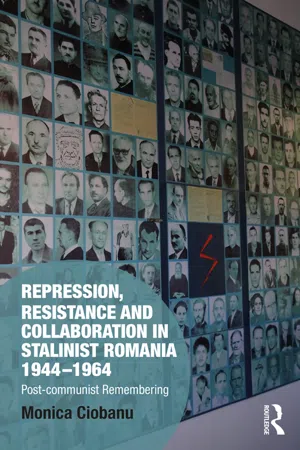
This book examines how the process of remembering Stalinist repression in Romania has shifted from individual, family, and group representations of lived and witnessed experiences characteristic of the 1990s to more recent and state-sponsored expressions of historical remembrance through their incorporation in official commemorations, propaganda sites, and restorative and compensatory measures. Based on fieldwork dealing with Stalinist repression and memorialization, together with archival research on the secret police (Securitate), it adopts an interdisciplinary approach to reveal the resurfacing of particular themes. As such it draws on concepts from sociology, political science, and legal studies, related to memory, justice, redress, identity, accountability, and reconciliation. A study of competing narratives concerning the meaning of the past as part of a struggle over the legitimacy of the post-communist state, Repression, Resistance, and Collaboration in Stalinist Romania 1944–1964 combines memory studies with a transitional justice approach that will appeal to scholars of sociology, heritage and memory studies, politics, and law.
eBook - ePub
Repression, Resistance and Collaboration in Stalinist Romania 1944-1964
Post-communist Remembering
- 232 pages
- English
- ePUB (mobile friendly)
- Available on iOS & Android
eBook - ePub
Repression, Resistance and Collaboration in Stalinist Romania 1944-1964
Post-communist Remembering
About this book
Information
1
Repression and victimization
This chapter examines the mechanisms and contexts that shaped the construction of a political and cultural narrative of the Stalinist repression between 1989 and 2018. This repression can be referred to in broad terms as a “gulag” for it included the network of prisons, labor camps, forced domicile, and deportations that developed between 1944 and 1964 in Romania. The analysis considers three distinctive levels of the representation of repression and victimization in the gulag that are expressed by three different types of actors or “agents of memory.”
The first refers to the victims of repression itself, including former political prisoners, undesirable elements sent to forced labor camps, as well as whole families of deportees who were forcibly removed from their homes from the western Banat region into the arid southern part of Bărăgan. These actors produced firsthand accounts and testimonies of the lived experience of their victimization through memoirs, autobiographical accounts, media interviews, and oral histories. A second intermediary level connects individual and group actors with state actors in the development of historical remembrance and collective narrative construction. It also includes activists or agents of memory construction represented by civil society organizations consisting of journalists, artists, and some intellectuals. Together with an emerging anti-communist opposition associated especially with the old historical parties (the PNŢ and PNL), these actors until the mid-2000s reinterpreted and reexpressed such experiences from the perspective of an anti-communist and post-communist discourse in the aftermath of the December 1989 overthrow of the communist regime. It was through media documentaries, artistic productions and exhibitions, museums, and religious commemorations that the narrative of suffering and resistance against an obviously alien communist regime was manufactured. Finally, this narrative was most recently appropriated by state actors that incorporated both myths of collective victimization and resistance into a much broader historical and cultural story. Thus, Stalinist communism, as it came to be understood, has become part and parcel of a political rhetoric that sustains a traditionalist patriotic, nationalist, and Christian-Orthodox political culture. This rhetoric has been expressed in official ceremonies and in certain measures and symbolic gestures of historical redress. In parallel, relatively new (primarily after the mid-2000s) and quite vocal civil society actors, represented by conservative, right-wing, and religious groups sometimes in concert with elements of the Orthodox clergy, have attempted to amplify this political message and take it to more extreme forms of public representation. This has reawakened deep-seated tension between one set of memories of Holocaust repression during World War II under Marshal Ion Antonescu’s fascist government and those of communist repression following the war.1
In analyzing these three levels of memory construction, we will focus in each on the relationship between memory and remembrance; issues of individual, social, and collective identity; and affirmation, recognition, and representation. By utilizing these three multilayered frameworks, we can establish a model of memory that takes into consideration channels and processes through which memory as an individual and social act becomes intergenerationally transmitted. It is then subsequently embedded culturally in a comprehensive discourse of a community through ritualized and performative acts of historical remembrance. To establish a framework for this analysis, we outline a brief theoretical and empirical account of the politics of memory in general and in post-communist Eastern and Central Europe in particular, with a special emphasis on the influence of non-state actors in reckoning with the past.
Social and institutional aspects of memory-making after communism
Any analysis must begin with the premise that memory is a socially and culturally constructed act that individuals, families, groups (broadly defined along social class, ethnic, religious, national, and gender lines, or in terms of local or regional residency), and succeeding generations develop in their relations between them because of multiple experiences throughout the life course. So, memory as a social act is shaped by both personal circumstances and social and political events. As Halbwachs emphasized in his study On Collective Memory, memories are constantly produced and reproduced through successive stages of biography but also readjusted as present circumstances and contexts change (Coser 1994, 41). In the process, individuals acquire a sense of identity through their simple belonging to a community of memory (Durkheim 1915; Olick 2007). Eviatar Zeruvabel shows that when certain memories appeal to larger groups, individuals do not remember and represent merely their own lived experiences but participate in specific recollections shared by these groups (Zeruvabel 2003, 2–3). It is precisely this dividing line between individual and collective memory that has become the core concern of any sociological approach to the area of memory studies. Researchers in memory deal with this issue by stressing how memory is a mediated process through communication, symbols, narratives, and language. They also addressed how these avenues of memory transmission are connected to a wider culture (Olick and Robbins 1998; Olick 2003; Radstone 2000; Winter 2006). Maria Bucur argues that in the context of culture, “remembering as a social phenomenon is linked to one essential concept: identification” (Bucur 2009, 19). But ultimately it is political institutions that have the sole official authority to incorporate certain representations of the past in public settings and to convey a powerful message to a broader audience. In this way dominant official narrative is internalized, taken for granted, and ultimately forms the basis for a common historical and cultural narrative.2
However, memory construction cannot be understood without taking into consideration the present and, especially in the case of societies that must cope with a difficult past, the relationship between memory and social and political change (Megill 1998; Assman and Shortt 2011). This will become even more contentious in times and locations when abrupt changes generate serious identity crises. In the Introduction, we have already shown how after 1989 multiple changes in the countries of East and Central Europe posed difficult challenges for these societies in redefining themselves as part of what they thought to be a new freely democratic and capitalist order. As members of a new transnational cultural and political community (the European Union), individuals suddenly and alarmingly found that they had no choice but to renounce the many securities of state socialism and enter a more individualistic and competitive world. At the same time, the one single narrative of state socialism manufactured by communist regimes based on the one only true and just ideology – Soviet communism as elaborated by communist ideologues – was abruptly displaced (Passerini 1992; Watson 1994). Instead, older competing memories have reemerged in its place. How to address this problematic relationship between reckoning with the communist past, overarching and multi-faceted social changes, and the almost simultaneous creation of new identities inevitably became a challenge for both society and the state.
In addition, the duration of these regimes, which had endured for more than four decades, and the mass character of communist parties, resulted in having to deal with uncomfortable questions of how to interpret the facts of repression, collaboration, victimization, resistance, and acquiescence. Scholars of post-communist transitional justice have analyzed the specific legal and quasi-legal methods employed by these countries in addressing the abuses and crimes of communism, including lustration (the removal or disqualification from the office of compromised officials), the opening of the secret files of the communist police, criminal trials, restitution and reparations, and truth commissions. In addition, they have also attempted to develop explanatory models of national country differences in the region, the implementation of certain transitional justice methods, and their failures or successes as well as their impact on the democratization process.3 In the context of post-communist Baltic countries, Eva-Clarita Onken has developed what she refers to as a bottom-up memory model and classifies memory actors according to their “memory consciousness” and degree of social capital they possess and invest to gain participation, representation, and, ultimately, become party to the process of inclusion and exclusion in memory politics (Onken 2010).
The search for a usable past, however, remains an unresolved issue in the context of post-EU accession and generates politically contentious and emotionally charged responses. Some authors have attempted to examine this by looking beyond the institutional methods of reckoning with the past and pointed out that these societies are already predisposed to myth-making (Watson 1994). In such cases where myth replacement occurs, generalized feelings of collective suffering, unjust treatment, and marginalization by more powerful external actors as well as skepticism regarding accountability are likely to take shape (Boia 1997; Schopflin 1997; Shafir 2006; Stan 2006). In Romania, the execution of the Ceauşescus in December 1989 after a dubious trial created fertile ground for such myths to develop.4 Thus, the unreformed elites of the PCR scapegoated the Ceauşescus and his regime loyalists for their betrayal of the party. To a certain extent, they were also successful in replacing the old narrative of communism with the myth of a national and heroic revolution in December 1989 (Ciobanu 2015). Yet addressing the past was not a priority for much of the population. The exception to this was the emergence of a vocal but rather disorganized and heterogeneous anti-communist opposition movement. It was in this context that former political prisoners and other victims of the old regime began to seek recognition by speaking out for the first time after three to four decades of enforced silence. We turn now to the individualized recollections and narratives of these victims of Stalinist-style repression.
Individualized accounts of lived experience
In narrating their lives, as Paul Ricoeur notes, individuals attempt to create coherent self-images as a basis for their own identities (Ricoeur 2004). Given that the life-course is shaped by different sets of circumstances (family, professional, social, political), the task of constructing an autobiography is marked by tensions, ambiguities, and contradictions. Because of this, memory scholars need to be extremely careful in examining the multifaceted and sometimes confusing or guarded language of autobiographies. It is essential to acknowledge, as Peter Berger suggests, that individuals are prone to reinterpreting and readjusting their autobiographies as they “move from one social world to another” (Berger 2011, 219). In this process, some episodes of life are likely to be shared while others avoided or de-emphasized. For those whose lives were disrupted by sudden and unforeseen traumatic events that caused major difficulties for them, personal recollection becomes a means of asserting an existence as a survivor. In consequence, victims of Stalinism, after decades of silence, have found themselves able not only to bring back repressed and painful memories but also to communicate those experiences to an audience that for the most part was minimally informed about this specialized past.5 Given that a large part of the population was neither violently coerced nor involved in the communist apparatus of repression but were simply bystanders trying to adjust to the challenges of daily life under socialism, rehearsing such a past could often be perceived with indifference or hostility (Todorova and Gille 2012). In many instances, the families of victims themselves were not acquainted with or even aware of the extent and character of the Stalinist repression because on release political prisoners were required to commit themselves legally never to discuss with anyone what they had witnessed or experienced during incarceration. In some cases, they themselves chose silence to protect children or spouses from any resulting social stigma that had already become common.
In this context, they not merely defined themselves as survivors of something they described as inherently evil but had become moral witnesses who “speak for us from the outside of a veil … and remind us that remembering the cruelty of the past is not a choice but a necessity” (Winter 2006, 271). In the immediate aftermath of 1989 in Romania, many realized the transformative potential of their stories by communicating to their audiences (and especially to younger generations) the ever-present inherent danger of allowing the old communists to return to power in any form. However, a close look at these narratives shows that there are many contradictions and tensions between different and often divergent characterizations of what it meant to be part of the larger community of those politically and socially repressed, whether in prison, forced labor camp, or as a community of deportees. Narratives go back and forth between conflicting attitudes and themes that emphasize heroism, resistance, honesty, dignity, and altruism, and, at the other extreme reveal weakness, cowardice, moral ambiguity, betrayal, and selfishness. Two distinctive but interrelated explanations for these apparent inconsistencies can be offered. One is sociological and addresses the varied previous existence of individuals before an abrupt transition to Soviet communization, which rapidly changed a predominantly traditional agrarian society into a socialist system of forced industrialization and collectivization.6 It is important to stress here the variety of sociodemographic and political backgrounds of those condemned as class enemies or counterrevolutionaries by the new authorities in respect to age, occupation, level of education, inhabitance, political belief, and ethnic and religious affiliations. The second explanation is rooted in the institutional aspects of the repression itself. This brings us to questions of the gulag and how to situate life inside it.
During the interwar period, the Romanian penitentiary system enjoyed relative autonomy and complied with some reasonable standards of humanity. But after 1949, this changed entirely as a result of a basic reorganization occurring within the Ministry of Internal Affairs (Ministerul Afacerilor Interne, MAI). In August 1948, a special department within the MAI was established – the General Directory of People’s Security (Direcţia Generală a Securităţii Poporului, DGSP, referred to as Securitate) – charged with the mission of defending national security against both internal and external enemies. Gheorghe Pintilie, the head of DGSA, and his two deputies, Alexandru Nicolschi and Vladimir Mazuru, were agents of Soviet security, its eventual ally and counterpart. The new penal code that was introduced in February 1948 was based on the model of Soviet security. It introduced a novel criminal category of “counterrevolutionary” allowing the authorities to pursue massive arrests indiscriminately among undesirable social and political categories. These were now labeled as enemies of the new regime regardless of political affiliations and sympathies or their ethnicity, social class, or religion.7 The label “enemy” and any ensuing applying of methods of persecution was extended to families, friends, or associates of the imprisoned or interned, and often to whole communities where the new regime encountered opposition to collectivization.
Because of this new legislation, the prison system and later associated work colonies were made fully subordinate to the new regime in 1949 by their transfer from the jurisdiction of the Ministry of Justice to the Ministry of Internal Affairs (Bălan 2000; Muraru 2008a). Two years after that work colonies were created and the structure of the penitentiary system expanded, it was established as the General Directory of Penitentiaries and Work Colonies (Direcţia Generală a Penitenciarelor şi a Coloniilor de Muncă, DGPCUM). A legal decision issued by the Council of Ministers in July 1951 invested the DGPCUM with its principal mission of isolating socially dangerous elements and their reeducation in accordance with the tenets of Marxist ideology and socialism. Its highly bureaucratized structure, consisting of many departments and offices, however, inhibited its effective functioning. The old professional staff was replaced with personnel recruited on the basis of desirable social class origin (primarily the poor peasantry and industrial working class) and their willingness to join the PCR. Moreover, the increasing influence of the Communist Party and Securitate in the internal affairs of DGPCUM created far harsher conditions of detention for political prisoners. Each prison was governed by a dual leadership structure of commandant and political officer that overlapped and confused the lines of administrative authority between the two. In this way, Securitate ultimately managed through its superior manipulative power to gain control over the penitentiary system’s administration.8
Depending on their assessed level of threat to the new regime and their political, professional, and group affiliations, political prisoners were housed in three different types of prison facility. The first consisted of maximum-security prisons such as Aiud and Gherla that already practiced techniques of isolation and reeducation. Here were incarcerated the most “socially dangerous elements” with the...
Table of contents
- Cover
- Half Title
- Series Page
- Title Page
- Copyright Page
- Contents
- List of figures
- Acknowledgments
- Introduction
- 1 Repression and victimization
- 2 The Piteşti project: testimonies of remembering
- 3 Vernacular and politicized representations of the armed resistance
- 4 Perpetrators: indifference, denial, and delayed justice
- 5 Different voices: the experiences of women and their representations of repression and resistance
- 6 The past in the present tense: the case of the National Peasant Christian-Democratic Party and its leader Corneliu Coposu
- Concluding remarks
- Bibliography
- Index
Trusted by 375,005 students
Access to over 1.5 million titles for a fair monthly price.
Study more efficiently using our study tools.
Frequently asked questions
Yes, you can cancel anytime from the Subscription tab in your account settings on the Perlego website. Your subscription will stay active until the end of your current billing period. Learn how to cancel your subscription
No, books cannot be downloaded as external files, such as PDFs, for use outside of Perlego. However, you can download books within the Perlego app for offline reading on mobile or tablet. Learn how to download books offline
Perlego offers two plans: Essential and Complete
- Essential is ideal for learners and professionals who enjoy exploring a wide range of subjects. Access the Essential Library with 800,000+ trusted titles and best-sellers across business, personal growth, and the humanities. Includes unlimited reading time and Standard Read Aloud voice.
- Complete: Perfect for advanced learners and researchers needing full, unrestricted access. Unlock 1.5M+ books across hundreds of subjects, including academic and specialized titles. The Complete Plan also includes advanced features like Premium Read Aloud and Research Assistant.
We are an online textbook subscription service, where you can get access to an entire online library for less than the price of a single book per month. With over 1.5 million books across 990+ topics, we’ve got you covered! Learn about our mission
Look out for the read-aloud symbol on your next book to see if you can listen to it. The read-aloud tool reads text aloud for you, highlighting the text as it is being read. You can pause it, speed it up and slow it down. Learn more about Read Aloud
Yes! You can use the Perlego app on both iOS and Android devices to read anytime, anywhere — even offline. Perfect for commutes or when you’re on the go.
Please note we cannot support devices running on iOS 13 and Android 7 or earlier. Learn more about using the app
Please note we cannot support devices running on iOS 13 and Android 7 or earlier. Learn more about using the app
Yes, you can access Repression, Resistance and Collaboration in Stalinist Romania 1944-1964 by Monica Ciobanu in PDF and/or ePUB format, as well as other popular books in Política y relaciones internacionales & Políticas de Oriente Medio. We have over 1.5 million books available in our catalogue for you to explore.