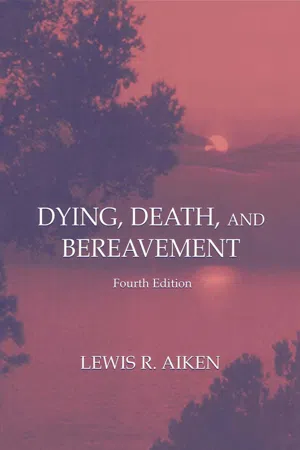
This book is a brief but comprehensive survey of research, writings, and professional practices concerned with death and dying. It is interdisciplinary and eclectic--medical, psychological, religious, philosophical, artistic, demographics, bereavement, and widowhood are all considered--but with an emphasis on psychological aspects. A variety of viewpoints and research findings on topics subsumed under "thanatology" receive thorough consideration. Questions, activities, and projects at the end of each chapter enhance reflection and personalize the material.
This fourth edition features material on:
* moral issues and court cases concerned with abortion and euthanasia;
* the widespread problem of AIDS and other deadly diseases;
* the tragedies occasioned by epidemics, starvation, and war; and
* the resumption of capital punishment in many states.
The book's enhanced multicultural tone reflects the increased economic, social, and physical interdependency among the nations of the world.
Topics receiving increased attention in the fourth edition are: terror management; attitudes and practices concerning death; cross-cultural concepts of afterlife; gallows humor, out-of-body experiences; spiritualism; mass suicide; pet and romantic death; euthanasia; right to die; postbereavement depression; firearm deaths in children; children's understanding of death; child, adolescent, adult, and physician-assisted suicide; religious customs and death; confronting death; legal issues in death, dying and bereavement; death education; death music; creativity and death; longevity; broken heart phenomenon; beliefs in life after death; new definitions of death; children's acceptance of a parent's death; terminal illness; and the politics of death and dying.
- 408 pages
- English
- ePUB (mobile friendly)
- Available on iOS & Android
eBook - ePub
Dying, Death, and Bereavement
About this book
Information
PART I
INTRODUCTION
1
Mortality and Thanatology
TOPICAL OUTLINE OF THE CHAPTER:
Denial and acceptance of death
Familiarity with death
Denial of death
Definitions and determination of death
Multiple meanings of death
Determination of death
Traditional indicators of death
Contemporary indicators of death
Demography, death rate, and life expectancy
Demography
Life expectancy
Time and death
Place and death
Age and Other individual differences
Age and cause of death
Gender differences
Ethnic group differences
Socioeconomic status
Marital status
Social support
Public and professional interest in thanatology
Events promoting an interest in thanatology
Organizations concerned with death, dying, and survival
Research on death and dying
QUESTIONS DEALT WITH IN THE CHAPTER:
- How familiar are people with death, and why do so many of them deny its inevitability?
- How is death defined and determined?
- What are the causes of death and how common is each?
- What are the various meanings of death rate, and how are they used?
- How do rates and causes of death differ for different demographic groups?
- How is the factor of social support related to mortality?
- Why has public and professional interest in death and dying increased during the past few decades?
- What professions and organizations are concerned with the topic of death and dying and in what activities are they engaged?
- What methods are used in conducting research on death and dying, and where and by whom is it done?
Death eventually comes to everyone—poet and peasant, saint and sinner, the wise and the foolish. It is a fate that people share not only with each other but with all living things. The inevitability of death and the shortness of life have been expressed frequently in anonymous folklore, for example:
Doctor, Doctor shall I die,
Yes my child, and so shall I,
Yes my child, and so shall I,
as well as in literature:
No man can be ignorant that he must die,
nor be sure that he may not this very day.
nor be sure that he may not this very day.
(Cicero, De Finibus Bonorum et Malorum, 45 BC, VII, 28, 176)
Art is long, and Time is fleeting,
And our hearts, though stout and brave,
Still, like muffled drums, are beating
Funeral marches to the grave.
And our hearts, though stout and brave,
Still, like muffled drums, are beating
Funeral marches to the grave.
(Henry Wadsworth Longfellow, in Canby, 1947, p. 302)
Depressing though these sentiments may appear, they emphasize the certainty of death, and consequently the importance of not squandering the time one has on earth. Sooner or later, everyone must face his or her own vulnerability and the inevitability of death. Distraction and denial may postpone the realization and acceptance of the inevitable, but no matter how physically fit or informed one may be, that day will surely come.
DENIAL AND ACCEPTANCE OF DEATH
Humans are presumably the only living creatures who realize that they will die some day. How do they cope with this knowledge? How does it shape their attitudes, beliefs, and actions?
Attitudes toward death are not completely positive or negative; rather, they are on a continuum. At one end of the continuum is the perception of death as humanity’s mortal enemy, a fearsome Grim Reaper armed with a scythe for harvesting lives. Shaped by this perception is the idea of death as a mortal enemy that must be energetically combated with whatever heroic measures are necessary and available. Some religions and medical science have promoted the idea of death as an enemy, an enemy that is ultimately victorious but that can be avoided for a while if one is alert, capable, and persistent. As seen in the biblical query “Grave where is thy victory? Death where is thy sting?”, death need not be permanent if one believes in an afterlife.
At the other end of the attitude-toward-death continuum is accepting and even welcoming death as a passage to a more blissful state of being. Such an attitude allows the dying person, who is “sustained and soothed by an unfaltering trust” to “approach thy grave like one who wraps the drapery of his couch about him and lies down to pleasant dreams.” (Thanatopsis, Bryant) Somewhere in the middle of the attitude-toward-death continuum, and perhaps characteristic of most people, is a feeling of mystery or bewilderment in the face of death, as Shakespeare’s Hamlet describes it: “the undiscovered country from whose bourne no traveler returns.”
Such a realm may be considered beyond human experience, a place of uncertain character that cannot be described in words.
Familiarity With Death
To a great extent, fear and acceptance of death vary with its familiarity. Such familiarity with death does not necessarily breed contempt for it, but it can promote a kind of anesthesia and lead to other ways of coping.
During the Middle Ages and the Renaissance, death and dying were more visible in the Western world than they are today. Publicly viewed executions, mortal skirmishes involving ordinary people, and mass epidemics that claimed the lives of thousands were common occurrences before the 19th century. No one knew when death might strike or even if it might happen before the day was over. It has been estimated, for example, that the Black Plague killed approximately 25% of the population of Europe during the 14th century. And travelers to 16th-century London might very well have been greeted by the sight of severed human heads displayed on London Bridge.
Prior to the 19th century, dying people frequently organized rituals in their own bedrooms. These rituals were attended by family members, physicians, priests, and perhaps legal representatives clustered around the bedside of the dying person. During these rituals, which could last for days, grief was expressed, and personal, religious, and legal matters were discussed. This encouraged dying persons to put their worldly affairs in order so they could then die in peace with the knowledge that their last wishes would be honored. During the 1800s, deathbed rituals were largely replaced by postmortem rituals, and by the middle of the 20th century even these postmortem activities had been minimized (Aries, 1974). A typical funeral in the United States at the end of the 20th century was a rather cut-and-dried affair, often noted more for its efficiency than for its ritualism or expression of grief for the dear departed. In addition, because most people now die in institutions rather than at home or in public, personally witnessed death has become an uncommon event in many Western countries.
Denial of Death
The decline of public dying and death during the 20th century not only reflects but also promotes the denial of death. Attempts to deny the reality of death, however, have not been completely successful. People today may not think much about death, but they are clearly aware of it. How could it be otherwise with the constant barrage of pictures, reports, and stories of violence, disease, and deterioration vividly displayed and portrayed in the media? Millions of deaths during the 20th century have been caused by war, which was viewed in previous times as a noble, glorious, and even romantic human enterprise. But two world wars, the Korean War, the Vietnam War, and various “operations” and regional conflicts throughout the world have dampened public enthusiasm for war and dimmed the perception of it as a heroic and glorious enterprise.
Graphic depictions of violent death on television and in motion pictures have horrified some people but anesthetized many others to the reality of dying. Furthermore, the viewer can simply turn off the set, leave the theater, or toss away the newspaper or magazine when the pictures become too disturbing. Without dwelling on these second-hand experiences with death, or even thinking about them at all, one can maintain the illusion of personal invulnerability and even exemption from the curse of mortality. Death becomes something that happens to others but not to oneself, at least not for a very long time. It is a subject that can be thought about tomorrow without spoiling today. Sigmund Freud’s assertion that no one can truly imagine his or her own death is not even an issue for the chronic denier of death: He or she simply never tries to imagine it.
Understanding what it will be like when one is no longer living is particularly difficult for young children. There is a story about a 3-year-old boy who asked his parents if he could be alone for a while with his newborn baby brother. The parents were puzzled but finally agreed. They were startled and somewhat amused to overhear the little boy, on approaching the crib, ask the baby: “What’s heaven like? I don’t remember; it’s been so long!”
Adolescents comprehend death better than children, but to a typical teenager it is still a distant and perhaps dreamy, romanticized event. Recently, however, murders and associated threats of violence in high schools throughout the country, air disasters in which hundreds of people and celebrities are killed, and other deadly events featured on television have made adolescents more aware of the reality of death and, to many, its personal nature. Of course, the reality and imminence of death become clearer as one ages and experiences the demise of friends and relatives. Then it is more difficult to maintain the illusion of personal invulnerability and invincibility.
The tendency to deny or overlook death does not keep it from occurring. It has been estimated that well over 100 million deaths during the 20th century resulted from unnatural causes. At least 50 million deaths occurred from violent acts and more than 60 million from starvation and deprivation. In fact, every year over 50 million people throughout the world, over 2 million of whom are residents of the United States, die from all causes (Hoyert, Kochanek, & Murphy, 1999; Population Reference Bureau, 1999).
DEFINITIONS AND DETERMINATION OF DEATH
Most people tend to think of death as a unique event, but there are many definitions of the term. According to the dictionary, death is “the act of dying; the end of life; the total and permanent cessation of all the vital functions of an organism This definition is closest in meaning to biological death, the irreversible breakdown of respiration in an organism and the consequent loss of the ability to use oxygen. When respiration and heartbeat cease, oxygen is no longer inhaled and diffused by the lungs into the blood; when the heart fails, the flow of oxygenated blood through the blood vessels stops.
When the body dies, cells in the higher brain centers, which are very susceptible to oxygen deprivation, die first. This usually occurs within 5 to 10 min after the supply of oxygen is cut off. Next to die are cells in the lower brain centers, including those in the medulla oblongata, which is the regulator of respiration, heartbeat, and other vital reflexes.
Thus, the death of a person does not occur all at once. Certain body structures, such as the thymus gland, deteriorate before the individual is fully mature. Old cells are constantly dying and being replaced by new cells, even before a person is born. The buildup and breakdown of body cells and structures, known as anabolism and catabolism, respectively, are complementary metabolic processes. As a person ages, the breakdown rate begins to exceed the buildup rate, a point reached earlier in some body structures than others.
Cessation of heartbeat is a natural result of brain death, but the brain is not necessarily dead when the heart stops. In fact, the pumping action of a stopped heart can be restored before the vital centers of the brain are affected. Restoration of the heartbeat by electric shock (countershock) is a common procedure in modern hospitals. Unfortunately, when the heart has stopped beating for too long or for other reasons the blood supply to the brain has been interrupted, the higher brain cells are deprived of oxygen and their functioning is disrupted. As a consequence, the sensorimotor and cognitive skills of the person may deteriorate to some extent.
The cells of certain glands and muscles die only after the medulla has stopped functioning, but cutaneous and bone cells may remain viable for some time, depending on temperature, level of functioning of the cell, and nutrient requirements. However, the apparent ability of the hair and nails to continue growing after the person has died is probably due to the settling of body fluids, the loss of fluid from the cells, the atrophying of tissues, and the retraction of those tissues from the hair and nails that were already there. The combined effect of these processes is to cause the hair and nails to protrude through the tissue as if they have grown when they actually have not. Nevertheless, certain body processes, such as the conversion of glycogen to glucose by the liver and the digestive actions of intestinal tissues, have been observed after the person has been pronounced clinically dead. In fact, by being placed in a special chemical solution or freezing them, some body tissues can stay alive for years after the donor has died.
Multiple Meanings of Death
Biological death is the most common meaning of the term death, but psychological death, social death, legal death, civil death, spiritual death, and certain other kinds of death have also been described. A person is said to be psychologically dead when his or her mind (the seat of conscious experiencing and knowing) ceases to function. This could happen in a severe brain disorder or in an extreme case of mental illness. A person is socially dead when other people act as if he or she were dead. An example of the distinction between biological, psychological, and social death is seen in catatonic stupor, an extreme form of withdrawal in which a person becomes immobile and unresponsive. On coming out of the stuporous state, a catatonic patient often reports that, while in that state, he or she had been aware of remarks and other events occurring in the immediate environment but simply could not react to them. It was as if the patient were paralyzed or restrained yet wide awake. During this condition, the patient was biologically and perhaps psychologically alive, but was treated by others as if he or she were not present or as dead (socially dead). Furthermore, a person may be biologically dead and yet be talked about as if he or she were socially alive. For example, many people continue to talk to (and even argue with!) a friend or relative who has long been biologically dead and yet continues to exist in the mind of the speaker. Rather than reacting to the actual presence of the deceased, the speaker is responding to an internal representation (an introject) of the person.
The idea of legal death refers to a judgment by a legal authority that a person is dead and therefore that his or her possessions may be distributed by the survivors or beneficiaries. In such instances, the individual may or may not be biologically dead, as when a person who is missing in combat ...
Table of contents
- Cover Page
- Title Page
- Copyright Page
- Preface
- Part I Introduction
- Part II Causes and Circumstances of Death
- Part III Cultural Beliefs and Customs
- Part IV Human Development and Death
- Part V Dying and Surviving
- Appendix A
- Appendix B
- Appendix C
- Appendix D
- Appendix E
- Glossary
- References
Trusted by 375,005 students
Access to over 1.5 million titles for a fair monthly price.
Study more efficiently using our study tools.
Frequently asked questions
Yes, you can cancel anytime from the Subscription tab in your account settings on the Perlego website. Your subscription will stay active until the end of your current billing period. Learn how to cancel your subscription
No, books cannot be downloaded as external files, such as PDFs, for use outside of Perlego. However, you can download books within the Perlego app for offline reading on mobile or tablet. Learn how to download books offline
Perlego offers two plans: Essential and Complete
- Essential is ideal for learners and professionals who enjoy exploring a wide range of subjects. Access the Essential Library with 800,000+ trusted titles and best-sellers across business, personal growth, and the humanities. Includes unlimited reading time and Standard Read Aloud voice.
- Complete: Perfect for advanced learners and researchers needing full, unrestricted access. Unlock 1.5M+ books across hundreds of subjects, including academic and specialized titles. The Complete Plan also includes advanced features like Premium Read Aloud and Research Assistant.
We are an online textbook subscription service, where you can get access to an entire online library for less than the price of a single book per month. With over 1.5 million books across 990+ topics, we’ve got you covered! Learn about our mission
Look out for the read-aloud symbol on your next book to see if you can listen to it. The read-aloud tool reads text aloud for you, highlighting the text as it is being read. You can pause it, speed it up and slow it down. Learn more about Read Aloud
Yes! You can use the Perlego app on both iOS and Android devices to read anytime, anywhere — even offline. Perfect for commutes or when you’re on the go.
Please note we cannot support devices running on iOS 13 and Android 7 or earlier. Learn more about using the app
Please note we cannot support devices running on iOS 13 and Android 7 or earlier. Learn more about using the app
Yes, you can access Dying, Death, and Bereavement by Lewis R. Aiken in PDF and/or ePUB format, as well as other popular books in Psychology & Social Psychology. We have over 1.5 million books available in our catalogue for you to explore.