CODING MANUAL INFORMATION IS AVAILABLE FROM THE CHAPTER AUTHORS, AND THEIR E-MAIL ADDRESSES CAN BE FOUND ON PAGE XV OF THE BOOK.
Family studies is an area that has enjoyed the benefits of conceptual and methodological advances in recent years including the widespread adoption of observational research techniques. The selection of an appropriate coding system is critical to achieving a better understanding of the complex family processes related to normative and pathological development.
This book presents 14 examples of family observational coding systems, chosen for the wide range of constructs and phenomena they capture. Each system is described in detail, and excerpts from the coding manual are presented (links to the full coding manuals are available to purchasers of the book at LEA's Web site, www.erlbaum.com). Each chapter follows a consistent outline, so that the different coding systems can be more easily compared to one another. They include the theoretical underpinnings of the measure, its reliability and validity, the coding process, strategies for coder training, and examples of studies in which it has been used. This volume will prove invaluable to students and researchers in family studies, clinicians, and other practitioners who need to interpret data from family observations.
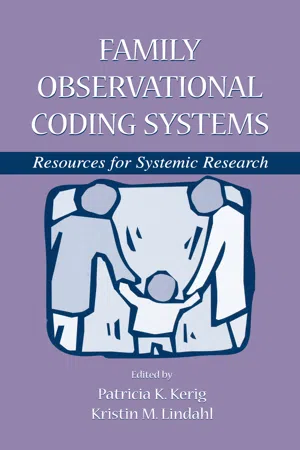
eBook - ePub
Family Observational Coding Systems
Resources for Systemic Research
- 340 pages
- English
- ePUB (mobile friendly)
- Available on iOS & Android
eBook - ePub
Family Observational Coding Systems
Resources for Systemic Research
About this book
Information
Table of contents
- Contents
- Preface
- List of Contributors
- 1 Introduction and Overview: Conceptual Issues in Family Observational Research
- 2 Methodological Issues in Family Observational Research
- 3 The Iowa Family Interaction Rating Scales: Instrument Summary
- 4 Assessing Families With the Family Problem Solving Code
- 5 The System for Coding Interactions and Family Functioning
- 6 Coding the Social Dimensions of Parent-Toddler Play From a Vertical/Horizontal Perspective
- 7 The Family Coding System: Studying the Relation Between Marital Conflict and Family Interaction
- 8 The Structural Analysis of Social Behavior Observational Coding Scheme
- 9 Evaluating Coparenting and Family-Level Dynamics During Infancy and Early Childhood: The Coparenting and Family Rating System
- 10 Measuring Parent-Child Mutuality During Play
- 11 The Social Events System: Creating and Coding Focused Narrative Records of Family Interaction
- 12 Assessing Changes in Family Interaction: The Structural Family Systems Ratings
- 13 Meso-Analytic Behavioral Rating System for Family Interactions: Observing Play and Forced-Compliance Tasks With Young Children
- 14 Measuring Triadic Coordination in Mother-Father-Child Interactions
- 15 Observing Families Through the Stories That They Tell: A Multidimensional Approach
- 16 The Young Family Interaction Coding System
- Author Index
- Subject Index
Trusted by 375,005 students
Access to over 1.5 million titles for a fair monthly price.
Study more efficiently using our study tools.
Frequently asked questions
Yes, you can cancel anytime from the Subscription tab in your account settings on the Perlego website. Your subscription will stay active until the end of your current billing period. Learn how to cancel your subscription
No, books cannot be downloaded as external files, such as PDFs, for use outside of Perlego. However, you can download books within the Perlego app for offline reading on mobile or tablet. Learn how to download books offline
Perlego offers two plans: Essential and Complete
- Essential is ideal for learners and professionals who enjoy exploring a wide range of subjects. Access the Essential Library with 800,000+ trusted titles and best-sellers across business, personal growth, and the humanities. Includes unlimited reading time and Standard Read Aloud voice.
- Complete: Perfect for advanced learners and researchers needing full, unrestricted access. Unlock 1.5M+ books across hundreds of subjects, including academic and specialized titles. The Complete Plan also includes advanced features like Premium Read Aloud and Research Assistant.
We are an online textbook subscription service, where you can get access to an entire online library for less than the price of a single book per month. With over 1.5 million books across 990+ topics, we’ve got you covered! Learn about our mission
Look out for the read-aloud symbol on your next book to see if you can listen to it. The read-aloud tool reads text aloud for you, highlighting the text as it is being read. You can pause it, speed it up and slow it down. Learn more about Read Aloud
Yes! You can use the Perlego app on both iOS and Android devices to read anytime, anywhere — even offline. Perfect for commutes or when you’re on the go.
Please note we cannot support devices running on iOS 13 and Android 7 or earlier. Learn more about using the app
Please note we cannot support devices running on iOS 13 and Android 7 or earlier. Learn more about using the app
Yes, you can access Family Observational Coding Systems by Patricia K. Kerig, Kristin M. Lindahl, Patricia K. Kerig,Kristin M. Lindahl in PDF and/or ePUB format, as well as other popular books in Psychology & Developmental Psychology. We have over 1.5 million books available in our catalogue for you to explore.