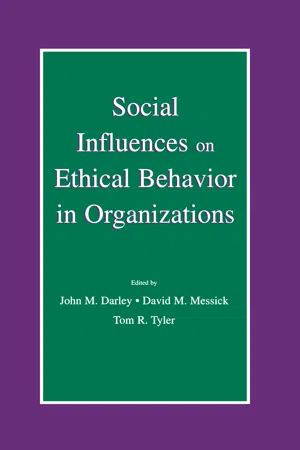
For too long, organizational scientists have not adequately attended to the problems of unethical behavior in organizations. This collection of essays provides the stimulus needed to help move the study of unethical behavior to center stage in the organizational sciences. It does so by posing provocative questions that not only entail a concern for understanding unethical behavior but that also strike at the very core of how and why organizations function as they do. The book addresses:
* the asymmetries in power and influence created by hierarchies that give rise to ethical problems;
* the tactics that might reduce the effectiveness of improper influence attempts; and
* how the inappropriate use of influence diffuses, for example, through a market.
eBook - ePub
Social Influences on Ethical Behavior in Organizations
- 256 pages
- English
- ePUB (mobile friendly)
- Available on iOS & Android
eBook - ePub
Social Influences on Ethical Behavior in Organizations
About this book
Information
Publisher
Psychology PressYear
2001Print ISBN
9780415651776
9780805833300
Edition
1eBook ISBN
9781135667320
1
Introduction: Social Influence and Ethics in Organizations
John M.Darley
Princeton University
Princeton University
David M.Messick
Northwestern University
Northwestern University
Tom R.Tyler
New York University
New York University
How do executives shape the behavior and beliefs of employees in their organizations? What are the ethical constraints on this form of influence? What obligations do employees have to their employers, and what types of conflicts, moral and otherwise, are employees confronted with when they feel that the orders they have received are unethical? How do ethical norms emerge from and govern markets, groups, and networks?
These were some of the questions about the ethical dimensions of social influence in organizations that were discussed at a conference entitled “Ethics and Social Influence” held at the Kellogg Graduate School of Management of Northwestern University. Participants included social psychologists, sociologists, organizational theorists, communication specialists, business ethicists, and lawyers. The central issue addressed by this interdisciplinary group of scholars was the analysis of appropriate and inappropriate forms of social influence in organizations and groups. This issue was considered key in understanding such organizational phenomena as trust, cooperation, deference to authority, and moral courage to oppose wrongdoing. This volume presents chapters based on the conference presentations and written by the conference participants. The chapters continue the themes of the conference report, drafted to include input from the conference discussions and from editorial reviews.
The chapters of this book fall into three categories. Part I deals with influence in hierarchical relationships in places such as organizations. These hierarchies create asymmetries in power and influence that raise many psychological and ethical problems. Some types of influence (e.g., coercion) require differential power, whereas other types (e.g., persuasion) can occur among organizational equals. Communications from superiors to subordinates may differ systematically from communications among equals. People who create the procedures by means of which others will be evaluated may be suspected of manipulating the procedures for their own benefit. In other words, hierarchies create the context in which ethical, unethical, and morally ambiguous influence strategies are found.
The targets of influence attempts may be less skillful, powerful, or sophisticated in the use of influence than those who wield it. Nonetheless, these targets of influence may sometimes become suspicious of the morality of efforts to shape their beliefs and behavior. In Part II of this book, several authors explicitly address tactics that can be employed to reduce the effectiveness of improper influence attempts. These efforts can be either organizational, as in whistle-blowing, or individual, as in personally resisting influence.
Not all influence occurs in hierarchical organizations. People are influenced by reference groups, by market processes, by competitors, and by friends and neighbors. How appropriate and inappropriate influence spreads through these systems is a topic of great interest and complexity. In negotiations, is it wrong for a party with more power to use this power when negotiating with a less powerful party? When might this be unethical? How will ethical strategies fare in a competition with unethical ones? Is there a “market” for moral ideas? The chapters in Part III discuss some of these issues.
SOCIAL INFLUENCE IN HIERARCHIES
Chapter 2. Ethical Limits on the Use of Influence in Hierarchical Relationships
Herbert C. Kelman
By definition, in a hierarchical relationship, the superior is entitled to exert influence on the subordinate, and the subordinate is obligated to accept the superior’s influence. Ethical use of influence, however, presupposes certain intraorganizational and extraorganizational limits on the demands and requests that the superior is entitled to make and the subordinate is expected (or, at times, in fact permitted) to carry out. Intraorganizational limits to be discussed include (a) the definition of the domain within which the superiors can exert influence, (b) norms about the influence tactics that are deemed appropriate in the superior-subordinate relationship, and (c) the availability of mechanisms for recourse in cases of disagreement about expectations and abuses of power. Extraorganizational limits refer to the applicability of general principles of ethical conduct, whatever the particular organizational context may be. Thus, this chapter argues that (a) forms of influence that violate the norms of ethical conduct in the society at large are unacceptable in any given organization, and (b) the positive duty to promote the welfare of those with whom we interact applies to the hierarchical relationships within organizations as much as it does to other human relationships.
Chapter 3. Toward a More Deontological Approach to the Ethical Use of Social Influence
Randall S.Peterson
Scholars have long been concerned about the ethical implications of the use of social influence by leaders of groups, organizations, and nations. The concern has focused almost entirely on the direct social influence of leaders trying to sway followers. A 50-year stream of research implicates directive leadership as the cause of defective group interaction, poor information processing, and disastrous (often unethical) group decisions. This chapter argues that those results are actually the cause of process directiveness (i.e., the methods a leader uses to regulate the process by which the group makes a decision) rather than outcome directiveness (i.e., the degree to which a leader advocates a favored solution).
Following from this argument, it is suggested that leaders have strong ethical influence on their organizations via the decision-making processes that they employ (a deontological perspective). This chapter reviews social influence research through that process-oriented lens and suggests an agenda for future research.
Chapter 4. The Dynamics of Authority in Organizations and the Unintended Action Consequences
John M.Darley
There are two kinds of actions that an honest corporation wishes not to produce in its members: actions that are not in the best interests of the organization, and actions that are immoral, such as lying, cheating, claiming credit for others’ work, and so on. But often, taking those actions might benefit the individual, at least in the short term. How can the organization prevent individuals from taking those actions, and what does the organization inadvertently do to make those actions more likely? In organizations, authority is legitimate, often expert, and empowered to fulfill a coordinating function in which the authority figure coordinates the actions of the organizational subordinates. As a result, authority possesses great power.
Furthermore, organizations create “incentive systems” to reward workers for achieving actions that bring about organizationally desired outcomes. But, of course, some actions that have a short-term benefit (e.g., achieving high sales during a quarterly reporting period and thus earning the sales force a bonus) may be taken in ways that eventually damage the organization. The organization expects that employees’ moral standards coupled perhaps with corporate codes of conduct will be sufficient to keep employees from “taking advantage” of the system in these ways. However, in practice, the employees may not realize that these sorts of actions are not in the best interests of the corporation. That these actions carry incentives may communicate to the employees that the organization regards the actions as legitimate. Even when employees realize that certain incentivized actions produce morally bad outcomes, the fact that they see other employees taking these actions and receiving rewards for doing so creates a climate in which it is difficult for the disadvantaged employees to behave morally.
In this way, a corporate code of conflict that is not integrated with the incentive system of the organization may gradually lose its force, causing the corporate subordinates to behave in ways which, although the hierarchy may be unaware of these behaviors, are destructive to the organization’s reputation and eventually its survival.
Chapter 5. Confronting Organizational Transgressions
Michael E.Roloff and Gaylen D.Paulson
Witnesses of rule infractions often do not choose to confront the transgressor or to report the observed infraction, and much research has been done to determine the conditions under which such whistle-blowing might occur. Individuals most vulnerable to retaliation are least likely to engage in whistle-blowing, especially when an individual acts in a subordinate role to the transgressor. The nature of the authority structure undermines the desire or ability to report infractions, even in cases when a subordinate may be held culpable for the ethical lapse. This chapter examines the relational and linguistic factors that may impact organizational influence. Influence is exerted when the recipient of a directive desires some response or reward from a superior and when noncompliance would result in punitive measures. Directives can be very direct, such as an explicit imperative coupled with a threat of retribution for noncompliance. Although this eliminates misunderstandings, the culpability for that directive rests directly on the superior. Given the downside of clear culpability for ethical infractions, authority figures may resort to implicit directives, such as hints, suggestions, or other means to mollify an instruction to bend or break ethical codes. Often, threats are not needed in such directives, for implicit in any suggestion by an authority figure is the possibility of retaliation for noncompliance. The chapter examines the coercive potential of such interaction and the role of communication in both direct and indirect imperatives. Additionally, just as unethical directives may be indirect, resistance to such directives also may be achieved by indirect means. Such measures include procrastination, partial complicity, or avoidance. Although much research has been done on direct resistance to unethical imperatives, this chapter examines hidden or passive means of resistance.
Chapter 6. Procedural Strategies for Gaining Deference: Increasing Social Harmony or Creating False Consciousness?
Tom R.Tyler
Recent studies conducted within political, legal, and managerial organizations suggest that authorities can gain deference for their decisions by making those decisions in ways that people will judge to be fair. Furthermore, an important component of procedural fairness involves treating people with dignity and respect, rather than giving them fair or favorable outcomes. Thibaut and Walker originally encouraged the study of procedural justice because they felt it suggested a way for authorities to bridge differences in interests within conflict situations and create decisions th...
Table of contents
- LEA’s Organization and Management Series
- Contents
- Series Editors’ Foreword
- 1 Introduction: Social Influence and Ethics in Organizations
- I Social Influence in Hierarchies
- II Awareness of and Resistance to Social Influence
- II Social Influence in Groups, Networks, and Markets
- Author Index
- Subject Index
Trusted by 375,005 students
Access to over 1.5 million titles for a fair monthly price.
Study more efficiently using our study tools.
Frequently asked questions
Yes, you can cancel anytime from the Subscription tab in your account settings on the Perlego website. Your subscription will stay active until the end of your current billing period. Learn how to cancel your subscription
No, books cannot be downloaded as external files, such as PDFs, for use outside of Perlego. However, you can download books within the Perlego app for offline reading on mobile or tablet. Learn how to download books offline
Perlego offers two plans: Essential and Complete
- Essential is ideal for learners and professionals who enjoy exploring a wide range of subjects. Access the Essential Library with 800,000+ trusted titles and best-sellers across business, personal growth, and the humanities. Includes unlimited reading time and Standard Read Aloud voice.
- Complete: Perfect for advanced learners and researchers needing full, unrestricted access. Unlock 1.5M+ books across hundreds of subjects, including academic and specialized titles. The Complete Plan also includes advanced features like Premium Read Aloud and Research Assistant.
We are an online textbook subscription service, where you can get access to an entire online library for less than the price of a single book per month. With over 1.5 million books across 990+ topics, we’ve got you covered! Learn about our mission
Look out for the read-aloud symbol on your next book to see if you can listen to it. The read-aloud tool reads text aloud for you, highlighting the text as it is being read. You can pause it, speed it up and slow it down. Learn more about Read Aloud
Yes! You can use the Perlego app on both iOS and Android devices to read anytime, anywhere — even offline. Perfect for commutes or when you’re on the go.
Please note we cannot support devices running on iOS 13 and Android 7 or earlier. Learn more about using the app
Please note we cannot support devices running on iOS 13 and Android 7 or earlier. Learn more about using the app
Yes, you can access Social Influences on Ethical Behavior in Organizations by John M. Darley, David M. Messick, Tom R. Tyler, John M. Darley,David M. Messick,Tom R. Tyler in PDF and/or ePUB format, as well as other popular books in Business & Management. We have over 1.5 million books available in our catalogue for you to explore.