This book assembles 11 of the leading thinkers and researchers in the field of family psychology to create a compendium summarizing both what psychology researchers have learned about the family and where the field should be going next. It evolved after the volume's contributors met with other distinguished family scholars to discuss family influences on child development and to ponder how this knowledge could be used to benefit families and children.
This volume includes approaches to the family that feature multiple levels and topics of focal interest to benefit anyone interested in the family. Central topics include mothering, fathering, marriages, family group processes, sibling relations, and families as systems. In addition, three senior authors offer road maps to detect, and suggest (a) challenges in research on parenting, (b) marital and family dynamics, and (c) family systems in the years ahead. In keeping with the theme of how research affects the lives of families outside the university lab settings, this volume includes a chapter on the interface between family research and law. This book closes with a "big picture" analysis and critique of what is known and not known. Psychologists, anthropologists, sociologists, and public policymakers interested in the family should especially find this volume of interest.
eBook - ePub
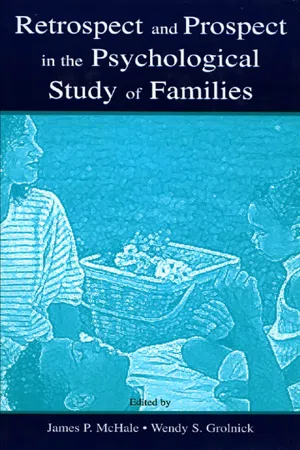
Retrospect and Prospect in the Psychological Study of Families
- 400 pages
- English
- ePUB (mobile friendly)
- Available on iOS & Android
eBook - ePub
Retrospect and Prospect in the Psychological Study of Families
About this book
Information
PART I
RETROSPECT AND PROSPECT IN THE PSYCHOLOGICAL STUDY OF PARENTING
CHAPTER 1
Mothering: Retrospect and Prospect
Wendy S.Grolnick
Suzanne T.Gurland
Clark University
Suzanne T.Gurland
Clark University
In this volume of works on the family, it seems apt to begin with a chapter on mothers. In the history of research on the family, for better or worse, the mother was the first and primary target of focus. To be sure, mothers are multifaceted and play multiple roles—they are women, partners, breadwinners, and caretakers, among other things, and much feminist writing has been devoted to how mothers manage their multiple roles and identities (e.g., Reddy, Roth, & Sheldon, 1994). In this chapter we keep within the spirit of the volume and focus on mothers as parents, highlighting how mothers parent their children. In doing so, we attempt to address questions such as: What do we know about “effective” mothering? What is the state of mothering today?
RETROSPECT IN THE STUDY OF MOTHERING
In thinking about the history of research on mothering, we were struck by the paradox of two historical trends. The first was the ubiquitous emphasis on mothers in the clinical and early developmental literatures. It was all about mothers. Mothers were the cause of all of children’s problems.
The second trend, paradoxically, was the virtual absence of mothers from the parenting literature because parenting had become synonymous with mothering. Much of the “parenting” research from the 1930s to the 1970s actually involved only mothers. In this literature, however, mothers were “invisible” because they were the standard backdrop against which other caretakers were measured. Scarr (1998) pointed out that the history of child care is one in which special notice was granted only to caregivers other than the child’s mother.
We start with the early work focusing exclusively on mothers as the source of children’s problems. Although mother blaming began earlier than the birth of psychoanalysis, Freud’s theory of neurosis, emphasizing the mother’s frustration of her children’s instincts, began a systematic blaming of the mother. The associated work of Spitz (1950) and Bowlby (1944, 1951) in early institutions continued the focus on mothers, this time stressing the importance of her physical presence. During and after World Wars I and II, many children were orphaned. These children were placed in orphanages that met the children’s physical, nutritional, and medical needs, but, of course, they did not include a mother. In addition, to quell the epidemic of tuberculosis, authorities took effected children from their parents and placed them in isolation sanitariums. Though the institutions were well intentioned, the children raised there showed severe psychological dysfunction and an inordinate number became physically ill and died. Bowlby (1944) reported that these terrible consequences were the result of their mothers’ absence and coined the “maternal deprivation” hypothesis. In his article, “Maternal Care and Mental Health,” Bowlby (1951) extended this work to all forms of mother-child separation. Later accounts of institutional effects, of course, pointed out that children were not only without mothers, but also without any social stimulation or love (Rutter, 1972). Yet, at the time, mothers’ absence alone was viewed as the cause of the negative outcomes experienced by these children. In other work conducted around the same time, theorists argued that schizophrenic individuals had been adversely affected during their early childhoods by damaging relationships with their mothers. Fromm-Reichmann (1949) theorized about “schizophrenogenic mothers” whose parenting characteristics were thought to induce later schizophrenia in their children. During the 1940s and 1950s mother blaming was a clear and dominant trend.
Later empirical work continued the focus on mothers using biological models. Early models of mother-child attachment, for example, focused on the importance of early bonds between mothers and their children. Klaus and Kennell (1976) used the animal model of imprinting as a basis for a theory of mother-child bonding. In this theory, the mother forms a bond to her child during a limited time after the child’s birth. Presumably, this is a bio logical process related to the hormonal state of the mother. The experience in the first hours after birth, and whether this bond is formed, were said to have long-lasting effects on the child. For example, Klaus and Kennell compared mothers given early and extended contact with their newborns during the first few days with those who received “routine” hospital care. These authors reported that mothers in the extended-contact group soothed their infants more, and displayed more eye contact and fondling of the infant than mothers in the routine-care group, and that differences between the groups persisted up to one year. Later studies using appropriate controls, however, found no differences between groups receiving extended care versus routine care (Svejda, Campos, & Emde, 1980).
The early studies focusing on the exclusive and direct role of mothers in determining outcomes for children were not without positive consequences. Spitz (1950) and Bowlby’s (1951) work on institutions was pivotal in institutional reform. The bonding literature resulted in new hospital pro cedures in which mothers are typically given opportunities for extensive contact with their infants, and childbirth is viewed as a normal, healthy human experience (Goldberg, 1983). However, the early work also led to a distorted view of the sanctity of mothers’ presence and to guilt about her absence. Mothers who miss opportunities to be with their children at birth (e.g., parents of premature infants) may feel their ability to care for their infants will be impaired. Mothers who are employed may get the message that they are damaging their children. Fathers get the message that they are peripheral (cf. Silverstein, chap. 2, this volume).
Although we think of mother blaming as a thing of the past, Caplan and Hall-McCorquodale (1985) argued that it persists, albeit in more subtle ways, in the clinical literature. In their quantitative study of mother blaming in nine major clinical journals, Caplan and Hall-McCorquodale found that mothers were held responsible for 72 child disorders whereas fathers were held responsible for none. Their compelling illustrations include case studies in which fathers were described using neutral or positive characteristics (e.g., age and occupation) whereas mothers were described using negative characteristics (e.g., poor emotional functioning). One case study mentioned a father’s abuse and alcoholism briefly, yet blamed the child’s problems on the mother’s overprotection.
Why does mother blaming persist? It cannot be accounted for by issues such as greater recruitment of mothers into studies or actual relations between risk of psychopathology for children of disturbed mothers versus disturbed fathers, which tend to be equal (Phares & Compas, 1992). Furthermore, it is not that mothers are held accountable for all of children’s behavior, as there is some evidence that mothers and fathers are held equally responsible for children’s positive behavior (Phares, 1993). A more contextual explanation is required. Ruddick (1980) suggested mother blaming is a result of the power differential between men and women: “Almost everywhere the practices of mothering take place in societies in which women of all classes are less able than men of their class to determine the conditions in which their children grow. Throughout history, most women have mothered in conditions of military and social violence, as well as economic deprivation, governed by men whose policies they could neither shape nor control” (p. 355). Such circumstances silence mothers and make them easy scapegoats when their children misbehave or develop various forms of psychopathology.
Mother blaming, then, has been a dominant and pervasive trend that, despite spawning a few positive institutional reforms along the way, has primarily placed undue culpability on mothers for children’s negative outcomes. What is more, the trend has persisted in less explicit ways in contemporary research, undeterred by empirical data pointing to the inadequacy of “maternal deprivation” or other mother-blaming theories in explaining child outcomes. For researchers aiming to remedy this state of affairs, however, there is the danger of yet another extremist position: the “invisible mother” problem alluded to earlier.
In attempting to shift the focus away from mothers as exclusively responsible for their children’s psychological distress or well-being, researchers are tempted to treat mothers and fathers as interchangeable and to obscure the unique circumstances in which mothers parent. On the other hand, to take a non-mother-blaming view is to recognize the similarities between mothers and fathers. Both, after all, are parents attempting to meet their children’s needs, and we should therefore expect continuity across the mothering and fathering styles that are best for children. Radin (1981), for example, suggested that it is fathers’ warmth, and not their masculinity, that predicts children’s levels of competence, achievement, and sex-role identity. Thus, our aim is to view mothering in a way that is consistent with the goals of all parenting generally, but that avoids placing undue blame or responsibility on mothers, and that recognizes the importance and uniqueness of the circumstances surrounding mothers’ contributions to their children’s development.
Indeed, several advances have helped the research community move to ward this more balanced view of mothers and mothering. With regard to psychopathology, for example, researchers now acknowledge the role of biology in affective, schizophrenic, and anxiety disorders, among others. This recognition of the multidetermined nature of psychopathology helps to render the pure mother-blaming stance obsolete. Similarly, mothering is now recognized as a bidirectional process in which the mother is not the only determinant of the child’s outcomes or of the quality of the parent-child relationship. Bell’s (1968) pioneering work on the effects of children on their parents alerted us that parents parent at least partly in response to the characteristics of their children. A case in point is the key role of temperament in determining parenting. In our own work, for example, parents who saw their adolescents as more difficult tended to be more controlling and less involved with them (Grolnick, Weiss, McKenzie, & Wrightman, 1996) than those who saw their children as easier to handle. Rutter and Quinton (1984), in their longitudinal study of family illness, showed that children with adverse temperamental features were more likely than other children to be targets of maternal hostility, criticism, and irritability. In addition to this recognition of children’s own contributions, other key influences on children have also been identified and studied: notably the father, the peer group, and the neighborhood. All of these advances encourage a balanced view in which our focus is broadened away from an exclusive motherblaming stance, but we also do not lose sight of mothers’ unique contribution as they face challenges and take on particular roles with their children.
In this chapter on mothering, we aim to achieve such a balanced view. We begin by reviewing what we know about the effects of different types of parenting on children, stressing the consensus and controversy in the field. We then discuss modern circumstances surrounding mothering. In particular, we focus on maternal employment, once the rarity but now the norm, and on mothers parenting solo, also a growing trend. Throughout, we remain true to the notion of consistency across caregivers in what is best for children by reviewing findings from the parenting literature that apply equally to mothers and fathers. We also, however, maintain a focus on mothers in context, appreciating that mothers play an important and unique role in their children’s lives and that all mothers mother under complex circumstances that can enrich, constrain, or otherwise impinge on their ability to provide emotional resources to their children. Finally, we offer suggestions for future research that may shed new light on mothering.
REVIEW OF LITERATURE
Before beginning our review of the literature, we point out that recent critiques, such as that by Harris (1995), have questioned whether parents, never mind mothers versus fathers, matter at all. A major tenet of this critique has been the argument that nearly all studies finding that parents influence their children’s development have employed correlational designs that cannot allow researchers to determine cause and effect (Collins, Maccoby, Steinberg, Hetherington, & Bornstein, 2000). Although it is not possible to randomly assign children to parents and thereby conduct definitive studies, many contemporary studies do use complex statistical procedures, employ longitudinal designs to control for child effects, examine jointly characteristics of children and parents as they affect child outcomes, and examine multiple influences simultaneously (e.g., parents and peers; Collins et al.). The consensus from such work has been that parents do indeed influence their children.
Thousands of studies have been conducted on mothering and parenting, ranging in focus from mother-infant interaction to maternal psychopathology to maternal education and employment status. It is impossible to comprehensively review these thousands of studies, so we have chosen to focus on two important themes. First, we address dimensions of parenting and attempt to show that, viewed from the proper perspective, the literature yields a more consistent picture than it might appear at first blush. Second, we review findings that support consistent relations between parenting style and child outcomes, with an emphasis on “good” parenting as dependent on what we take to be the appropriate telos of children’s development.
Recall that our treatment of these two themes draws on the parenting literature, so that for the most part we are focusing on findings that are equally applicable to mothers and fathers. We intend for this focus to stress the notion that mothers are neither no more nor no less accountable for the satisfaction of children’s needs than are other caregivers. In subsequent sections, however, we highlight the features of the parenting context that we believe apply uniquely to mothers.
Consensus Regarding Parenting Dimensions
There is no doubt that the parenting literature is replete with a sometimes confusing array of terms to describe various parenting styles and parenting dimensions. Some researchers, for example, have used terms such as responsive parenting, sensitive parenting, democratic versus autocratic, controlling versus autonomy supportive, and restrictive versus nonrestrictive. If we want to determine what makes for good parenting, we have to wade through these terms, in many cases looking beyond the words themselves to particular researchers’ usages and meanings, and evaluate the way particular parenting dimensions are measured. Our task is further complicated by the not-infrequent differential use of the same terms. Baumrind’s (1967) notion of control, for example, refers to demands for maturity, whereas Barber’s (1996) control refers to psychological pressures on children.
The mire of terminology can make it appear that no two researchers are yielding consistent findings. However, when parenting questionnaires, made up of multiple self-report parenting items or ratings of parents drawn from observations, have been factor analyzed over the last 35 years, they have consistently yielded two dimensions.
The first dimension, variously referred to as maternal warmth, acceptance, responsivity, involvement, or child centeredness, captures maternal provision of emotional and material resources to children. In our work, we have referred to this dimension as involvement. Schaefer’s (1959) factor analysis revealed a warmth-hostility dimension based on ratings of high affection, positive reinforcement, and sensitivity to the child’s needs and desires on one end, and ratings of rejection and hostility on other end. Baldwin (1955) and Becker (1964) found evidence of a dimension that ranged from warmth to coolness. Pulkkinen (1982) distinguished parent-centered versus child-centered parenting, and Parker, Tupling, and Brown (1979), using the Parent Bonding Instrument, identified caring and empathic versus rejecting or indifferent parenting. Baumrind’s (1967) typological scheme identified authoritative parents as warm and accepting and authoritarian parents as cold and aloof. Evidence for the underlying similarity of these differently named constructs comes from shared correlates, found consistently across studies. Warmth has been found to be associated with higher self-esteem in classic studies by Coopersmith (1967). Involvement has been linked to self-esteem (Loeb, Horst, & Horton, 1980) as well as to higher levels of achievement and motivation and lower levels of delinquency and aggression (Hatfield, Ferguson, & Alpert, 1967). We present this simply for now, but argue later that the effects of warmth and involvement depend on other dimensions. At this point, however, we can conclude that warm, responsive, and involved caretaking produces positive effects (see Fig. 1.1).
There is a second dimension that emerges in factor analyses of parenting instruments. This dimension has been far more perplexing than involvement. What unites the second dimension emerging across different factor analyses is its relationship to control of one kind or another. Descriptions such as controlling versus ...
Table of contents
- Cover Page
- Title Page
- Copyright Page
- Preface
- Foreword
- Part I Retrospect and Prospect in the Psychological Study of Parenting
- Part II Retrospect and Prospect in the Psychological Study of Marital and Family Group Dynamics
- Part III Retrospect and Prospect in the Psychological Study of Families as Systems
- Part IV Taking Stock
Trusted by 375,005 students
Access to over 1.5 million titles for a fair monthly price.
Study more efficiently using our study tools.
Frequently asked questions
Yes, you can cancel anytime from the Subscription tab in your account settings on the Perlego website. Your subscription will stay active until the end of your current billing period. Learn how to cancel your subscription
No, books cannot be downloaded as external files, such as PDFs, for use outside of Perlego. However, you can download books within the Perlego app for offline reading on mobile or tablet. Learn how to download books offline
Perlego offers two plans: Essential and Complete
- Essential is ideal for learners and professionals who enjoy exploring a wide range of subjects. Access the Essential Library with 800,000+ trusted titles and best-sellers across business, personal growth, and the humanities. Includes unlimited reading time and Standard Read Aloud voice.
- Complete: Perfect for advanced learners and researchers needing full, unrestricted access. Unlock 1.5M+ books across hundreds of subjects, including academic and specialized titles. The Complete Plan also includes advanced features like Premium Read Aloud and Research Assistant.
We are an online textbook subscription service, where you can get access to an entire online library for less than the price of a single book per month. With over 1.5 million books across 990+ topics, we’ve got you covered! Learn about our mission
Look out for the read-aloud symbol on your next book to see if you can listen to it. The read-aloud tool reads text aloud for you, highlighting the text as it is being read. You can pause it, speed it up and slow it down. Learn more about Read Aloud
Yes! You can use the Perlego app on both iOS and Android devices to read anytime, anywhere — even offline. Perfect for commutes or when you’re on the go.
Please note we cannot support devices running on iOS 13 and Android 7 or earlier. Learn more about using the app
Please note we cannot support devices running on iOS 13 and Android 7 or earlier. Learn more about using the app
Yes, you can access Retrospect and Prospect in the Psychological Study of Families by James P. McHale, Wendy S. Grolnick, James P. McHale,Wendy S. Grolnick in PDF and/or ePUB format, as well as other popular books in Psychology & Developmental Psychology. We have over 1.5 million books available in our catalogue for you to explore.