- 152 pages
- English
- ePUB (mobile friendly)
- Available on iOS & Android
eBook - ePub
About this book
Knowledge Management (KM) is strongly rooted in the discipline of Knowledge Engineering (KE), which in turn grew partly out of the artificial intelligence field. Despite their close relationship, however, many KM specialists have failed to fully recognize the synergy or acknowledge the power that KE methodologies, techniques, and tools hold for enh
chapter one
Knowledge management and knowledge engineering: working together
A little knowledge goes a long way! The following anecdote typifies the value of knowledge:
A man goes into a New York City bank and asks for a $2000 loan to take a two-week trip to Europe. The loan officer asks the man what collateral he has. The man points to his Rolls Royce parked in front of the bank and gives his car keys to the loan officer. The man gets the loan and comes back two weeks later after returning from Europe to pay back the loan. He asks the loan officer how much he owes. The loan officer replies it will be $2000 for the principal plus $15.46 for interest. “And by the way,” the loan officer continues, “I checked your background and noticed you are a multimillionaire. Why did you need a loan for such a small amount of money?” The man replies, “Where else can I park in New York City for two weeks for only $15.46?!”
The man in this story applied his “knowledge” — his capability to act. He certainly understood the value of knowledge!
Like the man in this story, organizations are beginning to realize that their competitive edge is their employees’ knowledge — the intellectual capital of the organization. One Navy captain who serves as the commanding officer of a Navy research lab stated that their main product is knowledge. Similarly, organizations worldwide have realized that their future growth is predicated on how well they create, manage, share, and leverage their knowledge internally and externally. This has created the knowledge management or knowledge sharing movement.
Knowledge management (KM)
Knowledge management is the process of creating value from an organization’s intangible assets. Intangible assets, also referred to as intellectual capital, include human capital, structural capital, and customer or relationship capital. Human capital is the brain power — the people knowledge — in the organization. Structural capital refers to intellectual assets that cannot be easily taken home with the employees, such as patents, trademarks, certain databases, and other related items. Customer or relationship capital is what can be learned from the organization’s customers or stakeholders. For example, many years ago Johnson & Johnson began to include Italian powder for preventing skin irritation with the medical plasters that it sold. Customers contacted Johnson & Johnson and expressed their enthusiasm for the powder, which evolved into Johnson & Johnson’s baby powder, which at one time accounted for 44% of Johnson & Johnson’s revenues. In this sense, Johnson & Johnson learned from its customers through the customer demand which generated a new product — baby powder.
Organizations are embracing knowledge management for several reasons. One primary reason is to increase innovation within the firm. Other major factors for engaging in knowledge management include knowledge retention, people retention, and return on vision. By capturing key knowledge before experts retire or leave the firm, knowledge retention can be increased for building the institutional memory or knowledge base via knowledge management efforts. Communities of practice in which people have shared trusts, beliefs, and values are components of knowledge management programs that give people a sense of belonging and allow lessons learned to be shared. Thus, people retention should be increased because employee morale will be enhanced through collaboration and bonding among those communities of practice. Return on vision vs. return on investment should appear through knowledge management efforts, as knowledge management should promote the vision of the organization. It is sometimes hard to quantify a return on investment for knowledge management efforts, so some organizations are encouraging a return on vision approach. Appendix A shows a knowledge management strategy developed for the Federal Communications Commission.
Is knowledge management new?
Sir Francis Bacon coined the expression, “knowledge is power.” For knowledge management, the focus is “sharing knowledge is power.” With intranets and Web-based technologies, we now have the connectivity to bridge across isolated islands of knowledge. Sharing in a collaborative way to stimulate new ideas is not a new concept, although facilitating this sharing in an electronic networking fashion is somewhat novel. However, the basic underpinnings of knowledge management are not at all new. The basic principles deal with people, culture, and technology. Many experts feel that about 80% of knowledge management involves the people and culture components, and about 20% deals with the knowledge management technologies. The aspects of people and culture are rooted in organizational behavior, human resources management, and fundamentals of management. The technology component of the triad has its foundation in artificial intelligence, knowledge engineering, information technology, library science, and information systems. The real paradigm shift that makes knowledge management difficult is the migration from an individualist, competitive, “knowledge is power” attitude to a collaborative, “sharing knowledge is power” viewpoint. A cultural shift needs to be created to encourage knowledge sharing. In fact, some organizations such as The World Bank and Andersen Consulting have established learning and knowledge sharing proficiencies as part of their annual employee performance evaluations. From elementary school through college, we have been educated and evaluated on individual performance — individualized tests, individual homework assignments, etc. — as opposed to group, collaborative, team sharing performance. This has stymied a knowledge-sharing culture, but new programs encouraging integrated multi-disciplinary programs and emphasizing team problem-solving are being created that promote building a supportive culture for knowledge sharing. In the coming years, these integrated programs will create classes of scientists, engineers, technologists, humanists, and others who will espouse a knowledge-sharing culture.
Knowledge engineering (KE)
Knowledge management is strongly rooted in a discipline called knowledge engineering, a field that involves the development of knowledge-based or expert systems. Knowledge engineering emerged in the 1960s and 1970s, and gained commercial interest starting in the early 1980s. Knowledge engineering grew out of the field of artificial intelligence and focused on building computer programs that simulated the behavior of experts in well-defined domains of knowledge.
The knowledge engineering process involves the capture, representation, encoding, and testing/evaluation of expert knowledge. As such, a knowledge base is built containing the set of facts and heuristics (rules of thumb) relating to the expert’s well-defined task of knowledge.
The two fields of knowledge management and knowledge engineering often overlap, as this book emphasizes throughout the following chapters. The knowledge management cycle can be depicted as shown in Figure 1.1. Figure 1.2 shows the KE and KM models when both processes are put together.

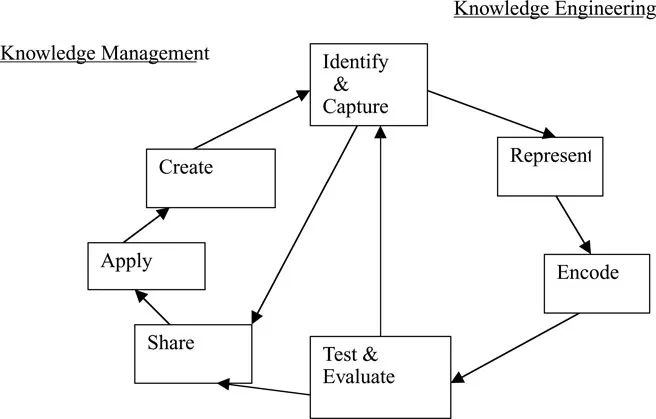
Knowledge management first involves identifying (or locating) and capturing knowledge. Once the knowledge is captured (including tacit knowledge, which deals with what is in the heads of individuals, and explicit knowledge, which can be easily codified), the knowledge can be shared with others. Then, individuals will apply this shared knowledge and internalize it using their own perspectives. This may produce new knowledge, which then needs to be captured, and the cycle starts over again.
Knowledge engineering has a comparable life cycle to knowledge management. As in knowledge management, knowledge engineering involves both tacit and explicit knowledge, and the emphasis is on capturing tacit knowledge. In knowledge engineering, expertise has to be first located and then captured. After knowledge is acquired and elicited, the knowledge must be represented in rules, cases, or other types of knowledge representation methods. This is similar to developing a KM taxonomy or ontology (in KE terms) in which the KM or KE system will be structured. After the knowledge is represented, it must be encoded into software and then evaluated. Knowledge refinement will probably need to be conducted whereby omitted knowledge needs to be included and captured, and the KE cycle begins again.
What is ahead in this book?
From the brief descriptions in this chapter, one can begin to see where knowledge management and knowledge engineering overlap. Unfortunately, many KM specialists have failed to recognize that KE methodologies, techniques, and tools can greatly enhance the current state of the art of KM. In the following chapters, we will describe how KE and artificial intelligence (AI) techniques are akin to KM and how one can use these processes to improve KM.
chapter two
Knowledge mapping and knowledge acquisition
Developing a knowledge map of an organization is a critical component of knowledge management. This is typically part of the knowledge audit step that attempts to identify stores, sinks, and constraints dealing with knowledge in a targeted business area, and then identifies what knowledge is missing and available, who has the knowledge, and how that knowledge is used. A knowledge map will then be drawn to depict those relationships in that organization.
The methodology used to determine the available and missing knowledge and to capture this knowledge can be borrowed from the knowledge engineering discipline, specifically the knowledge acquisition field. This chapter discusses the knowledge mapping process and how knowledge acquisition techniques can be applied to enhance this process.
Knowledge mapping
According to Jan Lanzing (1997) at the University of Twente, concept mapping is a technique for representing knowledge in graphs. Knowledge graphs are networks of concepts. Networks consist of nodes (points/vertices) and links (arcs/edges). Nodes represent concepts and links represent relations between concepts. Lanzing further explains that concepts and, sometimes, links are labeled. Links can be non-, uni-, or bi-directional. Concepts and links may be categorized; they can be simply associative, specified, or divided in categories such as causal and temporal relations. Research by McDonald and Stevenson (1999) shows that navigation was best with a spatial map, whereas learning was best with a conceptual map.
Typically, concept mapping is performed for several purposes (Lanzing, 1997):
• To generate ideas (brainstorming, etc.)
• To design a complex structure (long texts, hypermedia, large web sites, etc.)
• To communicate complex ideas
• To aid learning by explicitly integrating new and old knowledge
• To assess understanding or diagnose misunderstanding
The idea of knowledge maps and knowledge mapping in the knowledge management field is analogous to the use of concept maps and conceptual mapping. According to Wright (1993), a knowledge map is an interactive, open system for dialogue that defines, organizes, and builds on the intuitive, structured, and procedural knowledge used to explore and solve problems. Knowledge mapping is an active technique for making contextual knowledge representable, explicit, and transferable to others. In knowledge management terms, knowledge mapping relates to conceptual mapping in a very direct way. Specifically, the objective of knowledge mappin...
Table of contents
- Cover
- Title Page
- Copyright Page
- Preface
- Author’s bio
- Table of Contents
- Chapter 1 Knowledge management and knowledge engineering: working together
- Chapter 2 Knowledge mapping and knowledge acquisition
- Chapter 3 Knowledge taxonomy vs. knowledge ontology and representation
- Chapter 4 The knowledge management life cycle vs. the knowledge engineering life cycle
- Chapter 5 Knowledge-based systems and knowledge management
- Chapter 6 Intelligent agents and knowledge dissemination
- Chapter 7 Knowledge discovery and knowledge management
- Chapter 8 People and culture: lessons learned from AI to help knowledge management
- Chapter 9 Implementing knowledge management strategies
- Chapter 10 Expert systems and AI: integral parts of knowledge management
- Appendix A A knowledge management strategy for the U.S. Federal Communications Commission
- Appendix B Partial knowledge audit for the U.S. Social Security Administration
- Appendix C Modeling the intelligence analysis process for intelligent user agent development
- Appendix D Planning and scheduling in the era of satellite constellation missions: a look ahead
- Index
Trusted by 375,005 students
Access to over 1.5 million titles for a fair monthly price.
Study more efficiently using our study tools.
Frequently asked questions
Yes, you can cancel anytime from the Subscription tab in your account settings on the Perlego website. Your subscription will stay active until the end of your current billing period. Learn how to cancel your subscription
No, books cannot be downloaded as external files, such as PDFs, for use outside of Perlego. However, you can download books within the Perlego app for offline reading on mobile or tablet. Learn how to download books offline
Perlego offers two plans: Essential and Complete
- Essential is ideal for learners and professionals who enjoy exploring a wide range of subjects. Access the Essential Library with 800,000+ trusted titles and best-sellers across business, personal growth, and the humanities. Includes unlimited reading time and Standard Read Aloud voice.
- Complete: Perfect for advanced learners and researchers needing full, unrestricted access. Unlock 1.5M+ books across hundreds of subjects, including academic and specialized titles. The Complete Plan also includes advanced features like Premium Read Aloud and Research Assistant.
We are an online textbook subscription service, where you can get access to an entire online library for less than the price of a single book per month. With over 1.5 million books across 990+ topics, we’ve got you covered! Learn about our mission
Look out for the read-aloud symbol on your next book to see if you can listen to it. The read-aloud tool reads text aloud for you, highlighting the text as it is being read. You can pause it, speed it up and slow it down. Learn more about Read Aloud
Yes! You can use the Perlego app on both iOS and Android devices to read anytime, anywhere — even offline. Perfect for commutes or when you’re on the go.
Please note we cannot support devices running on iOS 13 and Android 7 or earlier. Learn more about using the app
Please note we cannot support devices running on iOS 13 and Android 7 or earlier. Learn more about using the app
Yes, you can access Knowledge Management by Jay Liebowitz in PDF and/or ePUB format, as well as other popular books in Business & Information Management. We have over 1.5 million books available in our catalogue for you to explore.