- 162 pages
- English
- ePUB (mobile friendly)
- Available on iOS & Android
eBook - ePub
About this book
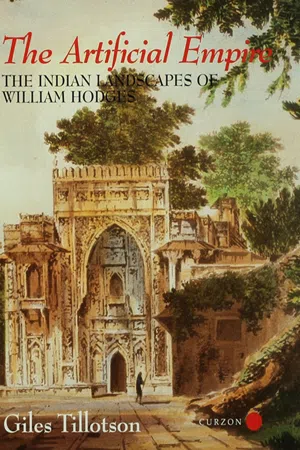
The role of the visual arts in the assertion of European colonial power has been the subject of much recent investigation and redefinition. This book takes as a ground for discussion the representation of Indian scenery and architecture by British artists in the late eighteenth and early nineteenth centuries. It includes the work of a diversity of
Information
Chapter One
The Picturesque Prospect
TO HIS CLASSIC study of the picturesque in 1927, Christopher Hussey appended a ‘Chronological List of The Most Eminently Picturesque English Painters 1730–1830’. Beginning with Wilson, Gainsborough, de Loutherbourg and other founding masters of the English Landscape School, this list includes a great many names; indeed, having reached Turner and Constable, Hussey abandons attempting to mention artists individually and suggests that one ought to include everyone predating the influence on English art of French Impressionism, and he thus recalls the comment at the opening of his book that the term ‘picturesque’ is almost synonymous with ‘English art’ in one of its most glorious periods. As he and later commentators have gone on to show, such an elision receives some further justification from the fact that the picturesque aesthetic was not restricted to painting: its considerable power derived precisely from its ability to pervade, and unite, a spectrum of art forms, including landscape gardening and architecture.1 Paradoxically, it was perhaps its very comprehensiveness which explains why no one since its eighteenth-century theorists had remembered to identify it as a distinct aesthetic; it was in the context of the changes represented by another great period of English art, in the early twentieth century, that Hussey was able to recognise the picturesque as embodying a particular ‘point of view’. And even then its spirit was not extinct, since Hussey observed that ‘it is still in request to write for the newspapers’, having in mind, no doubt, work which included his own contributions to Country Life. Versatile, pervasive and durable, the picturesque has with some justice been described as England’s major contribution to European aesthetics.
Not surprisingly, then, it has received much attention in art-historical scholarship since Hussey.2 But in spite of the easy accessibility of its primary texts, and a rich secondary literature, some further account is necessary here because its interpretation has lately become a matter of dispute.3 The intricacies of the dispute among specialists are of secondary importance here, and I do not propose a detailed critique of recent contributions. But a review of the primary sources is required because of the connection here proposed between their language and ideas and the practice of artists such as Hodges, and because of the frequent references to the qualities of the aesthetic that are central to the arguments of the chapters which follow. I offer a summary of the aesthetic’s character and consider the broader issues of the dispute in this next section’s concluding part, but the account begins with a rehearsal of the salient points of the main original theoretical texts.
Articulating the Theory
‘The full perfection of Keswick consists of three circumstances, beauty, horror, and immensity united;… To give you a complete idea of these three perfections, as they are joined at Keswick, would require the united powers of Claude, Salvator and Poussin.’4 In these often-quoted remarks of Dr John Brown of St John’s College Cambridge are found united three habits that were to become commonplaces of the picturesque: drawing nice distinctions between aesthetic categories, some of doubtful sounding appeal; admiring scenery which was not yet familiar to everyone; and relating a natural landscape to the paintings of the masters of the preceding century. Claude Lorrain, Salvator Rosa and Gaspard Dughet (styled Poussin after his now more illustrious brother-in-law) were the three artists who particularly dominated a mid-eighteenth century English view of landscape painting. English aristocrats and dilettanti, while making the Grand Tour, would be able to see and even acquire works by these artists and their imitators, whilst they explored the actual landscapes that had inspired them; and it was against this background that there arose a fashion for describing natural landscapes in a manner informed by principles derived from painting. Horace Walpole’s travel writing of 1739 is often pointed to as marking the moment when an occasional habit became a cult, which only increased in vigour as the century progressed.
From the appreciation of natural landscapes in terms of pictures it was a short step to the creation of artificial landscapes intended to look like pictures, and the end of the century saw this vision being applied to a new style of landscape gardening, promoted particularly through the writings of Richard Payne Knight and Uvedale Price. And having thus found its way into an allied art, the idea of the picturesque came to exert a potent influence on architecture. But since, whatever the context, the picturesque involved an appeal to pictorial values, it is scarcely surprising that it was applied first and for the longest time to the art of landscape painting itself. The central figure as a theorist in this regard, and in many ways the most important proponent of the picturesque, was William Gilpin.
Less intellectual and coherent, perhaps, than Knight and Price, Gilpin was nevertheless more prolific and influential; and in his extensive and somewhat rambling writings the aesthetic received its earliest and its fullest explanation and justification. Gilpin is probably best known for his commentaries on tours through various parts of Great Britain made between 1769 and 1774; at first circulated privately, these were published as a series of volumes from 1782 onwards, and they reveal Gilpin applying his theory in a critique of the countryside. More important in the formulation of the theory itself is the ‘Essay on Picturesque Beauty’, one of Three Essays published in 1792. He opens this work by defining picturesque objects as those ‘capable of being illustrated in painting’; it is his aim to distinguish the category of the picturesque from that of the beautiful, and he therefore poses the question, ‘what is that quality in objects which particularly marks them as picturesque?’5 In answering such an elementary question, a starting point for Gilpin (as for other theorists of the picturesque) was supplied by Edmund Burke.
In his Philosophical Enquiry into the Origin of our Ideas of the Sublime and the Beautiful of 1757, Burke had attempted to account for our ideas about aesthetics in terms of more basic human instincts. He suggested first that there were but two fundamental human instincts – those of self-protection and selfpropagation – and that all of our most powerful emotions relate to one of these two. The emotions and passions associated with the instinct for selfprotection are those of pain and fear; while those associated with selfpropagation are those of pleasure and happiness. Burke’s major step was to assert that our ideas about the sublime arise from those emotions connected with the instinct for self-protection (that is to say, from fear), while our ideas about the beautiful arise from emotions connected with our instinct for selfpropagation (that is, from pleasure).6 By thus proposing a link between two aesthetic categories and our allegedly two most fundamental and wholly opposed human instincts, Burke established the aesthetic categories as entirely discrete from each other and forming a complete system together. This argument was one important starting point for the picturesque theorists since they were seeking to add a third aesthetic category to Burke’s perfect system.
The second guiding element derived from Burke was his definition of beauty. The essential criterion of beauty, Burke declared, was smoothness. The claim was founded on empirical observation: smoothness is ‘a property constantly observable’ in objects that are considered to be beautiful. So much so indeed that
I do not now recollect anything beautiful that is not smooth. In trees and flowers, smooth leaves are beautiful; smooth slopes of earth in gardens; smooth streams in the landscape; smooth coats of birds and beasts in animal beauties; in fine women, smooth skins; and in several sorts of ornamental furniture, … smooth and polished surfaces … Take any beautiful object, and give it a broken and rugged surface, and however well formed it may be in other respects, it pleases no longer. Whereas let it want ever so many of the other constituents, if it wants not this, it becomes more pleasing than almost all the others without it.7
Burke could account for this. Smoothness is gratifying to the senses of touch, taste and hearing (unlike roughness, which causes pain); smoothness is therefore a source of those emotions which, following the theory, are linked to the basic human emotion of self-propagation and are the source of our ideas of the beautiful.
It ought, incidentally, to follow from this that roughness is similarly related to the sublime: roughness – identified by Burke as the opposite of smoothness and a source of pain – is therefore a source of those emotions that are linked to the basic human instinct of self-protection, and should thus be a source of our ideas of the sublime. In fact, Burke argues that the sublime depends not on roughness but on an assortment of other qualities including obscurity, privation and vastness.8 This disruption of the symmetry of Burke’s system was seemingly unconscious; but it was most convenient for Gilpin, because it left roughness unspoken for, ready to be claimed as the essential criterion of the new category, the picturesque.
Gilpin, after all, was seeking to distinguish the picturesque from the beautiful. Burke’s idea that beauty depended on smoothness – coupled with his omitting to theorise roughness – suggested to Gilpin the path that he adopted: ‘Roughness forms the most essential point of difference between the beautiful and the picturesque’, he announced, and it is ‘that particular quality which makes objects chiefly pleasing in painting’. It is observable in nature on both a small and a large scale: ‘in the outline and bark of a tree, as in the rude summit and craggy sides of a mountain’.9
Gilpin next pursues his distinction between the picturesque and the beautiful through two examples. First, he observes that
a piece of Palladian architecture may be elegant in the last degree. The proportion of its parts – the propriety of its ornaments – and the symmetry of the whole, may be highly pleasing. But if we introduce it in a picture, it immediately becomes a formal object and ceases to please. Should we wish to give it picturesque beauty, we must use the mallet instead of the chisel: we must beat down one half of it, deface the other, and throw the mutilated members around in heaps. In short, from a smooth building we must turn it into a rough ruin. No painter, who had the choice of the two objects, would hesitate a moment.
His second example is a park. A smooth garden may be supremely beautiful, but it is not a suitable subject for the painter. What pleases in nature may offend in art.
Turn the lawn into a piece of broken ground: plant rugged oaks instead of flowering shrubs: break the edges of the walk: give it the rudeness of a road: mark it with wheel-tracks; and scatter around a few stones, and brushwood; in a word, instead of making the whole smooth, make it rough-, and you make it also picturesque … You fit it for your picture.10
It will be noticed from these examples that Gilpin is not only defining a new aesthetic category to add to Burke’s pair; he is suggesting that only objects in this third category are fit subjects for painting. When he seeks to distinguish the beautiful and the picturesque, he is seeking to distinguish between what pleases in nature and what pleases in art; and the logical implication of this is that beauty has no place in art. In the preface to the essay quoted, Gilpin protests that his critics have misunderstood him; he is not (as some imagine) attempting to establish the picturesque as the sole aesthetic category, but as one which has not previously been recognised, accepting the existence of others. While this is a just self-defence, it is possible to see how the misunderstanding arose, for in the argument which follows Gilpin does insist that the picturesque is the only aesthetic category relevant to painting; others, though they exist, find their proper place only in nature. Thus the seemingly bland and generous definition of picturesque objects as those ‘capable of being illustrated in painting’ turns out to be highly specific and selective. If picturesque objects are those which could appropriately be painted, and the criterion of the picturesque is roughness, it follows that only rough objects are fit subjects for art. Beautiful ob...
Table of contents
- Cover
- Half Title
- Title Page
- Copyright
- Contents
- Foreword
- Introduction
- Chapter One: The Picturesque Prospect
- Chapter Two: Drawn on the Spot
- Chapter Three: Others’ Designs
- Chapter Four: Colonial and Visual Domains
- Chapter Five: With Architecture in Mind
- Bibliography
- Index
Trusted by 375,005 students
Access to over 1.5 million titles for a fair monthly price.
Study more efficiently using our study tools.
Frequently asked questions
Yes, you can cancel anytime from the Subscription tab in your account settings on the Perlego website. Your subscription will stay active until the end of your current billing period. Learn how to cancel your subscription
No, books cannot be downloaded as external files, such as PDFs, for use outside of Perlego. However, you can download books within the Perlego app for offline reading on mobile or tablet. Learn how to download books offline
Perlego offers two plans: Essential and Complete
- Essential is ideal for learners and professionals who enjoy exploring a wide range of subjects. Access the Essential Library with 800,000+ trusted titles and best-sellers across business, personal growth, and the humanities. Includes unlimited reading time and Standard Read Aloud voice.
- Complete: Perfect for advanced learners and researchers needing full, unrestricted access. Unlock 1.5M+ books across hundreds of subjects, including academic and specialized titles. The Complete Plan also includes advanced features like Premium Read Aloud and Research Assistant.
We are an online textbook subscription service, where you can get access to an entire online library for less than the price of a single book per month. With over 1.5 million books across 990+ topics, we’ve got you covered! Learn about our mission
Look out for the read-aloud symbol on your next book to see if you can listen to it. The read-aloud tool reads text aloud for you, highlighting the text as it is being read. You can pause it, speed it up and slow it down. Learn more about Read Aloud
Yes! You can use the Perlego app on both iOS and Android devices to read anytime, anywhere — even offline. Perfect for commutes or when you’re on the go.
Please note we cannot support devices running on iOS 13 and Android 7 or earlier. Learn more about using the app
Please note we cannot support devices running on iOS 13 and Android 7 or earlier. Learn more about using the app
Yes, you can access The Artificial Empire by G. H. R. Tillotson in PDF and/or ePUB format, as well as other popular books in Social Sciences & Ethnic Studies. We have over 1.5 million books available in our catalogue for you to explore.