Interactions between drug particulates are crucial in determining drug dispersion and deaggregation, and ultimately delivery efficiency. This book combines principles established in surface and colloidal chemistry with pharmaceutical powder technology. It discusses some of the factors affecting particulate interactions, and particle-fluid interaction in the respiratory tract. It review some of the studies carried out in dry powder formulation development, and proposes possible strategies in improving DPI efficiency. The majority of these principles are applicable to other pharmaceutical solid dosage forms (e.g. tablets and capsules).
Trusted by 375,005 students
Access to over 1.5 million titles for a fair monthly price.
In the western world most drugs are administered as solid dosage forms which means that, with a few exceptions, they will exist in the powdered state at some stage of their manufacture. Therefore, it is important for the pharmaceutical developer to have a comprehensive understanding of the properties of powdered materials. Most regulatory bodies have focused primarily on issues of safety, quality and efficacy, which in turn has led to an overriding interest in all aspects of chemical purity. However, it has been recognised also that the physical state of a solid formulation may sometimes be as important as the chemical structure of the drug since its in vivo disposition is often determined by many of its physical properties. For example, absorption of a drug entity of low aqueous solubility from the gastrointestinal tract is often dependent upon the particle size of the drug in the formulations. Polymorphism is another important factor in determining drug disposition both in vitro and in vivo. It is widely known for instance that amorphous drugs have a higher molecular mobility than crystalline drugs and hence, the former dissolve more readily in aqueous solutions, often resulting in a higher rate of absorption than when the drug is presented in the latter state. However, the amorphous state is thermodynamically unstable and it will eventually transform to a more stable crystalline form under normal conditions. Such a transformation is known to result in physical and even chemical changes in the drug formulation, which may eventually lead to an alteration in the pharmacological effects of the formulation.
The need for physical characterisation becomes even more crucial when excipients are used in formulations. With the rapid development in the material sciences in recent years, a wide variety of pharmaceutical excipients have been used and these will undoubtedly have a concomitant range of physico-chemical properties. To improve the safety and efficacy of drug formulations, the physical characterisation of drugs, excipients, and blends of the two is gradually becoming a part of preformulation studies. Various spectroscopic methods (including ultraviolet/visible, diffuse reflectance spectroscopy, vibrational spectroscopy and magnetic resonance spectrometry), optical and electron microscopy, X-ray powder diffractometry and thermal methods of analysis, etc. have been used to characterise the physical states of many pharmaceutically-active therapeutic agents (Brittain, 1995). A systematic approach to the physical characterisation of pharmaceutical solids has been outlined (Brittain et al., 1991) and the physical properties classified as being associated with the molecular level, the particulate level and the bulk level. The use of these techniques has undoubtedly promoted a scientific and systematic approach to the development of pharmaceutical solid dosage forms and has provided formulation scientists with invaluable information that has optimised therapeutic effects and minimised toxic reactions.
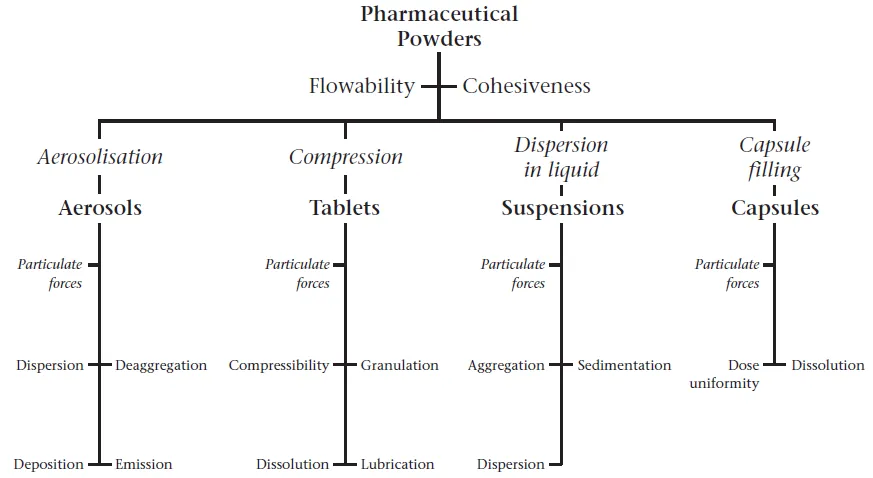
However, many associated difficulties still exist with the study of solids in the powdered state. Even current technological advances have not produced a comprehensive or exhaustive insight into the characterisation of solids incorporated within dosage forms. This is particularly true in the case of the particulate interactions between powders. The vast majority of drugs, when isolated, exist as either crystalline or amorphous solids. They are normally milled (comminuted), mixed with other inactive excipients (such a term may not always be accurate since some excipients do have biological activities) and may be finally filled into capsules or compacted to form tablets. Other solids, after comminution, may be suspended in a suitable medium to produce dosage forms such as suspensions. Particles in powdered dosage forms interact with each other throughout all the powder handling process from comminution, through mixing and compaction, to storage, due to the ubiquitous attraction and/or repulsion forces. Particulate interaction has been actively researched in other scientific and technological fields, such as powder technology and in the semiconductor industry, but this has not been the case with pharmaceutical solids and much of the pertinent work is scattered throughout the literature. The importance of particulate interaction in pharmaceutical solid dosage forms must not be underestimated since many bulk properties of powders, such as flowability, mixing, deaggregation, dispersion, compression and even drug dissolution, may be affected by the particle–particle interaction between the solids (Figure 1.1). In order to provide a more systematic insight into these interactions in pharmaceutical solid dosage forms, it is necessary to introduce some of the basic principles generated from other scientific fields. The emphasis of this work will be placed on the type of particulate interactions and factors that may affect them together with their relevance to pharmaceutical solid dosage forms. Special focus will be placed on their effects on the powder flowability, mixing, drug delivery from aerosols, tablets, capsules and suspensions.
Figure 1.1: Flow chart showing some of the properties of pharmaceutical solid dosage forms which may be affected by particulate forces.
Particle interactions occur as a consequence of so-called long range attractive forces. The forces arising from the covalent bonds that result in the formation of molecules from atoms are not covered by this definition. Covalent forces bring two atoms together to form a molecule which has completely different properties to that of the component atoms. Such bonds are extremely strong with an energy of formation often greater than 40 kJ mol-1 (300 to 700 kJ mol-1 being typical). Particle interactions, however, are due to much weaker physical bonding usually with energies of bonding less than 40 kJ mol-1. These forces are thus weaker than chemical bonds but their influence extends over greater distances and they are thus termed, ‘long range forces’.
Particulate interactions can be broadly classified into two classes, namely cohesive and adhesive (Zimon, 1982). Cohesion usually refers to interactions between particles of the same chemical structure and of similar particle size. Adhesion refers to interactions between particles of different materials. Thus, a powder is said to be cohesive when the component particles tend to stick to each other and the interaction forces between these particles are termed cohesive forces. On the other hand, a particle is adhesive if it readily adheres to the surface of an object of larger dimensions. Similarly, the forces between a particle and such a surface are defined as the adhesive forces. Either cohesion or adhesion becomes significant when gravitational forces acting upon these particles become negligible; that is, when the dimensions of the particulate materials become smaller than 10 μm (Visser, 1995). Many pharmaceutical solids fall within this size range and hence, either cohesion or adhesion is commonly encountered in drug formulations.
Particulate interactions may be a result of a number of concurrently acting forces or mechanisms, van der Waals, electrostatic, capillary forces, solid bridging or mechanical interlocking being typical. Since pharmaceutical solids are often insulators, particles are likely to carry a charge during the powder handling process. Charged particles will exert so-called electrostatic forces (Coulombic) on other particles. However, uncharged particles also interact with each other due to dispersion forces (van der Waals forces). They are very complicated but may be understood by imagining an instantaneous picture of molecules possessing different electronic configurations, giving them a dipolar (having both a negative and positive pole) character. This temporary situation will result in local imbalances in charge, leading to transient induced dipoles. Consequently, the molecules attract each other. Dispersion forces may exert their influence over a range in the order of 10 nm and have a typical strength, for van der Waals bonds, of around 1 kJ mol-1. When water (or other liquid) condensation occurs on the solid–solid interfaces, then particulate interaction due to capillary forces arises. Such forces, resulting from the surface tension of the adsorbed liquid layer, may dominate over other forces if sufficient liquid is condensed on the solid–solid interface. Finally, pharmaceutical solids are often irregularly shaped with rough surfaces. Mechanical interlocking between particles is a common occurrence once they are in contact, especially after compaction. Thus, mechanical interlocking can also be an important contributor to overall particulate interactions.
1.2 VAN DER WAALS FORCES
The major forces between uncharged solid particles are named after the Dutch physicist van der Waals, who pointed out more than a century ago that the deviations from the ideal-gas law at high pressures could be explained by assuming that the molecules in a gas attract each other (van der Waals, 1873). More than half a century later, by employing the then newly developed quantum chemistry, London was able to quantify van der Waals’ hypothesis (London, 1930) and hence, the forces are also called van der Waals–London forces. According to London’s theory, the energy of interaction between two molecules, V, can be given as the following expression:
where α is the polarisability, h is Planck’s constant, v0 the characteristic frequency and d the separation distance between the two objects. Since v0 is found in the ultraviolet region of the absorption spectra and plays a key role in optical dispersion, van der Waals–London forces are also termed dispersion forces.
By assuming the additivity of the energy of interaction by dispersion forces, Hamaker (1937) was able to calculate the interaction energy between two solid objects simply by summarising all the possible individual molecular interactions and the energy changes of interaction between macroscopic bodies:
where E is the total energy of interaction; v1, v2 are the total volumes of particles, 1 and 2; q1, q2 are the number of atoms per unit volume of particles 1 and 2; r is the distance between volume element 1 and 2.
The constant of dispersion
in equation (1.2) can be calculated from the following equation:
where h is the Planok’s constant; f is the vibration frequency of the interacting electronic oscillators; a is the polarisability of molecules. Van der Waals forces, F, between two ideally smooth spheres of diameters d1 and d2, separated by a distance r in vacuum can be expressed as:
The interaction forces between two flat plates per unit of surface area, PA, are given as:
where A is Hamaker’s constant which is given by:
If a particle with a diameter d1 is separated by a distance r in vacuum from a plane surface, the adhesive force of a sphere to a plane composed of the same molecules due to van der Waals forces is given as:
The adhesion of a sphere (1) to a plane surface (2) composed of different molecules can be calculated as:
where A11 and A22 are the Hamaker constants for the fine particle and the ...
Table of contents
Cover Page
Title Page
Copyright Page
Chapter 1 Interparticulate Forces
Chapter 2 Interparticulate Forces in Pharmaceutical Powders
Chapter 3 Medicinal Aerosols
Chapter 4 Particle Interactions with Air Streams
Chapter 5 Particulate Interactions in Dry Powder Aerosols
Chapter 6 Measurement of Cohesion, Adhesion and Dispersion of Powders
Chapter 7 Physical Characterisation of Pharmaceutical Powders
Frequently asked questions
Yes, you can cancel anytime from the Subscription tab in your account settings on the Perlego website. Your subscription will stay active until the end of your current billing period. Learn how to cancel your subscription
No, books cannot be downloaded as external files, such as PDFs, for use outside of Perlego. However, you can download books within the Perlego app for offline reading on mobile or tablet. Learn how to download books offline
Perlego offers two plans: Essential and Complete
Essential is ideal for learners and professionals who enjoy exploring a wide range of subjects. Access the Essential Library with 800,000+ trusted titles and best-sellers across business, personal growth, and the humanities. Includes unlimited reading time and Standard Read Aloud voice.
Complete: Perfect for advanced learners and researchers needing full, unrestricted access. Unlock 1.5M+ books across hundreds of subjects, including academic and specialized titles. The Complete Plan also includes advanced features like Premium Read Aloud and Research Assistant.
Both plans are available with monthly, semester, or annual billing cycles.
We are an online textbook subscription service, where you can get access to an entire online library for less than the price of a single book per month. With over 1.5 million books across 990+ topics, we’ve got you covered! Learn about our mission
Look out for the read-aloud symbol on your next book to see if you can listen to it. The read-aloud tool reads text aloud for you, highlighting the text as it is being read. You can pause it, speed it up and slow it down. Learn more about Read Aloud
Yes! You can use the Perlego app on both iOS and Android devices to read anytime, anywhere — even offline. Perfect for commutes or when you’re on the go. Please note we cannot support devices running on iOS 13 and Android 7 or earlier. Learn more about using the app
Yes, you can access Particulate Interactions in Dry Powder Formulation for Inhalation by Xian Ming Zeng,Gary Peter Martin,Christopher Marriott in PDF and/or ePUB format, as well as other popular books in Medicine & Pharmacology. We have over 1.5 million books available in our catalogue for you to explore.