eBook - ePub
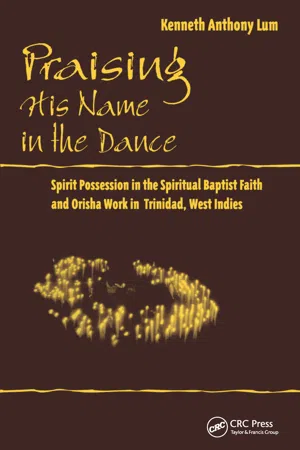
Praising His Name In The Dance
Spirit Possession in the Spiritual Baptist Faith and Orisha Work in Trinidad, West Indies
- 292 pages
- English
- ePUB (mobile friendly)
- Available on iOS & Android
eBook - ePub
Praising His Name In The Dance
Spirit Possession in the Spiritual Baptist Faith and Orisha Work in Trinidad, West Indies
About this book
The author provides a detailed portrait of the Spiritual Baptist Faith and Orisha Work, two religions that share a common basis in the traditional religion of the Yoruba in West Africa. Specifically, the author studies the phenomenon of spirit possession, an integral aspect of worship in both religions. In the Spiritual Baptist Faith, a person who
Information
Chapter 1
Introduction
I
The island of Trinidad is situated at the southernmost end of the Caribbean archipelago which stretches from Florida in North America to Venezuela in South America. Trinidad, with an area of 4,828 sq km, is the larger of the two islands which comprise the Republic of Trinidad and Tobago; the other island is Tobago, with an area of 300 sq km. The population of Trinidad in 1980 was 1,016,239, comprising persons from many diverse ethnic backgrounds. The 1980 census used the following ethnic categories: “Negroes” (38.8%); “East Indians” (42.2%); “Chinese” (0.5%); “Syrian/Lebanese” (0.1%); “White” (0.9%); “Mixed” (16.8%); “Other Races” (0.3%); and “Not Stated” (0.4%). The religious composition of the population was similarly diverse, and all of the major world religions were represented; however, Christianity (61.6%) and Hinduism (25.9%) claimed the most adherents.
In 1910 my grandfather initially migrated to Trinidad from China, and although my parents were also born in China, I was born, in 1955, and grew up in Trinidad. In 1970 my family, including myself, emigrated to Australia where we have been ever since, although we did return to Trinidad in 1972–1974. In the intervening years most of the links between my family and Trinidad have been gradually severed, apart from those with our immediate relations still living on the island. I had last been in Trinidad briefly in 1982, and in 1986–1988 I returned there to conduct anthropological fieldwork for my doctoral thesis (Lum, 1989).
I chose to go to Trinidad for several reasons. The original reasons were methodological; they were also largely based on expediency. I assumed that since I had been born and raised in Trinidad, I would have the advantage of familiarity with the dialect of English spoken there and my knowledge of the island, even after fourteen years absence, would enable me to conduct research more effectively in the limited time I had at my disposal, that is, eighteen months, than if I were to go elsewhere. And I maintained these reasons even though I only became aware of the two religions in 1986 in Australia when I was looking for a research topic. From my initial readings it appeared that the two religions shared many aspects in common, including overlapping memberships; and also, the ritual possession of a devotee by a spirit was a central aspect of worship in both religions. A comparison of their respective types of possession-events, therefore, seemed feasible: there was a likelihood that an individual could experience both types of possession, assuming that they were two different types in the first place, since he or she was often an adherent of both religions.
When I arrived in Trinidad in September 1986, many changes had occurred since I had last been there. I had originally left in 1970 with my family, in the aftermath of an upsurge in black consciousness on the island when numerous protest marches occurred, rioting erupted on the streets of the capital city of Port of Spain and elsewhere, and an attempted coup by a section of the army was quashed. This period in early 1970 was known as the Black Power Revolution, and my family’s migration from Trinidad was part of the massive exodus from the island following this period of unrest. Then, as now, the two major segments of the population of Trinidad were comprised of persons of African and East Indian descent respectively.
Trinidad has always had one of the highest standards of living in the Caribbean, first with the cultivation of sugar in the nineteenth century, and then with the production of oil in this century. Natural gas has also recently been discovered in significant quantities (Thorndike, 1984, p. 241). Historically, the migrations to Trinidad have been in association with the development of these industries (see Chapters 10 and 11 below). Between 1976 and 1982 the price of oil rose to over $30 (USD) a barrel, and Trinidad enjoyed boom times, accumulate massive monetary reserves, but the cost of living also dramatically rose (Renwick, 1983, p. 261). In 1982 the downturn in the economy had begun, largely due to a glut of oil in the world market, resulting in lower oil prices. And when the price of oil dropped to a low of $9.00 (USD) a barrel in early 1986, the majority of the people of Trinidad began to experience increasing economic hardships. In December 1985, the Trinidad and Tobago dollar was devalued from $2.40 (TT) to $3.60 (TT) per $1.00 (USD), resulting in a further cost of living increase in Trinidad’s mainly import-oriented economy. Between 1986 and 1988, when I was there, the price of oil hovered around $17.00 (USD) a barrel however, the cost of living still remained high, with only prices for housing and accommodation dropping, as more and more people sold their houses prior to migrating overseas.
In December 1986 the People’s National Movement (P.N.M.), the political party which had been in power continuously since 1956, was removed from office in a general election. The P.N.M. had come to power under the leadership of the late Dr Eric Williams, and it was mainly due to his charismatic presence that the party stayed in office. Even after his death in 1981 the P.N.M. remained in power for the next five years. Dr Williams took Trinidad and Tobago to independence in 1962, and to a republic in 1976. After his death, electoral disenchantment with the P.N.M. gradually set in, especially in the economic climate of a recession. In the election of 1986 the P.N.M. could only win three out of a total of thirty six seats.
The winning party was the National Alliance for Reconstruction (N.A.R.), and the new Prime Minister was A.N.R. Robinson, who took over from the P.N.M.’s George Chambers. The new government faced a daunting prospect. In 1987 the unemployment figure in Trinidad was 19%, up from 5% in 1980, and expected to rise even further (Thorndike, 1987, p. 195; see also the Sunday Express, December 20, 1987, p. 12). This increase in the numbers of unemployed resulted mainly from the demise of many companies in the severe economic climate. In 1987 the Labour Minister, Dr Albert Richards, reported that since 1983, 193 companies had gone into receivership, resulting in the retrenchment of 11,000 workers (The Evening News, October 21, 1987, p. 1; Sunday Express, November 15, 1987, p. 5). Many of these persons ended up on the streets, a sight for which I was totally unprepared.
“Vagrants,” as homeless persons were commonly referred to in Trinidad, were just not as visible when I was living there in the 1950s and 1960s. Whether my stark comparison of the present with the past resulted from a sheltered childhood, blindness on my part then, or a nostalgic remembrance of my early years in Trinidad in 1988, I cannot clearly say — the different threads have proven to be very difficult to disentangle. But times were different then, and these differences were clearly evident on my return in the drug problem, mainly cocaine, heroin and crack, which was compounded by the growing spread in AIDS in Trinidad. All of these issues — vagrants, drugs, AIDS — were highlighted almost daily in the media while I was in Trinidad; they were certainly not as prominent in the 1950s and 1960s, and AIDS was not known at all then. The expediency factor which I had blissfully incorporated into my methodology in Australia slowly evaporated when I realised that the Trinidad in which I thought I was going to do fieldwork was very different to the reality of Trinidad in the mid-1980s. Fourteen years had taken its toll; I might just as well have gone to Patagonia.
But perhaps not, as my Trinidadian heritage began to play an unforeseen and crucial role in my fieldwork. The social, economic and political conditions in Trinidad may have changed in the intervening fourteen years, but my early association with the island became a constant, and indeed, the most important factor in my interactions with Trinidadians in 1986 — even though I had an Australian passport and had been away for so many years. I was no longer a Trinidad citizen but I was still seen as a Trinidadian by the people whom I encountered during the course of my research. And it was this factor which ultimately granted my research a measure of credibility and plausibility in the eyes of those devotees whom I met in the course of my fieldwork, and who gave me access to the religions. I might also have been a Chinese who spoke with a strange accent, and the religions might have been predominantly black religions which I had only learnt about when I was in Australia, but somehow these factors did not seem to matter within the context of my fieldwork. What mattered then was that I was still seen as a Trinidadian who was interested in their religions, the Spiritual Baptist Faith and Orisha Work.
II
The Spiritual Baptist Faith is also referred to as the Shouter Baptist Faith by some of its members, who are variously known as Spiritual Baptists, Shouter Baptists, “shouters” or the “converted.” In one recent article, Holland and Crane (1987, p. 63, Note 12) refer to the religion as Spiritual Baptism. I will refer to the religion as the Spiritual Baptist Faith as this is the name which its devotees most often use for their religion. It is predominantly a black working-class religion which draws the majority of its members from the economically depressed sectors of Trinidad. Although I did meet members who had achieved a university education most members had only attained a primary school education. Education to this level is free and compulsory.
The Spiritual Baptist Faith has had a turbulent history, clouded in ambiguity and mystery; it was illegal between 1917 and 1951 to worship in the Spiritual Baptist manner. Similar religious groups can be found in the nearby West Indian islands of St. Vincent (the Shakers, see Henney, 1973; 1974), Barbados (the Tieheads, see Weekes, 1974; Griffith and Mahy, 1984; 1985; 1986), Jamaica (the various revivalist cults, see Simpson, 1956), and of late as far afield as the USA, Canada and England. This list is not exhaustive, as the research in this area is extensive. Most of these groups are affiliated with each other in some manner, and they all exhibit a strong Christian, mainly Protestant, aspect to their religiosity as well as an African quality, to a lesser extent. The Spiritual Baptists in Trinidad are not to be confused with either the London Baptists or the Independent (Merikin) Baptists (see Stewart, 1974; 1976), two other religious groups which are ostensibly similar to the Spiritual Baptists and which also appear to be unique to Trinidad. These three religions are quite distinct and separate; and further, their respective members are often openly hostile to each other.
The second religion in this study, Orisha Work, has also been variously referred to as Shango, Trinidadian Shango, the Shango cult, the Shango religion, the Orisha religion and Trinidad Yoruba. Most of its devotees refer to their religion as either Orisha Work or Shango. I will refer to the religion as Orisha Work as it is the name its devotees mainly use for their religion. Orisha Work is also a predominantly black working-class religion, with its membership overlapping extensively with that of the Spiritual Baptist Faith. Orisha Work exhibits strong African aspects to its religiosity with additional Christian, mainly Roman Catholic, elements. There are also elements derived from other religions. Similar types of religions are to be found in the Caribbean and South America, for example, Grenada (Shango, see Pollak-Eltz, 1968; 1993), Haiti (Vodu, see Courlander, 1960; Deren, 1975; Metraux, 1959), Cuba (Santeria, see Gonzalez-Wippler, 1981), Jamaica (Pocomania; Cumina, see Warner-Lewis, 1977), and Brazil (Candomble; Umbanda, see Herskovits, 1943; Pressel 1974). There are numerous similar religions found throughout the Americas and the Caribbean (see Gates, 1980; Romer, 1979; Simpson, 1978; 1980). This list is not exhaustive, as the research in this area is extensive. Apart from the historical links between Orisha Work and Grenadian Shango, and possibly Haitian Vodu, little is known of the relation between Orisha Work and any of these other latter New World religions. A similar type of religion, namely Rada, was also practised in Trinidad (see Carr, 1953) and had very strong historical links with Orisha Work. The Rada religion, which was also associated with the black working-class, is no longer practised in Trinidad; some of its elements, however, have been incorporated into Orisha Work.
The most prominent and central aspect of worship in the Spiritual Baptist Faith and Orisha Work is the seizure or possession of the body of a devotee by a spirit. In the Spiritual Baptist Faith the spirit is the Holy Spirit, the third person of the Christian Trinity; and in Orisha Work, the spirits are generally orishas and re-res who are the spirits associated with the cosmology of a traditional West African, that is, Yoruban, religion. There are other spirits who are associated with other religions. In both religions the term for this phenomenon of ritual seizure by a spirit is “manifestation.” In this book I will examine and compare the phenomenon of manifestation as it is found in the two religions, specifically in relation to their respective beliefs and practices (see Chapters 4, 8, 9 and 12 below).
Apart from manifestations, there are also phenomena in which persons are similarly seized by various other spirits. These events are termed “possessions,” and unlike manifestations which are valued religious experiences, possessions are seen in the same light as sicknesses which require curing (see Glazier, 1980b; Lewis, 1965; Ward and Beaubrun, 1980; 1981); possessing spirits have to be exorcised. Possession appears to be a common occurrence in Trinidad, affecting persons of both genders, all ages and all religious and ethnic affiliations. In Chapter 5 I describe one episode of possession which I encountered in my fieldwork; however, I will not discuss possession in any detail. I am concerned with the phenomenon of manifestation, and I refer to it specifically as a manifestation rather than a possession because of the terminological distinction that is made in Trinidad between the two phenomena.
This terminological distinction also highlighted the illusory nature of my original reason for doing research in Trinidad; that is, the assumed expediency of my not having to learn a new language. I was simply unaware of these additional religious meanings, and it took me quite a while to discover that a separate terminology even existed. This separate terminology had not been discussed in my readings on the religions while I was in Australia, prior to my leaving for Trinidad. One example will serve to illustrate my ignorance in this regard.
Early on in my fieldwork, at the first orisha ceremony I attended, a woman whom I had not previously met said to me, “You know, by the time the [ceremony] end you will have to dance.” I assumed that her usage of “dance” corresponded with mine, which I associated only with secular connotations. However, the word “dance” also had a religious meaning, when it pertained specifically to a manifestation. She was telling me that I had to undergo the supreme religious experience, namely dance, for my research, which she knew I was doing, and I replied in a most flippant and off-handed manner, which I only realised much later, that I was indeed willing to dance and have a good time. She viewed the ceremony as a religious occasion when the spirits could be present, and I viewed it simply as a party and a research opportunity. I only realised that there was a ritual meaning to the word dance when I heard it being used in contexts which made no sense initially to me, at which point I started to discuss the word more critically with people. This was not the only example of crossed communications during my fieldwork.
The Spiritual Baptist Faith and Orisha Work in Trinidad have been previously researched by Dorothy Clement (1969) [later Dorothy Holland], Julia Crane (Holland and Crane, 1987), Stephen Glazier (1979; 1980a; 1981; 1982–3; 1983a; 1983b; 1985a; 1985b; 1988; 1993), Melville and Frances Herskovits (1964), James Houk (1986; 1992; 1993; 1995), Joseph Howard (1967, pp. 195–196), Lisa Lekis (1960, pp. 125–142), Kenneth Lum (1989), Michael Lieber (1981), Noorkumar Mahabir and Ashram Maharaj (1989); Cecilia McDaniel (1973), Lorna McDaniel (1994), Frances Mischel (1957; 1958; 1959; see also Mischel and Mischel 1957) [later Frances Henry (1965; 1981; 1983)], James Adeyinka Olawaiye (1980), Alfrieta Parks (1981), Angelina Pollak-Eltz (1993); William Sargant (1976, pp. 190–200), George Simpson (1962b; 1964; 1965b; 1966), Fr Ian Taylor (1993); Colleen Ward (1979; Ward and Beaubrun, 1979), and Richard Waterman (1943; 1948, pp. 33–36). These scholars, with the exception of myself, are all non-Trinidadians. Trinidadian scholars include Michael Beaubrun (Ward and Beaubrun, 1979), Jacob Elder (1970; 1976; 1988), David Trotman (1975; 1976), Maureen Warner (1971a; 1971b) [later Maureen Warner-Lewis (1978)], Frank Mayhew (1953), Reverend Fitzroy Small (1976), Archbishop Ashram Stapleton (1983), Reverend Eudora Thomas (1987), and Viola-Gopaul Whittington (n.d.). The last five named are also Spiritual Baptists.
Both religions have also been the featured in the works of many artists, including painters, writers, dancers, singers, story-tellers and performers. The Trinidadian writer Earl Lovelace has written a novel, The Wine of Astonishment (1983), which is set in Trinidad and which has a Spiritual Baptist theme; and similarly, Brenda Flanagan has written the short story “Shango” (1979). No official figures exist either for the numbers of the Spiritual Baptists or Orisha Work devotees, as these two religions were not included in any of the censuses previously undertaken in Trinidad.
III
In Part One I present ethnographies of the Spiritual Baptist Faith (Chapters 2–4) and Orisha Work (Chapters 5–8) drawn from my fieldwork in Trinidad during 1986–1988. For epistemological reasons the only researchers I discuss are Mayhew, Small, Stapleton, Thomas and Whittington, essentially because they are Spiritual Baptists. I regard their accounts/knowledge in the same light as I do the accounts/knowledge of those adherents whom I met in the course of my fieldwork. Their statements on their religion emanate from, are located in, and only “make sense” primarily from within the beliefs and practices of that religion; further, they have to be interpreted in the light of an all-important theological distinction that the Spiritual Baptists make between spiritual and carnal knowledge. I discuss this distinction in more detail in Chapters 2–4.
This distinction betw...
Table of contents
- Cover
- Halftitle
- Title
- Copyright
- Dedication
- Contents
- List of Tables
- Introduction to the Series
- Preface
- 1 Introduction
- I Ethnographies
- II Commentary
- Appendices
- Bibliography
- Index
Trusted by 375,005 students
Access to over 1.5 million titles for a fair monthly price.
Study more efficiently using our study tools.
Frequently asked questions
Yes, you can cancel anytime from the Subscription tab in your account settings on the Perlego website. Your subscription will stay active until the end of your current billing period. Learn how to cancel your subscription
No, books cannot be downloaded as external files, such as PDFs, for use outside of Perlego. However, you can download books within the Perlego app for offline reading on mobile or tablet. Learn how to download books offline
Perlego offers two plans: Essential and Complete
- Essential is ideal for learners and professionals who enjoy exploring a wide range of subjects. Access the Essential Library with 800,000+ trusted titles and best-sellers across business, personal growth, and the humanities. Includes unlimited reading time and Standard Read Aloud voice.
- Complete: Perfect for advanced learners and researchers needing full, unrestricted access. Unlock 1.5M+ books across hundreds of subjects, including academic and specialized titles. The Complete Plan also includes advanced features like Premium Read Aloud and Research Assistant.
We are an online textbook subscription service, where you can get access to an entire online library for less than the price of a single book per month. With over 1.5 million books across 990+ topics, we’ve got you covered! Learn about our mission
Look out for the read-aloud symbol on your next book to see if you can listen to it. The read-aloud tool reads text aloud for you, highlighting the text as it is being read. You can pause it, speed it up and slow it down. Learn more about Read Aloud
Yes! You can use the Perlego app on both iOS and Android devices to read anytime, anywhere — even offline. Perfect for commutes or when you’re on the go.
Please note we cannot support devices running on iOS 13 and Android 7 or earlier. Learn more about using the app
Please note we cannot support devices running on iOS 13 and Android 7 or earlier. Learn more about using the app
Yes, you can access Praising His Name In The Dance by Kenneth Anthony Lum in PDF and/or ePUB format, as well as other popular books in Social Sciences & Anthropology. We have over 1.5 million books available in our catalogue for you to explore.