eBook - ePub
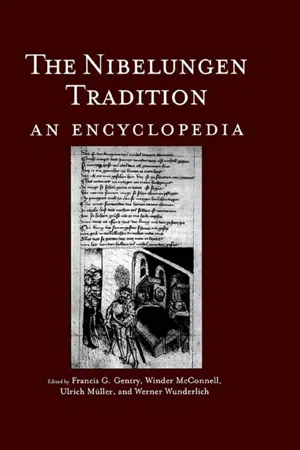
The Nibelungen Tradition
An Encyclopedia
- 496 pages
- English
- ePUB (mobile friendly)
- Available on iOS & Android
eBook - ePub
The Nibelungen Tradition
An Encyclopedia
About this book
Within the English-speaking world, no work of the German High Middle Ages is better known than the Nibelungenlied, which has stirred the imagination of artists and readers far beyond its land of origin. Its international influence extends from literature to music, art, film, politics and propaganda, psychology, archeology, and military history.Now
Information
PART I
Primary Works
ÄLTERE NIBELUNGENÔT (Elder Nibelungenot). Given the hypothetical nature of this work, see under PART V: SCHOLARSHIP.
ATLAKVIDA (Lay of Atli), a poem in the Elder Edda combining the fall of the Burgundians with the death of Attila and the collapse of the Hun empire. The Burgundian brothers Gunnar and Hogni are invited to the court of Atli and, in spite of warnings from their sister Guðrún, now Atli's wife, Gunnar makes the decision to go to the court accompanied only by a select band of warriors. Their departure is mourned, and on arrival Guðrún curses them for coming. After a brave struggle against the avaricious Huns Gunnar and Hogni are taken prisoner. Then, in a reversal of the situation that prevails at the end of the Nibelungenlied, Gunnar refuses to reveal the whereabouts of their treasure until he knows that his brother Hogni is dead. After an attempt to trick him with the heart of another warrior, which Gunnar knows cannot be Hogni's because it is trembling, Hogni is killed and his heart is brought to Gunnar. Gunnar then refuses once more to reveal where the treasure is hidden and dies defiantly in a snake pit, singing a song of triumph. He is praised by the poet for behaving as a king should and for defending his gold against his enemies. The treasure, now lost to all, is referred to as the "metal of strife." Guðrùn then exacts revenge for the death of her brother by killing the drunken Atli and burning the hall. Gunnar is here more heroic than Gunther, to whom he corresponds in the Nibelungenlied, and he takes the dominant role, while his sister Guðrún is more violent than the sister Kriemhild in the Nibelungenlied
[BOM]
Bibliography
Dronke, Ursula, ed. and trans. The Poetic Edda. Vol. 1 of Heroic Poems. Oxford: Clarendon, 1969, pp. 1—74.
Gottzmann, Carola L. Das alte Atlilied. Heidelberg: Winter, 1973.
Murdoch, Brian. The Germanic Hero. London: Hambledon, 1996, pp. 46—52.
ATLAMÁL IN GROENLENZKU (The Greenlandish Lay of Atli) is one of the most recent lays of the Poetic Edda and it is the longest one (105 stanzas in málaháttr; this meter is only used here in an Eddic poem, being more typical of scaldic poetry). It was written during the twelfth or the thirteenth century (Icelandic scholars suggest a much earlier date, 1050— 1150). The title indicates that the lay was written in Greenland, and the work corresponds to the poet’ inclination to describe everyday life in modest circumstances. There is also the presence of the hvítabjorn (white bear), the polar bear, in stanza 18, further pointing to Greenland as a place of the lay’ origin, although this animal was known to Icelanders as well. The rural atmosphere described in the poem is typical of wide areas in Scandinavia. Thus while scholars suspect that the lay was written in Greenland, its origin cannot be proven definitively.
The lay relates the same story as the Atlakviða in a broader and more descriptive style. The poet included new persons and new scenes, foreboding dreams, and many events in retrospect. He is more interested in the mental and emotional state of his figures, especially in Gudrun's cruelty to her children, than in action and events. According to the story, Atli invites Gunnar and Hogni, the sons of the Rhenish King Gjuki, to his court. Gudrun tries to warn her brothers of the treachery planned by her husband, but her warning runes are subtly altered by Vingi, a treacherous messenger, and her intended message does not get through. The Hunnish envoys are received very kindly by Hogni and Gunnar, yet their wives, Kostbera and Glaumvor, have dreams that foretell a catastrophe. The husbands interpret the dreams as being harmless and depart together with Snäwar and Solar, Hogni's sons, and Orkning, Kostbera’ brother. They row their boat so violently that they ruin it and leave it untied (stanza 37; cf. Nibelungenlied B, 1581). When Vingi admits that he has deceived Gunnar and Hogni, they kill him. The two are later joined by their sister in the battle that takes place in the hall. Snäwar, Solar, and Orkning are killed and Hogni is taken prisoner. Beiti, Atli's master of ceremonies, advises the Huns to kill Hjalli instead of Hogni and cut his heart out of his breast. Hjalli is such a coward that he is spared at Hogni's request, and Hogni is killed. Gunnar ends up in a snake pit playing the harp with his toes. (According to the Volsunga saga his hands are bound together. The scene of Gunnar playing the harp with his toes is depicted on the portals of the Norwegian churches of Hyllestad and Ostad.) Atli tries to reconcile with Gudrun, but she does not accept his presents. She is intent on revenge. She gives him so much beer that he becomes completely drunk. Meanwhile, in a tender scene, Gudrun says goodbye to her and Atli's boys and then cuts their throats. She has drinking vessels made out of their skulls, and Atli drinks beer mixed with the children's blood out of them and consumes their roasted hearts. A long dialogue between Gudrun and the dying Atli closes the poem. Gudrun and Hniflung (he is not mentioned before), Hogni's son, finally strike Atli dead.
[GW]
Bibliography
Andersson, Theodore M. "Atlamál in groenlenzku." In Dictionary of the Middle Ages, edited by Joseph R. Strayer. Vol.1. New York: Scribner, 1982.
— "Did the Poet of Atlamal Know Atlakviða?" ln Edda: A Collection of Essays, edited by Robert J. Glendinning and Haraldur Bessason. Winnipeg: University of Manitoba Press, 1983, pp. 243–257.
de Vries, Jan. Altnordische Literaturgeschichte. Vol. 2. 2nd ed. Grundriss der germanischen Philologie 15. Berlin: de Gruyter, 1967, pp. 150–154.
Dronke, Ursula, ed. and trans. The Poetic Edda. Vol. 1 of Heroic Poems. Oxford: Clarendon Press, 1969, pp. 77–141.
Finch, R. G. ”Atlakviða, Atlamál, and Volsunga Saga: A Study in Combination and Integration.“ In Speculum Norroenum: Norse Studies in Memory of Gabriel Turville-Petre, edited by Ursula Dronke et al. Odense: Odense University Press, 1981, pp. 123-138.
Gering, Hugo, and B. Sijmons. Kommentar zu den Liedern der Edda. 2. Hälfte: Heldenlieder. Germanistische Handbibliothek VII 3,2. Halle (Saale): Buchhandlung des Waisenhauses (Francke), 1931, pp. 364–410.
Haymes, Edward R., and Susann T. Samples. Heroic Legends of the North: An Introduction to the Nibelung and Dietrich Cycles. New York: Garland, 1996, pp. 124f.
Simek, Rudolf, and Hermann Pálsson. Lexikon der altnordischen Literatur. Stuttgart: Krüner, 1987, pp. 24, 240
BROT AF SIGURD ARKVIDU (Fragment of a Sigurd Lay). The beginning of this Eddie lay is lost in the lacuna of the Codex Regius. Only nineteen stanzas in fornyrðislag exist. Obviously the scribe did not know the end of the poem, and so he used a prose bridge about Sigurd's death to the Guðrúnarkviða in fyrsta. Andreas Heusler called the lay Sigurðarkviða in forna (The Old Lay of Sigurd) and believed it to be the oldest and shortest of the Sigurd lays. Although parts of the lay are missing, we can reconstruct those parts of the story from the Volsunga saga.
The background of the story is that Sigurd arrives at the court of Rhenish King Gjuki's sons, Gunnar, Hogni, and Gutthorm. He marries Gudrun, their sister, and becomes blood brother to Gunnar and Hogni. Sigurd agrees to help Gunnar win the valkyrie-like queen Brynhild, and, drawing on his magical powers, exchanges shapes with him, because Gunnar cannot pass through the Waberlohe (wall of flame) around her hall. He spends three nights with Brynhild with a drawn sword between them. Later, while bathing in a river, Gudrun and Brynhild quarrel about their husbands, and Brynhild finds out she has been deceived by Sigurd. She then claims that Sigurd had betrayed Gunnar while they slept together and that she does not want to be the wife of two men. At that moment the lay begins. Gunnar learns of his own supposed deception and wants Sigurd to be killed, but Hogni opposes the murder. Finally Gutthorm, who is not bound by an oath, kills Sigurd in the forest. The deed itself is not depicted in the lay. The kings return home, and Hogni tells Gudrun that they have murdered her husband. During the night and after a drinking spree, Brynhild tells Gunnar the truth: she had lied to them, Sigurd never broke his oath, and as a result they were treacherous in their murderous deed. The final prose passage discusses the different versions of Sigurd's death. The original conclusion probably told of Brynhild’ suicide and her joining Sigurd on his funeral pyre.
The lay closely mirrors the German tradition: Sigurd/Siegfried is killed in the forest "south of the Rhine," not in his bed or at the Thing, the Old Norse assemby. His death is already connected with the fall of the Niflungs/Nibelungs. The Hunnish king Atli will avenge Sigurd’ death on Gunnar and Hogni (contrary to the Atlakviða, in which Atli invites the brothers because of his greed for Sigurd's gold). The lay is very heterogeneous in its language and its narrative style. Some scholars suggest it may be very old (ninth and tenth centuries), although most of them believe it was written between the eleventh and twelfth century.
[GW]
Bibliography
Andersson, Theodore M. "The Lays in the Lacuna of Codex Regius." In Speculum Norroenum: Norse Studies in Memory of Gabriel Turville-Petre, edited by Ursula Dronke et al. Odense: Odense University Press, 1981, pp. 6-26.
de Vries, Jan. Altnordische Literaturgeschichte. Vol. 1. 2nd ed. Grundriss der germanischen Philologie 15. Berlin: de Gruyter, 1964, pp. 299–303.
Gering, Hugo, and B. Sijmons. Kommentar zu den Liedern der Edda. 2. Hälfte: Heldenlieder. Germanistische Handbibliothek VII 3,2. Halle (Saale): Buchhandlung des Waisenhauses (Francke), 1931, pp. 223–233.
Haymes, Edward R., and Susann T. Samples. Heroic Legends of the North: An Introduction to the Nibelung and Dietrich Cycles. New York: Garland, 1996, p. 122.
Heusler, Andreas. "Die Lieder der Lücke im Codex Regius." In Germanistische Abhandlungen Hermann Paul dargebracht. Strassburg: Trübner, 1902, pp. 1-98.
Schier, Kurt. "Brot af Sigurðarkviðu." In vol. 18 of Kindlers neues Literaturlexikon, edited by Walter Jens. Munich: Kindler, 1992, pp. 340-341.
See, Klaus von. "Die Werbung um Brynhild." ZfdA 88 (1957/1958): 1-20.
Simek, Rudolf, and Hermann Pálsson. Lexikon der altnordischen Literatur. Stuttgart: Krüner, 1987, p. 48.
BRYNNHILDA TÁTTUR. see PART X: FAEROE ISLANDS
CODEX REGIUS is the name given to the main vellum manuscript of the Poetic Edda (Icelandic: Konungsbòk eddukvæða), written in the second half of the thirteenth century and preserved since 1662 in the Royal library Copenhagen (Gl.kgl.sml.2365 4to). In April 1971 the Codex Regius was returned to Iceland as the first of a series of Old Icelandic manuscripts and is now preserved in the Icelandic Foundation for Manuscripts (Stofnun Árna Magnússonar á Islándi). Formerly it had belonged to the Icelandic bishop Brynjòlfr Sveinsson at Skálholt (1605–1675), who gave it the title Edda Saemundi multiscii (Edda of Saemund the Learned), thereby demonstrating that he believed it to be the work of the Icelandic historian Sæmundr Sigfússon inn frúði (Saemund Sigfusson the Wise, 1056—1133). It is clear, however, that the book was compiled at a much later period than that of Saemund, probably in the 1270s, and written in a single hand, although some of the poetry contained in it is among the oldest preserved in a Scandinavian language. The scribal and linguistic evidence of the manuscript indicates that all the poems now preserved in the Codex Regius must have existed in written form before 1240. We do not know where in Iceland the codex was written. There is also no record of the manuscript before it came into the possession of Bishop Brynjólfr Sveinsson in 1643. Already at that date it had lost the original fifth gathering, probably of eight leaves. This lacuna concerns poems about Sigurd, mainly the Brot af Sigurðarkviðu. In 1662 the manuscript was sent as a gift by the bishop to King Frederich III of Denmark, and so it later became part of the "Old Royal Collection."
The codex contains forty-five leaves in six gatherings, five of which consist of eight leaves, and the last one of five leaves. It also includes eleven mythological poems, sixteen heroic poems preserved in their entirety, two heroic poems in fragmentary form, and two short prose parts. The poems in the last two gatherings all deal with the legends of Sigurd and Brynhild, the Niflungar and their descendants.
[GW]
Bibliography
Codex Regius of the Elder Edda. MS No. 2365 4to in the Royal Collection in the Royal Library in Copenhagen. With an introduction by Andreas Heusler. Corpus Codicum Islandicorum Medii Aevi 10. Copenhagen: Levin & Munksgaard, 1937.
Schier, Kurt. "Edda, Ältere." In Reallexikon der germanischen Altertumskunde, edited by Johannes Hoops. 2nd ed. Berlin: de Gruyter, 1986, pp. 355-394.
DAS LIED VOM HÜRNEN SEYFRID (The Lay of Seyfrid with the Horny Skin), this poem, first known from a Nuremberg edition of about 1530, is a clumsy compilation from different sources. Though devoid of merit in purely literary and poetic terms, it is of interest for the light it throws on narrative traditions and popular beliefs around 1500. The lay consists of 179 strophes in the Hildebrandston (Hildebrand's melody), of which strophes 16–172 focus on Seyfrid's rescue of Krimhilt, daughter of King Gybich of Worms, from a dragon who has abducted her. Strophes 1–15 give a laconic account of Seyfrid's adventures largely as found in Scandinavian sources, telling how he acquired a horny skin. Strophes 173–179 represent an attempt to relate the story of Seyfrid's rescue of Krimhilt from the dragon to the story known from the Nibelungenlied: Seyfrid returns to Worms with Krimhilt after having thrown the treasure he has won from the dwarfs into the Rhine to avoid envy. His behavior gives rise to hatred in Krimhilt's brothers, Günther, Gyrnot and Hagen, who murder him broadly speaking in the manner recounted in the Nibelungenlied.
The importance of the LhS lies in the fact that it contains material found in Scandinavian sources (Eddic lays, Volsunga saga, Piðreks saga (especially chapters 163-168) but which are otherwise only uncertainly attested in Germany, for example in Rosengarten (see Golther, p. xxx). It is not clear whether the LhS as known to us was composed only in the sixteenth century (see the diagram in King,...
Table of contents
- Cover
- Halftitle
- Fulltitle
- Copyright
- Contents
- Preface
- Contributors
- Contributions
- Part I Primary Works
- Part II Personal and Place Names
- Part III Themes, Motifs, Objects, and Key Words
- Part IV Manuscript Collections and Literary/Historical Analogues
- Part V Scholarship
- Part VI The Literary Reception of the Nibelungen Theme in Germany, Austria, and Switzerland
- Part VII The Literary Reception of the Nibelungen Theme in Non-German-Speaking Countries
- Part VIII Music and Composers
- Part IX Art, Artists, Film, Filmmakers, Sculpture, and Sculptors
- Part X Miscellaneous: Historians, Clerics, Politics, the Military, Propaganda, Psychology, Education, Icongraphy, and Geography
- Translations of the Nibelungenlied and the Klage Other than German
- Selected Bibliography
- Index
Trusted by 375,005 students
Access to over 1.5 million titles for a fair monthly price.
Study more efficiently using our study tools.
Frequently asked questions
Yes, you can cancel anytime from the Subscription tab in your account settings on the Perlego website. Your subscription will stay active until the end of your current billing period. Learn how to cancel your subscription
No, books cannot be downloaded as external files, such as PDFs, for use outside of Perlego. However, you can download books within the Perlego app for offline reading on mobile or tablet. Learn how to download books offline
Perlego offers two plans: Essential and Complete
- Essential is ideal for learners and professionals who enjoy exploring a wide range of subjects. Access the Essential Library with 800,000+ trusted titles and best-sellers across business, personal growth, and the humanities. Includes unlimited reading time and Standard Read Aloud voice.
- Complete: Perfect for advanced learners and researchers needing full, unrestricted access. Unlock 1.5M+ books across hundreds of subjects, including academic and specialized titles. The Complete Plan also includes advanced features like Premium Read Aloud and Research Assistant.
We are an online textbook subscription service, where you can get access to an entire online library for less than the price of a single book per month. With over 1.5 million books across 990+ topics, we’ve got you covered! Learn about our mission
Look out for the read-aloud symbol on your next book to see if you can listen to it. The read-aloud tool reads text aloud for you, highlighting the text as it is being read. You can pause it, speed it up and slow it down. Learn more about Read Aloud
Yes! You can use the Perlego app on both iOS and Android devices to read anytime, anywhere — even offline. Perfect for commutes or when you’re on the go.
Please note we cannot support devices running on iOS 13 and Android 7 or earlier. Learn more about using the app
Please note we cannot support devices running on iOS 13 and Android 7 or earlier. Learn more about using the app
Yes, you can access The Nibelungen Tradition by Winder McConnell,Werner Wunderlich,Frank Gentry,Ulrich Mueller in PDF and/or ePUB format, as well as other popular books in Literature & European Medieval History. We have over 1.5 million books available in our catalogue for you to explore.