eBook - ePub
Tudor England
An Encyclopedia
- 837 pages
- English
- ePUB (mobile friendly)
- Available on iOS & Android
eBook - ePub
Tudor England
An Encyclopedia
About this book
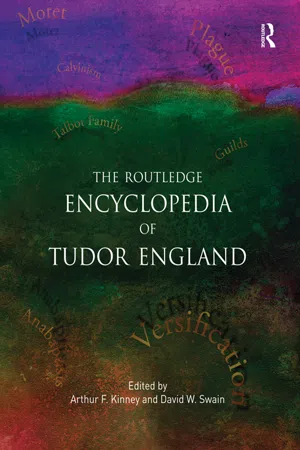
This is the first encyclopedia to be devoted entirely to Tudor England. 700 entries by top scholars in every major field combine new modes of archival research with a detailed Tudor chronology and appendix of biographical essays.Entries include: * Edward Alleyn [actor/theatre manager] * Roger Ascham * Bible translation * cloth trade * Devereux fami
A
Accession Day
During the later sixteenth century, the anniversary of the monarch’s accession became a national day of celebration. Under Henry VIII, the festivities at court associated with his accession on April 22 were subsumed in the celebrations of St. George’s Day (April 23) held either at Windsor or Greenwich. Elizabeth’s accession day, November 17, however, developed into an annual festival, which acted as a vehicle to express adoration for the queen. At court, the festivities centered on the accession day tilts, which, under the imaginative eye of Sir Henry Lee, the master of the armoury and queen’s champion, became elaborate neo-chivalric entertainments full of sophisticated allegories and symbolism. At the local level, the day was never a public holiday but was celebrated as a festival of thanksgiving marked by bell ringing, bonfires, and church services with special prayers.
Bibliography
Cressy, David. Bonfires and Bells: National Memory and the Protestant Calendar in Elizabethan and Stuart England. 1989.
Strong, Roy. The Cult of Elizabeth: Elizabethan Portraiture and Pageantry. 1977.
Strong, Roy. “The population of the accession day of Queen Elizabeth I.” Journal of the Warburg and Courtauld Institutes, vol. 21. 1959.
Yates, Frances. Astraea: The Imperial Theme in the Sixteenth Century. 1975.
Susan Doran
See Also
Calendar, Secular; Elizabeth I
Actors
A combination of public support and the construction of purpose-built playhouses fueled the development of the acting profession. The earliest players were liveried servants, connected with aristocratic households or the court interludes. They performed periodically, at the prerogative of their lords, and otherwise earned an uncertain living. The construction of public playhouses turned the occasional nature of performing into a more consistent, professional setting, establishing the companies on a more permanent footing, and creating opportunities for players to earn a more regular wage. Thus, by the 1590s, the itinerant player had turned into a shareholder, capable of earning a sizeable income. Throughout the heyday of the theater, between two and four adult companies dominated the theatrical scene, principally the Lord Admiral’s Prince Henry’s Elector Palatine’s Men, and the Lord Chamberlain’s King’s Men.
There seems not to have been a “typical actor” in terms of origins, education, or talent. Actors came from a variety of backgrounds. Some, like Edward Alleyn, were armigerous by birth while others were orphans apprenticed into companies by parish officials eager to avoid the stringent requirements of contemporary poor laws. Most actors seem to have been moderately well educated (though not university educated). A significant number were freemen of the London guilds, and those who left acting frequently returned to their trades. Actors could be classified as masters, hirelings, or apprentices. Masters (often coterminous with shareholders) invested heavily in the company and/or playhouse and bore the brunt of the responsibility for commissioning playbooks, purchasing costumes and props, and maintaining the playhouse. Hirelings were paid for each performance, or on a weekly or monthly basis, but they were not extended the opportunity to make a long-term investment. Apprentices were essentially the boy players (some of whom were paid a small annual wage in return for room, board, and training). Most adult companies consisted of roughly twelve men (the shareholders) and three or four boys, few of whom continued into adulthood as actors. (The boy companies—most of them attached to schools such as the Merchant Taylors School or St. Paul’s—functioned as separate entities from the adult companies. Their popularity vacillated, and they tended to perform either at the private playhouses or at court.)
Scholarly debate has not yet determined whether acting styles were naturalistic or highly stylized, although dramatic fashions clearly changed. What is clear, however, is that talent was as individualistic as the players themselves. Popular historical culture has privileged the actors of Shakespeare’s company, especially his principal tragedian (Richard Burbage), the loyal friends who constituted the First Folio of his plays (John Heminges and Henry Condell), and his clowns (Will Kemp, Richard Tarlton, and Robert Armin). However, accounts of players from other companies—such as Edward Alleyn, William Bird, and Edward Juby—indicate that English audiences enjoyed the talents of many competent (perhaps even charismatic) actors, a surprising number of whom devoted an entire lifetime to performing with a particular company.
Bibliography
Baldwin, T.W. The Organization and Personnel of the Shakespearean Company. 1927.
Bentley, Gerald E. The Jacobean and Caroline Stage. 1941.
Bentley, Gerald E. The Profession of Player in Shakespeare’s Time, 1590–1642. 1984.
Chambers, E.K. The Elizabethan Stage. 1923.
Davies, W.R. Shakespeare’s Boy Actors. 1939.
Gair, Reavley. The Children of Paul’s. 1982.
Gurr, Andrew. The Shakespearian Playing Companies. 1996.
Hillebrand, H.N. The Child Actors. 1926.
Joseph, Bertram. Elizabethan Acting. 1964.
King, T.J. Casting Shakespeare’s Plays: London Actors and Their Roles, 1590–1642. 1992.
Mann, David. The Elizabethan Player. 1991.
Nungezer, Edwin. A Dictionary of Actors. 1929.
Shapiro, Michael. Children of the Revels. 1977.
Streitberger, W.R. “Personnel and Professionalization.” In A New History of the Early English Drama. John D. Cox and David Scott Kastan, eds., pp. 337–335. 1997.
S.P. Cerasano
See Also
Alleyn, Edward; Armin, Robert; Burbage, Richard; Kemp, Will; Tarlton, Richard; Theaters; Theater Companies, Adult; Theater Companies, Boys
Acts of Religion
See Submission of the Clergy, Supremacy, Acts of; Uniformity, Acts of
Adamson, Patrick (1537–1592)
Born in Perth, Scotland, and educated at St. Andrews, Patrick Adamson, archbishop of St. Andrews, was appointed minister at Ceres in Fife in 1563. He came to feel intellectually stifled and, in 1566, renounced the position, spending the next five years abroad. He was briefly imprisoned in Paris for an impolitic poem exalting the newborn son of Mary Queen of Scots as “serenissimus princeps” of Scotland, England, France, and Ire-land; later, in Geneva, he studied Calvinism with Theodore Beza. Adamson returned to Scotland, and the ministry, around 1572, and published a catechism and a Latin translation of the Scottish Confession of Faith. Raised to archbishop in 1576, he skirmished with Presbyterian factions—in one incident a woman who cured him of an illness was accused of witchcraft and burned at the stake. He served as ambassador to Elizabeth I’s court in England in 1583, and, on his return, wrote his Declaration of the King’s Majesty’s Intention in the late Acts of Parliament (1585). His Presbyterian foes, led by Andrew and James Melville, launched a new series of attacks on his character and beliefs, culminating in his excommunication by the Synod of Fife in 1586. Adamson summarily excommunicated the Melvilles, and James VI (the “serenissimus princeps,” later James I of England) inter-ceded on Adamson’s behalf. The next year, though, he was excommunicated again, by the General Assembly, and now without the king’s support, Adamson was reduced to seeking the aid of Andrew Melville, who coerced him into a dubious recantation of his Declaration. Adamson’s other writings include Latin versions of several biblical books. He died in 1592.
Bibliography
Calderwood, David. True History of the Church of Scotland. 1678.
Wilson, Thomas. Memorial in Adamson’s complete works, De Sacro Pastoris Munere. 1619.
Mark Goldblatt
See Also
James VI and I; Melville, Andrew
Adiaphora
The translation of the Greek word adiaphora is “things indifferent.” The concept goes back to the earliest days of Christianity, when local churches developed customs peculiar to themselves that were not always readily understood or accepted elsewhere. The wider church was forced to distinguish between the essentials of the faith and the nonessentials. Before the Reformation, a pattern had been worked out whereby each autonomous branch of the church could determine its own rites and ceremonies, as long as these did not affect matters of doctrine. A good example of this is the way in which the Roman Catholic Church has accepted a married priesthood in the Eastern (Greek) rite, but forbidden it in the Western (Latin) rite. At the same time, each church was entitled, even expected, to enforce its discipline within its own sphere.
At the Reformation, Archbishop Thomas Cranmer used this principle to justify the changes he wanted to make to the rites and ceremonies of the Church of England, explaining this in the essay “On Ceremonies” in the Book of Common Prayer. In Elizabethan England, both the supporters of the establishment and the Puritans agreed that “things indifferent” could be decided by the local church, but they disagreed about how this should be done in practice.
Unfortunately, the establishment contained a large number of traditionalists who wanted to retain as much of the pre-Reformation ceremonial as possible. It also contained a number of inflexible disciplinarians not prepared to tolerate even minor divergences from the official norm. The Puritans did not usually object to the idea of order in worship, but they were disturbed that so much of what they saw reminded them of the Roman ways they had rejected. They also thought that a greater degree of flexibility was possible, and that severe disciplinary measures should not be taken against clergy merely because of a difference of opinion or practice concerning adiaphora.
The weakness of the establishment position was theological. It could not provide a biblical or spiritual rationale for its insistence on matters of indifference. On the other hand, the weakness of the Puritans was practical. They rejected the status quo, but could not agree about what to put in its place.
It was the tragedy of Elizabethan England that, as time went on, opinions on both sides hardened and moderates in both camps were silenced or ejected. In the end the Puritans were driven out of the church, leaving an Anglicanism in which the adiaphora were both compulsory and a mark of distinction from other Protestants.
Bibliography
Collinson, Patrick. The Elizabethan Puritan Movement. 1990.
Gerald L. Bray
See Also
Book of Common Prayer; Church of England; Cranmer, Thomas; Puritanism; Reformation, English
Adlington, William (c. 1541–?)
Best known for his translation of Lucius Apuleius’s The Golden Asse (1566), William Adlington completed his translation while at University College, Oxford; little else is known about him. The story of Lucius’s transformation into an ass, and his subsequent adventures and eventual return to human form through the divine intervention of Isis, also contains the myth of Cupid and Psyche. Both this myth and Lucius’s adventures were extremely popular, and The Golden Asse was reprinted in 1571, 1582, 1596, and 1600(?). In 1582, Stephen Gosson complained, “The Golden Ass … ha[s] been thoroughly ransacked to furnish the Playe houses in London”; after 1582, The Golden Asse was “ransacked” by Chapman, Heywood, Jonson, and Marston, and in 1600, Henslowe commissioned Dekker, Chettle, and Day to write a play (now lost) by the same name. Adlington’s translation was also an important source for Shakespeare’s asinine transformations in The Comedy of Errors and A Midsummer Night’s Dream, and Psyche’s trials in All’s Well That Ends Well and in Cymbeline.
Adlington may also be the author of a 1579 tract, A Speciall Remedie against the Furious Force of lawless Love, and of an unpublished Latin poem, The annotami of the Masse (1561).
Bibliography
Adlington, William, trans. The Golden Ass. Revised by Stephen Gaselee Loeb Classical Library. 1915; repr. 1974.
Benedikz, B.S. “A Note on Two Protestant Verse Polemics.” Cahiers Elisabethains, vol. 21, pp. 49–53.
Starnes, D.T. “Shakespeare and Apuleius.” PMLA, vol. 60, pp. 1021–1050.
Tobin, J.J.M. Shakespeare’s Favorite Novel: A Study of The Golden Asse As Prime Source. 1984.
Kerri Lynne Thomsen
See Also
Classical Literature, English Translations
Admonition Controversy
The admonition controversy is the name given to a doctrinal debate that developed as a result of two petitions, or Admonitions, composed in 1572. Puritans had been accused of opposing practices in the church thought to be nonessential, such as clerical vestments, and their protests had been dismissed accordingly, but the authors of the Admonitions took matters much further than this. They claimed that the very nature of the ministry, and thus of the church, was at stake in the controversies between them and the church authorities. What they wanted was a Presbyterianism modeled after the polity at Geneva, in which all ministers would be thoroughly trained and examined before being ordained. They also wanted ministers to be equal and given collective responsibility for church government. The Admonitions emphasized the preaching of the pure Word of God, what they deemed the correct administration of the sacraments, and above all the need to discipline ministers who failed to perform their duties adequately.
The first Admonition was presented to Parliament in June of 1572, too late to have any real effect on delibera-tions. But its clear and determined prose caused a flurry of excitement and led to various attempts to counter its effect. Before the end of the year, a second (and less impressive) Admonition had appeared, in answer to these critics. Authorship of the first Admonition is generally ascribed to Thomas Wilcox, but the second Admonition remains anonymous, in spite of attempts to assign it to Thomas Cartwright or one of his associates. Men of the persuasion that agreed with the beliefs in these documents were coming to be called Puritans, and one purpose of the Admonitions was to clarify what for many was still an unclear doctrinal position.
Clearly, the Admonitions touched a raw nerve in the church, since many of the criticisms opponents voiced touched on abuses. The church authorities were already trying to correct the more flagrant ones, and in a series of measures taken in 1571, they had legislated for a more learned and more clearly Protestant ministry. The authors of the Admonitions no doubt felt that time was on their side; but the speed at which they wished to push ahead was unacceptable to the government, and the queen was hostile to any change in her settlement. Nor did defenders of this settlement neglect to make a case against the Admonitions. John Whitgift did that with his Answer to the Admonition late in 1572; if his reply makes much duller reading than the original tract, the criticisms he leveled against it were devastating. Thomas Cartwright felt obliged to reply to Whitgift (1573), and this in turn produced an even longer work from the former in Defence of the Answer (1574). The controversy continued for many years, and was not ended until Cartwright finally accepted the Elizabethan Settlement in 1585.
Agitation began almost immediately to have the Admonitions confiscated. A proclamation to this effect was issued on June 11, 1573, but results proved disappointing. I...
Table of contents
- Cover
- Half Title
- Title Page
- Copyright
- Dedication
- Contents
- Preface
- Using This Book
- Dates, Quotations, and Bibliographies
- Acknowledgments
- A Tudor Chronology
- Contributors
- A to Z Entries
- Appendixes:
- Index
Trusted by 375,005 students
Access to over 1.5 million titles for a fair monthly price.
Study more efficiently using our study tools.
Frequently asked questions
Yes, you can cancel anytime from the Subscription tab in your account settings on the Perlego website. Your subscription will stay active until the end of your current billing period. Learn how to cancel your subscription
No, books cannot be downloaded as external files, such as PDFs, for use outside of Perlego. However, you can download books within the Perlego app for offline reading on mobile or tablet. Learn how to download books offline
Perlego offers two plans: Essential and Complete
- Essential is ideal for learners and professionals who enjoy exploring a wide range of subjects. Access the Essential Library with 800,000+ trusted titles and best-sellers across business, personal growth, and the humanities. Includes unlimited reading time and Standard Read Aloud voice.
- Complete: Perfect for advanced learners and researchers needing full, unrestricted access. Unlock 1.5M+ books across hundreds of subjects, including academic and specialized titles. The Complete Plan also includes advanced features like Premium Read Aloud and Research Assistant.
We are an online textbook subscription service, where you can get access to an entire online library for less than the price of a single book per month. With over 1.5 million books across 990+ topics, we’ve got you covered! Learn about our mission
Look out for the read-aloud symbol on your next book to see if you can listen to it. The read-aloud tool reads text aloud for you, highlighting the text as it is being read. You can pause it, speed it up and slow it down. Learn more about Read Aloud
Yes! You can use the Perlego app on both iOS and Android devices to read anytime, anywhere — even offline. Perfect for commutes or when you’re on the go.
Please note we cannot support devices running on iOS 13 and Android 7 or earlier. Learn more about using the app
Please note we cannot support devices running on iOS 13 and Android 7 or earlier. Learn more about using the app
Yes, you can access Tudor England by Arthur F. Kinney, David W. Swain, Eugene D. Hill, William A. Long, Arthur F. Kinney,David W. Swain,Eugene D. Hill,William A. Long in PDF and/or ePUB format, as well as other popular books in History & British History. We have over 1.5 million books available in our catalogue for you to explore.