eBook - ePub
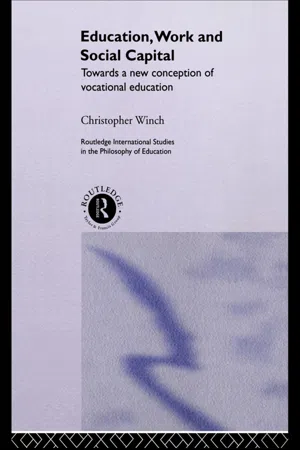
Education, Work and Social Capital
Towards a New Conception of Vocational Training
- 240 pages
- English
- ePUB (mobile friendly)
- Available on iOS & Android
eBook - ePub
About this book
This book provides an integrated treatment of the relationship between political economy and vocational education at the beginning of the twenty-first century. Approaching the subject from a philosophical perspective the author engages with debates about* the work-related aims of education * the moral and spiritual significance of work * the concep
Information
1 Introduction
THE MAIN ARGUMENT
There are relatively few books about the philosophy of vocational education, published in English. This is due, in large part, to a persistent cultural bias, particularly in the UK, against contaminating educational concerns with such gross matters as work and the economy. Anyone interested in promoting vocational education is thought to be a philistine, concerned only with material gain rather than with higher forms of human achievement. The main aim of this book is to show that this view is a travesty, that our deepest concerns with moral and spiritual well-being are bound up with work, and that any education directed towards the well-being of the vast majority who are not going to live the life of the country gentry of yesteryear needs to concern itself with preparation for work in the broadest sense. The richness and complexity, as well as the importance, of vocational education will then become apparent, and the subject may at last be taken with the seriousness it deserves by philosophers of education. That it should at last be taken seriously is the ambitious aim of this book.
The main theme is the relationship between politics, economic well-being and education. It is not a treatise in economics or politics, but in philosophy of education. However, in developing a philosophical view about education in general and vocational education in particular, it is unavoidable that certain theses about politics, economics and their respective relationships with education are advanced. These theses are, on the one hand meta-political, meta-economic and meta-educational, and, on the other, substantive normative theses about the conduct of politics, economics and education in developed and developing societies.
Put briefly, the ‘meta’ theses can be stated as follows. The view of politics presented here owes much to Aristotle. Any political society consists of different groups with different particular views of the good to be pursued in human life which are integrated in some way into a view of the common good for the society as a whole.1 Day-to-day politics concerns the working out of particular group and individual conceptions of the good within the framework of the society’s view of the common good. Such a common view of the good is necessarily complex and reflects both the diversity of the society and the relative strengths of the various groups whose contesting conceptions of the good happen to predominate. There are many different political structures, both democratic and non-democratic, in which political questions can be contested and resolved, but the normative side of the discussion in this book will be particularly concerned with democratic, although not necessarily liberal in any metaphysical sense, forms of polity. The liberalism argued for will be the contingent and non-foundational kind described by Gray as ‘agonistic’ or contested.2
The view of economics presented here is much broader than that usually presented by professional economists. Keynes wrote that ‘Consumption— to repeat the obvious—is the end and object of all economic activity.’3 This definition follows the classical tradition of conceiving economic activity in terms of maximising the production and circulation of consumable commodities, a conception derived from Adam Smith in particular. A little reflection shows, however, that although the academic study of economics may largely be concerned with the mechanics of the production, circulation and consumption of goods, a political conception of the subject (a political economy) will necessarily be concerned with a broader conception, which will encompass the scope of the discipline hinted at in Keynes’ definition of the aims of economic activity. This broader definition would have it that the aim of economic activity is the maintenance and reproduction of the society. Consumption will be a large part of that aim, since without consumption humans could not survive, let alone prosper. It is another matter to maintain, however, that consumption is the sole goal of economic activity or that the maximisation of consumption is the only goal of the study of economics and of economic policy.
For it is obvious, in the first place, that certain forms and certain degrees of consumption may actually be harmful to a society, either to individuals, to the environment they inhabit or to the interests of those yet to come, on whose well-being the future of the society depends. In this sense, political economy is concerned with the good of the society as a whole, not just with the maximisation of consumption. For such reasons did Mill advocate the redistribution of inheritances, List the development of national strength and even Keynes, the elimination of unemployment and the civilisation of the acquisitive instinct that underlies capitalism.4 Given this approach, the aims of economic activity will be complex, reflecting the various points of view and interests of different groups with competing conceptions of the good, together with the current balance of forces between them. The normative thesis of this book is very much concerned to give consumption its due place within broader concerns for the physical and social environment and the preservation and further development of society. The maintenance of intrinsically worthwhile activities, institutions and ways of life is to be accorded as much importance as the maximisation of consumption and more when they come into conflict.
Finally, the concept of education advanced here is also political in the broad, Aristotelian sense set out earlier. Education as a concept is concerned with preparation for life in its broadest sense, primarily, but not exclusively, with the preparation that takes place in childhood and youth. However, since there are different points of view as to what are appropriate forms of preparation for life, there are also different conceptions of education. These are subject to the contingent play of the relative strengths of different points of view as to what these form of life should be, and are inextricably bound up with different conceptions of what the ends of economic and political life should be.5 In this sense, one cannot disentangle a particular conception of education from particular conceptions of economic and political life. The importance and nature of vocational conceptions of education in any particular society is bound up with these contesting conceptions of economic life and the contesting conceptions of the good that animate politics. One of the main aims of this book is to explore the consequences for vocational education of taking genuine account of the different political conceptions of economic activity that are alive within developed and developing societies and, normatively, to link a preferred conception of vocational education with preferred conceptions of normative politics and political economy.
Two caveats concerning these contesting conceptions should be entered. First, a contest in this sense is not necessarily a zero-sum game where a gain for one conception is pure loss for an opposing one. Different conceptions of the good may only be incompatible to a degree, for example, if they contain common elements but differ in the respective emphases that they put on some of them. Very often contests about these competing conceptions amount to the degree of priority that should be accorded to one element rather than another, rather than about whether some elements should be totally eliminated from national life. For example, it is unlikely that anyone would wish to see the aim of consumption banished from conceptions of the economic good, but there may well be contesting conceptions concerned with the relative balance between present and future consumption, with the allocation of consumables, with the relative importance of private and public goods or with the balance between consumption and investment. Likewise in education, few would dispute that in some sense education is concerned with the growth of individual independence. However, the proponents of different conceptions may well dispute concerning the degree of independence desirable, the stages in life at which it should occur and the contexts in which it should be exercised.
It would also be wrong, in painting this picture of societies in which conceptions of the good compete with each other, to ignore the fact that rigidities within a society may cramp or even ossify that society’s ability to maintain such competition. In some ways this is good and necessary. There are times at which particularly bitter disputes must be settled and left behind. But it can also be unfortunate. As Hume pointed out, men are creatures of habit to a large extent and the status quo can easily be seen as having eternal validity. It frequently happens that if a prevailing conception takes hold at a crucial transition point in a society’s history then it comes to have an almost permanent status and surrounds itself with such prestige that it is only with great difficulty that it can be dislodged by conventional political means. Such was the case with the conception of economics as the maximisation of the production of commodities in the early stages of the industrial revolution, due largely to Adam Smith. Such was also the case with the conception of education as personal realisation that was adopted in the state system of education in the UK in the latter part of the nineteenth century, under the impact of the prestige of the education of the gentry, the influence of the churches and the prevailing laissez-faire view of economic activity.6
Briefly, the normative theses that will be argued for against the background of these respective conceptions of politics, economics and education are as follows. In relation to politics a non-foundational, contingent liberalism with a strong emphasis on collectivist, rather than individualist, solutions to political and social issues will be argued for. In relation to economics, it will be argued that economic policy in the kind of normative political context described above, needs to adopt as aims consumption and competitiveness, but also the opportunity for people to enjoy a certain degree of self-fulfilment in their lives predominantly, although not exclusively, through the production and consumption of high-skill, high-value goods and services. In relation to education, there needs to be a mix of liberal, vocational and civic-related aims of education, which take account of the need for social diversity, economic specialisation and social cohesion.
SOCIAL CAPITAL
In recent years it has become fashionable to use the term ‘capital’ in a much wider sense than that of labour power, raw materials, buildings and machinery. These can be physical or financial (the latter the power to command physical capital).7 It will be helpful to call this ‘economic capital’. We now speak about ‘human capital’, ‘cultural capital’ and ‘social capital’. To avoid confusion, it will be helpful to distinguish the senses in which these terms are used and to outline the way that they are going to be used in this book. Human capital is what Smith called ‘productive powers’, conceived of as the potential for labour of individuals.8 Nowadays it has been increasingly recognised that the skill and knowledge that an individual brings to work is an important part of that potential. Cultural capital refers to the moral and cognitive assets laid down by someone’s culture which they can draw upon as individuals; for example, a certain ability to use language. In Bernstein’s theory of codes, the ability to use an elaborated, as well as a restricted code in order to communicate in an impersonal, context-free manner would be an example of the ability an individual has in virtue of the capital on which he can draw through his membership of a community with a common culture, understood here as the rules, social relationships, customs, institutions and norms of a particular social group.9
The term ‘social capital’ has a longer history, but a more varied etymology. In the work of Mill and Marshall it refers to economic capital that is socially owned.10 In recent years, it has acquired meanings more akin to those of human and cultural capital. ‘Social capital’ can take an individualistic interpretation, referring to the sum total of human capitals or it can refer to the cultural assets on which individuals can draw in their individual economic activity. On the individualistic interpretation it has no reality beyond that of each quantity of human capital, that is the skill and knowledge that each individual in the society possesses. As such, it reflects a widespread interpretation of methodological individualism, that social assets have no further reality than the collections of individuals that associate together numerically, constituting a social collectivity.
‘Cultural capital’ on the other hand, points to a more collectivist interpretation of these social assets. Although ontologically, proponents of the notion of cultural capital may concede that there is no society without the individuals who compose it, they also hold that a society’s human assets consist of more than individual knowledge and skill. These cannot be understood independently of the social milieu in which they are created and in which they exist. One, Wittgensteinian, way of putting this point is to admit the ontological priority of human creatures for any society, but to argue that in terms of understanding human society it is necessary to appreciate the norms, customs and institutions that constitute that society. The individual human qua social being can only be understood as a member of a particular society and has his cognitive, moral and social life constituted in terms of the society in which he lives.11
The modern use of the term ‘social capital’ trades, at least implicitly, on this insight. For writers such as Coleman, social capital is constituted through the social relationships that people have with each other, through the collective knowledge of a group, and the moral, cognitive and social supervision that the group exercises over its members.12 On this view, one cannot understand individual human capital independently of understanding the social relationships within which it arises and which nurture and perpetuate it. Social capital in this sense has a strongly moral dimension. For example, it is often described in terms of norms of trust prevalent within a society.13
Something important is missing from these accounts of cultural and social capital. Without an understanding of the cognitive as well as the cultural and moral aspects of human a...
Table of contents
- COVER PAGE
- TITLE PAGE
- COPYRIGHT PAGE
- PREFACE
- ACKNOWLEDGEMENTS
- 1 INTRODUCTION
- 2 NECESSITY, WORK, EFFORT AND LEISURE
- 3 THE ECONOMIC AND WORK-RELATED AIMS OF EDUCATION
- 4 CONCEPTUALISING ECONOMIC LIFE
- 5 CONCEPTUALISING ECONOMIC LIFE
- 6 MORAL EDUCATION AND WORK
- 7 VOCATIONAL EDUCATION AND VOCATIONAL TRAINING
- 8 LEARNING IN THE WORKPLACE
- 9 TWO RIVAL CONCEPTIONS OF VOCATIONAL EDUCATION
- 10 EDUCATION AND LABOUR MARKETS
- 11 EDUCATION, WELL-BEING AND ECONOMIC GROWTH
- 12 THE SOCIAL VALUE OF WORK
- 13 EDUCATION AND THE END-OF-WORK THESIS
- 14 EDUCATION AND WORK IN A SOCIAL CAPITAL PERSPECTIVE
- 15 POLICY ISSUES
- BIBLIOGRAPHY
Trusted by 375,005 students
Access to over 1.5 million titles for a fair monthly price.
Study more efficiently using our study tools.
Frequently asked questions
Yes, you can cancel anytime from the Subscription tab in your account settings on the Perlego website. Your subscription will stay active until the end of your current billing period. Learn how to cancel your subscription
No, books cannot be downloaded as external files, such as PDFs, for use outside of Perlego. However, you can download books within the Perlego app for offline reading on mobile or tablet. Learn how to download books offline
Perlego offers two plans: Essential and Complete
- Essential is ideal for learners and professionals who enjoy exploring a wide range of subjects. Access the Essential Library with 800,000+ trusted titles and best-sellers across business, personal growth, and the humanities. Includes unlimited reading time and Standard Read Aloud voice.
- Complete: Perfect for advanced learners and researchers needing full, unrestricted access. Unlock 1.5M+ books across hundreds of subjects, including academic and specialized titles. The Complete Plan also includes advanced features like Premium Read Aloud and Research Assistant.
We are an online textbook subscription service, where you can get access to an entire online library for less than the price of a single book per month. With over 1.5 million books across 990+ topics, we’ve got you covered! Learn about our mission
Look out for the read-aloud symbol on your next book to see if you can listen to it. The read-aloud tool reads text aloud for you, highlighting the text as it is being read. You can pause it, speed it up and slow it down. Learn more about Read Aloud
Yes! You can use the Perlego app on both iOS and Android devices to read anytime, anywhere — even offline. Perfect for commutes or when you’re on the go.
Please note we cannot support devices running on iOS 13 and Android 7 or earlier. Learn more about using the app
Please note we cannot support devices running on iOS 13 and Android 7 or earlier. Learn more about using the app
Yes, you can access Education, Work and Social Capital by Christopher Winch in PDF and/or ePUB format, as well as other popular books in Education & Education General. We have over 1.5 million books available in our catalogue for you to explore.