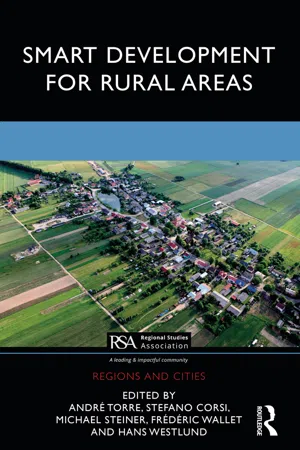
Smart Development for Rural Areas
  1. 226 pages
  2. English
  3. ePUB (mobile friendly)
  4. Available on iOS & Android
eBook - ePub

About this book

This thought-provoking book questions the framework of the Horizon 2020 strategy and the policies of smart development. It aims to answer the following question: Is there any possibility for a policy of smart development and smart specialization in rural and peri-urban areas? Based on detailed analytical studies, empirical and econometric methods, as well as various European case studies, several conclusions are drawn.

Smart development policies are well adapted to the developed or intermediate regions containing at the same time rural and urban areas, but do not really function for the more rural or more peripheral regions. The development policies of rural areas must be adapted to their particular characteristics, to the structure of their economies (agriculture, small firms), as well as in their diversity (distant regions, intermediate regions, rural areas near the urban areas). It appears interesting to exploit natural and cultural amenities, to develop the multifunctional character of the agriculture, to promote territorial innovation under all its forms, to favor the synergies between the various uses of land and space, and to develop the knowledge on the ecological, socioeconomic processes, as well as on the mechanisms of territorial governance.

These results are very important because they question the validity of the H2020 policy and the smart development and smart specialization policies and their applicability to the whole European area, and not only for the most urban and rich areas. It will be valuable reading for students, researchers and policy-makers in regional development, rural studies, spatial planning and economic geography.

Frequently asked questions

Yes, you can cancel anytime from the Subscription tab in your account settings on the Perlego website. Your subscription will stay active until the end of your current billing period. Learn how to cancel your subscription.
At the moment all of our mobile-responsive ePub books are available to download via the app. Most of our PDFs are also available to download and we're working on making the final remaining ones downloadable now. Learn more here.
Perlego offers two plans: Essential and Complete
  • Essential is ideal for learners and professionals who enjoy exploring a wide range of subjects. Access the Essential Library with 800,000+ trusted titles and best-sellers across business, personal growth, and the humanities. Includes unlimited reading time and Standard Read Aloud voice.
  • Complete: Perfect for advanced learners and researchers needing full, unrestricted access. Unlock 1.4M+ books across hundreds of subjects, including academic and specialized titles. The Complete Plan also includes advanced features like Premium Read Aloud and Research Assistant.
Both plans are available with monthly, semester, or annual billing cycles.
We are an online textbook subscription service, where you can get access to an entire online library for less than the price of a single book per month. With over 1 million books across 1000+ topics, we’ve got you covered! Learn more here.
Look out for the read-aloud symbol on your next book to see if you can listen to it. The read-aloud tool reads text aloud for you, highlighting the text as it is being read. You can pause it, speed it up and slow it down. Learn more here.
Yes! You can use the Perlego app on both iOS or Android devices to read anytime, anywhere — even offline. Perfect for commutes or when you’re on the go.
Please note we cannot support devices running on iOS 13 and Android 7 or earlier. Learn more about using the app.
Yes, you can access Smart Development for Rural Areas by André Torre, Stefano Corsi, Michael Steiner, Frédéric Wallet, Hans Westlund, André Torre,Stefano Corsi,Michael Steiner,Frédéric Wallet,Hans Westlund in PDF and/or ePUB format, as well as other popular books in Economics & Economic Conditions. We have over one million books available in our catalogue for you to explore.

Information

Year
2020
eBook ISBN
9781000067019
Edition
1

Part I

Main analytical results

1On smart business in rural areas

Entrepreneurship, innovation and their determinants

Sofia Wixe, Lucia Naldi, Pia Nilsson and Hans Westlund
In collaboration with Maryline Filippi, Danielle Galliano, Johannes Mossböck and Michael Steiner

1.1 Introduction

The ability of firms and regions to renew themselves is becoming increasingly important from the perspective of survival and competitiveness. Renewal, technological change, or innovation is also commonly perceived as the main driver of economic growth, which implies that innovation is important from both a micro- and a macro perspective. Following Schumpeter (1934), innovation should be regarded as a broad concept that incorporates not only new products, but also e.g. new production processes and new ways of doing business.
The concept of innovation used by the European Commission is indeed broader than technological innovation or improvements in technology. Innovation also encompasses new and improved services, new marketing, branding, and design methods as well as new forms of business organizations (European Commission 2010). These dimensions of innovation, which may better reflect the innovation efforts of firms located in rural regions, can be captured by specific survey instruments, such as the Community Innovation Survey (CIS). According to this enlarged perspective of innovation, also entrepreneurship, the start-up of new local businesses, is an important dimension of innovation, especially in rural contexts (cf. Kirchhoff (1994), p. 37, who regarded entrepreneurship as “innovation by newly formed independent firms”). The fact that these regions are less attractive for non-local enterprises makes the emergence and success of local new firms a key aspect of rural development.
It is thus well established that entrepreneurship and innovation are important drivers for economic development, particularly smart rural development (Naldi et al. 2015). A remaining question, which is the focus of this chapter, concerns the determinants for entrepreneurship and innovation in rural regions. The results and conclusions presented here are based on studies on three European countries – Austria, France and Sweden, using both quantitative and qualitative approaches. The specific determinants for innovation and entrepreneurship that are in focus in this report can be broadly defined in three groups; knowledge, diversity and amenities. This chapter summarizes the results from the studies undertaken within the TASTE project (work package 4), in combination with previous empirical studies.

1.2 Knowledge, diversity and amenities

Knowledge is commonly perceived as the most important resource for innovation (Tödtling and Kaufmann 2001). While internal knowledge is more important for firm performance (Black and Lynch (1996), Teece et al. (1997), and Blundell et al. (1999)), external knowledge provides an important resource for innovation activities (Chesbrough 2003) and the ability to exploit external knowledge is a crucial innovative capability of firms (Cohen and Levinthal 1990). Access to external knowledge through e.g. collaboration and networks is thus an important factor that influence innovation capacity (Tödtling and Kaufmann 2001). This is particularly relevant for small and medium-sized firms (SMEs) (Edwards et al. 2005; Rothwell 1991; Smallbone et al. 2003) as they commonly lack many of the necessary internal resources for innovation, such as financial resources for research and development (R&D) and access to high-skilled labor. In addition, firms located in sparse rural regions have lower access to local knowledge resources, such as highly educated employees and research centers (Tödtling and Trippl 2005). The hypothesis is thus that networks and collaboration provide one important dimension in the development of rural smart growth policies.
The importance of external knowledge for firm survival and growth is embedded in theories on agglomeration economies. Marshall (1890) argues that firms benefit from agglomeration due to reductions of transport costs, access to labor, and knowledge spillovers. Duranton and Puga (2004) argue along these lines and identify matching, sharing and learning as the micro-foundations of agglomeration economies. Regarding knowledge spillovers, or learning, Jacobs (1969) points to diversity as the driving force of growth and innovation. Firms benefit from being located in diverse environments due to the creation of new ideas that spill over between people and firms, which spur the innovative potential of firms.
In recent research, there is an argument that for diversity to give rise to knowledge spillovers some sort of cognitive proximity or complementarity between firms is required. This implies that diversity in related areas stimulates knowledge flows and thus innovation and growth. Frenken et al. (2007) denote this type of diversity as ‘related variety’. Related v...

Table of contents

  1. Cover
  2. Half Title
  3. Series Information
  4. Title Page
  5. Copyright Page
  6. Contents
  7. Notes on contributors
  8. Foreword
  9. Introduction: Is there a smart development for rural areas?
  10. Part I Main analytical results
  11. Part II Case studies in Europe
  12. Conclusion
  13. Index