Beef cattle production is a widespread industry carried out worldwide. Reproduction management is an essential tool that producers and veterinarians must realize to achieve the aim of beef production: to get pregnant high number of females, to develop and maintain gestations, to ensure easy-calving offspring and to wean healthy calves. Knowledge in the physiology of reproduction such as endocrinology of the estrus cycle and dynamics events in the reproductive tract in cattle has advanced in the last 20 years. Stages as puberty, anestrus, and cyclicity of cattle have been studied in detail after many experiments and publications from researchers from many countries, and these informations have favored for the massive application of biotechnologies of reproduction such as artificial insemination and fixed-time artificial inseminations. This chapter describes recent advances in bovine reproductive management emphasizing in different treatments for the synchronization of ovulation for natural breeding or fixed-time artificial insemination in beef cattle.
1.1INTRODUCTION
Beef production is a huge industry worldwide, and in Europe, Australia, North America, and South America extension forage-based systems are a commonly use practice for producers. Longevity and precocity are two features pursued by producers and have an important impact in the profitability and sustainability of the business. Heifers and cows must conceive every year to wean one calf, challenging the prepuberal and postpartum anestrus, respectively. Faced with nutritional deficiency, and depending on its severity, the natural physiological response is to renounce reproduction (Meikle et al., 2018). Therefore, there are many nutritional and hormonal strategies and calf management to prevent the physiological status above mentioned that could benefit heifers and suckled cows before the breeding season initiation.
Artificial insemination (AI) treatment protocols are an alternative tool to enhance reproductive management, not only by manipulating the estrus and ovulation or by inducing cyclicity (Lucy et al., 2001), but also by producing an advanced in genetics in the future calves generation. Hormonal treatments are efficient and economical strategies that enhance reproductive responses either in natural service (NS) or in fixed-time AI programs (FTAI; Baruselli et al., 2018). Recently, new technologies in relation with sexed-sorted semen are available for commercial applications (Bó et al., 2018a). These new technologies are a milestone in the industry of the FTAI and will be an interesting option to increase superior genetic of predefined sex calves. The objective of this chapter is to review different and recent hormonal treatments strategies to avoid negative effects of anestrus and will focus in new approaches of programs for FTAI for improving reproduction managements in beef cattle.
1.2BEEF HEIFERS AND BEEF COWS REPRODUCTIVE MANAGEMENT
In beef cattle production, the nutritional management of the herd is essential to attain cyclicity in both heifers and postpartum cows. Beef heifers must achieve puberty before breeding season (BS) and postpartum beef cows cyclicity depends on different main factors such as body condition score (BCS) at calving, body reserves (energy stores), suckling and nutrition (feed intake). BCS is an easy and quick method to predict adipose tissue reserves in animals and is useful to estimate the physiological active endocrine activity of different substances (insulin, IGF1, leptine, and adiponectin) that fine-tune the reproductive axis at central (hypothalamus-pituitary gland) and peripheral (ovaries, reproductive tract, and embryos) levels (Meikle et al., 2018). Briefly the BCS, based on a scale 1–9 score point (Herd and Sprott, 1986), in which code 1 is consider an emaciated animal (BCS 1) whereas code 9 indicates an obese animal (BCS 9). At the beginning of BS, the optimum BCS in all animal categories should be more than 5, with fluctuations lower than 1fold, to permit a normal occurrence of the estrus cycle. In beef cows if nutrition is adequate and allows for an increase gain plane, the first postpartum ovulation takes place on the third follicular wave after parturition (~30 days), but if beef cows present poor body condition and/or with undernourished conditions, ovulation is delayed (~70–100 days, reviewed by Crowe et al., 2014). Short et al. (1990) described the biological priorities for nutrient utilization by cattle, ranking in different vital physiological functions: (i) basal metabolism, (ii) motor activity, (iii) growth, (iv) basic energy reserves, (v) maintenance of pregnancy, (vi) lactation, (vii) additional energy reserves, (viii) estrus cycles and initiation of pregnancy, and (ix) excess reserves. Beef cattle have the unique ability to convert low-quality forages into meat and milk for the offspring, and in times of excess nutrition they deposit energy stores for future maintenance of bodily functions and production (Perry and Cushman, 2013).
During the postpartum period (Fig. 1.1), negative energy balance (NEB) is generated particularly by deficient nutrition and the presence of the offspring. The reproductive response increases the length of anestrus, decreased fertility and increases early embryo mortality. In cows, BCS at parturition was the most important factor that determines the period to re-conception postpartum (D’Occhio et al., 2019) and cows with high BCS synchronized with progesterone-based treatment protocols for FTAI had higher pregnancy rates than cows with poor BCS (Bó et al., 2002). Resumption of ovarian cyclicity is largely dependent on LH pulse frequency (Crowe et al., 2014) as well as the dominant follicle in the ovary should grow with the stimulation of many growth factors (e.g. IGF 1 family) and nutrients (Meikle et al., 2018). At calving, pituitary LH stores are low, because of high plasma concentration of progesterone in the early and medium gestation, and later estrogen is synthesized by placental tissue. The re-accumulation of pituitary stores of LH takes 2–3 weeks to complete (reviewed by Crowe et al., 2014). In Argentina, a common practice is to wean calves as early as ~ 60 days (early weaning), ~120 days (anticipated weaning) or later at ~150 days (traditional weaning). After the early weaning, calves are feed with high quality hay and a protein supplementation, and management must be done in a dry lot system with an intensive assistance during 40–50 days after weaning. Calf management enable to postpartum cow to return to cyclic stage between 10–20 days post weaning, preventing the maternal-offspring bonding, resulting in cyclic LH pulse frequency and periodic surge that will trigger a subsequent ovulation. First ovulation after parturition is generally silent (without behavioral estrus signs) and the first luteal phase would be, at least in 70% of cases, of short duration (short-live corpus luteum), in which oocyte can become fertilized. However, embryo arrests growing, an early luteolysis undergoes and the embryo dies prior to the maternal-embryo recognition (day 10–14 after ovulation).
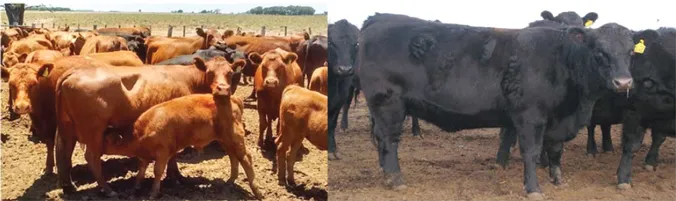
FIGURE 1.1 Left: Angus suckled beef cows and their calves at the beginning of spring breeding season (BS). Body condition score (BCS; scale 1:9) of cows in the image are among 5 to 6. Different strategies of managements, not only in cows but also in calves, can be done to enhance reproductive performance during BS. Right: 2-year old Angus beef heifers ready for breeding season. Heifers must attain at least 60% of mature body weight to be satisfactory for a breeding program.
Heifer reproductive management has been widespread studied in a large amount of research that is available in the literature (Gutierrez et al., 2014; Perry and Cushman, 2013). Beef heifers should be managed, well-nourished and selected for the reposition (Fig. 1.1). Puberty in heifers has been defined as the first ovulation that is accompanied by visual signs of estrus and normal luteal function. Selection criteria are focus in 3 basic concepts: (1) age, (2) body weight and (3) average daily gain (ADG) during rearing. Usually, the target weight considered suitable in beef heifer management practice is 65% of mature weight. The ideal developing varies among breeds, mature size, and some research works reported that puberty was obtained between 55% and 60% of mature body weight, suggesting that adequate growth and BCS are necessary for the initiation of normal estrus cycle (Perry and Cushman, 2013). Optimal timing of puberty in beef heifers requires an ADG of 0.6–0.7 kg/day (reviewed by D’Occhio et al., 2019), indicating that, similarly to postpartum cows, gain plane is essential for heifers reproduction success during the rearing period from weaning to puberty stage. In modern production systems, Bos taurus beef heifers might attain puberty, conceive, and achieve first calving at around 2 years, to optimize lifetime reproductive performance, and heifers that calve as early tend to calve early throughout their entire life (Reviewed by Perry and Cushman, 2013).
Previous to the BS, practitioners can examine the herd to determine if postpartum cows and/or heifers are ready, not only for natural service (NS) but also before the initiation of assisted reproductive technologies, such as estrus synchronization protocols for FTAI, superovulation protocols for in vivo-derived embryos and/or in vitro embryo production. BCS and nutrition are important factors that should be considered to evaluate, account that BCS should be 5–7 at the beginning of the season to ensure the likelihood of reproductive success.
In heifers, reproductive tract scoring (RTS) is a valid method to determine reproductive size development and maturation (Anderson et al., 1991). RTS uses rectal palpation and/or ultrasonography to de...
Table of contents
Cover
Half Title
Title Page
Copyright Page
About the Editors
Contents
Contributors
Abbreviations
Preface
Introduction
Foreword
Section I: Bovine
Section II: Equine
Index
Trusted by 375,005 students
Access to over 1.5 million titles for a fair monthly price.
Study more efficiently using our study tools.
Frequently asked questions
Yes, you can cancel anytime from the Subscription tab in your account settings on the Perlego website. Your subscription will stay active until the end of your current billing period. Learn how to cancel your subscription
No, books cannot be downloaded as external files, such as PDFs, for use outside of Perlego. However, you can download books within the Perlego app for offline reading on mobile or tablet. Learn how to download books offline
Perlego offers two plans: Essential and Complete
Essential is ideal for learners and professionals who enjoy exploring a wide range of subjects. Access the Essential Library with 800,000+ trusted titles and best-sellers across business, personal growth, and the humanities. Includes unlimited reading time and Standard Read Aloud voice.
Complete: Perfect for advanced learners and researchers needing full, unrestricted access. Unlock 1.5M+ books across hundreds of subjects, including academic and specialized titles. The Complete Plan also includes advanced features like Premium Read Aloud and Research Assistant.
Both plans are available with monthly, semester, or annual billing cycles.
We are an online textbook subscription service, where you can get access to an entire online library for less than the price of a single book per month. With over 1.5 million books across 990+ topics, we’ve got you covered! Learn about our mission
Look out for the read-aloud symbol on your next book to see if you can listen to it. The read-aloud tool reads text aloud for you, highlighting the text as it is being read. You can pause it, speed it up and slow it down. Learn more about Read Aloud
Yes! You can use the Perlego app on both iOS and Android devices to read anytime, anywhere — even offline. Perfect for commutes or when you’re on the go. Please note we cannot support devices running on iOS 13 and Android 7 or earlier. Learn more about using the app
Yes, you can access Biotechnologies Applied to Animal Reproduction by Juan Carlos Gardón, Katy Satué, Juan Carlos Gardón,Katy Satué in PDF and/or ePUB format, as well as other popular books in Medicine & Equine Veterinary Science. We have over 1.5 million books available in our catalogue for you to explore.