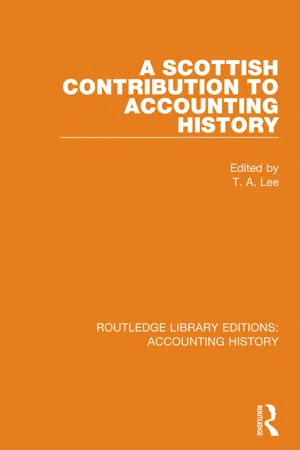
This book, first published in 1986, is a celebration of Scottish accounting influence and tradition. The essays are critical contributions to the study of accounting history, split into two main sections: the development of accounting thought and practice prior to the emergence of a regulated accountancy profession; and the problems faced in the first 70 years of the accountancy profession.
- 164 pages
- English
- ePUB (mobile friendly)
- Available on iOS & Android
eBook - ePub
A Scottish Contribution to Accounting History
Preprofessionalism
Anna B. G. Dunlop
Bibliographical Notes on Five Examples of Pacioli’s Summa (1494) in Scotland
Among five examples of the ‘Summa’ (1494), all in Scotland, four show minor bibliographical variations, but the fifth is a major variant.Typography, standard of printing, misprints and correction · aberrations of woodcut initial letters, paper and watermarks, collation, bindings and manuscript annotations are all examined, and relevant works of reference noted.Some possible inferences are drawn.Illustrations of the typesettings and drawings of the watermarks are provided, as is an appendix classifying the main variations found.The aim is to provide a methodological guide to the bibliographical comparisons which underlie textual comparisons.Key words: Bookkeeping; Books; History.
Of the five Summas examined, two are the property of The Institute of Chartered Accountants of Scotland, Edinburgh. In 1982 they were deposited on long-term loan, along with the rest of the Institute’s Antiquarian Book Collection, in the National Library of Scotland, Edinburgh. The other three copies1 are respectively in the libraries of the University of Glasgow, University of Edinburgh and Royal Observatory, Edinburgh (Crawford Library).
Four of the Summas are examples of what is generally agreed to be the first state of the first edition (editito princeps). (See Antinori, 1980; Dunlop, 1961).
The fifth, the ‘Edinburgh’ Summa of the Scottish Institute, is a variant of the first edition. The Scottish Institute’s other copy is referred to as the ‘Aberdeen’ Summa, because it was sent to the Institute’s headquarters from its then Aberdeen Library.
All five Summas are in good condition. All are set in romano-gothic type and have some manuscript notes in various hands, some of which, to judge by their style, were added early in the life of the volume. The book consists of two works by Pacioli, ‘Arithmetica’ and ‘Geometria’, bound together in that order.
- 1 In English, ‘copies’ may mean ‘replicas’, but equally may mean ‘examples’, especially of a book, in which case it means Originals’, as it is used here.
- Anna Dunlop now retired, was the Keeper of the Antiquarian Book Collection of the Institute of Chartered Accountants of Scotland and is a member of the Scottish Committee on Accounting History.The paper was presented at the Fourth International Congress of Accounting Historians, at Pisa in 1984. The author is indebted to Mr J. Baldwin (Glasgow University Library); Dr J. T. D. Hall (Edinburgh University Library); Dr. B. P. Hillyard (National Library of Scotland); Mr A. Macdonald (Royal Observatory Library, Edinburgh); and the Hon. Mrs Jane Roberts (Curator of the Print Room, Royal Library, Windsor) for giving their time to help and for sharing their expertise. She also thanks Professor C. Antinori (Parma University); Professor T. A. Lee (University of Edinburgh); and Dr G. A. Lee (University of Nottingham), for their encouragement.
The following notes were compiled in response to a request from Professor Antinori for comparisons among these copies of the Summa. The aim has been to provide a sufficiently detailed bibliographical framework to help others to identify other variants of the Summa (1494) and to lay a base for other researchers who may wish to carry out textual comparisons. It may also act as a methodological guide to research on other old books.
‘Aberdeen’ Summa (Aber.)
This was taken as the most easily accessible basis of the bibliographical comparison and therefore the standard against which the other four Summas were compared. Later evidence confirmed the likelihood that it was, in fact, probably the earliest printed of the five Summas examined.
Its provenance shows that it had belonged previously to The Institute of Chartered Accountants in England & Wales, in London. While in the possession of the English Institute, it had been fully bound in red morocco by Zaehnsdorff (signed), with that Institute’s insignia stamped in gold on the front cover, and with the pages gilt-edged on three sides. In 1933 the English Institute, lacking a second edition of the Summa (1523) and having more than one copy of the first edition, offered one of their first edition Summas to the Scottish Institute’s then Aberdeen library, in exchange for the second edition Summa which was there.
The type face used in the Summa (Aber.) is consistent throughout and accords with typesetting A, described by B. Boncompagni (1862-63), as quoted by Clarke (1974) but includes on the first page of the Arithmetica, folio 1 recto (A), the seven lines printed in red noted in Boncompagni’s setting C.
The decorative initials, though roman, are consistent in their style, except for one or two slight variations introduced from other founts.
The first page of text of the Arithmetica includes a woodcut border of a white interlaced design, Celtic in style, on a black background. The text begins with the letter L, which is ornamented, in a large square, with a line drawing, against a ‘snowstorm’ background, of a monk holding a pair of compasses, with an open book in front of him. Presumably it was intended to represent Pacioli, who became a Franciscan friar while still a professor of mathematics.
This woodcut block letter L appears four more times in the book, one place being the beginning of the text of Distinctio nona (9) Tractatus xi (De computis & de scripturis), the treatise on double-entry book-keeping, at f. 198 verso (A). The other positions are ff. Ill verso (A), 150 recto (A) 182 verso (A) and 198 verso (A).
The following pecularities appear only in the Summa (Aber.): f. 23 recto (A) folio number is printed as 24, f. 57 recto (A) folio number is printed as 64, f. 71 recto (A) folio number is not printed, and f. 223 verso (A) decorative initial A is the right way up. The folio number mistakes, corrected in all four other Summas, are typical of early printings, though f. 223 verso (A) may have been printed later in the run. Two watermarks, a duck and a set of scales (a hanging weighing balance) have been identified in this Summa. These are the most easily found identifying features of the editio princeps Summa, compared with the other four Summas studied.
Glasgow University Library Summa (GUL)
The University of Glasgow acquired this Summa in 1928, when it was bequeathed, along with the rest of his book collection, by David Murray, a Glasgow lawyer who was a noted historian and bibliophile (Stevelinck, 1972). He mentions Pacioli’s Summa in his posthumously published book on the history of accounting (Murray, 1930).
This Summa is half bound in leather, with pages gilt-edged on three sides. Someone has inserted, throughout, manuscript paragraph signs in red ink.
Typographically it agrees with the description of the Summa (Aber.), although there are a few minor differences (some of which have been detailed above, by implication, in the list of distinctions peculiar to that Summa).
In addition, in the Summa (GUL): f. 209 recto (A) ‘questi’ (last word) is printed as ‘quest’; f. 25 recto (G) ‘Modus’ (in a subheading) is correctly aligned. The watermarks are the same as in the Summa (Aber.)
Edinburgh University Library Summa (EUL)
Another distinguished donor was responsible for the presentation of this Summa. This was Philip Kelland, Professor of Mathematics at the University of Edinburgh from 1838 to 1879, whose signature appears on the fly-leaf. The book is quarter-bound in vellum, on marbled boards. The edges of the printed pages are coloured red.
Again, it is typographically similar to the Summa (Aber.), though not entirely, e.g. f. 25 recto (G) ‘Modus’ is correctly aligned.
A particularly interesting manuscript note on the first page (Contents) adds ‘& fuorj’ (‘and elsewhere’) after ‘del quaderno in vinegia’ (‘on the ledger in Venice’), referring to the double-entry treatise.
Additional manuscript pages, whose watermark differs from those of the printed pages, are bound in at the end of the printed pages. Here the fore-edges are left untrimmed and uncoloured. The MS consists of 29 folios, together with the verso of the last printed folio, making 59 pages.
The manuscript begins on the verso (blank of printing) of f. 76 (Geometria). Some of the MS pages, a few of which are in Latin, though most are in Italian, bear the dates 1497, 1501, 1502 etc. The MS must therefore have been added to the Summa (EUL) by its first, or a very early, owner.
Most of the pages are in the same hand, a fast, cursive, pre-italic script, different from the writing in marginal notes in the printed part of the book, though similar to the ‘& fuorj’ noted above. It is a small, assured handwriting. The only material breaks in it are on ff. 19 verso and 20 recto, which are blank, and on ff. 20 verso and 21 recto, where the handwriting changes to a larger, more irregular style, but still in Italian. Thereafter it reverts to the original hand.
Folio 3 verso has the name ‘philippi callandrj’ at the top, and the first line contains the word ‘denaro’ (‘money’). Many pages have the sign of the cross ( + ) at the top. There are many geometrical diagrams in the earlier pages. The pages in a different hand contain a mysterious circular diagram with an inscription, and a dagger in the centre.
No reference to this MS has been found in Kelland’s published pamphlets in Edinburgh University Library. However, Dr J. T. D. Hall has identified the presumed writer of the main MS as Filippo Calandri, a Florentine, whose ‘Aritmética’, now extremely rare, was printed in Florence by Lorenzo de Morgiani and Giovanni Thedesco da Maganza (‘the German from Mainz’) and issued on 1 January 1491.
As a Florentine, it would be natural for Calandri —presumably an early, or the first, owner of the Summa (EUL) —to dispute Pacioli’s description of double-entry as ‘the method of Venice’, by adding ‘& fuorj’ (‘and elsewhere’), since Florence may well have preceded Venice in its use!
Acting on further information from Dr Hall, an excellent copy of Cal...
Table of contents
- Cover
- Half Title
- Title Page
- Copyright Page
- Original Title Page
- Original Copyright Page
- Dedication Page
- Table of Contents
- Introduction
- Preprofessionalism
- Professionalism
- Overview
Trusted by 375,005 students
Access to over 1.5 million titles for a fair monthly price.
Study more efficiently using our study tools.
Frequently asked questions
Yes, you can cancel anytime from the Subscription tab in your account settings on the Perlego website. Your subscription will stay active until the end of your current billing period. Learn how to cancel your subscription
No, books cannot be downloaded as external files, such as PDFs, for use outside of Perlego. However, you can download books within the Perlego app for offline reading on mobile or tablet. Learn how to download books offline
Perlego offers two plans: Essential and Complete
- Essential is ideal for learners and professionals who enjoy exploring a wide range of subjects. Access the Essential Library with 800,000+ trusted titles and best-sellers across business, personal growth, and the humanities. Includes unlimited reading time and Standard Read Aloud voice.
- Complete: Perfect for advanced learners and researchers needing full, unrestricted access. Unlock 1.5M+ books across hundreds of subjects, including academic and specialized titles. The Complete Plan also includes advanced features like Premium Read Aloud and Research Assistant.
We are an online textbook subscription service, where you can get access to an entire online library for less than the price of a single book per month. With over 1.5 million books across 990+ topics, we’ve got you covered! Learn about our mission
Look out for the read-aloud symbol on your next book to see if you can listen to it. The read-aloud tool reads text aloud for you, highlighting the text as it is being read. You can pause it, speed it up and slow it down. Learn more about Read Aloud
Yes! You can use the Perlego app on both iOS and Android devices to read anytime, anywhere — even offline. Perfect for commutes or when you’re on the go.
Please note we cannot support devices running on iOS 13 and Android 7 or earlier. Learn more about using the app
Please note we cannot support devices running on iOS 13 and Android 7 or earlier. Learn more about using the app
Yes, you can access A Scottish Contribution to Accounting History by T. A. Lee in PDF and/or ePUB format, as well as other popular books in Business & Business General. We have over 1.5 million books available in our catalogue for you to explore.