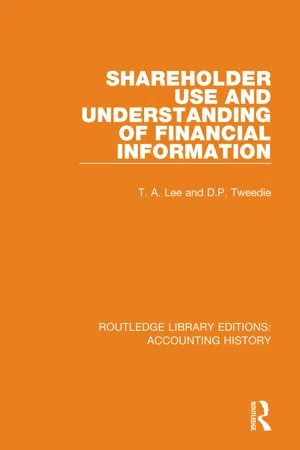
This book, first published in 1977 and reissued in 1990, examines one of the most familiar aspects of accountancy – that of company financial reporting. Assessing the view that shareholders have little time for financial reports, this book presents the findings from a research project analysing whether or not shareholders understand financial reports; what they do and don't understand; their use of financial reports; the type of shareholders who have the most, and least, understanding and who make most, and least, use of financial reports.
- 430 pages
- English
- ePUB (mobile friendly)
- Available on iOS & Android
eBook - ePub
Shareholder Use and Understanding of Financial Information
The Institutional Investor and Financial Information
THE INSTITUTIONAL INVESTOR
AND
FINANCIAL INFORMATION
A report sponsored by the Research Committee of
The Institute of Chartered Accountants in England and Wales
The Institute of Chartered Accountants in England and Wales
THE INSTITUTE OF CHARTERED ACCOUNTANTS
IN ENGLAND AND WALES
CHARTERED ACCOUNTANTS’ HALL, MOORGATE PLACE,
LONDON EC2P 2BJ
1981
IN ENGLAND AND WALES
CHARTERED ACCOUNTANTS’ HALL, MOORGATE PLACE,
LONDON EC2P 2BJ
1981
This study is sponsored by the Research Committee of The Institute of Chartered Accountants in England and Wales and does not necesarily represent the views either of the Research Committee or of the Council of the Institute.
No responsibility for loss occasioned to any person acting or refraining from action as a result of any material in this publication can be accepted by the authors or publisher.
© 1981 T. A. Lee and D. P. Tweedie
ISBN 0 85291 301 X
All rights reserved. No part of this publication may be reproduced, stored in a retrieval system, or transmitted, in any form or by any means, electronic, mechanical, photocopying, recording or otherwise, without the prior permission of the publisher.
Alsace Print-Production Ltd., London, SW1
Contents
Preface and Acknowledgements
1 Introduction
Identifying the ‘sophisticated’ investor
How important is the ‘sophisticated’ investor?
2 Research Methodology and Survey Respondents
The sample
The survey response
The interviews
Background factors
Respondents’ sex
Number of shareholdings in portfolio
Value of portfolio
Final say in investment decision making
Experience of institutional investment
Experience of using accounting information
Accounting training
Summary of background factors
Respondents and non-respondents
Approach to analysis
3 Understanding Financial Information
Assessing actual understanding
Perceived understanding of respondents
4 Assessing Actual Understanding of Traditional Financial Information
General nature of reporting
Nature of financial statements
Accounting terminology
Accounting valuation bases
Financial ratios
Summary
5 Further Assessment of Actual Understanding of Financial Information
Understanding scores
Constructing the index of understanding
The index of understanding
Perceived relevance and actual understanding
Summary
6 Assessment of Actual Understanding of Inflation Accounting
Nature of inflation accounting statements
Inflation accounting terminology
CCA valuation bases
Understanding scores
Constructing the index of understanding
Perceived relevance and actual understanding
Summary
7 Respondents’ Views on the Use Made of Financial Information in Their Organisations
Useful financial information
The use of external financial advisers
Information analysis
Forecasting of results
Summary
8 Individual Respondents’ Use and Assessment of the Annual Report
Respondents’ reading of the annual report
Perceived importance of sections of the annual report
Useful information in annual reports
Reading pattern of the individual respondent
Supplementary inflation accounting statements
Summary
9 Individual Respondents’ Use of Other Sources of Information
Use of other sources of financial information
Perceived importance of other sources of financial information
Use of all sources of published information
Useful information found in published sources other than the annual report
Summary
10 Respondents’ Views on Company Visits
Companies visited by respondents’ organisations
The objectives of company visits
Perceived importance of company visits
Summary
11 Understanding, Rending Behaviour and Respondents’ Background
Readership and understanding
Understanding, readership and type of respondent
Understanding, readership and shareholdings
Understanding, readership and portfolio valuation
Understanding, readership and final say
Understanding, readership and investment experience
Understanding, readership and use experience
Understanding, readership and accounting experience
Summary
Understanding of inflation accounting and respondents’ background
Areas of misunderstanding of traditional reporting practice
12 Summary, Conclusions and Recommendations
Summary
Conclusions
Recommendations
13 Appendices
14 Bibliography
Preface and Acknowledgements
In 1974, we embarked on the task of obtaining evidence of the use and understanding of financial information by shareholders of limited companies. It appeared then to us that it was important to establish whether or not shareholders used available information (and, if so, to what extent); and also whether or not they had a reasonable understanding of such information. Seven years later, we are now in a position to report on the last major part of this project — that is, a study of the financial experts in the shareholder community; namely, institutional investors and stockbrokers.
The earlier parts of the project had concerned the individual private shareholder, and his use and understanding of available financial information (see the bibliography for a list of the relevant publications). In this respect, we believed it was desirable to separate the private shareholder from his professional counterpart and, consequently, this study examines in some depth the latter person. The main objectives are the same as in the previous studies — to evidence the degree to which corporate financial reports and other sources of financial information about companies are used and understood by investors — in this case, by ‘sophisticated’ investors. We have gathered together what we believe to be unique evidence in this respect, telling us much about the way in which the professional investment community processes financial information prior to making its investment decisions.
The areas covered in this study are similar to those examined in relation to the private shareholder — that is, shareholder understanding of various aspects of traditional financial reporting practice (including, inter alia, financial statements, accounting terminology and asset valuation); and use of corporate annual reports and other sources of financial information (including, inter alia, interim financial statements and press reports). However, the opportunity has also been taken to expand the coverage to include such matters as the role of company visits by institutional investors and stockbrokers; the nature of the financial analysis process utilised by them; and their use and understanding of inflation accounting statements. It was felt that such extensions to the previously tested areas of information use and analysis provided us with a reasonable coverage of the major matters of concern in the general area of financial information use and understanding.
As in the main private shareholder study, the research method was by means of an interview questionnaire which enabled suitable data to be gathered for further analysis. The latter activity contained a mixture of straightforward reporting of response aggregates, together with suitable cross-analyses of processed data with various background characteristics of the respondents. These cross-analyses were also aided by the use of composite data which distinguished different types of readers of corporate annual reports, and different levels of reader comprehension.
All the respondents in this study could be classified as financial experts as they we...
Table of contents
- Cover
- Half Title
- Original Title Page
- Original Copyright Page
- Title Page
- Copyright Page
- Acknowledgement
- Introduction
- The Private Shareholder and the Corporate Report
- The Institutional Investor and Financial Information
Trusted by 375,005 students
Access to over 1.5 million titles for a fair monthly price.
Study more efficiently using our study tools.
Frequently asked questions
Yes, you can cancel anytime from the Subscription tab in your account settings on the Perlego website. Your subscription will stay active until the end of your current billing period. Learn how to cancel your subscription
No, books cannot be downloaded as external files, such as PDFs, for use outside of Perlego. However, you can download books within the Perlego app for offline reading on mobile or tablet. Learn how to download books offline
Perlego offers two plans: Essential and Complete
- Essential is ideal for learners and professionals who enjoy exploring a wide range of subjects. Access the Essential Library with 800,000+ trusted titles and best-sellers across business, personal growth, and the humanities. Includes unlimited reading time and Standard Read Aloud voice.
- Complete: Perfect for advanced learners and researchers needing full, unrestricted access. Unlock 1.5M+ books across hundreds of subjects, including academic and specialized titles. The Complete Plan also includes advanced features like Premium Read Aloud and Research Assistant.
We are an online textbook subscription service, where you can get access to an entire online library for less than the price of a single book per month. With over 1.5 million books across 990+ topics, we’ve got you covered! Learn about our mission
Look out for the read-aloud symbol on your next book to see if you can listen to it. The read-aloud tool reads text aloud for you, highlighting the text as it is being read. You can pause it, speed it up and slow it down. Learn more about Read Aloud
Yes! You can use the Perlego app on both iOS and Android devices to read anytime, anywhere — even offline. Perfect for commutes or when you’re on the go.
Please note we cannot support devices running on iOS 13 and Android 7 or earlier. Learn more about using the app
Please note we cannot support devices running on iOS 13 and Android 7 or earlier. Learn more about using the app
Yes, you can access Shareholder Use and Understanding of Financial Information by T. A. Lee,D.P. Tweedie in PDF and/or ePUB format, as well as other popular books in Business & Business General. We have over 1.5 million books available in our catalogue for you to explore.