Low-level river crossings, including culverts, are important for delivering a range of valuable socioeconomic services, including transportation and hydrological control. These structures are also known to have negative impacts on freshwater river system morphology and ecology, including the blockage of upstream fish passage, particularly small-body-mass fish species. Given the enormous environmental problems created by road crossings, new hydraulic engineering guidelines are proposed for fish-friendly multi-cell box culvert designs.
The focus of these guidelines is on smooth box culverts without appurtenance, with a novel approach based upon three basic concepts: (I) the culvert design is optimized for fish passage for small to medium water discharges, and for flood capacity for larger discharges, (II) low-velocity zones are provided along the wetted perimeter in the culvert barrel, and quantified in terms of a fraction of the wetted flow area where the local longitudinal velocity is less than a characteristic fish speed linked to swimming performances of targeted fish species, and (III) the culvert barrel is smooth, without any other form of boundary treatment and appurtenance.
The present monograph develops a number of practical considerations, in particular relevant to box culvert operations for less-than-design discharges. It is argued that upstream fish passage capabilities would imply a revised approach to maintenance, in part linked to the targeted fish species.
This reference work is authored for civil and environmental engineers, as well as biology and ecology scientists interested in culvert design. While the book is aimed to professionals, the material is also lectured in postgraduate courses and in professional short courses.
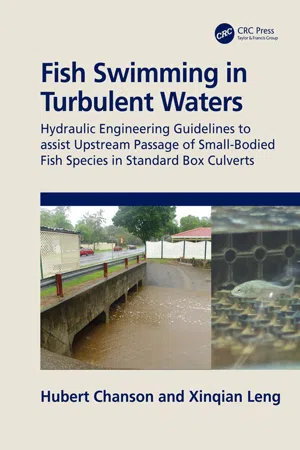
eBook - ePub
Fish Swimming in Turbulent Waters
Hydraulic Engineering Guidelines to assist Upstream Passage of Small-Bodied Fish Species in Standard Box Culverts
- 182 pages
- English
- ePUB (mobile friendly)
- Available on iOS & Android
eBook - ePub
Fish Swimming in Turbulent Waters
Hydraulic Engineering Guidelines to assist Upstream Passage of Small-Bodied Fish Species in Standard Box Culverts
About this book
Information
Chapter 1
Introduction
1.1 Presentation
Low-level river crossings are important for delivering a range of important socioeconomic services, including transportation and hydrological control. These structures are also known to have negative impacts on freshwater river system morphology and ecology, including the blockage of upstream fish passage (Warren and Pardew, 1998, Anderson et al., 2012). The manner in which waterway crossings block fish movement include perched outlet,1 high velocity and insufficient water depth in the culvert barrel, debris accumulation at the culvert inlet, and standing waves in the outlet or inlet (Behlke et al., 1991; Olsen and Tullis, 2013). And it is closely linked to the targeted fish species. For small, weak-swimming fish species, the upstream traversability of the culvert barrel is too often a major obstacle, especially because of the high water velocities. In order to restore upstream fish passage in culverts over the widest extent possible, the thrust of this monograph is to apply a physically based design methodology to yield cost-effective culvert structures, with the aim to maintain and restore waterway connectivity for a range of small-bodied and juvenile native fish species.
A culvert is a covered channel designed to pass flood waters, drainage flows, and natural streams through embankment structures (e.g. roadway, railroad) (Fig. 1.1). (Appendix A details a glossary of technical terms.) The cross-sectional shape of the culvert barrel may be circular (pipe) or rectangular (box and multicell box), and may be designed as a single-cell or multiple-cell structure. In terms of hydraulic engineering, a box culvert is basically a covered rectangular channel, with a converging section at the entrance, called the inlet, and a diverging section at the exit, called the outlet. The culvert channel is typically narrower than the natural river channel. The narrowest part of the culvert is the barrel or throat. Sometimes, rectangular cells are placed side by side to increase the discharge capacity (i.e. a multicell box culvert). Figures 1.1A and 1.1B present typical examples of modern multicell box culverts, and further examples are illustrated in Chanson and Leng (2019). Figure 1.2 shows some culvert operations for medium to large discharges. In one case (Fig. 1.2A), the road embankment was over-topped, and the discharge at the time of the photograph was larger than the design discharge.2 The movie CIMG50.48.mov (Appendix F) illustrates a box culvert operation at full capacity.
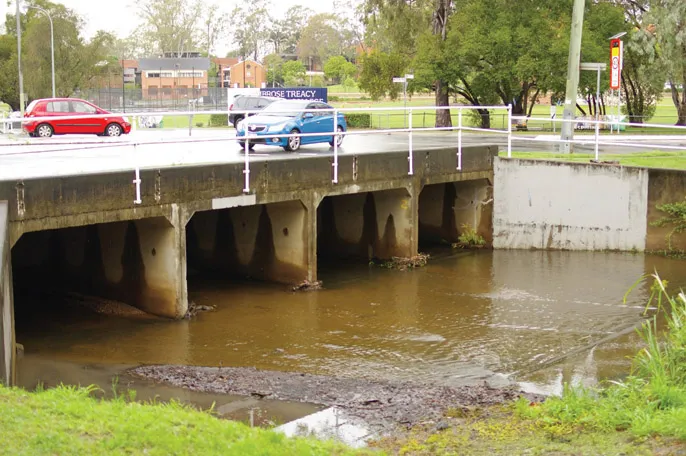
(A) Culvert inlet below Kate Street, Indooroopilly QLD, Australia, on 15 October 2018
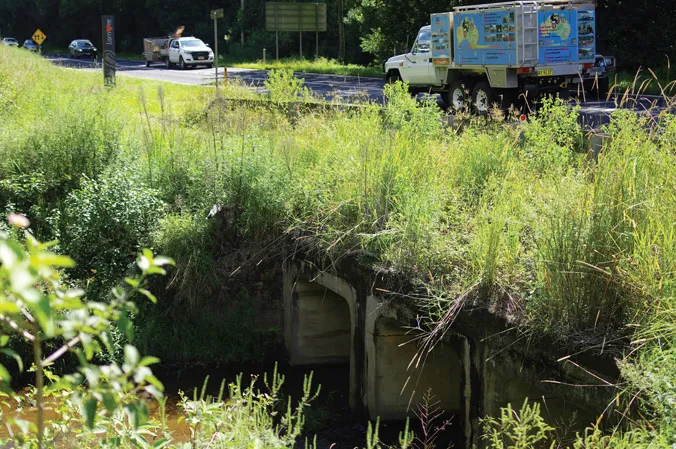
(B) Outlet of three-cell standard box culvert along Marom creek beneath Bruxner highway B60 at Wollongbar NSW, Australia, on 15 March 2018
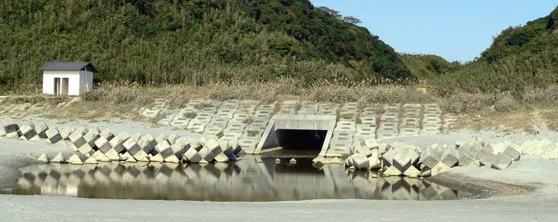
(c) Culvert along the Enshu coast, Japan, on 21 November 2008
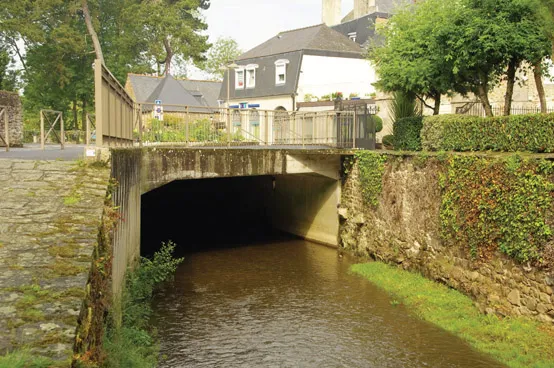
(D) Culvert inlet along Le Gouessant river at Lamballe, France, on 26 June 2019
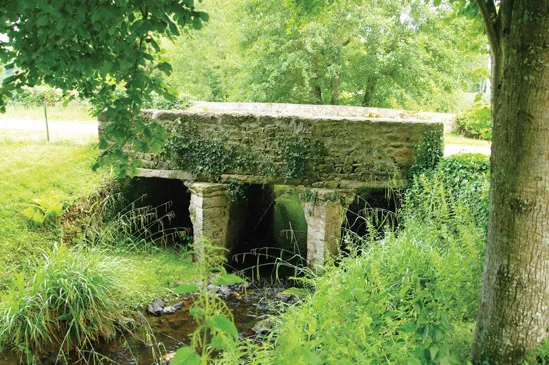
(E) Multicell masonry culvert inlet along the Flora river at Pléneuf-Val-André, France, on 27 June 2019 – construction second half of 19th century
Figure 1.1 Photographs of standard box culverts
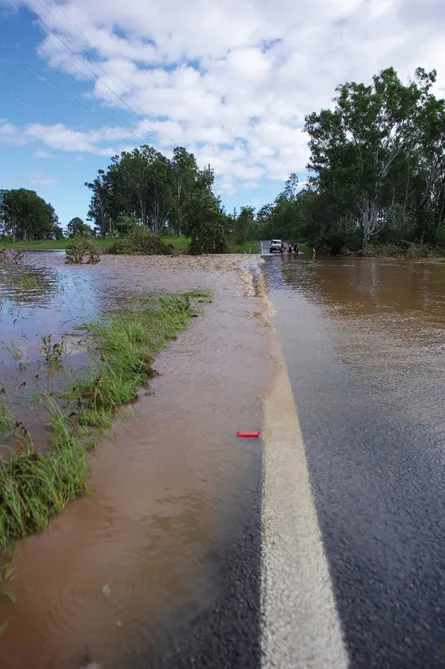
(A) Submerged culvert road embankment in the Coomera river catchment QLD on 31 March 2017 following tropical cyclone Debbie – runoff from right to left
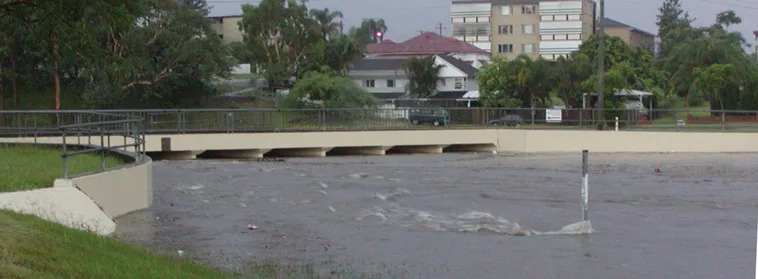
(B) Culvert inlet operation during Norman creek flood on 21 December 2001, Greenslopes QLD, Australia – culvert beneath Cornwall Street
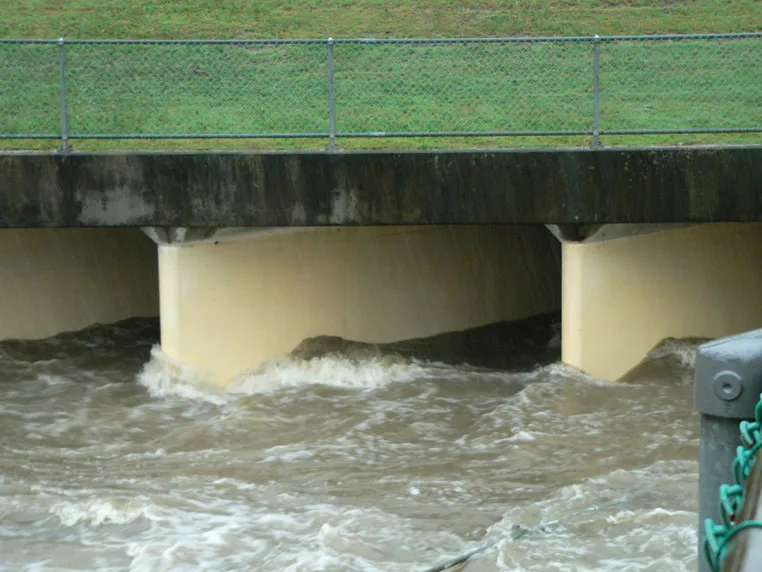
(C) Culvert operation (barrel entrance) during Norman creek flood on 20 May 2009, Greenslopes QLD, Australia – culvert beneath Ridge Street
Figure 1.2 Culvert operation in eastern Australia
During operation, the fluid flow motion in a culvert is complicated because of the boundary conditions and flow turbulence. The prediction of the fluid dynamics is challenging due to the broad range of culvert shapes and designs (Figs. 1.1 and 1.2). For discharges up to the design discharge, the culvert structure should operate as a free-surface flow. The open channel fluid dynamics are intricate because of the complicated interactions between the water and a number of mechanisms, including the boundary friction, gravity, and turbulence (Rouse, 1938; Chow, 1959; Henderson, 1966). Traditionally, open channel flows have been modeled based upon one-dimensional, depth-averaged equations, which predict the mean flow properties (i.e. the bulk velocity Vmean and water depth d). The approach encompasses a fair level of empiricism: “this simple 1D approach is clearly problematic” (Morvan et al., 2008, p. 192). In relation to upstream fish passage, by far a most pertinent flow property is the velocity distribution in the vicinity of solid boundaries, given that small fish predominantly swim upstream next to the bottom corners and sidewalls (Blank, 2008; Jensen, 2014; Katopodis and Gervais, 2016; Wang et al., 2016a; Cabonce et al., 2019). A complete characterization of the velocity field requires a detailed investigation, which may be undertaken physically in the laboratory, numerically using computational fluid dynamics (CFD), and possibly theoretically for a few simplistic cases. Laboratory measurements must be based upon a large number of data points to characterize the main stream, boundary regions (i.e. next to bed and walls), and secondary flows, for example, more than 250 to 300 sampling points per cross-section for a given flow rate, as in the studies of Wang et al. (2018) and Cabonce et al. (2018, 2019). Although the implementation of complex three-dimensional (3D) CFD models in aeronautics and industrial flows has become common (Roache, 1998; Rizzi and Vos, 1998), the application of this approach is much more recent in open channel flows, with inherent difficulties in applying 3D CFD to free-surface flows, for example, the air–water interface, complicated geometry, and roughness definition (Rodi et al., 2013; Khodier and Tullis, 2018; Zhang and Chanson, 2018). Appendix D discusses more specifically the application of 3D CFD to fish-friendly box culvert barrel modeling.
1.2 Impact of road crossings
Freshwater fish species constitute about one-quarter of all living vertebrates and are considered an at-risk group due to deleterious habitat impacts. In Australia, for example, there are about 250 freshwater fish species, with approximately 30% listed as threatened under state and commonwealth legislations (Allen et al., 2002; Lintermans, 2013). The negative effects of river crossings on freshwater fish species have been well documented in the literature (Warren and Pardew, 1998; Briggs and Galarowicz, 2013). Culvert structures create physical or hydrodynamic barriers that often prevent or reduce access to essential breeding and feeding habitats. The direct consequences of losing access to and fragmentation of river habitats on fish encompass reduced recruitment, restricted range size, and changes in fish population composition (Dynesius and Nilsson, 1994; O’Hanley, 2011). Apart from impeding fish passage, road crossing barriers can act in other disruptive ways. Examples include modified suspended and bed load sediment...
Table of contents
- Cover
- Half Title
- Title Page
- Copyright Page
- Dedication Page
- Contents
- List of symbols
- Acknowledgments
- Declarations of interest
- About the authors
- Foreword
- 1 Introduction
- 2 Hydraulic engineering design of standard box culverts – current practice
- 3 Fish passage in standard box culverts
- 4 Hydraulic engineering design for upstream fish passage in standard box culverts: general concepts and design guidelines
- 5 Design application
- 6 Discussion and practical considerations
- 7 Conclusion
- Appendices
- References
- Author index
- Subject index
Trusted by 375,005 students
Access to over 1.5 million titles for a fair monthly price.
Study more efficiently using our study tools.
Frequently asked questions
Yes, you can cancel anytime from the Subscription tab in your account settings on the Perlego website. Your subscription will stay active until the end of your current billing period. Learn how to cancel your subscription
No, books cannot be downloaded as external files, such as PDFs, for use outside of Perlego. However, you can download books within the Perlego app for offline reading on mobile or tablet. Learn how to download books offline
Perlego offers two plans: Essential and Complete
- Essential is ideal for learners and professionals who enjoy exploring a wide range of subjects. Access the Essential Library with 800,000+ trusted titles and best-sellers across business, personal growth, and the humanities. Includes unlimited reading time and Standard Read Aloud voice.
- Complete: Perfect for advanced learners and researchers needing full, unrestricted access. Unlock 1.5M+ books across hundreds of subjects, including academic and specialized titles. The Complete Plan also includes advanced features like Premium Read Aloud and Research Assistant.
We are an online textbook subscription service, where you can get access to an entire online library for less than the price of a single book per month. With over 1.5 million books across 990+ topics, we’ve got you covered! Learn about our mission
Look out for the read-aloud symbol on your next book to see if you can listen to it. The read-aloud tool reads text aloud for you, highlighting the text as it is being read. You can pause it, speed it up and slow it down. Learn more about Read Aloud
Yes! You can use the Perlego app on both iOS and Android devices to read anytime, anywhere — even offline. Perfect for commutes or when you’re on the go.
Please note we cannot support devices running on iOS 13 and Android 7 or earlier. Learn more about using the app
Please note we cannot support devices running on iOS 13 and Android 7 or earlier. Learn more about using the app
Yes, you can access Fish Swimming in Turbulent Waters by Hubert Chanson,Xinqian Leng in PDF and/or ePUB format, as well as other popular books in Technology & Engineering & Civil Engineering. We have over 1.5 million books available in our catalogue for you to explore.