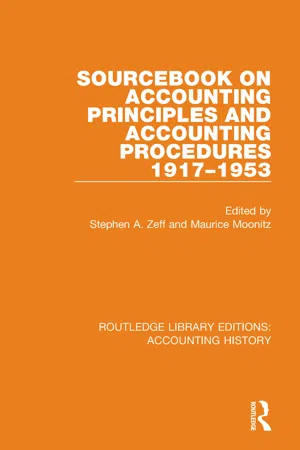
This book, first published in 1984, collects together a host of valuable research papers published on accounting and auditing principles and procedures from the years 1917 to 1953. They are a key resource on the history and development of the accounting professions.
eBook - ePub
Sourcebook on Accounting Principles and Accounting Procedures, 1917-1953
- 354 pages
- English
- ePUB (mobile friendly)
- Available on iOS & Android
eBook - ePub
Sourcebook on Accounting Principles and Accounting Procedures, 1917-1953
Inventories
A Preliminary Statement by the Research Department of the American Institute of Accountants
The research department, having carried its study of inventories to a certain point, desires to submit for discussion and criticism certain basic propositions which have been put forward. The committee on accounting procedure has briefly discussed these propositions, but has not in any sense reached conclusions with respect to them. The committee scarcely expects to adopt all the points listed; but would be glad to hear from anyone who wishes to comment on any of these propositions, or to add others to them.
The basic propositions affecting the statement of inventories in the accounts are as follows:
- The determination of profit and loss is the main consideration.
- The primary basis for inventories is useful (or recoverable) cost.
- When, therefore, market is lower than cost, correct income determination requires that the existence of a deficiency in useful cost be taken up as a loss.
- In a case in which it could be shown that a decline in raw-material purchase prices would not be realized in a loss from a decline in selling prices of finished products, the raw-material inventory may be stated at cost.
- This is the true significance of the “cost or market” rule, which is approved in this sense, as a general proposition.
- It is undesirable to specify any one rule for defining “cost” or “market,” to the exclusion of others.
- But consistent practice from period to period is essential, and changes of practice should be explained.
- The basis should be disclosed in some detail in the balance-sheet caption or by footnote. Whenever a company makes a general statement of its accounting principles, in an annual report or elsewhere, a description of its inventory practice should be a part of such a statement. In subsequent annual reports the requirements of full disclosure may be met, in part at any rate, by reference to this statement.
- Under 8, “cost” may be first-in first-out, last-in first-out, average, base-stock, or standard, though any one of these may be preferable in a specific case.
- Similarly “market” may mean reproduction cost, replacement cost, etc.
- In the determination of cost, first-in first-out and average may be regarded as general practices not calling for special mention. Any other practices should be specifically named or described.
- The committee’s statement will deal only with the financial accounts, as they become reflected in the balance-sheet and income statement, which furnish a report of stewardship by the management, and of earnings and their availability for dividends. Records subsidiary or supplementary to the financial accounts will not be discussed.
- When market is used because it is below cost, the amount of the adjustment should be separately shown in the income statement.
- The use of market or other values as a basis for allocation of joint costs is not an abandonment of the cost basis, and should be differentiated from the statement of inventories at market.
- “ Market” must take cognizance of condition, obsolescence, salability, etc.
- Repossessed goods, and goods taken in exchange, should be valued at amounts which, when re-conditioning costs have been added thereto, will be less in total than selling values by a margin approximating anormal profit.
- “Cost or market” means by items, unless specifically described otherwise.
- A practice sometimes followed is the “reserve” method, in which the adjustment from cost to present market is accomplished by a reserve account. Its distinguishing feature is that it may result in an inventory being reduced to market, and then adjusted upward with a recovery of the market, provided it does not go above original cost.
It would seem that the first five points mentioned above might furnish a basis on which those who favor the traditional cost-or-market basis might find themselves in agreement with the protagonists of a cost basis. Both groups agree that accounting is essentially a matching of costs against income, and differ only as to the time when certain portions of income or cost shall be recognized in the accounts. The cost-basis advocates are for the most part ready to recognize a loss arising from damaged or obsolete goods, since the recovery of that part of cost has thereby been jeopardized, if not made impossible.
It is but a short step to say that costs whose recovery has been jeopardized by a decline in market prices should also be written off as losses, and this is the purpose of the cost-or-market rule. The rule has perhaps been too simply or too sweepingly stated; it is not surprising that it looks illogical to some to say that the replacement market should govern the statement of inventories, but only when the replacement market has declined. Stated in that form it is illogical. But when the rule is regarded as essentially an adherence to cost, but regarding “cost” as “recoverable cost,” the difference between the two groups practically disappears.
All comments addressed to the research department of the American Institute of Accountants will be carefully considered in formulating its statement on this question.
Inventories
A Tentative Statement by the Research Department of the American Institute of Accountants
Foreword
The statement below is preliminary in character, and is issued jjl for the purpose of inviting comment which may be of assistance in developing a release by the committee on accounting procedure. It is published at this time in the hope that it may be the subject of discussion—formal or informal, at the forthcoming meeting of the Institute.
The June issue of The Journal carried a condensed statement of tentative propositions on inventories. A number of letters were received containing comments upon that statement, which have been helpful to the committee on accounting procedure and to the research department in preparing the statement presented below. There has also been considerable correspondence within the committee and the research department and it is clear that today not all the statements in the subjoined paper would command general agreement among the members of the committee. In particular there is substantial difference of opinion on the question, how far conservatism may legitimately be carried in the statement of inventories. This is one phase of the general question of the part of conservatism in accounting which the committee may deem to call for separate discussion.
The questions discussed are of such general interest that it is desirable to give all accountants the widest opportunity to oiler comment and suggestion before the committee proceeds further. The committee would like to make a statement, not merely of existing practices, but of the most desirable bases of stating inventories. It is, therefore, hoped that all who may have such comments will forward them as early as possible to the research department at the offices of the Institute.
The subject is of such great and wide-spread importance, that the committee is anxious to get the fullest expression of opinion upon it from members engaged in any kind of accounting work.
Inventories
General Considerations
The amounts at which inventories are stated at the beginning and end of an accounting period have a direct effect on (a) the amount of income shown for the period and (b) the computation of the current ratio, working capital, and other balance-sheet factors which are of especial importance where short-term credit is involved.
Determination of income is usually the more important objective. If, however, there is any question of solvency, the amount at which inventories are carried in the current assets on the balance-sheet may well be the more important, or at any rate the more immediate, consideration. Even in such cases inventories are not ordinarily realizable except through the operation of the business as a going concern, to which accurate reporting of income is still the question of major importance.
But accounting must undertake to deal with inventories satisfactorily from both of these viewpoints and, in general, the inventory methods which have been evolved accomplish this. During recent years, the change of emphasis from the balance-sheet to the income statement has had an influence in effecting changes in accounting practice in relation to inventories. The use of “last-in, first-out” in certain cases is an example; this method as sometimes applied may result in subordinating the function of the inventory as a factor in the showing of the current position.
It would not be practicable or desirable to agree upon any single basis as the most appropriate for the statement of inventories in all cases. Different conditions, and varying emphasis on different objectives, wilt properly and necessarily give rise to the use of different bases by different companies, and particularly by a company in one line of business as compared with another company in another line of business. For the same reason, when a single company is engaged in different lines of business, it may appropriately use different bases for different parts of its inventory.
Another vitally important consideration is that the inventory which is in effect a credit to the operations of one year is a charge against the operations of the next, so that any advantages which may be derived from employing a method which results in a higher inventory figure are only transitory.
The consistent application of accounting principles from year to year by a particular company, which has been so much emphasized of late, is nowhere more important than with respect to inventories. A change of inventory basis should be regarded as a major change of accounting policy and the effect of the change, if material, should be fully disclosed in the accounts of the period in which the change is made. For tax purposes the Bureau of Internal Revenue exerts a general influence against changes in the inventory basis used by individual companies and for the most part the purposes of accounting are best served by that policy.
In each particular case the inventory basis should be selected which will best show the facts in that case. The basis used should be disclosed, and particularly should be fully set forth whenever a company makes a general statement of its accounting principles.1 If two companies do not use the same inventory basis their income accounts can scarcely be comparable—particularly for a short period.
It seems desirable to delimit the scope of this study by dealing only with accounting principles which affect the amounts at which inventories are stated in financial statements (balance-sheets and income accounts) which are prepared for the use of management, and are distributed to those outside the management as a report of stewardship.
Questions concerning the methods to be used in determining the inventory quantities, description, and condition are important, but are related to auditing rather than to accounting principles, and will not be discussed here. It will be assumed that the company has adequate facilities for establishing the quantities and for determining the dollar amounts thereof in accordance with the accounting principles set forth in this paper. It is recognized that the inventory quantities may be obtained in either of two ways, both of which are widely used in practice and, in many cases, both methods may be used by the same company for different parts of its inventory. In a company with integrated cost-accounting records and so-called “perpetual inventory records,” the basic quantity figures for the closing inventories are usually obtained from such records. The accuracy of these perpetual records is ordinarily checked by comparing test counts of the physical goods against the records, and these tests may be made all at one time or from time to time during the year. Where such “perpetual records” are not maintained, the inventory quantities are determined by inspection and count, weight, or measurement of the goods on hand at the end of an accounting period. In some cases, the count, weight, or measurement is taken a short time before or after the end of the period, and is adjusted to give effect to transactions affecting inventories between that date and the actual closing date.
1The New York Stock Exchange includes this point among those on which the management is required to express its policy. See also the correspondence between the American Institute of Accountants and the Stock Exchange in 1932.
This paper will also exclude from its scope auxiliary or supplementary records relating to inventories which the management may consider useful for its purposes. Since such records are frequently designed to reflect managerial operating policies rather than corporate financial results, inventories may be stated in them by methods which are in conflict with the principles here set forth. For example, the sales department may be furnished with product cost figures based on raw materials at current market prices, or materials may be transferred from one department to another at current market prices to stimulate a competitive spirit among departmen...
Table of contents
- Cover
- Half Title
- Title Page
- Copyright Page
- Original Title Page
- Original Copyright Page
- Table of Contents
- Part I: Papers published by the Research Department of the American Institute of Accountants in reference to the work of the Committee on Accounting Procedure and the Committee on Audit-ing Procedure, 1940–1953. (All papers first appeared in The Journal of Accountancy.)
- “Inventories: A Tentative Statement,” October, 1940
- “Foreign Operations and Foreign Exchange,” January, 1941
- “Clients’ Written Representations Regarding Inventories, Liabilities, and Other Matters,” March, 1941
- “Accountants’ Reports—or Certificates,” May, 1941
- “Should the Term ‘Surplus’ Be Eliminated?” May, 1942
- “Current Practice in Accounting for Special War Reserves,” August, 1942
- “Confirmation of Inventories in Public Warehouses,” November, 1942
- “Valuation of Inventories,” January, 1943
- “Balance Sheet Classification of’ V Loans,” February, 1943
- “Effects of Wartime Government Regulations on Auditing Procedure,” March, 1944
- “Accountant’s Report and Opinion,” March, 1944
- “Accountants’ Responsibility on Securities Registrations,” May, 1944
- “Comment on ‘Accounting for Income Taxes,’” March, 1945
- “Nature and Purpose of the Income Statement,” September, 1945
- “Corporate Accounting Principles,” October, 1945
- “ ‘Tax Reductions’ in Statements of Income,” February, 1946
- “Inventory Reserves,” September, 1947
- “Appropriation, Not Charges, Recommended to Cover Inflated Replacement Cost,” October, 1947
- “Disclosure in Financial Statements: Codification of Institute Pronouncements,” August, 1948
- “Institute Committee Rejects Change in Basis for Depreciation Charges,” November, 1948
- “Illustrating Methods of Income Presentation under Accounting Research Bulletin No. 35,” December, 1948
- “An Inquiry into the Reliability of Index Numbers,” April, 1949
- “Problems Engaging Immediate Attention of the Committee on Accounting Procedure,” July, 1949
- “Should Estimated Current Value of Inventories Be Disclosed?” September, 1949
- “Accounting Problems Arising from Devaluation of Foreign Currencies,” January, 1950 (Reproduced in volume I, part II)
- “Suggestions for Operating Under SEC’s New Rules Governing Financial Statements,” February, 1951
- “Should Goodwill Be Written Off?” April, 1952
- “Accounting for Stock Options: Why Accounting Research Bulletin 37 Was Revised,” April, 1953
- “Some Problems Regarding Consolidated and Parent Company Statements,” November, 1953
- Appendix: List of Members and Terms of Office of the Committee on Accounting Procedure, 1938-1953
- Part II: Activities of the Securities and Exchange Commission in the field of accounting and auditing: Annual Reports of the Securities and Exchange Commission, 1939-1953
- Report of the Special Committee on Stock Dividends, September 11, 1929
- Further Announcement on Stock Dividends, April 30, 1930
- Letter of October 8, 1931, from the Exchange President to listed companies, urging the publication of quarterly statements
- Letter of January 12, 1932, from J.M.B. Hoxsey, Executive Assistant of the Committee on Stock List, to the presidents of listed companies, conveying the Committee’s attitude on the disclosure of certain information in companies’ annual reports
- Letter of December 18, 1933, from Frank Altschul, Chairman of the Committee on Stock List, to the Exchange’s Governing Committee, recommending certain changes in the Listing Agreement relating to reacquired shares and stock options and warrants
- Letter of February 5, 1934, from J.M.B. Hoxsey to the oil companies listed on the Exchange, requesting information about certain of their accounting practices
- Memorandum of May 15, 1934, by the Committee on Stock List, reporting the results of its survey of certain accounting practices of 30 oil companies listed on the Exchange
- Letter of March 23, 1936, from J.M.B. Hoxsey to listed companies, suggesting the publication of 12-month reports at quarterly intervals
- Letter of July 15, 1936, from J.M.B. Hoxsey to the presidents of listed companies, advising that companies will not be expected to estimate the new federal surtax on undistributed profits in their interim reports
- Report of August 11, 1939, of the Sub-Committee on Independent Audits and Audit Procedure of the Committee on Stock List regarding certain matters affecting the work of the independent public accountant
- Letter of July 10, 1941, from P.L. West, Acting Director of the Department of Stock List, to the presidents of listed companies, regarding the treatment of federal income tax in interim earnings statements
- Letter of July 28, 1943, from President Emil Schräm to the presidents of listed companies regarding the impact of renegotiation proceedings on the disclosures in interim earnings statements
- Statement on Stock Dividends of October 7, 1943, The Journal of Accountancy, November, 1943
- Statement on Stock Dividends, May 28, 1948
- Letter of January 10, 1949, from President Emil Schräm to the presidents of listed companies, regarding the effects of rapid price changes on the reporting of earnings (Also reproduced in volume I, part II)
- Statement on Stock Dividends, February 19, 1953
Trusted by 375,005 students
Access to over 1.5 million titles for a fair monthly price.
Study more efficiently using our study tools.
Frequently asked questions
Yes, you can cancel anytime from the Subscription tab in your account settings on the Perlego website. Your subscription will stay active until the end of your current billing period. Learn how to cancel your subscription
No, books cannot be downloaded as external files, such as PDFs, for use outside of Perlego. However, you can download books within the Perlego app for offline reading on mobile or tablet. Learn how to download books offline
Perlego offers two plans: Essential and Complete
- Essential is ideal for learners and professionals who enjoy exploring a wide range of subjects. Access the Essential Library with 800,000+ trusted titles and best-sellers across business, personal growth, and the humanities. Includes unlimited reading time and Standard Read Aloud voice.
- Complete: Perfect for advanced learners and researchers needing full, unrestricted access. Unlock 1.5M+ books across hundreds of subjects, including academic and specialized titles. The Complete Plan also includes advanced features like Premium Read Aloud and Research Assistant.
We are an online textbook subscription service, where you can get access to an entire online library for less than the price of a single book per month. With over 1.5 million books across 990+ topics, we’ve got you covered! Learn about our mission
Look out for the read-aloud symbol on your next book to see if you can listen to it. The read-aloud tool reads text aloud for you, highlighting the text as it is being read. You can pause it, speed it up and slow it down. Learn more about Read Aloud
Yes! You can use the Perlego app on both iOS and Android devices to read anytime, anywhere — even offline. Perfect for commutes or when you’re on the go.
Please note we cannot support devices running on iOS 13 and Android 7 or earlier. Learn more about using the app
Please note we cannot support devices running on iOS 13 and Android 7 or earlier. Learn more about using the app
Yes, you can access Sourcebook on Accounting Principles and Accounting Procedures, 1917-1953 by Stephen A. Zeff, Maurice Moonitz, Stephen A. Zeff,Maurice Moonitz in PDF and/or ePUB format, as well as other popular books in Business & Business General. We have over 1.5 million books available in our catalogue for you to explore.