This book examines the power relations that emerge from the convergence of the universe in which the sporting spectacle is produced and the universe in which a city is produced.
It adopts Bourdieu's concept of field to explore the interests and disputes involved in the production of sports mega-events across different times and spaces and the role of host cities in these processes. It aims to identify the bases that give these spectacles the power to produce disruptions in the social fabric of the host cities and countries, and to enable the production of authoritarian forms of exercising power. By observing the historical constitution of the field of production of sport spectacle as an autonomous field, this book explores how sport mega-events create both an arena and a context for radical expressions of authoritarianism of neoliberal planning models.
It will be of interest to students, scholars and professionals in architecture and urban studies, urban planning, municipal governance, sport and leisure studies, and those interested in the relationship between State and capital in the production of urban space.
Part 1 Production of sports spectacle on a global scale
1Laying the field
A genealogy of sport spectacle1
Introduction
Strong images, together with rituals and symbolism, are all elements that have given support to sporting events ranging from the most expressive – such as the Football World Cup or the Olympic Games – to schoolyard scavenger hunts. It is difficult to imagine these kinds of event without considering fair play, the forms in which they are celebrated, and the comradery they promote among athletes of different races, cultures, and nations. Magical scenes of the opening and closing ceremonies, moments of surpassing limits while competing for medals, and the emotional tears of spectators watching their country consecrated as champion are all part of this imaginary.
When these occasions take on the character of a mega-event,2 they can promote the projection and redefinition of the international image of a host country and city. Mega-events – which have always been associated with major urban development projects and with the movement of economic, political, and symbolic capital – have become major objects of desire among governments. Places that host mega-events produce profound regulatory and institutional ruptures and realignments across multiple scales of power.
The idea of amateurism – substantiated by the discourse of disinterest and de-politicization – has come to legitimate the pretense of autonomy of modern sports as a specific field of production and to bestow upon sports the power to constitute their own political and financial structures that are legally autonomous in relation to the rules that govern society in general. In contemporary times, the principles and rules laid out in the International Olympic Committee’s (IOC) Olympic Charter (IOC 2019a) and in the statues of Fédération Internationale de Football Association (FIFA 2019) – together with a tangle of recommendations, codes, guarantees, contracts, and even specific tribunals – has further consolidated this autonomy.3 These mega-events hold powers that extrapolate the field of sport spectacle and impose restraints on the legal structures of the countries and cities that host them, as we will see in Chapters 3 and 6.
Researchers who observe the constitution of modern sports as a sort of rupture in relation to their “ancestral” activities (Huizinga 1980; Elias & Dunning 1986a; Bourdieu 1993) identify the development of a more elaborate set of rigid, explicit rules as one of the essential characteristics responsible for the radical differentiation separating modern sporting practices from earlier physical exercises or games.
When a grouping of sports practices is organized around international tournaments and other competitions, the specific rules governing each modality are not sufficient. New rules must be made in order to determine how and in what conditions the system of institutions and agents directly or indirectly connected to these competitions’ practices and modes of consumption must function. First, regulations are established for the functioning of groupings intended to assure representation of the interests of athletes in a given modality or grouping of modalities (such as forms of organization, the conditions for membership, deliberative processes, rule-making procedures, etc.). Soon, other rules are added, such as those relating to the functioning of events and associated roles (teachers, coaches, doctors, etc.) or to the necessary conditions for the venues in which these events occur (such as stadium architecture or infrastructure and security demands) as well as other rules that govern the production and commerce of symbols, goods, and services related to these events.
There is a common-sense tendency to consider rules as a given, as existing unto themselves in an ontological sense. However, as Elias (1986b) notes, rules do not have their own existence; even as they dictate behaviors, they are established, (re)produced, or modified as the result of agreements and compromises between agents or groups of agents who act in specific historical conditions. Rules have not always existed; rather, they themselves are products of disputes and represent dominant interests within the institutions that maintain them in a given moment in time. The observance of these rules depends not only on the strength of the institutions that produce them but also on the behavior and efforts of certain groups in maintaining control of their application.
Therefore, understanding current relationships between cities and mega-events must necessarily pass through an understanding of the historical processes of production of rules and conventions that determine the conduct of agents who act in producing sporting spectacles. How and why are particular forms of organization structured in such a way as to make the development of these rules possible? This is one of the questions that this chapter aims to address.
Very rarely has observing rules, their effects, and the conditions that has made their origin and development viable within each historical context been the object of scientific exploration. Among these rarities is the work of Norbert Elias (1986a, 1986b) who conducts systematic studies of the historical development of rules established in different games and disputes involving physical exercise. Elias’s studies range from combat games in ancient Greece to tournaments and popular games in the Middle Ages and the forms to which the specific nomenclature of sport was attached beginning in the seventeenth and eighteenth centuries. Elias’s objective is to identify the moment and the form in which certain pre-existing physical exercises began to take on a radically new meaning, transforming them into sports per se, endowed with objectives, functions, rules, and even specific social qualities among their participants.
Bourdieu (1993), in agreement with Elias (1986a, 1986b), also questions scholars who refer to the games of pre-capitalist societies as pre-sporting practices. In considering sporting practices to be something radically new – the appearance of which is contemporary to the constitution of a field of production of “sporting products” – Bourdieu recognizes the importance of studying the social history of sport through a genealogy of sport’s appearance as a specific reality. He is interested in identifying the moment in which a specific field of competition was constituted; Bourdieu (ibid.) argues that sports appeared through the constitution of this field and were defined as specific practices without being reduced to simple ritual games or festive amusements.
Considering previous studies by both Elias (1986a, 1986b) and Bourdieu (1993), this chapter will approach the constitution of a specific camp in which “sporting spectacle” is produced through transformations in modern sports competitions. Here, such practices will be considered, in consonance with the aforementioned authors, as ruptures in the practices of pre-existing games. Constructing a genealogy of the field of production of sporting spectacle – through a perspective that relates the construction of autonomy within the field to political, economic, and social aspects of each historical moment – will allow us to understand how structures of power relating to the production of the city in different scales of time and space have been constituted.
How did the relations of modern sports to economic, political, and legal fields develop during the period of time under analysis in this chapter? How did modern sports pass through a discourse of amateurism toward professionalization and, later, spectacularization? How do the formation of the field and the production of the city relate to these different moments? How, and to what extent, did private international institutions relating to this field acquire the power to impose rules that are naturally accepted and obeyed by cities and countries? Might we affirm that this power is linked to the forms in which the field of production of sporting spectacle relates to other fields? What is the intensity of the transformations that have taken place in this field, and what are the elements that accelerate or slow these movements? Finally, when a game transforms into a commodity, can we still consider the activities that take place in this field to be sports?
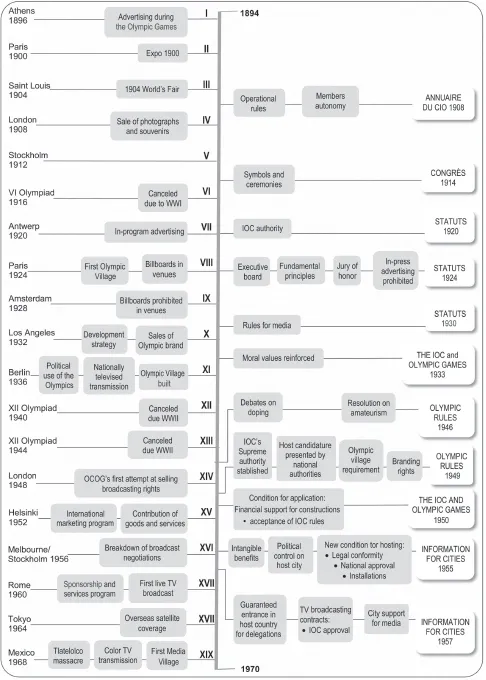
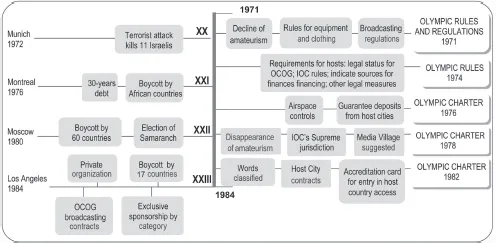
The timeline in figures 1.1, 1.2, and 1.3 is part of the search for answers to these questions. On the left side of the figures, events are arranged in chronological order; these are events that have taken place within other fields and that relate to the changes within the field under analysis. On the right side are changes in the economic, legal, or political orders that have taken place in rules that govern the functioning of the Olympic Movement, beginning with the first Olympic Charter, which was published in 1908 (Comité International Olympic [CIO] 1908), and entitled “Annuaire.”4
Based on this chronological order, I have identified three periods that maintain a certain specificity in their structures. In the first period (1894–1970), the Olympic Movement concentrated on strengthening its brand and autonomy through a discourse of amateurism; in the second period (1971–1984), Olympic sports began to be professionalized; finally, in the third period (After 1984), the complete spectacularization of sport began to take hold. Before entering into the narrative of this timeline, I will present some introductory considerations that may facilitate the reader’s understanding.
Figure 1.1 Olympic Movement timeline: first period (1894–1970)
Figure 1.2 Olympic Movement timeline: se...
Table of contents
Cover
Half Title
Series
Title
Copyright
Contents
List of figures
List of tables
Foreword
Acknowledgments
List of abbreviations
Introduction
Part 1 Production of sports spectacle on a global scale
Part 2 Production of sports spectacle on a local scale
Final considerations
Index
Trusted by 375,005 students
Access to over 1.5 million titles for a fair monthly price.
Study more efficiently using our study tools.
Frequently asked questions
Yes, you can cancel anytime from the Subscription tab in your account settings on the Perlego website. Your subscription will stay active until the end of your current billing period. Learn how to cancel your subscription
No, books cannot be downloaded as external files, such as PDFs, for use outside of Perlego. However, you can download books within the Perlego app for offline reading on mobile or tablet. Learn how to download books offline
Perlego offers two plans: Essential and Complete
Essential is ideal for learners and professionals who enjoy exploring a wide range of subjects. Access the Essential Library with 800,000+ trusted titles and best-sellers across business, personal growth, and the humanities. Includes unlimited reading time and Standard Read Aloud voice.
Complete: Perfect for advanced learners and researchers needing full, unrestricted access. Unlock 1.5M+ books across hundreds of subjects, including academic and specialized titles. The Complete Plan also includes advanced features like Premium Read Aloud and Research Assistant.
Both plans are available with monthly, semester, or annual billing cycles.
We are an online textbook subscription service, where you can get access to an entire online library for less than the price of a single book per month. With over 1.5 million books across 990+ topics, we’ve got you covered! Learn about our mission
Look out for the read-aloud symbol on your next book to see if you can listen to it. The read-aloud tool reads text aloud for you, highlighting the text as it is being read. You can pause it, speed it up and slow it down. Learn more about Read Aloud
Yes! You can use the Perlego app on both iOS and Android devices to read anytime, anywhere — even offline. Perfect for commutes or when you’re on the go. Please note we cannot support devices running on iOS 13 and Android 7 or earlier. Learn more about using the app
Yes, you can access Mega-Events, City and Power by Nelma Gusmão de Oliveira in PDF and/or ePUB format, as well as other popular books in Business & Business General. We have over 1.5 million books available in our catalogue for you to explore.