Based on extensive survey data, this book examines how the population of Japan has experienced and processed three decades of rapid social change from the highly egalitarian high growth economy of the 1980s to the economically stagnating and demographically shrinking gap society of the 2010s. It discusses social attitudes and values towards, for example, work, gender roles, family, welfare and politics, highlighting certain subgroups which have been particularly affected by societal changes. It explores social consciousness and concludes that although many Japanese people identify as middle class, their reasons for doing so have changed over time, with the result that the optimistic view prevailing in the 1980s, confident of upward mobility, has been replaced by people having a much more realistic view of their social status.
eBook - ePub
Social Change in Japan, 1989-2019
Social Status, Social Consciousness, Attitudes and Values
- 176 pages
- English
- ePUB (mobile friendly)
- Available on iOS & Android
eBook - ePub
Social Change in Japan, 1989-2019
Social Status, Social Consciousness, Attitudes and Values
About this book
Information
Part I
Deciphering the “middle”
Subtle change behind the scenes
2 Images of social stratification and the “Gap Society”1
1 Considering society from the “shape of society”
1.1 What is the shape of society?
In society, there are the rich, the regular and the poor. But what are the actual proportions of existing rich people, regular people and poor people? And if a shape of modern society was drawn based on these proportions, what would it look like?
From the 1970s to the 1980s, terms like ichioku sōchūryū (middle-class of 100 million) and “mass middle-class society” were frequently used by mass media to describe Japanese society. The root of this perception of society was apparent in responses to a question in the Public Opinion Survey on the Life of the People (Cabinet Office) which asked, “Compared to the general public, what do you think is the standard of living for your household?” In the early 1970s, over 90% of the population surveyed reported that they felt like they belonged to the middle (upper middle, middle or lower middle). If one were to draw a picture of a society where the middle-class exceeds 90%, it would be shaped like a diamond, with a wide middle section. Figure 2.1 depicts the shape of post-war Japanese society published in an article in the Asahi Journal in 1989.2 A change in the width of the middle-class is depicted, increasing from a society with a majority lower-class in 1955 to an image where “everyone is middle-class” in 1975. As the lower stratum was depicted as re-expanding in the near future, it acts as an exceedingly precise prediction given Japan’s recent situation, which is often described as a “gap society” (kakusa shakai).
There is one observation that must be stressed here. The perception of a “mass middle-class society” is not a result of asking people, “What do you think is the shape of society?” but rather on the basis that many people answered “middle-class” when asked about their standard of living. A question that arises is what would happen if people were directly asked, “What do you think is the shape of society?” Do most people believe in the existence of a singular “mass middle-class”, as seen in Figure 2.1, or would their answers include a number of disjointed images of society? In this chapter, I analyze how objective changes in society and the way people imagine their society are interrelated based on social survey data from 1985 and 2015.
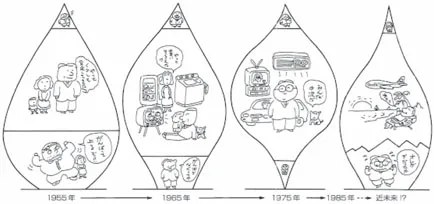
Figure 2.1 Changes to the shape of post-war Japanese society
Source: The Asahi Journal, April 7, 1989 issue
1.2 Reasons to explore the shape of society
The position of individuals within the upper and lower structures of the socioeconomic hierarchy (social status or social class) influences their way of life, their social attitudes and behaviours. For example, those who have a high socioeconomic status and a wealthy standard of living are likely to think of the status quo as ideal, as their current status and living standard supports this. On the other hand, people with lower statuses are likely to think otherwise.
The “position in the social structure” here includes not only objective measurements such as income and occupation but also the subjective position, measured in forms of status identification or class identification. This is because support or resentment of a certain societal model, as mentioned earlier, cannot occur without the awareness of oneself situated within it. Objective and subjective status, however, are not always the same. For example, an individual in a socioeconomic position which is – objectively speaking – not upper class, but is nevertheless satisfied with his/her current situation and believes “I belong to the upper-middle-class”, will not consider a need for change in his/her current situation.
As described, the perception of position within the social structure is important to understand people’s attitudes and behaviour. Moreover, grasping the shape of society, i.e. how socioeconomic status is distributed, may deepen our understanding of social phenomena.
Let me explain with an example. The slogan of the Occupy movement that occurred in the US in 2011 was “we are the 99%”, which means “we are in the lower 99% when it comes to income distribution in the US”. However, those unfamiliar with US society may not fully understand the slogan’s meaning. The slogan holds special significance due to th...
Table of contents
- Cover
- Half Title
- Series
- Title
- Copyright
- Contents
- List of contributors
- Introduction
- Part I Deciphering the “middle”: subtle change behind the scenes
- Part II Adapting to change: social consciousness over the Heisei period
- Index
Trusted by 375,005 students
Access to over 1.5 million titles for a fair monthly price.
Study more efficiently using our study tools.
Frequently asked questions
Yes, you can cancel anytime from the Subscription tab in your account settings on the Perlego website. Your subscription will stay active until the end of your current billing period. Learn how to cancel your subscription
No, books cannot be downloaded as external files, such as PDFs, for use outside of Perlego. However, you can download books within the Perlego app for offline reading on mobile or tablet. Learn how to download books offline
Perlego offers two plans: Essential and Complete
- Essential is ideal for learners and professionals who enjoy exploring a wide range of subjects. Access the Essential Library with 800,000+ trusted titles and best-sellers across business, personal growth, and the humanities. Includes unlimited reading time and Standard Read Aloud voice.
- Complete: Perfect for advanced learners and researchers needing full, unrestricted access. Unlock 1.5M+ books across hundreds of subjects, including academic and specialized titles. The Complete Plan also includes advanced features like Premium Read Aloud and Research Assistant.
We are an online textbook subscription service, where you can get access to an entire online library for less than the price of a single book per month. With over 1.5 million books across 990+ topics, we’ve got you covered! Learn about our mission
Look out for the read-aloud symbol on your next book to see if you can listen to it. The read-aloud tool reads text aloud for you, highlighting the text as it is being read. You can pause it, speed it up and slow it down. Learn more about Read Aloud
Yes! You can use the Perlego app on both iOS and Android devices to read anytime, anywhere — even offline. Perfect for commutes or when you’re on the go.
Please note we cannot support devices running on iOS 13 and Android 7 or earlier. Learn more about using the app
Please note we cannot support devices running on iOS 13 and Android 7 or earlier. Learn more about using the app
Yes, you can access Social Change in Japan, 1989-2019 by Carola Hommerich, Naoki Sudo, Toru Kikkawa, Carola Hommerich,Naoki Sudo,Toru Kikkawa in PDF and/or ePUB format, as well as other popular books in Social Sciences & Regional Studies. We have over 1.5 million books available in our catalogue for you to explore.