The relationship between teacher education and internationalization is often regarded as one that has just begun, sparked by globalization and its knowledge economy. This book questions such an assumption by arguing that although contemporary demands on teacher education have intensified the need for internationalization, teacher education and internationalization have a deep and complex relationship, which is context dependent and has developed differently over time.
This book urges its readers to question and rethink overly nationalistic approaches to teacher education. It shows how the internationalization of teacher education could be used as a strategic tool to support sustainable educational development and meet labor market demands for twenty-first century competencies. It puts the spotlight on the imperatives for internationalizing teacher education and its present forms, and considers this current phenomenon in the context of Singapore. This nation state has a history of internationalization, albeit with differing rationales, dimensions and strategies. Internationalization has been a key driver of the Singapore education system's sustained growth, from its humble beginnings to its present state as one of the best performing education systems in the world. This book will be of great interest to policy makers, academics, researchers and graduate students in the fields of international and comparative education, teacher education, and South East Asian studies.
Section Two Internationalization of teacher education in Singapore
4 Education and teacher education in Singapore as a high-performing school system
Singapore is a high-performing Asian economy (HPAE) (World Bank, 1993) and often named one of Asia’s Four Dragons1 (Tanzi, 1998) or ‘Tigers’ (Lee, Lee, Low, & Tan, 2014). It sustains high economic growth even today. From its independence in 1965, this country, with scarce natural resources and a land area of a mere 722.5km2 (Department of Statistics Singapore, 2019), boasts a per capita gross national income (GNI) of USD 58,770 (World Bank, 2019). Apart from the 2008–2009 global economic crisis (and the recent economic uncertainties due to COVID-19), “Singapore was an economy with low inflation and full employment, cushioned by huge international reserves and zero foreign debt” (Wong, 2009, p. 9). Alongside its glittering economic success, Singapore is also a modern example of a ‘successful’ education system. The nation state has received many international accolades for having one of the world’s best-performing and progressive school systems (Barber & Mourshed, 2007; Mourshed, Chijioke, & Barber, 2010; OECD, 2010; OECD, 2014a; OECD, 2018).
The correlation between economic and educational successes for this nation state is no accident. In a key World Bank publication, The East Asian Miracle: Economic Growth and Public Policy (1993), Singapore was identified as an HPAE, one of the eight economies alongside Japan, the Republic of Korea, Taiwan (China), Hong Kong (then a British Crown colony), Malaysia, Thailand and Indonesia, for attaining the world’s highest growth rates between 1965 and 1990. The report concluded that
the HPAEs achieved high growth by getting the basics right. … In this sense there is little that is “miraculous” about the HPAEs’ superior record of growth; it is largely due to superior accumulation of physical and human capital.
(World Bank, 1993, p. 5)
While this World Bank report has been criticized, especially for its over-generalized findings of the HPAEs (Jomo, 2001), most scholars concur that, although in varying degrees (Yusuf, 2001), both physical and human capital are important for economic success. Unlike some of the other HPAEs, Singapore has since maintained its economic position.
Today, the success of the Singapore story continues to earn recognition. Amongst other achievements, Singapore tops the World Bank’s 2018 Human Capital Index for its “sustained attention to human development” (World Bank, 2018, p. 7). Singapore also tops the World Economic Forum’s Global Competitiveness Index 4.0 20192 for its highest level of productivity (World Economic Forum, 2019). It is not surprising, then, that the Singapore government continuously rolls out aggressive domestic and foreign economic policies to overcome the country’s scarce resources by “intensifying … human resource development and by operating export-oriented development strategies” (Wong, 2009, p. 9). As Gopinathan (2013) notes, “Singapore’s state and society have benefited enormously from intelligent policy making in education … [especially those that] enhance human capital” (p. xviii). Education in Singapore, then, besides fulfilling its general function in human development, has a wider prevailing purpose of economic development.
This chapter examines how this “intelligent policy making in education” is evident in the nation state’s commitment to invest in human capital and its emphasis on building robust teacher preparation and a quality teaching force. In addition, this chapter discusses that while policies play a significant role in Singapore’s success, the nation state has a history of leveraging international resources, allowing it to intuitively ride on internationalization from its postcolonial past through industrialization and into globalization.
Commitment to invest in human capital
The current obsession with international assessments and benchmarking has put Singapore in a spotlight. By now, there are numerous academic and media reports citing the achievements of Singapore’s students, particularly in the OECD’s Programme for International Student Assessment (PISA). Even though PISA was launched in the year 2000, Singapore started participating in 2009 (OECD, 2020). Since then, Singapore students continue to perform near the top (Table 4.1), with the nation state taking PISA seriously.
Table 4.1 Singapore’s performance in PISA since 2009
Year
Singapore’s performance
Countries/economies ranked higher
2009
5th
1st – Shanghai (China); 2nd – Korea; 3rd – Finland; 4th – Hong Kong (China)
2012
2nd
1st – Shanghai-China
2015
1st
N.A.
2018
2nd
1st – Beijing, Shanghai, Jiangsu and Zhejiang (China)
Source: Author’s compilation, based on PISA Results from 2009, 2012, 2015 and 2018 OECD (2010, 2014a, 2016, 2019a)
The PISA results remain a useful international reference for MOE as we develop our education policies and programmes, as it provides us with rich insights about the progress we are making in building critical skills in our students, and the school and home contexts within which they do so.
(MOE Singapore, 2019a)
Praises for Singapore’s education system emphasize not only its present success but also how quickly it has risen to where it is.
It is also noteworthy that some of today’s highest-performing education systems have only recently attained their top positions. Less than 17% of 55–65 year-old Singaporeans scored at level 3 or higher in literacy in the Survey of Adult Skills (a product of the OECD Programme for the International Assessment of Adult Competencies, a kind of PISA for adults) – one of the smallest proportions amongst participating countries – while 63% of 16–24 year-olds did so, one of the largest proportions. And, as noted before, in PISA 2018, 15-year-old Singaporeans scored not statistically differently from the four provinces/municipalities of China in reading.
(OECD, 2019a, p. 5)
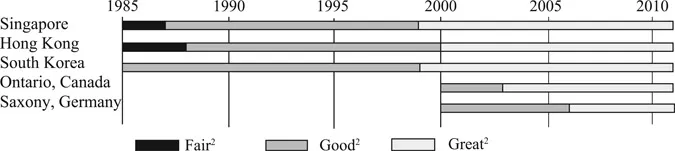
In an influential report by McKinsey and Company titled How the World’s Most Improved School Systems Keep Getting Better (Mourshed et al., 2010), it is shown that in the short span of about twelve years, Singapore’s education system has grown from a ‘fair’ system to a ‘great’ one (Figure 4.1). Considering that the post–British colony and post–Japanese occupation Singapore only became independent in the year 1965, this is indeed a great achievement. Much of this achievement has been attributed to the Singapore government’s ability to efficiently invest in its human capital as it navigates the various phases of national and educational needs (Gopinathan, 2013).
Figure 4.1 How the world’s most improved school systems1 keep getting better – continuum of improvement
1 Systems were categorized across time as poor, fair, good or great based on their average performance across test instrument, subject, and age group in each year where assessed … Universal scale start date marks the beginning of available student assessment data during the reform time period.
2 Score cut offs: Excellent < 560 (none of our sample systems achieved this level), Great 520–560, Good 480–520, Fair 440–480, Poor > 440.
Source: Adapted from Mourshed et al. (2010), based on TIMSS, PISA, NAEP, national and provincial assessments.
Education for the economy
The economists’ human capital theory focuses “upon the productive capacity of human manpower in the development process and in so doing treated the improvement of the human workforce as a form of capital investment” (Fager-land & Saha, 1989, p. 18). Singapore is a clear advocate of this, believing that the most efficient path to its national economic and social development lies in the improvement of its human capital. This is evident in the large investments the state pours into developing its human resources.
Second to the defense budget, Singapore prioritizes the education budget (Ministry of Finance Singapore, 2020a). In the financial year 2019, the education budget was SGD 13.2 billion (~USD 9.8 billion), following the education expenditure of SGD13.1 billion (~USD 9.7 billion) in the financial year 2018 (Ministry of Finance Singapore, 2020b). This expenditure was a marked increase from the SGD 7.5 billion (~USD5.6 billion) it spent on education in 2008–2009 (MOE Singapore, 2019b). Accordingly, in the financial year 2018–2019, the government spent SGD12,020 (~USD 8,931) on each primary school student and SGD15,518 (~USD 11,530) on each secondary school student (MOE Singapore, 2019b).
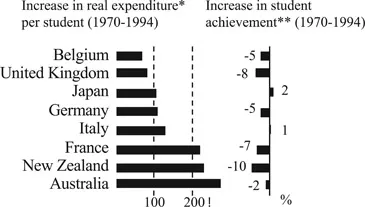
The issue of educational spending was once a fiercely debated one. For a while, there seemed to be little consensus on whether educational spending had an impact on student performance. Figure 4.2 shows that even with substantial increases in spending on education, “very few of the school systems in the OECD achieved significant improvements in performance. One study based on the results of national and international assessments showed that in many school systems performance had either flat-lined or deteriorated” (Barber & Mourshed, 2007, p. 10).
Figure 4.2 Educational spending and outcomes in the OECD
*Real expenditure, corrected for the Baumol effect using a price index of government goods and service
**Math and science
Source: Adapted from Barber and Mourshed (2007)
Other studies show that educational spending matters but only up to a certain point – when the basic necessities have been met. In an article in the Comparative Education Review, Emiliana Vegas and Chelsea Coffin’s (2015) analysis of
the association between education expenditures and mean student learning outcomes in mathematics suggest that, when education systems spend above US$8,000, the association is no longer statistically significant. Above this level of per student expenditure, additional spending does not have a significant estimated association with learning outcomes.
(pp. 301–302)
Findings from PISA 2018 echo this observation.
PISA results show that there is a positive relationship between investment in education and average performance – up to a threshold of USD 50,000 in cumulative expenditure per student from age 6 to 15. … However, after th...
Table of contents
Cover
Half Title
Series Page
Title Page
Copyright Page
Dedication Page
Contents
List of figures
List of tables
List of abbreviations
Foreword
Acknowledgements
Introduction
Section One Internationalization of teacher education and the nation state
Section Two Internationalization of teacher education in Singapore
Section Three Rethinking nationalization in Singapore and beyond
Technical appendix and explanation of key terms
Index
Trusted by 375,005 students
Access to over 1.5 million titles for a fair monthly price.
Study more efficiently using our study tools.
Frequently asked questions
Yes, you can cancel anytime from the Subscription tab in your account settings on the Perlego website. Your subscription will stay active until the end of your current billing period. Learn how to cancel your subscription
No, books cannot be downloaded as external files, such as PDFs, for use outside of Perlego. However, you can download books within the Perlego app for offline reading on mobile or tablet. Learn how to download books offline
Perlego offers two plans: Essential and Complete
Essential is ideal for learners and professionals who enjoy exploring a wide range of subjects. Access the Essential Library with 800,000+ trusted titles and best-sellers across business, personal growth, and the humanities. Includes unlimited reading time and Standard Read Aloud voice.
Complete: Perfect for advanced learners and researchers needing full, unrestricted access. Unlock 1.5M+ books across hundreds of subjects, including academic and specialized titles. The Complete Plan also includes advanced features like Premium Read Aloud and Research Assistant.
Both plans are available with monthly, semester, or annual billing cycles.
We are an online textbook subscription service, where you can get access to an entire online library for less than the price of a single book per month. With over 1.5 million books across 990+ topics, we’ve got you covered! Learn about our mission
Look out for the read-aloud symbol on your next book to see if you can listen to it. The read-aloud tool reads text aloud for you, highlighting the text as it is being read. You can pause it, speed it up and slow it down. Learn more about Read Aloud
Yes! You can use the Perlego app on both iOS and Android devices to read anytime, anywhere — even offline. Perfect for commutes or when you’re on the go. Please note we cannot support devices running on iOS 13 and Android 7 or earlier. Learn more about using the app
Yes, you can access Internationalization of Teacher Education and the Nation State by Rita Z. Nazeer-Ikeda in PDF and/or ePUB format, as well as other popular books in Education & Education General. We have over 1.5 million books available in our catalogue for you to explore.