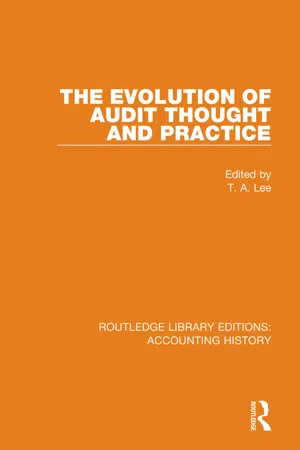
This book, first published in 1988, analyses the history of auditing with as much objectivity as possible. These chapters reveal the importance of auditing in society generally and business activity particularly. The character of the auditor is examined, and their part in history as their role developed from an amateur status to a professional one. The development of the accounting profession is a significant part of the history of auditing. The emerging professional bodies assumed a societal role and by doing so, the audit function changed in terms of its aims and practices, and became a matter of public as well as private concern.
- 344 pages
- English
- ePUB (mobile friendly)
- Available on iOS & Android
eBook - ePub
The Evolution of Audit Thought and Practice
Developments in the U.K. Context
THE AUDITOR AND THE BRITISH COMPANIES ACTS
Leonard W. Hein*
I. Introduction
The leaders of the accounting profession in the United States have frequently expressed the fear that the profession may some day be subjected to onerous statutory control. The profession in Great Britain at the present time does practice under a more detailed statutory control than that imposed upon accountants in the United States. This situation provides a clinical case worthy of study.
The controls under consideration are those imposed by the British Companies Act. This Act imposes controls on several phases of the practice of the accountant, e.g., (1) the auditor, (2) the balance sheet, (3) the income statement, (4) consolidations, (5) prospectuses, and (6) dissolutions. This paper is confined to those concerning the auditor. The controls affecting the auditor may be subdivided into: (1) qualifications; (2) appointment, tenure, and remuneration; and (3) duties and reports.
The time period selected for study is that beginning in 1844 and ending with the present time. The year 1844 was selected as the beginning date because in that year the modern era of business incorporation methods came into existence, i.e., a business could be incorporated merely by a formal process of registration.
II. The Qualifications of the Auditor
That the quality of an audit of a complex set of transactions is likely to be no better than the qualifications of the auditor performing the audit would appear to be a self-evident truism. Yet this is a quite modern concept that has emerged in comparatively recent times. Prior to 1844, the general body of proprietors tended to elect two groups of representatives. The one, designated as the managers, operated the enterprise; the other, called the auditors, ascertained that the results of the managerial activities were properly reported back to the main body of proprietors. Both groups were ordinarily selected from the members of the company. The managers were likely to be selected from those who were prominent in organizing the company, and hence presumably possessed some managerial ability. There is little to indicate that the auditors were selected on the basis of their aptitude for the position.
The first statute to be considered in the period 1844 to the present is the Act of 1844 entitled “An Act for the Registration, Incorporation, and Regulation of Joint Stock Companies.”1 Section 38 of this Act provided for the appointment of “One or more Auditors of the Accounts of the Company,” but the Act was completely silent as to who could serve in the position(s) or what his (their) qualifications should be.
When the Gladstone Committee considered the question of joint stock company legislation from 1841 to 1843, none of the witnesses recommended that the auditors should have any special qualifications. In fact, the only mention of such qualifications was a denial that the company employed a public accountant in the capacity of auditor.2
*Leonard W. Hein is Associate Professor of Accounting at Los Angeles State College.
17 & 8 Victoria. c. 110 (1844).
2“Report of the Select Committee on Joint Stock Companies.” House of Commons, Sessional Papers 1344 (119) VII, 1, q. 1908.
In 1855, the important privilege of limited liability was granted to all companies willing to register under the Act of 1855.3 The framers of this Act attached increased importance to the position of auditor, in the hope of protecting third parties from being harmed by their inability to go beyond the assets of the company to the personal assets of the proprietors in the event of insolvency. Section 14 of the Act required that at least one of the auditors be approved by the Board of Trade, but set no necessary qualifications to receive such approval.
The Act of 1855 was repealed in 1856, and a new, liberal concept of company law was embodied in the Act of 1856.4 The precept set forth by Robert Lowe, then Vice President of the Board of Trade, that “having given them a pattern the State leaves them to manage their own affairs and has no desire to force on these little republics any particular constitution,”5 applied especially to accounting and auditing regulations. All compulsory controls of this nature were eliminated, and only model regulations supplied. The original bill was amended and rewritten four times, but this part remained unchanged.6 The model regulations, even though not compulsory, did introduce the novel concept that “the Auditors need not be Shareholders in the Company.”7 This appears to be a significant departure from the idea that the position of auditor should consist of one segment of the company checking on another segment, and it appears to open the way for the position of auditor to be filled by professional accountants. The concept of independence was also introduced in this same article by stating that: “No Person is eligible as an Auditor who is interested otherwise than as a Shareholder in any Transaction of the Company; and no Director or other Officer of the Company is eligible during his Continuance in Office.”
Audits did not become compulsory again until 1900.8 Nevertheless, a number of attempts were made in the intervening years to reestablish, as compulsory, requirements similar to those contained in the Joint Stock Companies Act of 1844.9 Probably induced by the failure of the City of Glasgow Bank in 1878, in which fraud was covered by falsification of its accounts, Parliament imposed such provisions on all banking companies registered with limited liability under the Companies Acts in 1879.10 Some banks, incorporated under charter or by special act of Parliament, had operated under compulsory audit requirements prior to that date. It is interesting to note that the general manager of the National Bank of Liverpool, Ltd., when he gave testimony before the Select Committee on Limited Liability Acts, recommended that the compulsory audit be abolished.11 Finally, in 1895, the Davey Committee recommended that the audit once again be ...
Table of contents
- Cover
- Half Title
- Original Title Page
- Original Copyright Page
- Title Page
- Copyright Page
- Dedication Page
- Table of Contents
- T.A. Lee, “An Essay on the History of Auditing.”
- CHANGES IN AUDIT THOUGHT AND PRACTICE
- DEVELOPMENTS IN THE U.K. CONTEXT
- DEVELOPMENTS IN THE U.S. CONTEXT
- DEVELOPMENTS AND CONTINUING CONCERN
- EVIDENCE OF EARLY AUDIT THOUGHT AND PRACTICE
- EVIDENCE OF CONTEMPORARY AUDIT THOUGHT AND PRACTICE
Trusted by 375,005 students
Access to over 1.5 million titles for a fair monthly price.
Study more efficiently using our study tools.
Frequently asked questions
Yes, you can cancel anytime from the Subscription tab in your account settings on the Perlego website. Your subscription will stay active until the end of your current billing period. Learn how to cancel your subscription
No, books cannot be downloaded as external files, such as PDFs, for use outside of Perlego. However, you can download books within the Perlego app for offline reading on mobile or tablet. Learn how to download books offline
Perlego offers two plans: Essential and Complete
- Essential is ideal for learners and professionals who enjoy exploring a wide range of subjects. Access the Essential Library with 800,000+ trusted titles and best-sellers across business, personal growth, and the humanities. Includes unlimited reading time and Standard Read Aloud voice.
- Complete: Perfect for advanced learners and researchers needing full, unrestricted access. Unlock 1.5M+ books across hundreds of subjects, including academic and specialized titles. The Complete Plan also includes advanced features like Premium Read Aloud and Research Assistant.
We are an online textbook subscription service, where you can get access to an entire online library for less than the price of a single book per month. With over 1.5 million books across 990+ topics, we’ve got you covered! Learn about our mission
Look out for the read-aloud symbol on your next book to see if you can listen to it. The read-aloud tool reads text aloud for you, highlighting the text as it is being read. You can pause it, speed it up and slow it down. Learn more about Read Aloud
Yes! You can use the Perlego app on both iOS and Android devices to read anytime, anywhere — even offline. Perfect for commutes or when you’re on the go.
Please note we cannot support devices running on iOS 13 and Android 7 or earlier. Learn more about using the app
Please note we cannot support devices running on iOS 13 and Android 7 or earlier. Learn more about using the app
Yes, you can access The Evolution of Audit Thought and Practice by T. A. Lee in PDF and/or ePUB format, as well as other popular books in Business & Business General. We have over 1.5 million books available in our catalogue for you to explore.