Many works of fantasy literature feature a considerable number of embedded poems, some written by the authors themselves, some borrowed and transformed from other authors. Exploring the mechanisms of this mix and the interaction between individual poems and the overall narrative, this monograph analyses the various forms and functions of embedded poems in major works of fantasy literature. The choice of authors and texts shed light on the development of fantasy as a genre that frequently mixes prose and verse and thus continues the long tradition of prosimetric practices after the Romantic period. Not only does the analysis of the embedded poems allow for a new understanding of the individual works. It also promises insights into shared literary-historical roots, cross-influences between the authors and the role of the mix of poetry and prose for the imaginative and subversive potential of fantasy literature in general. Providing comprehensive case studies of the forms and functions of embedded poems in fantasy literature, this volume illuminates the emergence of modern fantasy and its impact on contemporary fantasy.
eBook - ePub
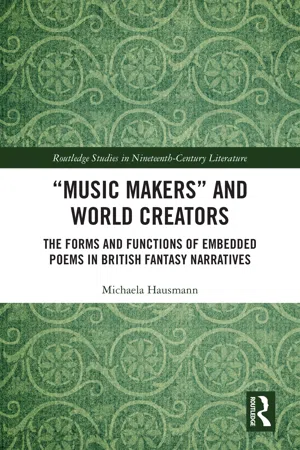
“Music Makers” and World Creators
The Forms And Functions Of Embedded Poems In British Fantasy Narratives
- 304 pages
- English
- ePUB (mobile friendly)
- Available on iOS & Android
eBook - ePub
“Music Makers” and World Creators
The Forms And Functions Of Embedded Poems In British Fantasy Narratives
About this book
Information
1 Introduction
We are the music makers,And we are the dreamers of dreams,Wandering by lone sea-breakers,And sitting by desolate streams;—World-losers and world-forsakers,On whom the pale moon gleams:Yet we are the movers and shakersOf the world for ever, it seems.
Although Arthur O’Shaughnessy’s poem ‘Ode’ celebrates art and artists in general, the opening stanza appears like a particularly apt portrayal and exaltation of artists concerned with the dreamlike, the imaginative, the otherworldly – all of which are associated with the sphere of fantasy. As “dreamers of dreams” fantasy authors frequently include scenes
reminiscent of the hypnagogic state, that period of soaring sensations and fleeting visions often experienced just before one falls asleep. Indeed, many fantasy writers describe the composition process as the cultivation of such states, in which the mind generates vivid and unexpected scenes which can then be assembled into narratives.
The collective “we” in O’Shaughnessy’s poem is presented as “wandering by lone sea-breakers” and “sitting at desolate streams” – all images of isolation and a separation from the mainstream. Fantasy writers have likewise usually occupied the margins of literary history whose spotlight more commonly fell on realist writers as Northrop Frye observes:
All through the nineteenth century and our own there had also been a flourishing development of romance and fantasy, […]. Some of these writers were immensely popular in their day, and a few, like Lewis Carroll, have never lost their popularity. But they do not seem to fit the history of fiction as defined by the great realists: they are simply other writers.
One reason for this neglect may have been fantasy’s flirtation with the unreal, the impossible, and the purely imaginary. Being illuminated by “the pale moon”, as O’Shaughnessy writes, suggests a heightened imaginative capacity but simultaneously invites attacks of “delusion, hallucination, or simply wishful thinking. Fantasy might be horrible, it might be delightful, but it was definitely unreal, and therefore of little more than clinical interest to sane and practical citizens” (Prickett 1979: 1). However, “thanks largely to the Romantic movement” imagination gradually became redeemed during the nineteenth century “as a ‘lamp’ illuminating unseen worlds beyond perceived reality” (Wolfe 2012: 8). As fantasy is also concerned with the individual mind and subconscious processes, “the science of psychology also begins to colour fantasy” at the end of the nineteenth century (Mathews 2002: 26).
European – and especially German – Romanticism was a crucial influence for the emergence of fantasy. Apart from its celebration of the human imagination, the period of Romanticism revived a fascination for folk and fairy tales and myths from all cultures around the world. All these were vital sources for fantasy, but the past in general, whose faithful reconstruction was equally impossible, also proved a playground for imaginary revision. Other influences feeding into the development of modern fantasy were preceding traditions like the bildungsroman, the Gothic novels, and the Romantic genre of Kunstmärchen (cf. Wolfe 2012: 12, 18; cf. Attebery 1992: 10). In light of these influences, Mathews has come to identify “[t]he subconscious depths of the mind and the unknown riches of the past […] as ‘roots of the mountains’ of fantasy” (Mathews 2002: 26).
Due to their preoccupation with fantastic elements and the pursuit of their own creative visions, fantasy writers perfectly fit O’Shaughnessy’s images of “world-losers” and “world-forsakers” because they imaginatively transcend the confines of this world in order “to extend and enrich ways of perceiving ‘reality’ by a variety of non-realistic techniques that included nonsense, dreams, visions, and the creation of other worlds” (Prickett 1979: xv). In this light, ‘world-makers’ would have been an apt alternative to “world-forsakers”. The latter term evokes the idea of escapism – one of the most frequent accusations levelled against fantasy literature (cf. Hunt/Lenz 2001: 2), which defenders of fantasy have attempted to rebuff. Jim Casey, for instance, argues that “fantasy would appear to be the logical medium for ‘autonomous art’, but many early twentieth-century critics were unprepared to deal with fantasy for fantasy’s sake” (Casey 2012: 114). In his seminal lecture and subsequent essay “On Fairy Stories”, J.R.R. Tolkien redeems the function of escapism by seeing it as the “Escape of the Prisoner” rather than the “Flight of the Deserter” (Tolkien 1983: 148). Moreover, his idea of escapism is bound to entail a reaction, which Tolkien conceptualises as “recovery” (Tolkien 1983: 146). According to this, it is not enough to escape to story worlds and get lost in them, but the entire experience of reading a fantasy text must include a return to the real world in which fantasy is necessarily rooted. This return, though, ideally goes hand-in-hand with a change of perspective. By seeing ordinary and supposedly ‘real’ things such as animals, water, and trees fantastically enhanced in fantasy stories, the reader is able to consider these things in a new light upon their return to reality and may consequently change their attitude towards them (cf. Tolkien 1983: 146).
All these reflections about fantasy and its roots have been potently summarised by the fantasy writer and critic Ursula Le Guin:
What is fantasy? On one level, of course, it is a game: a pure pretense with no ulterior motive whatever. […] It is escapism of the most admirable kind - the game played for the game’s sake. On another level, it is still a game, but a game played for very high stakes. Seen thus, as art, not spontaneous play, its affinity is not with daydream, but with dream. It is a different approach to reality, an alternative technique for apprehending and coping with existence. It is not antirational but pararational; not realistic, but surrealistic, superrealistic, a heightening of reality.
The opportunity of an altered perspective through the experience of fantasy, the persistence of fantasy literature in spite of all processes of marginalisation and critical neglect, and the overwhelming popularity and success of fantasy literature nowadays show why fantasy writers and artists could be seen as “world-forsakers” but also as its “movers and shakers”.
Most sobriquets from O’Shaughnessy’s poem seem therefore applicable to fantasy writers, but can they also be regarded as “music-makers”? Literature as a written, verbal genre necessarily limits the scope for musical performance, unless written scores are included that could be set to music. However, there is a literary genre that shows a strong affinity with music and performance, namely poetry, and a considerable number of literary fantasy works feature embedded poems or songs, from Victorian fantasies to twentieth-century and contemporary fantasy writers.
This technique results in a curious generic interplay of poetry and prose in literary fantasy. With the gradual establishment of fantasy as a literary genre, scholarly attention soon turned to generic features, preceding traditions, and the genre’s development:
On the T.S. Eliot principle that every writer creates his own tradition, the success of Tolkien’s book helped to show that the tradition behind it, of George MacDonald and Lewis Carroll and William Morris, was, if not ‘the great’ tradition, a tradition nonetheless.
Yet in spite of continuous analyses of fantasy narratives, their features, mutual sources, and cross-influences, there is a conspicuous lack of investigation regarding the occurrence of embedded poems in fantasy narratives, their forms and functions, and the general role of this technique in the emergence and development of the genre.
This research gap is all the more striking because the technique of mixing poetry and prose can be traced back to classical texts and has been the object of academic study in other genres and periods of literary history. In his book Die hybride Gattung (2010), Ulrich Beil gives a comprehensive overview of academic studies from 1921 up to the 1990s. One essay in this discussion is important to mention, namely Otto Immisch’s Über eine volkstümliche Darstellungsform in der antiken Literatur (1921) in which he proposes to use the term prosimetrum to describe the stylistic technique of mixing prose and verse (cf. Beil 2010: 14–18). Immisch’s study marks a re-discovery of the term and a reassessment of the literary form “since in the twentieth century historians of literature have tended to conceive of poetry and prose as mutually exclusive opposites and have not imagined the need for a tertium quid – for the prosimetrum” (Ziolkowski 1997: 45). Although various terms have been suggested as labels, the term prosimetrum has been used most persistently for mixtures of poetry and prose.
Joseph Harris and Karl Reichl’s collection Prosimetrum: Cross-Cultural Perspectives on Narrative in Prose and Verse constitutes one of the most important publications on prosimetric literature to date. The first articles of this volume analyse the use of the mixed form in certain historical periods from classical Menippean satires, medieval French and Celtic vernaculars, and Icelandic sagas to German Romanticism. The essays of the second part show that “the blending and mixing of verse and prose is widespread in the various poetic traditions of world literature” (Reichl/Harris 1997: 1) and range from analyses of the cante fable in occidental folk narratives, biblical and ancient Near Eastern literature, Arabic and Persian literature, to Asian literary traditions.
More specific and detailed studies have been put forth by Bernhard Pabst, who begins his monograph with Menippean satires by Greek and Roman authors, before he moves on to a long treatment of various medieval prosimetra, including hagiographies and chronicles of different European regions. Of all publications on the mixed form, Pabst’s monograph in two volumes is the most detailed one, but it is strictly confined to European antiquity and the Middle Ages. Other investigations of medieval prosimetra are Maureen Boulton’s and Eleanor Johnson’s monographs that both have a clear cultural focus on French (Boulton) and British (Johnson) literature. Johnson examines medieval texts by Chaucer, Gower, Usk, and Hoccleve in which “the mixed form of prose and meter is inextricable from the attempt either to provide ethical learning or to theorise how and whether it might be possible to do so at all in literary writing” (Johnson 2013: 4). Boulton, on the other hand, analyses lyric insertions in medieval French narratives (1200–1400) with regard to their function as character speech, as descriptions or as plot elements. For this purpose she differentiates between insertions that either have a communicative function, i.e. “the function of songs clearly embedded in the narrative and attributed to a character who sings them as a form of communication” or have a poetic function and thus “affect the formal structure of the work” (Boulton 1993: 19). However, she excludes non-lyric poetry from her analysis. Within the period of medieval prosimetra, saga literature as a form of prosimetric writing marks a special case because “prosimetrum was established as a literary mode right from the beginnings of Old Norse-Icelandic as well as Irish literature, and […] the earliest authors of extant saga narratives most probably inherited an oral model for such mixed narration” (O’Donoghue 2005: 2). Heather O’Donoghue’s Scaldic Verse and the Poetics of Saga Narrative is one of the most important and comprehensive monographs on this subject.
There are two more monographs devoted to tracing a tradition and development of the mix of prose and verse. Peter Dronke’s Verse with Prose from Petronius to Dante looks again at classical and European medieval texts with a specific focus on shifts in perspectives that are accomplished by the change from prose to verse and vice versa. Dronke’s analysis ranges from classical authors like Petronius to medieval writers like Notker, from French provençals and German mystic writings to Dante, whereby the author voices the opinion that
[…] the three vernacular prosimetra of the late thirteenth century - Das fliessende Licht, Le mirouer des simples ames, Vita Nuova - represent the summits of achievement. I do not know if the centuries that followed ever again brought to the mixed form such shining individualities.
As a consequence, Dronke disregards any subsequent forms of prosimetric literature. Similarly exclusive is Beil’s analysis of prosimetra from Heliodor to Goethe that chooses Heliodor’s Aithiopica, Petronius’ Satyricon, Renaissance texts by Sannazaro, Philip Sidney, Cervantes and Montemayor, and Goethe’s Wilhelm Meister’s Lehrjahre as its corpus. Although he concedes that the interrelationship between poetry and prose has not become extinct (cf. Beil 2010: 13), he considers the plurality of prosimetric works in Romanticism as the “Eschaton” and as the multi-faceted yet irrevocable end of the prosimetric technique (Beil 2010: 40; capitalisation and italicisation in the original).
With regard to British literature in particular, Gabrielle Starr’s Lyric Generations offers insights on the interplay between the genres of poetry and the rise of the novel. The author looks at lyric absorption in eighteenth-century novels like Richardson’s Clarissa (1748). Although she occasionally discusses the forms and functions of inserted verses, Starr’s actual interest lies in the way lyric language, generic patterns, and strategies of introspection and subjectivity are modified and adapted to the prose novel, especially in the epistolary tradition (cf. Starr 2004: 198). For the period of Romanticism, which has been researched most thoroughly in terms of hybrid forms and prosimetra, Marshall Brown’s article “Poetry and the Novel” is...
Table of contents
- Cover
- Half Title
- Series Page
- Title Page
- Copyright Page
- Dedication
- Table of Contents
- Acknowledgements
- List of Abbreviations
- 1 Introduction
- 2 Theory, Methodology, and Corpus
- 3 George MacDonald’s Phantastes (1858)
- 4 Lewis Carroll’s Through the Looking-Glass (1871)
- 5 William Morris’ The Sundering Flood (1897)
- 6 J.R.R. Tolkien’s The Lord of the Rings (1954/1955)
- 7 Conclusion
- 8 Works Cited
- Index
Trusted by 375,005 students
Access to over 1.5 million titles for a fair monthly price.
Study more efficiently using our study tools.
Frequently asked questions
Yes, you can cancel anytime from the Subscription tab in your account settings on the Perlego website. Your subscription will stay active until the end of your current billing period. Learn how to cancel your subscription
No, books cannot be downloaded as external files, such as PDFs, for use outside of Perlego. However, you can download books within the Perlego app for offline reading on mobile or tablet. Learn how to download books offline
Perlego offers two plans: Essential and Complete
- Essential is ideal for learners and professionals who enjoy exploring a wide range of subjects. Access the Essential Library with 800,000+ trusted titles and best-sellers across business, personal growth, and the humanities. Includes unlimited reading time and Standard Read Aloud voice.
- Complete: Perfect for advanced learners and researchers needing full, unrestricted access. Unlock 1.5M+ books across hundreds of subjects, including academic and specialized titles. The Complete Plan also includes advanced features like Premium Read Aloud and Research Assistant.
We are an online textbook subscription service, where you can get access to an entire online library for less than the price of a single book per month. With over 1.5 million books across 990+ topics, we’ve got you covered! Learn about our mission
Look out for the read-aloud symbol on your next book to see if you can listen to it. The read-aloud tool reads text aloud for you, highlighting the text as it is being read. You can pause it, speed it up and slow it down. Learn more about Read Aloud
Yes! You can use the Perlego app on both iOS and Android devices to read anytime, anywhere — even offline. Perfect for commutes or when you’re on the go.
Please note we cannot support devices running on iOS 13 and Android 7 or earlier. Learn more about using the app
Please note we cannot support devices running on iOS 13 and Android 7 or earlier. Learn more about using the app
Yes, you can access “Music Makers” and World Creators by Michaela Hausmann in PDF and/or ePUB format, as well as other popular books in Literature & English Literary Criticism. We have over 1.5 million books available in our catalogue for you to explore.