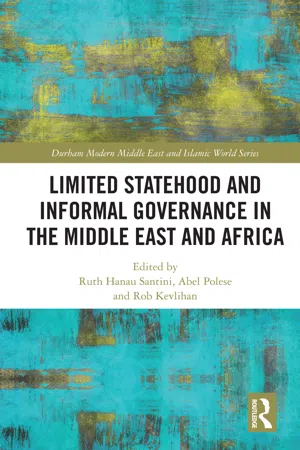
Hybrid forms of governance – where the central state authority does not possess a monopoly of violence and fails to exercise control – are not only an epiphenomena, but a reality likely to persist. This book explores this phenomenon drawing on examples from the Middle East and Africa. It considers the different sorts of actors – state and non-state, public and private, national and transnational – which possess power, examines the dynamics of the relationships between central authorities and other actors, and reviews the varying outcomes. The book provides an alternative view of the way in which governance has been constructed and lived, puts forward a conceptualisation of various forms of governance which have hitherto been regarded as exceptions, and argues for such forms of governance to be regarded as part of the norm.
eBook - ePub
Limited Statehood and Informal Governance in the Middle East and Africa
- 278 pages
- English
- ePUB (mobile friendly)
- Available on iOS & Android
eBook - ePub
Limited Statehood and Informal Governance in the Middle East and Africa
About this book
Information
Part I
International interventions and the interplay between formal and informal governance
1Fluid concepts and understandings redefined
States, porous borders and transnational militant actors in Syria
Introduction
In the past seven years, the Syrian war has witnessed numerous transformations in the course of the conflict that are worthy of examination. Most notable among these transformations is the role that Islamist jihadi movements, such as the Islamic State of Iraq and Sham (ISIS) and Jabhat Al-Nusra (JN), have played in attempting to weaken the regime of Bashar al-Assad. Equally noticeable has been the ability of the Syrian regime to mount offensives on several fronts throughout Syria and regain large areas of land, something which initially seemed to be a mission impossible. However, facing forces that use unconventional tactics in combating the Syrian army, the Syrian regime resorted to the assistance of a number of transnational non-state actors, including the Lebanese Shia group of Hezbollah, Abu Fadl El-Abbas from Iraq and Shia auxiliaries from Afghanistan and Pakistan, to name but a few.
This chapter discusses in some detail an underexplored aspect of statehood in the Middle East. The war in Syria, with a multiplicity of armed groups fighting alongside or against the state’s armed forces, transformed what had been a powerful, centrally controlled state into areas of limited statehood (ALS) hosting hybrid governance arrangements spanning a spectrum ranging from Westphalian to Islamist, underpinned by varying degrees of state correspondence to a Weberian ideal type.
This chapter argues that the war in Syria did not create ALS solely from the ground up. While several communal groups or social agents (such as the Kurds and some Arab tribes) seized the opportunity provided by the Syrian war to forge powerful relations with external powers, international powers (including the USA, Russia, Iran, Turkey and Gulf Co-operation Council (GCC) states) also attempted to gain a foothold in Syria and influence over certain actors and parts of the country.
As a consequence, the continuing role of foreign powers in Syria in any post-war scenario will have enormous repercussions for the status of existing ALS. The driving force of limited statehood in Syria has therefore been led by both domestic and international actors, whose cooperative relationship may continue to characterize Syrian politics well after the termination of hostilities.
This chapter is divided into three distinct parts. Part one considers the manner in which JN and ISIS’ narratives and approaches collide with notions of Westphalian sovereignty. Part two discusses the way JN and ISIS seized territory, gathered resources and built institutions in order to consolidate their position within the war system, with reference to the concept of ALS. Part three discusses the manner in which the enormous external intervention in the politics of Syria, combined with the desire of local actors to gain a share of power in the post-war political order, will continue to challenge the authority of the formerly strong and centralized Syrian state.
Part one: Islamism, Syria and state sovereignty
The views and ideology of JN and ISIS are not only discriminatory against individuals who do not share their beliefs but also threaten to redefine Westphalian understandings of statehood. By registering their opposition to the coordinates of a number of geographic state borders in the Middle East and by adopting violent means in attempting to compromise state authority in a number of domains, these groups are at loggerheads with the international state system and risk debunking statehood as a concept in many countries other than Syria.
Perhaps the words of Bastian Vasquez, a Norwegian–Chilean ISIS recruit, can best illustrate this point.1 In a video released by ISIS, he stated:
As you can see right now, I’m on the border of Iraq and al-Sham.2 Right now I’m inside of al-Sham. As you can see this is the so-called border of Sykes-Picot.3 Alhamdulillah, we don’t recognize it and we will never recognize it.4 Inshallah this is not the first border that we will break and Inshallah, we shall break all the borders, but we shall start with this, Inshallah.5 … As Abu Bakr Al Baghdadi used to say “He is the breaker of barriers”. Inshallah we will break the barrier of Iraq, Jordan, Lebanon, all the county [sic] Inshallah. Until we reach Quds.6
Earlier literature on statehood would have described the state in which JN and ISIS operated in Syria as a “failed state”.7 However, binary distinctions of states as strong or weak mask important features of statehood characterized by fluidity, hybridity and complexity in governance structures.8 Such a more nuanced approach in the analytical treatment of statehood is crucial in understanding the myriad actors that can jeopardize the sanctity of borders and constitute challenges to a state’s central authority throughout its sovereign territory.
In the case of Syria’s Civil War, threats to Syrian sovereignty were advanced forcefully by a multitude of international Islamist groups, including JN and ISIS. These groups included fighters from across the globe; their efforts to establish a state were diametrically opposed to modern understandings of statehood. Their challenge to Syrian statehood can be contrasted with the more traditional secessionist position of Kurds, whose identity never coincided with the Middle Eastern states in which they found themselves. Instead of a failed state in Syria, the multiplicity of actors nibbling away at state sovereignty; debunking the state’s legitimacy; weakening central authority; and wreaking havoc on a country’s cultural sites, infrastructure and resources created ALS in which the state and emerging actors all play a role in the governance of various domains.
Areas of limited statehood relate to parts of a country in which central authorities fail to implement or enforce rules and decisions or in which legitimate monopoly over the means of violence is lacking, albeit temporarily.9 These state shortcomings can be restricted across several dimensions; most notable among them are territorial (parts of a country’s territorial spaces), sectoral (with regard to specific policy areas), social (with regard to specific parts of the population) and temporal.10 Limitations to governance in the case of JN and ISIS in Syria relate to Risse’s concepts of the public and private spheres, intentionality and normativity of governance and the shadow of hierarchy.11 These concepts zoom in on the nature of players sharing in sovereignty (including private or public actors); the addressees of collective goods being distributed; and the direction and type of bargaining occurring between the state and other actors involved in governance.
Perhaps no single event sowed the seeds for the emergence of JN and ISIS more than the wars of Iraq and Syria of 2003 and 2011 because they provided a fertile environment for terrorist cells to operate. In the context of these wars, jihadi tactics evolved to pose an existential threat to the Iraqi state’s ability to impose authority over its territory, let alone its citizens who were joining various armed groups. This reality was further exacerbated by the tactics employed by the leading Al-Qaeda figure in Iraq, Abu Musab Al-Zarqawi, who aggravated the adoption of communal violence as a tactic to the extent that even the Al-Qaeda leadership in Afghanistan believed he was operating irrationally.12
Al-Qaeda, for its part, had developed a repertoire of collective action that was deeply rooted in conflicts that occurred elsewhere. For example, the murderous practice of throat-slitting had been carried out by Islamist groups in the conflict with the Algerian state in 1995.13 Moreover, their practice of kidnapping American citizens challenged the sovereignty of states that supposedly enjoyed consolidated sovereignty in security governance, such as Saudi Arabia.14 As a consequence, Islamist activism was leading to ALS throughout the Middle East region, since no state could effectively demonstrate that it was immune to attacks from Al-Qaeda, while nationals of various states joined Al-Qaeda to fight in conflicts beyond their national borders.
However, following the assassination of Zarqawi in 2006, the ferocious tactics adopted in warfare and the declaration of an Islamic State in Iraq drove a wedge between the Al-Qaeda leadership in Iraq and their leaders in Afghanistan. This move not only resulted in the beginning of an organizational independence from Al-Qaeda leadership in Afghanistan, but was also an evident divergence from Al-Qaeda’s strategy of establishing an Islamic State through persuasion and the agreement of its inhabitants, without forcing the project upon the people.
Therefore, while JN, which is a branch of Al-Qaeda, and ISIS share similar ideas, they clash in regard to the establishment of an Islamic State and the sanctioned repertoire of collective action. This point is best illustrated by William McCants, who shows that the suggestion of establishing Islamic States in Somalia, Yemen and Iraq were met with staunch opposition from Osama bin Laden, who warned against the establishment of a state before the idea received wide support among the local population to justify Islamic rule. For example, when bin Laden was asked by the leader of AQAP if he wished to control San...
Table of contents
- Cover
- Half Title
- Series
- Title
- Copyright
- Contents
- List of contributors
- Foreward: hybrid governance in areas of limited statehood
- Introduction: hybrid governance in the Middle East and Africa
- Part I International interventions and the interplay between formal and informal governance 11
- Part II Domestic agency and dynamics 121
- Index
Trusted by 375,005 students
Access to over 1.5 million titles for a fair monthly price.
Study more efficiently using our study tools.
Frequently asked questions
Yes, you can cancel anytime from the Subscription tab in your account settings on the Perlego website. Your subscription will stay active until the end of your current billing period. Learn how to cancel your subscription
No, books cannot be downloaded as external files, such as PDFs, for use outside of Perlego. However, you can download books within the Perlego app for offline reading on mobile or tablet. Learn how to download books offline
Perlego offers two plans: Essential and Complete
- Essential is ideal for learners and professionals who enjoy exploring a wide range of subjects. Access the Essential Library with 800,000+ trusted titles and best-sellers across business, personal growth, and the humanities. Includes unlimited reading time and Standard Read Aloud voice.
- Complete: Perfect for advanced learners and researchers needing full, unrestricted access. Unlock 1.5M+ books across hundreds of subjects, including academic and specialized titles. The Complete Plan also includes advanced features like Premium Read Aloud and Research Assistant.
We are an online textbook subscription service, where you can get access to an entire online library for less than the price of a single book per month. With over 1.5 million books across 990+ topics, we’ve got you covered! Learn about our mission
Look out for the read-aloud symbol on your next book to see if you can listen to it. The read-aloud tool reads text aloud for you, highlighting the text as it is being read. You can pause it, speed it up and slow it down. Learn more about Read Aloud
Yes! You can use the Perlego app on both iOS and Android devices to read anytime, anywhere — even offline. Perfect for commutes or when you’re on the go.
Please note we cannot support devices running on iOS 13 and Android 7 or earlier. Learn more about using the app
Please note we cannot support devices running on iOS 13 and Android 7 or earlier. Learn more about using the app
Yes, you can access Limited Statehood and Informal Governance in the Middle East and Africa by Ruth Hanau Santini,Abel Polese,Rob Kevlihan in PDF and/or ePUB format, as well as other popular books in Politics & International Relations & Middle Eastern Politics. We have over 1.5 million books available in our catalogue for you to explore.