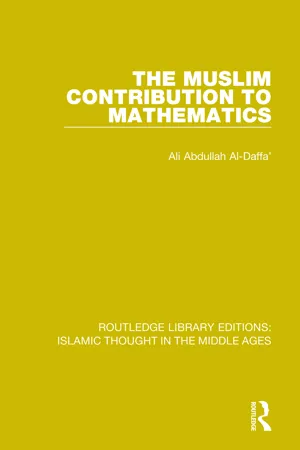
This book, first published in 1977, discusses the Muslim contribution to mathematics during the golden age of Muslim learning from the seventh to the thirteenth century. It was during this period that Muslim culture exerted powerful economic, political and religious influence over a large part of the civilised world. The work of the Muslim scholars was by no means limited to religion, business and government. They researched and extended the theoretical and applied science of the Greeks and Romans of an earlier era in ways that preserved and strengthened man's knowledge in these important fields. Although the main object of this book is to trace the history of the Muslim contribution to mathematics during the European Dark Ages, some effort is made to explain the progress of mathematical thought and its effects upon present day culture. Certain Muslim mathematicians are mentioned because of the important nature of their ideas in the evolution of mathematical thinking during this earlier era. Muslim mathematicians invented the present arithmetical decimal system and the fundamental operations connected with it – addition, subtraction, multiplication, division, raising to a power, and extracting the square root and the cubic root. They also introduced the 'zero' symbol to Western culture which simplified considerably the entire arithmetical system and its fundamental operations; it is no exaggeration if it is said that this specific invention marks the turning point in the development of mathematics into a science.
- 119 pages
- English
- ePUB (mobile friendly)
- Available on iOS & Android
eBook - ePub
The Muslim Contribution to Mathematics
About this book
Information
1 INTRODUCTION
Muslims directed their attention to intellectual activities during the early days of Islam, approximately 700 AD, turning first to the practical sciences, such as mathematics and astronomy.
There was a religious basis to the Muslims’ need for mathematics and astronomy. From geometric means they could find the direction to Mecca, towards which they turn daily in their prayers; arithmetic and algebra were needed to calculate inheritances and to count days and years. From astronomy, Muslims could determine the beginning of Ramadan, the month of fasting, and other great holy days.
However, Muslims did not confine the application of the sciences which they developed to the needs of religion but extended them in many directions for the benefit of mankind. When Muslims turned to the field of mathematics, which is often referred to as the ‘mirror of civilization,’ they were following an arduous road to cultural development.
Muslims had a great advantage in the Middle Ages because ‘the Koran encouraged them to study the sky and the earth to find proofs to their faith. The Prophet Mohammed Himself had besought his disciples to seek knowledge from the cradle to the grave, no matter if their search took them as far afield as China, for “he who travels in search of knowledge, travels along God’s path of Paradise.”’1
In Western countries mathematics was at a low ebb during the Dark Ages, but the great triumphs of Greek intellect were not lost to mankind. Muslims, under the influence of a great religious impulse had become a very rapidly expanding power. 2
From 600 to 1200 AD, the Muslim Empire stretched from India to Spain, Baghdad and Cordova being the centers for the reigning Caliphs.3 The ninth and tenth centuries may be regarded as the golden age of Muslim mathematicians to whom the world owes a great debt for preserving and expanding the classics in Greek mathematics otherwise lost. Europe owes its Renaissance to this golden age. A vast field for further investigation in this connection is left for the attention of future scholars.4
Particular attention should be given to the spectacular rise and decline of the Muslim State that occurred during the period of Europe’s Dark Ages. Within a decade following Prophet Mohammed’s flight from Mecca to Medina in 622 AD, the scattered and disunited tribes of the Arabian peninsula (modern Saudi Arabia) were consolidated by a strong religious fervor into a powerful nation. After Prophet Mohammed’s death, the caliphs not only governed wisely and well but many became patrons of learning and invited distinguished scholars to their courts. Numerous Hindu and Greek words in astronomy and mathematics were translated into the Arabic language and were saved. Later European scholars were able to retranslate them into Latin and other languages.5
About 800 AD, the city of Baghdad became a center of learning under the Muslim caliphate. The great caliph Al-Ma’mun, who was a scholar, a philosopher, and a theologian, established his famous ‘House of Wisdom’ (Bait Al-hikma), a combination of library, academy, and translation institution which proved to be the most important educational establishment since the foundation of the Alexandria Museum in the first half of the third century BC.6
Caliph Al-Ma’mun set scholars to work translating all the great Greek texts into Arabic. Thus the works of Ptolemy, Euclid, Aristotle, and many others were eventually circulated from Baghdad to Islamic universities as far away as Sicily and Spain. Through these Spanish universities established by Muslims, scientific knowledge was transferred to Europe during the Dark Ages.7
It was this period of the Dark Ages that may be called the Muslim Age in the history of mathematics. Princes, religious groups, and rich patrons rivalled with one another in commissioning the translation of ancient, and the writings of new, scientific masterpieces for which purpose they employed Muslim, Christian, Jewish, and even Zoroastrian scholars. All these men, though differing in religion and race, had one thing in common. They all wrote in Arabic,8 the Muslim language.
Abul Rihan Mohammed ibn Ahmed Al-Biruni declared that Arabic was the language of science and that he preferred Arabic curses to Persian praise. Adnan has explained that most of the textbooks used in the Turkish universities were written in Arabic, which remained the language of science in Turkey until the 18th century.9
In his monumental Life of Science, Professor George Sarton of Harvard University has stated:
I must insist on the fact that, though a major part of the activity of Arabic writing scholars consisted in the translation of Greek works and their assimilation, they did far more than that. They did not simply transmit ancient knowledge, they created a new one … However, a few Greeks had reached, almost suddenly, extraordinary heights. That is what we call the Greek miracle. But one might speak also, though in difference sense, of an Arabic miracle. The creation of a new civilization of international and encyclopaedic magnitude within less than two centuries is something that we can describe, but not completely explain.10
It is with the hope of making a contribution to such knowledge that the present book was begun. As a first step, it seemed advisable to coordinate Muslim contributions to mathematics of this period and interpret the findings to provide a basis for future writing. Professor George A. Miller of the University of Illinois wrote:
The history of mathematics is the only one of the sciences to possess a considerable body of perfect and inspiring results which were proved 2000 years ago by the same thought processes as are used today. This history is therefore useful for directing attention to the permanent value of scientific achievements and to the great intellectual heritage which these achievements present to the world.11
Scope of Muslim Contribution
The authoritative work on the history of Muslim mathematics has yet to be written. The author’s objective is to present a brief historical development of Muslim contributions to mathematics and the preservation of Greek and Hindu mathematics. According to F.W. Kokomoor ‘… there was probably not a single important work of the Golden Age of Greece that had not been translated and mastered by the Arabs.’12
CENTURY | DESCRIPTION | RESULT |
Seventh | Birth of the Prophet Mohammed about 570 AD | Beginning of Islam 622 AD |
Eighth and Ninth | The impetus | Period of consolidation of Muslim people |
Tenth | The Muslim Age | The rise of Muslim scholarship |
Eleventh | The Golden Age of Muslim thought | Encouragement of Muslim experimental and theoretical sciences |
Twelfth and Thirteenth | A turning point | Decline of the Muslim state and rise of western culture |
Fig. 1.1: The rise of Muslim Science
The Muslims developed a vast knowledge of their own in the field of mathematics. They accomplished some scholarly work which carried mathematics beyond the limits attained by the Greeks. In particular, this was true in the areas of algebra and trigonometry.13
Muslims not only contributed t...
Table of contents
- Cover
- Half Title
- Title Page
- Copyright Page
- Original Title Page
- Original Copyright Page
- Table of Contents
- Preface
- 1. Introduction
- 2. Historical Setting
- 3. Arithmetic
- 4. Algebra
- 5. Trigonometry
- 6. Geometry
- 7. Conclusions
- Bibliography
- Index
Trusted by 375,005 students
Access to over 1.5 million titles for a fair monthly price.
Study more efficiently using our study tools.
Frequently asked questions
Yes, you can cancel anytime from the Subscription tab in your account settings on the Perlego website. Your subscription will stay active until the end of your current billing period. Learn how to cancel your subscription
No, books cannot be downloaded as external files, such as PDFs, for use outside of Perlego. However, you can download books within the Perlego app for offline reading on mobile or tablet. Learn how to download books offline
We are an online textbook subscription service, where you can get access to an entire online library for less than the price of a single book per month. With over 1.5 million books across 990+ topics, we’ve got you covered! Learn about our mission
Look out for the read-aloud symbol on your next book to see if you can listen to it. The read-aloud tool reads text aloud for you, highlighting the text as it is being read. You can pause it, speed it up and slow it down. Learn more about Read Aloud
Yes! You can use the Perlego app on both iOS and Android devices to read anytime, anywhere — even offline. Perfect for commutes or when you’re on the go.
Please note we cannot support devices running on iOS 13 and Android 7 or earlier. Learn more about using the app
Please note we cannot support devices running on iOS 13 and Android 7 or earlier. Learn more about using the app
Yes, you can access The Muslim Contribution to Mathematics by Ali Abdullah Al-Daffa' in PDF and/or ePUB format, as well as other popular books in Social Sciences & Religion. We have over 1.5 million books available in our catalogue for you to explore.