eBook - ePub
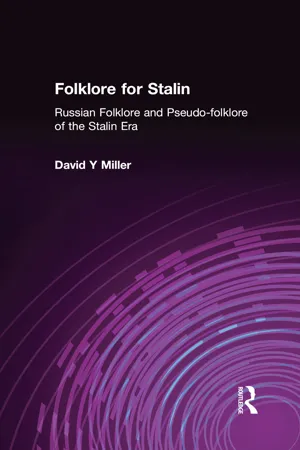
Folklore for Stalin
Russian Folklore and Pseudo-folklore of the Stalin Era
- 214 pages
- English
- ePUB (mobile friendly)
- Available on iOS & Android
eBook - ePub
About this book
After the First Congress of Soviet Writers in 1934, folklore, like literature, became an instrument of the political propagandist. Folklorists devoted considerable efforts to attending to what purported to be a rebirth of the Russian epic tradition, producing works of pseudofolklore that as often as not featured Joseph Stalin in the hero's role. Miller's account of this curious episode in the history of popular culture and totalitarian politics, and his synopses and translations of "classic" examples of folklore for Stalin, seek to serve as a resource not only for the study of contemporary folklore but also for the political scientist.
Information
1. The Origins of Folklore for Stalin
All major ethnic groups in the USSR, including the Russians, are familiar with their own folklore. Children study representative works of Russian folklore and those of other nationalities in grade school and middle school. The radio listener and the television viewer are constantly barraged with folk performances. Even the foreign tourist is encouraged to attend folk concerts or to spend money in special hard-currency shops for wooden trinkets and other “folk art” souvenirs. Every year in the USSR, approximately eleven thousand professional folklore collectives give over four million performances, attended by more than five hundred million people. Throughout the country, folklorists supervise the development of folk art and help choirs, dance groups, and individuals prepare works for public performance.1 Performers of folk songs and dances range from famous decorated professional artists (Liudmila Zykina) and professional groups (the Moiseev Dancers, the Osipov Balalaika Orchestra) to amateurs and amateur groups from all parts of the USSR. In many of their performances, however, the line between true folklore and folk stylization is all too often erased. Since the 1920s, hundreds of popular songs in imitation of the traditional folk song have been written, and no one seems to care whether they spring from the masses or from an individual poet. One popular “folksong” well known in the USSR and abroad, “Little Field, O Field” (Poliushkapole), is by the twentieth-century poet Gusev. One need only look at the table of contents in an anthology of Soviet Russian folklore to see the work of individual authors and performers classified as folklore.
Rather than accept western definitions of folklore as the “oral cultural tradition of a specific group of people,” Soviet and Russian folklorists have, since the 1930s, tended to define folklore as the “oral poetic creations of the broad folk masses.” Despite this definition, Russian folklorists since the nineteenth century have paid special attention to the work of the individual folk performer. During the 1930s, folklorists and writers collaborated with performers of traditional folklore to produce pseudofolklore in which the motifs and poetic devices of traditional folklore were applied to contemporary subjects. Many folk performers became full-fledged members of the Union of Soviet Writers and were accorded the status of “folk poets”, and their “folklore” was widely disseminated throughout the Soviet Union. The performers of the new folk stylizations of the Stalin era were no longer the guardians and transmitters of an inherited tradition. They became the authors of carefully planned and researched literary works based on the tradition, and the folklorists who worked with them became their editors and agents. This phenomenon can best be explained by the popularity of folklore throughout Russian society, which has traditionally accorded special status to professional folk performers, by Russian folklorists’ extraordinary concern with the personality of the individual performer, by a government eager to miss no opportunity to spread Bolshevik ideology, and by scholars desperate to vindicate a field that seemed to be losing prestige.
In pre-Revolutionary Russia, master storytellers and singers were always revered in their villages, and many made a living by their skills as professional performers. In many villages, professional wailers performed laments at funerals, weddings, and the departure of soldiers for war. Tsars and rich men often had their own personal narrators of fairytales, and many noblemen had choruses and orchestras on their estates. In the late nineteenth and early twentieth centuries, singers of laments and epic songs performed in major cities in Russia and abroad.2 Although isolated collections of Russian folklore were assembled during the seventeenth and eighteenth centuries, it was only in the early decades of the nineteenth century that the idea of national consciousness in the works of German romantic philosophers and folklorists such as Herder and the brothers Grimm found their reflection in the thoughts of the Russian Slavophiles about the “spiritual greatness of Russia” and inspired the first comprehensive collections of Russian folklore and a general interest in Russian folklore and folk customs. The folktales, lyric songs, laments, riddles, proverbs, and epic songs collected then have become the standard sources of traditional Russian folklore. Nineteenth-century authors, from Pushkin to Tolstoy, used themes from folklore, included numerous allusions to folk tradition in their works, and wrote imitations of folk narration.
P. N. Rybnikov and A. F. Gil’ferding, two early collectors of epic songs (byliny), noted the creative role of the singer and the reflection of the singer’s own personality in the recitation of a given work. Rybnikov pointed out that it is not easy to draw a clear distinction between performer and author, and both he and Gil’ferding observed that singers rarely, if ever, sang a bylina the same way twice.3 Gil’ferding described one singer who always gave a religious coloring to his narratives and represented the heroes as constantly praying to God.4 Although Rybnikov intended that the byliny he collected in the 1860s be published according to geographical region and singer, his editor, P. A. Bessonov, arranged them by subject. The second edition of Rybnikov’s collection, however, was published in 1910 according to his original plan, prefaced by his descriptions of and comments about individual performers. Gil’ferding was the first to apply the principle of arranging folklore material according to narrator, with commentary about each one, and in his collection Onega Byliny Recorded by A. F. Gil’ferding in the Summer of 1871, he included biographical data and physical descriptions of every performer whose works he transcribed.
Petr Lukich Kalinin, a peasant from the village Gorka of the Pudozhgorskii parish (of the Povenetskii District), is 43 years old, of medium height, with black hair, a small black beard and blue eyes. He is sluggish and clumsy in a strange sort of way. He is a tailor by trade. When he was a boy and a young man he often visited the villages and surroundings of Shunga and Tolvui for work and in this way grew accustomed to singing byliny, some of which he heard from the old men in these parts and some of which he learned from his father, who, according to Kalinin’s words, knew many…. The byliny printed here were transcribed “from voice”, that is, as they are sung, and not from a word-by-word retelling of the verses.5
After Gil’ferding, the study of the repertories of narrators of byliny and folktales and the gathering of information about their lives and about the characteristics of their creative work became an inherent part of Russian folkloristics.
By the time of the Russian Revolution, folkloristics was a thriving branch of literary study, and for a decade after the Revolution (1917—1927) the study of folklore, like the study of literature, was subject to relatively little government interference. A 1925 edict by the Central Committee of the Communist party allowed free competition among various groups and currents, and in this atmosphere scholars made valuable contributions to the study of folklore.6 At the same time, however, various literary circles that deemed folklore a reflection of the dying ideology of the ruling classes criticized it vehemently. Groups such as the Left Front of Art (LEF) and the Communist Futurists (KOMFUT) saw in folklore a worthless remnant of a patriarchal society, a cart that should be replaced by a truck. Proletarian folklore was cited as proof of the cultural backwardness of the working class. The Proletarian Cultural and Educational Organizations (Proletkult, 1917–1923) declared folklore a remnant of “kulak ideology” harmful to the Soviet people and called for the eradication of all folklore. There was even a children’s Proletkult, which sought to abolish fairytales on the grounds that they promote bourgeois ideals and corrupt children by fostering their proclivity for fantasy—a human tendency that seemed of little relevance to the rebuilding of society according to the principles of rationalist materialism. When control of the publishing of literature was given to the Russian Association of Proletarian Writers (RAPP) at the beginning of the First Five-Year Plan in 1929, folklore became the subject of much official debate and criticism. Finding folklore ideologically backward, RAPP branded it a harmful survival of the past, not to be cultivated as art. At the same time, the Russian Association of Proletarian Musicians (RAPM) was waging a campaign against the traditional folksong.7 Some literary scholars (V. M. Zhirmunskii and O. M. Freidenberg) saw in folklore the remnants of a past culture and attempted to reduce the essence of folkloristics to the understanding of cultural relics or survivals. Folklorists themselves noted the people’s declining interest in traditional folklore. Such genres as the folktale, the bylina, and the lament were approaching natural extinction. The younger generation no longer felt the need for traditional folklore and was indifferent to its gradual disappearance. Collectors of the 1920s observed that performers of the traditional epic songs no longer commanded the esteem in their villages that, according to the nineteenth-century folklorists Rybnikov and Gil’ferding, they had in the past.8 Folklorists had to justify their discipline and show it to be pertinent to everyday life. In addition to collecting and publishing folklore in the years 1929–1934, they organized discussions and conferences in order to prove folklore’s very right to exist.9
During the early 1930s, Iurii Sokolov, Russia’s leading folklorist, analyzed the nature of folklore and asserted its value in promulgating party doctrine among the masses. As early as 1931, in an article in Literatura i marksizm, he argued that the development of folklore should be controlled and that folklore should give direction to the newly developing poetry of the masses:
Insofar as oral poetic creation is one of the domains of literary art, the objective tasks of the contemporary workers’ and collective farmers’ folklore are exactly the same as the objective tasks of proletarian literature. In putting into practice the systematic class direction of literature, it would be inconsistent to leave oral creation at the mercy of the elements—it is necessary that, in the oral creations also, proletarian consciousness should subordinate to itself the elemental process.10
In 1933, the important periodicals Literaturmia gazeta and Utera-turnyi kritik began an active campaign in support of folklore. Literaturnaia gazeta devoted whole pages to the subject, which it had previously ignored. It stressed the value of folklore in Russian culture and supported Sokolov’s views. That same year Sokolov became chairman of the folklore section of the Union of Soviet Writers, formed in 1932 when the government dissolved RAPP, and held the post until his death in 1941.11 In his 1934 article “The Nature of Folklore and Problems of Folkloristics”, Sokolov expounded the theory of folklore that would guide Russian folklorists for twenty years. According to him, all [Soviet] folklorists now defined folklore as the “oral poetic creations of the broad folk masses” and folkloristics as a “branch of literary scholarship.”12 He emphasized the kinship of literature and folklore, pointing out the creative role of the singer in the performance of a work and asserting that the performer was at once creator and author. Moreover, Sokolov wrote, folklore is “an echo of the past and, at the same time, the vigorous voice of the present…. It has been and continues to be a weapon of class conflict.”13
Maxim Gorky’s keynote address to the First Congress of Soviet Writers that same year had far-reaching consequences for the field of folkloristics. He drew close connections between folklore and the concrete life and working conditions of the people and called on folklorists to deal with concrete historical reality rather than abstract mythic-religious ideas:
No doubt these old tales, myths, and legends are well known to you, but I should like to see their fundamental meaning understood more thoroughly. The fundamental meaning is the striving of primitive working men to ease their own labor and to increase its productivity…. In every flight of ancient fancy one can easily discover the motive, and the motive was always the desire of men to make their work easier.14
The optimism of folklore, he believed, expresses the deepest aspirations of the masses and is the source of the world outlook of a people in their individual historical periods. Gorky ...
Table of contents
- Cover
- Half Title
- Title Page
- Copyright Page
- Dedication
- Table of Contents
- Foreword
- Preface
- 1. The Origins of Folklore for Stalin
- 2. The Noviny
- 3. Soviet Tales
- 4. The Fate of Pseudofolklore
- Appendix I Synopses of Noviny
- Appendix II Synopses of Soviet Tales
- Appendix III Translations
- Notes
- Bibliography
- Index
Trusted by 375,005 students
Access to over 1.5 million titles for a fair monthly price.
Study more efficiently using our study tools.
Frequently asked questions
Yes, you can cancel anytime from the Subscription tab in your account settings on the Perlego website. Your subscription will stay active until the end of your current billing period. Learn how to cancel your subscription
No, books cannot be downloaded as external files, such as PDFs, for use outside of Perlego. However, you can download books within the Perlego app for offline reading on mobile or tablet. Learn how to download books offline
Perlego offers two plans: Essential and Complete
- Essential is ideal for learners and professionals who enjoy exploring a wide range of subjects. Access the Essential Library with 800,000+ trusted titles and best-sellers across business, personal growth, and the humanities. Includes unlimited reading time and Standard Read Aloud voice.
- Complete: Perfect for advanced learners and researchers needing full, unrestricted access. Unlock 1.5M+ books across hundreds of subjects, including academic and specialized titles. The Complete Plan also includes advanced features like Premium Read Aloud and Research Assistant.
We are an online textbook subscription service, where you can get access to an entire online library for less than the price of a single book per month. With over 1.5 million books across 990+ topics, we’ve got you covered! Learn about our mission
Look out for the read-aloud symbol on your next book to see if you can listen to it. The read-aloud tool reads text aloud for you, highlighting the text as it is being read. You can pause it, speed it up and slow it down. Learn more about Read Aloud
Yes! You can use the Perlego app on both iOS and Android devices to read anytime, anywhere — even offline. Perfect for commutes or when you’re on the go.
Please note we cannot support devices running on iOS 13 and Android 7 or earlier. Learn more about using the app
Please note we cannot support devices running on iOS 13 and Android 7 or earlier. Learn more about using the app
Yes, you can access Folklore for Stalin by Frank J. Miller in PDF and/or ePUB format, as well as other popular books in Politics & International Relations & Political Biographies. We have over 1.5 million books available in our catalogue for you to explore.