eBook - ePub
Semiconductor Packaging
Materials Interaction and Reliability
- 216 pages
- English
- ePUB (mobile friendly)
- Available on iOS & Android
eBook - ePub
About this book
In semiconductor manufacturing, understanding how various materials behave and interact is critical to making a reliable and robust semiconductor package. Semiconductor Packaging: Materials Interaction and Reliability provides a fundamental understanding of the underlying physical properties of the materials used in a semiconductor package. By tying together the disparate elements essential to a semiconductor package, the authors show how all the parts fit and work together to provide durable protection for the integrated circuit chip within as well as a means for the chip to communicate with the outside world. The text also covers packaging materials for MEMS, solar technology, and LEDs and explores future trends in semiconductor packages.
Information
section three
Materials used in semiconductor packaging
6.1 Molding compounds
6.1.1 Objectives
• Describe what a molding compound is.
• Convey its purpose and importance in semiconductor packaging, in regard to physical performance and contribution to reliability assessment.
• Illustrate continuous development and improvement of this material.
6.1.2 Introduction
This chapter briefly reviews the history and use of molding compounds in plastic semiconductor packages, addresses some of the issues and failure modes associated with molding compounds, and touches on future trends.
6.1.3 Background
Molding compounds have been around a very long time, since the advent of the through-hole plastic dual-inline package (DIP) family in the early 1970s. Essentially, molding compounds are epoxy resins filled with some sort of silica filler to reduce the coefficient of thermal expansion to better match that of the lead frame, along with small amounts of other additives, such as carbon black for color and bromine to act as a flame retardant. A comparison of the physical properties for the various components that constitute a plastic package was previously given in Table 1.3 and is repeated as a refresher in Table 6.1.
Initially, the predominant epoxy compound used was bisphenol-A. Epoxy cresol novolac replaced bisphenol-A as the preferred epoxy resin due to its better heat resistance. In general, epoxy resins became the preferred backbone for molding compounds due to their inherent low viscosity, fast cure properties, low shrinkage during cure, good adhesion to the other components in a chip package, and good overall mechanical stability. Both epoxy cresol novolac and bisphenol-A produce sodium chloride as by-products during synthesis. Because both elements are detrimental to integrated circuit (IC) reliability, care must be taken to remove them from the final resin product before molding compound formulation.
Table 6.1 Key Properties of Semiconductor Packaging Materials

Source: Adapted from National Semiconductor Corporation, Data Sheet: Semiconductor Packaging Assembly Technology, August 1999.
The filler comes in the form of amorphous or crystalline silica. Sometimes alumina is used as the filler for increased thermal conductivity and high heat dissipation properties, but it is very abrasive compared to silica. Amorphous silica is preferred when a low thermal expansion coefficient is needed, and crystalline silica provides some thermal conductivity at the expense of a higher coefficient of thermal expansion. In an epoxy cresol novolac—based compound, the filler makes up 65% to 75% by weight, with the resin constituting the majority of the balance. Fillers provide mechanical strength to the compound and reduce the thermal expansion coefficient, which, in turn, reduces shrinkage after molding. Fillers do have one major risk, in that silica may contain minute amounts of uranium and thorium, which generate a-particles and are known to cause soft errors in sensitive circuitry, like dynamic random access memory (DRAM) cells.
To complete the molding compound formulation, small amounts of pigments, coupling agents, mold release agents, reaction accelerators, antioxidants, water getters, plasticizers, and flame retardants are all added. Coupling agents increase resin adhesion to the fillers, the chip, and the lead frame. Mold release agents do just that: help free the molded part from the mold chase. Flame retardants are a necessary requirement for the plastic package to meet the industry flammability standard of Underwriters Laboratories’ (UL) standard 94 V-0, and until very recently, the standard was met by the use of brominated epoxy and antimony trioxide.
The properties of a molding compound are a balance between its moldability in a high-volume automated manufacturing environment and its relationship to the overall package’s performance and reliability. The coefficient of thermal expansion is considered a good marker that correlates to the projected reliability, as it is a marker of the mechanical quality of the package and its ability to withstand thermal stresses. Flexural modulus of the compound is next in importance when it comes to reliability, as it indicates the amount of “give” the compound has in the presence of mechanical or thermal stress.
Table 6.2 Influence of Molding Compound Ingredient on Physical Properties
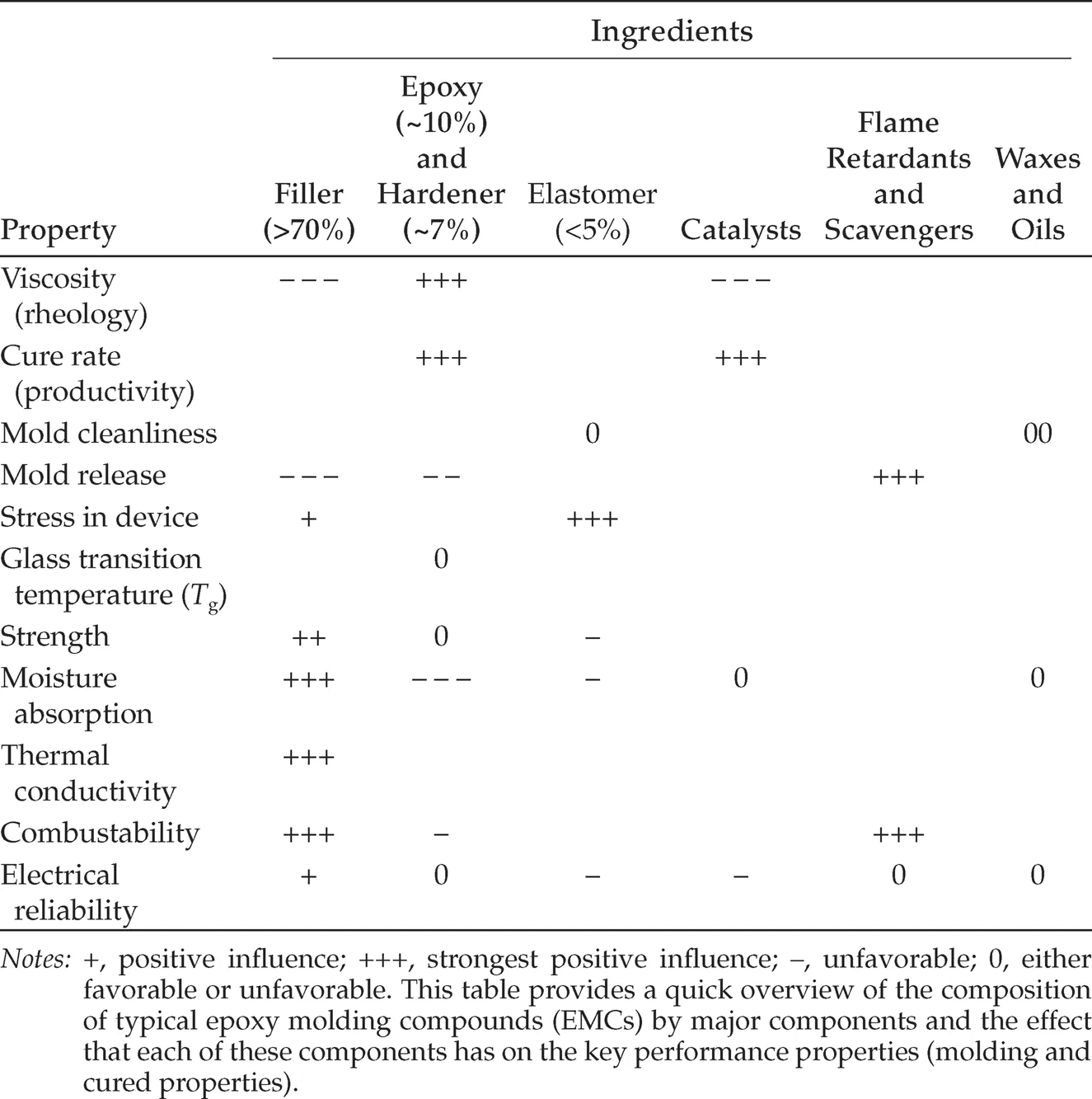
Source: Adapted from Richard C. Benson, Dawnielle Farrar, and Joseph A. Miragliotta, Johns Hopkins APL Technical Digest, 28(1), 58-667, 2008.
In summary, Table 6.2 shows how much effect each ingredient in a molding compound has on the overall material performance and behavior. As noted in the table, several key properties of the cured compound are attributable to the filler particles. The selection of filler type by material, size, and shape will control end parameters such as thermal expansion, moisture absorption, thermal conductivity, and strength.
6.1.4 Newer formulations
As already mentioned, epoxy cresol novolac was the backbone of most molding compounds until the 1990s. Then, with the use of larger and larger surface-mount packages and the advent of ball grid arrays and all of their attendant issues, new chemistries and formulations were required to meet their manufacturing and reliability needs.
6.1.4.1 Biphenyl
Biphenyl resins turned out to be the successful approach for reducing moisture uptake in compounds and increased resistance to popcorning (see Section 6.3.9). The reason was due to the nature of biphenyl resins that they could be loaded up with silica filler, to nearly 90% by weight. That way, there was hardly any organic material available to absorb moisture. The chemical structure is shown in Figure 6.1.
The possible disadvantage with biphenyl resins is their low glass transition temperature, typically around 125°C. It was feared that a given package using a biphenyl-based molding compound would most likely be subject to a coefficient of thermal expansion (commonly denoted as α2) above the glass transition temperature during subsequent thermal processing and reliability testing. α2 nearly ...
Table of contents
- Cover
- Half Title
- Title Page
- Copyright Page
- Table of Contents
- Preface
- Authors
- Partial list of abbreviations, acronyms, and symbols
- Section I: Semiconductor packages
- Section II: Package reliability
- Section III: Materials used in semiconductor packaging
- Section IV:—The future
- Glossary
- Appendix A: Analytical tools
- Appendix B: Destructive tools and tests
- Index
Trusted by 375,005 students
Access to over 1.5 million titles for a fair monthly price.
Study more efficiently using our study tools.
Frequently asked questions
Yes, you can cancel anytime from the Subscription tab in your account settings on the Perlego website. Your subscription will stay active until the end of your current billing period. Learn how to cancel your subscription
No, books cannot be downloaded as external files, such as PDFs, for use outside of Perlego. However, you can download books within the Perlego app for offline reading on mobile or tablet. Learn how to download books offline
Perlego offers two plans: Essential and Complete
- Essential is ideal for learners and professionals who enjoy exploring a wide range of subjects. Access the Essential Library with 800,000+ trusted titles and best-sellers across business, personal growth, and the humanities. Includes unlimited reading time and Standard Read Aloud voice.
- Complete: Perfect for advanced learners and researchers needing full, unrestricted access. Unlock 1.5M+ books across hundreds of subjects, including academic and specialized titles. The Complete Plan also includes advanced features like Premium Read Aloud and Research Assistant.
We are an online textbook subscription service, where you can get access to an entire online library for less than the price of a single book per month. With over 1.5 million books across 990+ topics, we’ve got you covered! Learn about our mission
Look out for the read-aloud symbol on your next book to see if you can listen to it. The read-aloud tool reads text aloud for you, highlighting the text as it is being read. You can pause it, speed it up and slow it down. Learn more about Read Aloud
Yes! You can use the Perlego app on both iOS and Android devices to read anytime, anywhere — even offline. Perfect for commutes or when you’re on the go.
Please note we cannot support devices running on iOS 13 and Android 7 or earlier. Learn more about using the app
Please note we cannot support devices running on iOS 13 and Android 7 or earlier. Learn more about using the app
Yes, you can access Semiconductor Packaging by Andrea Chen,Randy Hsiao-Yu Lo in PDF and/or ePUB format, as well as other popular books in Technology & Engineering & Electrical Engineering & Telecommunications. We have over 1.5 million books available in our catalogue for you to explore.