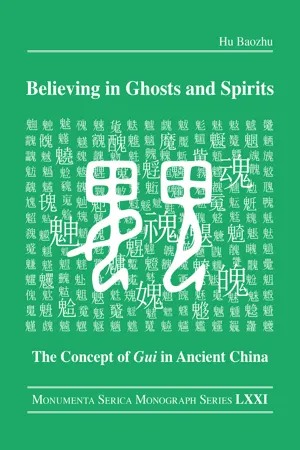
The present book by Hu Baozhu explores the subject of ghosts and spirits and attempts to map the religious landscape of ancient China. The main focus of attention is the character gui ?, an essential key to the understanding of spiritual beings. The author analyses the character gui in various materials – lexicons and dictionaries, excavated manuscripts and inscriptions, and received classical texts. Gui is examined from the perspective of its linguistic root, literary interpretation, ritual practices, sociopolitical implication, and cosmological thinking. In the gradual process of coming to know the otherworld in terms of ghosts and spirits, Chinese people in ancient times attempted to identify and classify these spiritual entities. In their philosophical thinking, they connected the subject of gui with the movement of the universe. Thus the belief in ghosts and spirits in ancient China appeared to be a moral standard for all, not only providing a room for individual religiosity but also implementing the purpose of family-oriented social order, the legitimization of political operations, and the understanding of the way of Heaven and Earth.
- 280 pages
- English
- ePUB (mobile friendly)
- Available on iOS & Android
eBook - ePub
About this book
Information
Normally, Chinese people speak about the otherworld in terms of guishen (ghosts and spirits), a collective title for spiritual beings. Since the beginning of their existence, these people, undergoing a gradual process of civilization, have been attempting to identify and then employ various common terms to classify those otherworldly entities based on their social, political, and religious experiences, as well as their accumulated knowledge over time. Shen, gui, guai 怪, jing 精, mei 魅, yao 妖, and mo 魔, just to name a few, certainly fall into the broad range of this cultural phenomenon. Being relevant to the theme as a whole, this segment of study will concentrate on the area of gui which obviously occupies a significant portion in this mystical spectrum.
Since Chinese characters have become essential elements of Chinese language which is in turn a key component of Chinese culture, the character gui itself deserves one’s foremost attention. Gui, which consists of more than one graphic symbol, has both phonetic and semantic aspects. Naturally, its script in shape, form, and even sound is of great importance. Forasmuch as this special linguistic feature is intrinsically built into the Chinese language, the beauty of a Chinese character can be unfolded when one gives a close look to its xing 形 (written form or shape), yin 音 (pronunciation or phonetics), and yi 義 (connotations or semantics). However, it is not enough for forming an adequate understanding or a right interpretation if one only pays attention to a character’s pronunciation, origin, and component, or only makes a particular study, for instance, on what possible meanings it might have, but ignores changes or alterations that might have taken place to a character in different times and spaces. In other words, Chinese language should be understood based on its xing, yin, and yi as well as how these three aspects are formed together and connected.1 This kind of linguistic information can be easily accessed if one consults Chinese dictionaries or reference books.
In this chapter, my point of departure is to investigate the concept of the character gui itself from a general viewpoint through the perspective of Chinese culture. Thus six notable Chinese lexicons, i.e., the Erya 爾雅 (Explaining What Is Refined), the Shuowen jiezi 說文解字 (Explaining Graphs and Analyzing Characters), the Guangya 廣雅 (Expanded Erya), the Yupian 玉篇 (Jade Chapters), the Kangxi zidian 康熙字典 (Kangxi Dictionary), and the Hanyu da zidian 漢語大字 典 (Great Compendium of Chinese Characters) will be chronologically introduced. The criteria of the selection tend to be more subjective. The center of attention is given to those materials from which one can get an overall understanding of gui. Therefore, the part of the gui-section in such lexicons should provide some concrete clues for one to trace the development of the concept of gui on the one hand and to draw a “comprehensive” picture of gui both in sound and meaning on the other hand. Accordingly, the unique character gui will be carefully studied so that its phonetic feature and multiple layers of meanings or implications can be discovered and clearly explained.
______________________
1 Lin Yin 1974, p. 31.
Furthermore, the supernatural realm from early on has been expanded and, correspondingly, supernatural beings are identified and added to the long list of pantheons. Yet human experiences always remind us of a fact: Our perception of those spiritual actualities might be still vague and could create possible confusion in the attempt to know them. It is thus necessary, in this part of the present study, to briefly discuss other tightly related names or concepts under the section of gui found in our selected references. For example, names such as shen, guai, jing, yao, mei and mo, as well as other relevant characters, will also be given due consideration, as a helpful addition to the main investigation on the character gui and its attainable significances. No doubt, their shared characteristics and possible differences can clear up some confusion and help us to achieve a fairer understanding of the term gui.
1.1 Erya: Gui 鬼 as Gui 歸
To investigate the initial meaning of a Chinese character, the best source is the Erya, the “earliest Chinese dictionary,” possibly dated from the third century B.C.2 It is a book of glossaries targeted on classical texts. Accordingly, the word gui appears two times on the list. One of them refers to guimu 鬼目 (ghost eyes) which is the byname of fu 苻 (Solanum Lyratum), a vine plant used for medical purposes.3 Due to its features such as bondless stems, fluffy hairs over the plant, and red berry-like fruits, one can see why it is called guimu. The Shanhai jing 山海經 (Classic of Mountains and Seas) mentions another kind of grass-like plant named after the gui character, guicao 鬼草 (ghost grass). Richard E. Strassberg, a professor in pre-modern Chinese literature and culture, translates it as “Demon- Plant.” “Its leaves resemble the sunflower but with red veins, and its blossoms resemble grain. If worn against the skin, it will cure melancholy.”4 Here the power of both plants might in a way allude to that of gui.
At another place in t...
Table of contents
- Cover
- Half Title
- Title Page
- Copyright Page
- Dedicated
- Table of Contents
- Acknowledgments
- Preface (Roderich Ptak)
- Chronological Table of Chinese History
- Conventions
- Abbreviations
- Keys to the Tables
- A Note on the Translation of the Character Gui
- Introduction
- Chapter One: The Preliminary Understanding of Gui
- Chapter Two: The Original Meaning of the Character Gui: An Examination of Jiaguwen and Jinwen
- Chapter Three: What’s in a Character? Definition and Variegated Characteristics of Gui in the Zuozhuan and Liji
- Chapter Four: Confucian, Daoist, and Mohist Perspectives on the Concept of Gui
- Chapter Five: Folk-oriented Usages of Gui in the Rishu Manuscript
- Conclusion
- Appendix I: Table of the Radical Gui and Its Related Characters
- Appendix II: Gui-related Oracle Bone Inscriptions
- Appendix III: Investigation: Annotated Translation of the “Jie” 詰 Section
- Bibliography
- Index with Glossary
Trusted by 375,005 students
Access to over 1.5 million titles for a fair monthly price.
Study more efficiently using our study tools.
Frequently asked questions
Yes, you can cancel anytime from the Subscription tab in your account settings on the Perlego website. Your subscription will stay active until the end of your current billing period. Learn how to cancel your subscription
No, books cannot be downloaded as external files, such as PDFs, for use outside of Perlego. However, you can download books within the Perlego app for offline reading on mobile or tablet. Learn how to download books offline
Perlego offers two plans: Essential and Complete
- Essential is ideal for learners and professionals who enjoy exploring a wide range of subjects. Access the Essential Library with 800,000+ trusted titles and best-sellers across business, personal growth, and the humanities. Includes unlimited reading time and Standard Read Aloud voice.
- Complete: Perfect for advanced learners and researchers needing full, unrestricted access. Unlock 1.5M+ books across hundreds of subjects, including academic and specialized titles. The Complete Plan also includes advanced features like Premium Read Aloud and Research Assistant.
We are an online textbook subscription service, where you can get access to an entire online library for less than the price of a single book per month. With over 1.5 million books across 990+ topics, we’ve got you covered! Learn about our mission
Look out for the read-aloud symbol on your next book to see if you can listen to it. The read-aloud tool reads text aloud for you, highlighting the text as it is being read. You can pause it, speed it up and slow it down. Learn more about Read Aloud
Yes! You can use the Perlego app on both iOS and Android devices to read anytime, anywhere — even offline. Perfect for commutes or when you’re on the go.
Please note we cannot support devices running on iOS 13 and Android 7 or earlier. Learn more about using the app
Please note we cannot support devices running on iOS 13 and Android 7 or earlier. Learn more about using the app
Yes, you can access Believing in Ghosts and Spirits by Hu Baozhu in PDF and/or ePUB format, as well as other popular books in Languages & Linguistics & Languages. We have over 1.5 million books available in our catalogue for you to explore.