I Salt lake
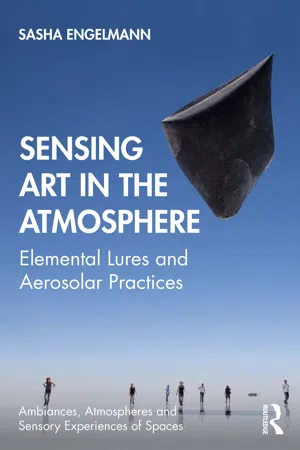
While sitting in a tent at the edge of the Salar de Uyuni in the Bolivian Andes and keeping watch over a rotating telescope recording the movements of astronomical entities hidden in the pale blue sky, I had plenty of time to observe the clouds. They drifted over the horizon of the 10,582 km2 salt flat, which shimmered in white heat during an unusually dry January. At times, forked tendrils of lightning sparked among and between them. They picked up dust with yellow and red hues. They looked oddly crystalline, like the tessellated lakebed and the salt on the surface of my skin.
I travelled to the Salar de Uyuni in early 2016 with artist Tomás Saraceno and colleagues Tato Chavez, Jan Hattenbach, Maximiliano Laina, Tobias Lange, Bernd Pröschold, Daniel Schulz and Jol Thoms. As we climbed the roads into the Bolivian Andes, we gradually adjusted to the elevation: 3,656 m above sea level. We passed the Lithium extraction pools, where mud is evaporated to produce a light, reactive element prized for its capacity to make currents flow through rechargeable batteries and, paradoxically, to calm flows of excitable neurotransmitters in the human brain.1 In addition to astronomical filming, we had travelled to the Salar de Uyuni to repeat an experiment that Tomás Saraceno had been performing there since the 1990s.2 We were preparing to launch aerosolar sculptures – pneumatic envelopes that float with the energy of the sun and the movements of air – over the mirror of the salty lake. Due to the lack of rain, however, the lake was no mirror. The radical differences between the sphere of the cosmos, encompassing the clocklike appearance of planets, nebulae and stars, and the sphere of the weather, all perception, movement and imagination, underscored everything we did. Yet in this encounter between astronomy and meteorology, we were only superficially rehearsing responses to changeable environments through the omens of stars, winds, planets and clouds: responses that had far less meaning for us as transient visitors to the Salar de Uyuni than for those making their living with and from it.
Inspired by my visit to the Salar de Uyuni and many similar experiences, in this volume I explore the elemental lures of air and atmosphere through practices and experiments of art. Lures are feelings of push, pull and attraction.3 They are movements, albeit unruly and unpredictable. Like the crystalline clouds of the Salar de Uyuni or the winds of the Balkan plateau, elemental lures are the expressions of air and atmosphere that attract, unsettle and reorient us. Yet, to be lured by clouds or winds is not only to perceive aerial phenomena but also to apprehend the cultures and politics of the air, as elaborated in the Preface and in the parable that begins this chapter.4 In these pages, I illustrate elemental lures by narrating practices and adventures in the aerosolar arts in which I have participated over the past six years, at first during an ethnography of Studio Tomás Saraceno in Berlin, and then extending beyond it. Gathered under the names Museo Aero Solar, Becoming Aerosolar and Aerocene, practitioners make, launch and fly aerosolar sculptures as vehicles for questioning the links between aeromobility, advanced capitalism and fossil fuel extraction. Honing techniques of form finding, distributed sensing, weather forecasting, waiting and releasing, the aerosolar arts seek a post-electric5 imaginary of nomadic movement and elemental intuition.
The lures of art are well documented and theorised6; however, their relationships to the aerial elements are less so.7 This volume investigates how art responds to and intervenes in the elements. To think about the elements is to invoke multiple cosmologies, not necessarily beginning, as is often the case in the western academy, with pre-Socratic thinkers like Empedocles. In common usage, the terms ‘element’ or ‘elemental’ are multifaceted: they describe different ontological categories of matter, especially air, earth, water and fire; the environmental milieus and media in which life is immersed; and the scientifically classified substances organised in the Periodic Table. As many have noted, the elements express something tangible and compelling about the world while also remaining excessive of human agency and control.8 They are also useful ‘metaphysical descriptors’ for thinking about ‘phase transitions’ of matter and energy under colonialism and empire.9 For others, to address the ‘force of the elemental’ is to attend to the world’s variability and contingency with recourse to the material imagination.10 This volume is particularly invested in the element of air. The phenomena of the air, from clouds and winds to transmissions and radiation, lure my conceptual and empirical insights. The aerosolar arts amplify these lures, enlarging spaces for thinking and feeling the air. At the same time, the aerosolar arts modify perceptions, inspire movements and animate the aerial imaginary otherwise.
What are the qualities of elemental air? According to Luce Irigaray, “Air does not show itself… it escapes appearing as (a) being”.11 Air, the medium known in opposition to the solid ground or the liquid ocean, moves into our lungs, pores, words and speech, troubling our assumptions of what ‘matters’. Air escapes rational description and eludes the visual. Apprehending air as a heuristic for a spectrum of experiences – including those of wind, odour, light, heat, dust, humidity and precipitation – links the personal to the political and the particular to the universal.12 In other words, to be affected by air, to be a breather, is to be in common with other breathing bodies and to register a medium that ties the body to the city, the region and the planet. The aesthetics of air – the way it is sensed in embodied, affective and emotional registers – influences our capacities to confront it as a political problem when pollution plagues our neighbourhoods and monsoons ‘condition life and the ability for life to exist as we know it’.13 In this book, I engage the aesthetics and politics of air by considering, for example, how an artistic experiment at the site of a former military airfield reveals the political and legal ‘weather’ hovering invisibly in the air. Building on previous work, I also engage the elemental force of air by attending to the relations between the air and the sun.14
Thinking about the relations of aesthetics to politics links air to atmosphere, a term that has received significant attention in the social sciences in part because it ‘connects… the affective as a field of potentially sensed palpability with the meteorological as the variation in the gaseous medium in which much life on Earth is immersed’.15 Although some work has presented atmosphere as an abstract metaphor for the transmission, circulation and spatialisation of affect, I foreground the breathable, meteorological and climatic properties of atmospheres as intrinsic to their affective potential.16 Like Timothy Ingold, Peter Adey and Derek McCormack, I approach atmospheres in a materialist sense by attending to airy-elemental spacetimes unfolding in the midst of, and propagating beyond, bodies, devices and surfaces. In conversation with McCormack who employs an ‘entity-oriented ontology’ to engage the emergent properties of ‘atmospheric things’, I explore how atmospheres elicit interest, catalyse movement, stir the imagination, and otherwise lure bodies, entities and matters into novel configurations.17 In other words, without turning away from a focus on the atmospheric materialisation of entities, I am interested in what ripples between and through atmospheric spacetimes. I am interested in atmosphere as an active, creative and sometimes uncanny force in the composition of worlds. In some cases, I suggest, the lures of air and atmosphere may require a suspension of the idea of the object or entity and an untethering from coordinates of space and discipline.
This volume makes three interrelated gestures. First, I demonstrate the vital role art has played, and will continue to play, in the theorisation of air and atmosphere in the social sciences. Second, I elaborate elemental lures to describe the sensual and imaginative propositions of aerial and atmospheric phenomena. If they take shape in winds or clouds, elemental lures do not collapse into romantic appreciation of ‘Nature’; rather, these winds and clouds also heighten our attentions to social, cultural and political conditions. Finally, I narrate experiments in the aerosolar arts to trace novel modes of perceiving, moving and imagining (in) the air. The remainder of this chapter contextualises this volume’s contributions. In the next section, I introduce the aerosolar arts in greater detail and outline the methods that informed my research and practice. Then, I attend to the role of art in social scientific approaches to air and atmosphere. In doing so, I position art at the cent...