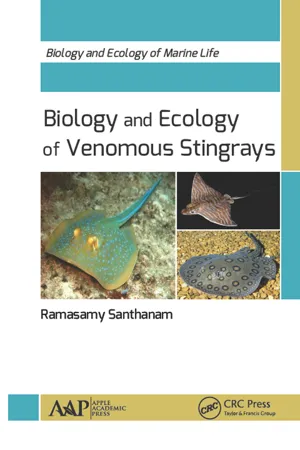
Biology and Ecology of Venomous Stingrays
eBook - ePub

Biology and Ecology of Venomous Stingrays

  1. 372 pages
  2. English
  3. ePUB (mobile friendly)
  4. Available on iOS & Android
eBook - ePub

Biology and Ecology of Venomous Stingrays

About this book

This comprehensive book provides first-hand information on the diversity, biology, and ecology of venomous stingrays of freshwater, brackish, and marine ecosystems. Each year thousands of injuries to swimmers and surfers are reported, with 750 to 1,500 stingray injuries reported each year in the US alone. As more vacationers spend their leisure time exploring coasts and tropical reefs, often in isolated areas without immediate access to advanced health care, there will be greater potential for stingray injuries. A thorough understanding about the diversity of stingrays of marine and freshwater ecosystems and their injuries and envenomations would largely improve the public health community's ability to better manage and to prevent stingray injuries. This volume fills that gap.

With over 200 photos and illustrations, this book shows the characteristics of venomous stingray families along with other profile information, such as common name, geographical distribution, diagnostic features, reproduction, predators, parasites, the International Union for Conservation of Nature's conservation status. Importantly, it includes valuable information on stingray injuries, envenomation, and medical management.

This volume will be very informative for students of fisheries science, marine biology, aquatic biology, and environmental sciences, and will become a standard reference for marine professionals, health practitioners, and college and university libraries, and as a helpful on-board

Trusted by 375,005 students

Access to over 1.5 million titles for a fair monthly price.

Study more efficiently using our study tools.

Information

Year
2017
Print ISBN
9781771885386
eBook ISBN
9781351800259
CHAPTER 1
INTRODUCTION
CONTENTS
Abstract
1.1 Biodiversity and Distribution of World Stingrays
1.2 Food Uses of Stingrays
1.3 Other Uses of Stingrays
1.4 Ecotourism
Keywords
ABSTRACT
Stingrays (phylum: Chordata; subphylum: Vertebrata; class: Chondrichthyes; subclass: Elasmobranchii; order: Myliobatiformes) are members of the “cartilaginous fishes,” which are characterized by cartilaginous skeletons. They have jaws, paired fins and nostrils, scales, and two-chambered hearts. The habitat and distribution of marine and freshwater stingrays along with their use to humans in terms of food, various products, and ecotourism are given in this chapter.
1.1 BIODIVERSITY AND DISTRIBUTION OF WORLD STINGRAYS
A total of 218 species of stingrays have so far been described including 177 species of marine stingrays with 19 genera and 41 species of freshwater stingrays with 7 genera. While marine stingrays have been found widely distributed throughout the coastal tropical and subtropical seas of the world, freshwater stingrays (family: Potamotrygonidae) inhabit the brackish waters, lagoons, and freshwater tributaries of some of the major tropical river systems of South America and Africa. Most myliobatoid rays are demersal and the eagle rays are pelagic (Michael, 2005). The dasyatid stingrays, on the other hand, are bottom-feeders in shallow brackish waters and near reefs.
Biodiversity and Distribution of World Stingrays
Family/genera
No. of species
Distribution
Dasyatidae (whiptail stingrays)
Dasyatis
43a
Atlantic, Indian, and Pacific Oceans
Himantura
28b
Makararaja
1c
Neotrygon
5
Pteroplatytrygon
1
Pastinachus
5
Taeniura
3
Taeniurops
1
Urogymnus
1
Potamotrygonidae (freshwater stingrays)
Heliotrygon
2c
Atlantic and Caribbean watersheds of South America and rivers in West Africa
Paratrygon
1c
Plesiotrygon
2c
Potamotrygon
24c
Gymnuridae (butterfly rays)
Gymnura
14
Worldwide in tropical and warm temperate (subtropical) seas; Atlantic (Black Sea), Pacific, and Indian oceans
Myliobatidae (eagle rays/manta rays)
Aetobatus
3
Tropical and western temperate seas
Aetomylaeus
4
worldwide; Atlantic, Pacific, and Indian oceans
Myliobatis
12
Manta
2
Mobula
9
Pteromylaeus
2
Rhinopteridae (cownose rays)
Rhinoptera
8
Circumglobal distribution (temperate and tropical continental seas)
Urolophidae (stingarees or round stingrays)
Trygonoptera
6
Eastern Indian, western Pacific, eastern Pacific (from California to Chile), and western Atlantic ocean
Urolophus
22
Urobatis
6
Urotrygon
13
Hexatrygonidae (sixgill stingrays)
Hexatrygon
1
Off South Africa
Plesiobatidae (deepwater stingray)
Plesiobatis
1
South Africa; Mozambique, Australia and Western Indian ocean; west-central Pacific ocean (from Japan to Philippines) and Hawaiian Islands
aFour species of Dasyatis and bseven species of Himantura are in freshwater habitats; cexclusively freshwater species.
Source: Schneider (1990).
1.2 FOOD USES OF STINGRAYS
Stingrays are of use to humans in terms of food, various products, and ecotourism. Proximate composition of several species of marine ...

Table of contents

  1. Cover
  2. Half Title
  3. Title Page
  4. Copyright Page
  5. Table of Contents
  6. List of Abbreviations
  7. Preface
  8. 1. Introduction
  9. 2. Biology and Ecology of Marine Stingrays
  10. 3. Profile of Marine Stingrays
  11. 4. Biology and Ecology of Freshwater Stingrays
  12. 5. Profile of Freshwater Stingrays
  13. 6. Stingray Injuries, Envenomation, and Medical Management
  14. References
  15. Index

Frequently asked questions

Yes, you can cancel anytime from the Subscription tab in your account settings on the Perlego website. Your subscription will stay active until the end of your current billing period. Learn how to cancel your subscription
No, books cannot be downloaded as external files, such as PDFs, for use outside of Perlego. However, you can download books within the Perlego app for offline reading on mobile or tablet. Learn how to download books offline
We are an online textbook subscription service, where you can get access to an entire online library for less than the price of a single book per month. With over 1.5 million books across 990+ topics, we’ve got you covered! Learn about our mission
Look out for the read-aloud symbol on your next book to see if you can listen to it. The read-aloud tool reads text aloud for you, highlighting the text as it is being read. You can pause it, speed it up and slow it down. Learn more about Read Aloud
Yes! You can use the Perlego app on both iOS and Android devices to read anytime, anywhere — even offline. Perfect for commutes or when you’re on the go.
Please note we cannot support devices running on iOS 13 and Android 7 or earlier. Learn more about using the app
Yes, you can access Biology and Ecology of Venomous Stingrays by Ramasamy Santhanam in PDF and/or ePUB format, as well as other popular books in Medicine & Veterinary Medicine. We have over 1.5 million books available in our catalogue for you to explore.