eBook - ePub
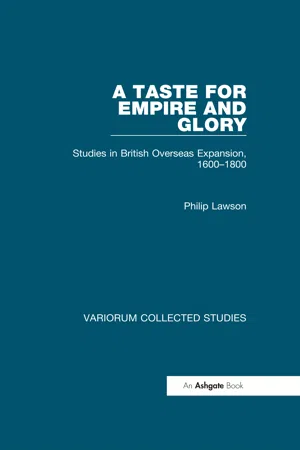
A Taste for Empire and Glory
Studies in British Overseas Expansion, 1600–1800
- 314 pages
- English
- ePUB (mobile friendly)
- Available on iOS & Android
eBook - ePub
A Taste for Empire and Glory
Studies in British Overseas Expansion, 1600–1800
About this book
In the decade and a half before his untimely death at 46, Philip Lawson had already achieved more than many historians. This posthumously published collection brings together his work on the British overseas expansion during the 'long' 18th century and includes two previously unpublished essays. The first articles deal with general issues of approach and interpretation, with Canada and the thirteen colonies, and with India and the empire of tea. The final essays illustrate Anglo-Indian relations and the tea trade, showing the relationship between the establishment of Indian tea plantations, the growth of the tea trade, and the political and cultural impact of tea drinking on the British and their colonists. Taken together these studies make an outstanding contribution to the field, important to anyone interested in the history of Hanoverian Britain as an imperial power.
PART ONE
Manifestos and Contexts
I
THE MISSING LINK: THE IMPERIAL DIMENSION IN UNDERSTANDING HANOVERIAN BRITAIN
Of late there has been some instructive debate about early British rule in India through the pages of several prominent historical journals. Two themes have stood out. The first involves a debate over territorial expansion in India, or more specifically an interpretation of the motives and mechanics behind early colonial rule in the East. The second analysed the historiographical development of literature covering the rise of British power in the East from 1757 to 1857.1 In these debates the ideological differences of approach to contemporary events and documents have been laid bare for all to see, hopefully fuelling further interest in this crucial period of Anglo-Indian history. Viewed from another perspective, however, this dialogue is even more revealing about the huge gaps in the historiography on this topic. In particular, the cavalier manner in which histories and historians of the Hanoverian era have treated imperial issues within the general framework of eighteenth-century studies. With regard to India this neglect appears inexplicable in view of the fundamental social, economic, political, legal and constitutional problems raised with the advance of British rule there after 1763. Indeed it will be argued here that the present approach to the history and development of an overseas empire in this period is still imprisoned in the whiggish past.
This timeless historical approach to imperial questions is best demonstrated by a brief look at the 1760s and 1770s. In his reconstruction of the middle decades of the eighteenth century, John Brewer asked and answered the question ‘What, then, is the evidence or the argument for treating the 1760s as a crucial decade in Hanoverian political history?’2 The kernel of his case can be found in the introductory chapter of his study – an object lesson in theoretical concision. The conflagration following George Ill’s accession was lit by many discordant sparks in the body politic, which included the debate over colonial rule in America. In this book it can be seen how vacuous an explanation of instability in the 1760s would be without reference to this imperial dimension. Yet even within this challenging study there is a shadow of traditionalism, for the only imperial dimension to receive any attention is the American colonial nexus. The obsession with America has been evident in works on the eighteenth century since the last century, and the justification for this bias is never questioned or, to echo Butterfield, even ackowledged.3 The mythology surrounding this problem is firmly planted in the historical psyche. The war of independence represented a cataclysmic event in the development of British authority overseas, leading, as Harlow’s thesis would have it, to the break-up of the first British empire.4 The fact that such discontinuity is not readily supported by the events in India and Quebec in the eighteenth century has not disturbed the firm grip of Harlow’s thesis on the writing of eighteenth-century history. Where Brewer has stepped forward in this debate, however, is in at least integrating American issues and problems of the 1760s into the general political dialogue of the time. Surely after this readers will no longer be treated to chapters in scholarly books on ‘the colonies’, in the same way social history used to be represented in texts with a section on ‘society’.
Despite such small advances, the suspicion remains strong that scholars have been duped by whiggish preconceptions about this period. Historians have accepted without question long-held prejudices in approaching the topic, failing to provide a necessary dimension to the imperial debate. Up to the 1760s this exclusivity can be understood. The economic predominance of the American empire, allied to a vibrant mercantile lobby in London, ensured that attention was focused then and now on the imperial west. After the Seven Years War, however, and in the wake of Robert Clive’s activities in India and England, this monocular approach to imperial matters appears inexcusable. Without doubt, researchers have not let the evidence tell the real story of the middle decades of the eighteenth century. If a new synthesis of the Hanoverian world has emerged through the work of John Brewer, Linda Colley and, more recently, Jonathan Clark, what part is the imperial dimension to be allotted in this scheme of things? Is the American obsession to continue? If so, then scholars will continue to be victims of an old mythology. To break out of this tiresome framework, the scope of the debate needs expanding. The 1760s and 1770s are special not simply because of the American problem but also for the imperial questions raised elsewhere, India and Quebec in particular, which proved equally intractable and difficult to answer. In the narrow focus on America, historians have thus been misleading their audience for far too long. It has been in defiance of the available evidence too. Anyone who has taken even a cursory look through the parliamentary debates, periodical and newspaper literature covering these two decades soon realizes that the source material for the debate on India, for example, is in no way reflected in the texts on this period. The explanation for this imbalance cannot simply be an overweening interest in the build-up to the American revolution, the ramifications of which are only known to the twentieth-century scholars with the benefit of hindsight. The contemporary anguish over imperial problems of the 1760s and 1770s was not narrowly focused on America as it is today. On the contrary, India took up far more time in public and private deliberation than America, certainly up to 1774. Why, therefore, have historians turned the weight of contemporary debate and evidence on its head?
To give an adequate response to such a query would require a major research project to be launched. There are, however, some immediate factors which can be singled out when accounting for the state of the historiography on imperial issues to date. To be brutally frank, the obsession with America and the American revolution in British history of the 1760s and 1770s serves the market. As Sir Lewis Namier discovered fifty years ago, and others who have trod the same path since, adding American revolution to British politics is like waving a magic wand.5 Studies of this type meet an academic demand, particularly in North America, that appears quite insatiable. The fine work published in the William and Mary Quarterly, for instance, and the endless stream of monographs on the revolutionary period, underscore the abiding interest in this dynamic period of Anglo-American relations. Another obvious point that has led to the concentration on America in this period, is the common language and cultural ties that exist for twentieth-century scholars peering back into Britain’s colonial past to deal with America rather than India. How much more simple it is to weave American grievances into the mouths of London radicals in the 1760s as opposed to dealing with the unique protestations of Muslims and Hindus experiencing the rougher edges of colonial rule in India.
Last, but by no means least, it would be foolish to ignore the fact that interest in the struggle for American independence, and the break with Britain, reflects the dominant position of the United States in the world today. To use a quotation from 1066 and all that ‘BAD THING: AMERICA was thus clearly top nation, and History came to a.’.6 It is attractive to trace this onward and upward progression of American hegemony, and proves highly marketable in a contemporary world concerned with superpower politics and posturing. The contrast to interest in mid-eighteenth-century Anglo-Indian relations is striking. Any student who has expressed a modicum of curiosity about this topic (which predates the period of interest so thoroughly documented by Professor Marshall), has been and will continue to be referred to Dame Lucy Sutherland’s book The East India Company in eighteenth-century politics.7 It is no exaggeration to say that this study has been almost unanimously accepted as the last word on the subject by Hanoverian scholars. The unmitigated praise for the scholarship is certainly warranted, but the assumption that it answers every question about India and East India Company issues in mid-eighteenth-century politics is not. The acclaim heaped upon this study has led to the unhealthy position where scholars presume the subject to be well and truly exhausted. This sort of acceptance requires revision, for Sutherland’s excellent research did not, and was probably never intended to, produce the definitive work on this topic. It is some thiry years or so since the book was first published and only now are some younger scholars daring to go where others have feared to tread.8 They have been assisted in their research by new archive material coming to light, but more important, new angles of approach to Anglo-Indian issues in the 1760s and 1770s have revealed a plethora of unexplored problems, ripe for further investigation. As this new ground is broken and cultivated, the neglect of this field of study will hopefully be overcome, delivering everyone from the present unrewarding interest in the minutiae of daily life with the Raj. The stuff that Professor Mukherjee is right to dismiss as ‘ a significant revival of the ideology of the White Man’s Burden, not restricted only to academic circles, but visible in the recent spate of coffee-table novels, scrapbooks and memoirs’.9
No trend of this nature has been so visible in the study of the American imperial dimension. A vibrant interest in this realm of the 1760s and 1770s continues, and is reinforced by the prejudices of scholars approaching the subject in the 1980s. If India appears at all in general texts and specialized studies covering the period, it receives only the most perfunctory analysis in terms of its relevance to political debate in the mid eighteenth century. This is nicely illustrated in Professor Dickinson’s study of the fundamental assumptions underlying political thought. The tone is set in the introduction, where examples are given of political crises that raise argument and sow the seeds of diverse ideological positions throughout the century. The domestic issues mentioned range over the Act of Union of 1707 and the excise crisis of 1733; the one imperial facet of this structure remains ‘the American colonies’.10 This is not to decry the ...
Table of contents
- Cover
- Halftitle Page
- Title Page
- Copyright Page
- Contents
- Preface
- Acknowledgements
- Philip Lawson’s Major Publications 1980–1995
- PART ONE: MANIFESTOS AND CONTEXTS
- PART TWO: THE TRUE NORTH
- PART THREE: THE THIRTEEN COLONIES
- PART FOUR: INDIA AND THE COMPANY
- PART FIVE: THE EMPIRE OF TEA
- Index
Trusted by 375,005 students
Access to over 1.5 million titles for a fair monthly price.
Study more efficiently using our study tools.
Frequently asked questions
Yes, you can cancel anytime from the Subscription tab in your account settings on the Perlego website. Your subscription will stay active until the end of your current billing period. Learn how to cancel your subscription
No, books cannot be downloaded as external files, such as PDFs, for use outside of Perlego. However, you can download books within the Perlego app for offline reading on mobile or tablet. Learn how to download books offline
Perlego offers two plans: Essential and Complete
- Essential is ideal for learners and professionals who enjoy exploring a wide range of subjects. Access the Essential Library with 800,000+ trusted titles and best-sellers across business, personal growth, and the humanities. Includes unlimited reading time and Standard Read Aloud voice.
- Complete: Perfect for advanced learners and researchers needing full, unrestricted access. Unlock 1.5M+ books across hundreds of subjects, including academic and specialized titles. The Complete Plan also includes advanced features like Premium Read Aloud and Research Assistant.
We are an online textbook subscription service, where you can get access to an entire online library for less than the price of a single book per month. With over 1.5 million books across 990+ topics, we’ve got you covered! Learn about our mission
Look out for the read-aloud symbol on your next book to see if you can listen to it. The read-aloud tool reads text aloud for you, highlighting the text as it is being read. You can pause it, speed it up and slow it down. Learn more about Read Aloud
Yes! You can use the Perlego app on both iOS and Android devices to read anytime, anywhere — even offline. Perfect for commutes or when you’re on the go.
Please note we cannot support devices running on iOS 13 and Android 7 or earlier. Learn more about using the app
Please note we cannot support devices running on iOS 13 and Android 7 or earlier. Learn more about using the app
Yes, you can access A Taste for Empire and Glory by Philip Lawson,David Cannadine,Ken Munro in PDF and/or ePUB format, as well as other popular books in History & World History. We have over 1.5 million books available in our catalogue for you to explore.