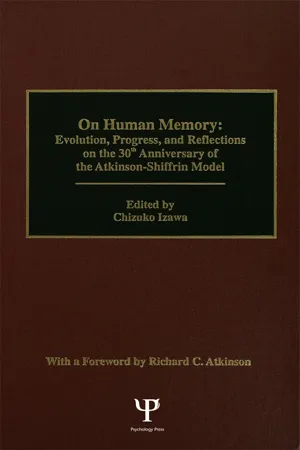
The model of human memory proposed in 1968 by Atkinson and Shiffrin has the distinction of having revolutionized information-processing theory. It catapulated a whole generation of cognitive psychologists into sustained research programs that continue to be productive year after year. The book's notable authors analyze and deliberate on the model's monumental scientific contributions to human learning and memory. They also challenge it and delve into its likely future evolution and impact on learning and memory.
The volume was published in celebration of the 30th anniversary of the Atkinson-Shiffrin model and sets forth a provocative future for memory workers and learning theorists.
eBook - ePub
on Human Memory
Evolution, Progress, and Reflections on the 30th Anniversary of the Atkinson-shiffrin Model
- 312 pages
- English
- ePUB (mobile friendly)
- Available on iOS & Android
eBook - ePub
on Human Memory
Evolution, Progress, and Reflections on the 30th Anniversary of the Atkinson-shiffrin Model
About this book
Information
Publisher
Psychology PressYear
1999Print ISBN
9781138003088
9780805829525
Edition
1eBook ISBN
9781135678739
Chapter 1
On Human Memory: A Brief Introduction
In the beginning, there was Ueber das Gedaechtnis [On Memory] by Hermann Ebbinghaus (1850-1909). It reflected his decade-long intense personal devotion to create a series of highly original experiments that set enduring precedents for the future scientific study of human learning and memory. It was the first such publication in the history of scientific psychology. The volume was the sweet fruit of highly disciplined hard labor, because after all, Experimenter and Subject were one. This original and masterful oeuvre had a commanding effect on the advancement of psychological science, in part because Wilhem Wundt (1832-1920), the founder of modem experimental psychology (first formal laboratory, Leipzig, 1879), asserted that higher mental processes, such as human memory, were beyond the scope of experimental investigation, and could only be explored through Voelkerpsychologie [folk psychology], which relied primarily on people’s casual recollections and traditions, rather than empirical science.
This first definitive stepping stone for theorists and experimentalists of human learning and memory, Ueber das Gedaechtnis [On Memory] (1885), set the standard for research on human learning and memory for over three quarters of a century. Henceforth learning/memory was predominantly investigated and measured in reference to the list (the list-design). During the 1985 centennial, Ebbinghaus’ unprecedented contributions were celebrated both at home and abroad, at conferences, and via special issues of journals and books (e.g., Gorfein and Hoffman published 1987).
The next decisive advance in human learning and memory was Atkinson and Shiffrin’s 1968 rehearsal buffer model. The advent of the cognitive revolution around 1960 promoted human learning and memory workers’ investigation of item-design (Brown, 1958; Peterson & Peterson, 1959), opening the path for this second conquest. In 1968, the 107 page chapter, entitled: “Human Memory: A Proposed System and its Control Processes,” was the prominent contribution to The Psychology of Learning and Motivation: Advances in Research and Theory (Vol. 2 edited by Spence & Spence). It was jointly written by Richard M. Shiffrin, then an outstanding graduate student at Stanford, and his well-known advisor/mentor, Richard C. Atkinson, a professor of psychology at the Institute for Mathematical Studies in the Social Sciences, also at Stanford, a major center for advanced research in psychology.
This seminal masterpiece by Atkinson and Shiffrin (1968), just like Ebbinghaus’, is a relatively short thesis packed with innovative ideas and sound methods for testing them. Highly impressive is their synthesis of earlier developments, for example, Estes (1955a, 1955b), Broadbent (1957, 1958), Greeno (1967), and Bower (1967), and the innovative constructions thereon. An effort requiring extensive knowledge of mathematics and statistics, and continuing mastery of the then rapidly developing high speed computer technology utilized as a hypothetical approximation of memory systems.
The Atkinson-Shiffrin model advanced both structural and control processes. First, in terms of memory structures, the model assumes three entities: Sensory register (SR), short-term store (STS, or STM), and long-term store (LTS, or LTM). External input/stimulus may be lost in any of the above three postulated structures which accounts for memory/information losses or forgetting (Fig. 1, Atkinson & Shiffrin, 1968, p. 93; reproduced on p. 18 of this volume as Fig. 2.1). Information in LTS can be transferred to STS, and vice versa.
Second, quite uniquely and importantly, the model emphasizes the role of processes controlled by the participants, for example, rehearsal, coding, and search strategies in human memory as the formal postulates of the theory. Most intriguingly, the model assumes a rehearsal buffer in STS where items may survive by virtue of rehearsals or transfer to LTS (Atkinson & Shiffrin, 1968, Fig. 2, p. 113). This postulate stimulated the imagination of many; because of it the Atkinson-Shiffrin model came to be referred to as “the rehearsal buffer model” or simply “the buffer model.”
The buffer model’s assumptions regarding coding processes and transfer between STS and LTS, storage in LTS, and long-term search processes are clearly spelled by then extant data. Most impressive of all were the rigorous empirical tests of these theoretical assumptions on 68 of 107 pages. Even today, it is very hard not to be impressed by this monumental early accomplishment. This signal contribution by Atkinson and Shiffrin testifies to the importance of the book chapter format to the advancement of outstanding scientific scholarship. Indeed, Atkinson and Shiffrin (1968) had set the direction for the field of memory during the last 30 years and far beyond.
The influence of the Atkinson-Shiffrin model has been profound; it has become one of the most cited references in experimental psychology. 1998 marks the model’s 30th anniversary. Considering its exceptional mastery of the events addressed, a celebration seems eminently proper. According to the 1996 (newest) edition of the unabridged Webster’s dictionary, “30” among numerical referents signifies “a mark or sign of completion.” And according to the free-association norms I developed for numbers 0 to 100 using well over 400 college students (Izawa, pending), the number 30 immediately elicits associations to youth or youthfulness.
Thus, on this occasion, close associates, mentors, former classmates, colleagues, students, postdoctoral fellows, and all admirers of Dick Atkinson and Rich Shiffrin are here, assembled to celebrate this 30th anniversary of the buffer model. This anniversary volume’s uniqueness is enhanced by the model’s architects’ contributions to it, through authoring the foreword and the lead chapter (scientific contributions), respectively. The rest of the volume is filled with essays and new experiments of high caliber, including one by the winner of the 1997 National Medal of Science.
The Structure of the Volume
Our 30th anniversary celebration volume commemorates a significant victory for researchers in human memory. The foreword by Richard C. Atkinson was prepared despite his consuming schedule as President of the University of California System. Subsequently, in Chapter 2, Richard M. Shiffrin shares his current psychological and mathematical insights.
In Chapter 3, Bennet B. Murdock presents his 30 years’ continued effort to improve on an alternative model, TODAM (theory of distributed associative model). In this editor’s eyes, scientific debate is a must for the advancement of knowledge. Such scientific controversy facilitates the healthy growth of a discipline. For instance, the Hullian (response learning) vs. Tolmanian (cognitive map development) debates (Yale vs. Berkeley) in the 1930s-1950s, and the all-or-none (Estes/Bower) vs. gradual learning (Bush-Mosteller/Underwood-Postman) controversy (Stanford vs. Penn/Nortwestem-Berkeley) in 1960s-1970s added not only rigor to our research, they also led to new knowledge. Fortunately for readers, the rehearsal buffer model vs. TODAM (Indiana vs. Toronto) is cast in very much the same mold!
In Chapter 4, the arguably best cognitive psychologist today, William K. Estes, favors our readers with an exceptionally insightful discussion. It allows readers to assess the landscape of human memory models of the past three decades with far greater accuracy than has been possible hitherto.
Starting with Chapter 5, some of Atkinson and Shiffrin’s colleagues will delve into current hot issues in their laboratories as part of our 30th Anniversary celebration.
Brief Personal Introduction to Contributors and Chapters
Universal concern with the Atkinson-Shiffrin rehearsal buffer model is well reflected by the diverse origins of contributors to this 30th anniversary volume. They are from Europe, Australia, North America, and Asia. This in itself is no small achievement! The following summarizes both the attributes of contributors to the volume and their chapters. More extensive career histories are, of course, publicly available, inclusive of the Internet. The entries follow the sequence of chapters in this volume, except for Chapter 1; its author and the volume editor is introduced along with Chapter 9, her scientific contribution.
Richard C. Atkinson
The foreword to this volume was written by Richard C. Atkinson, co-author with Richard Shiffrin of the model celebrated here. Since 1995, Dr. Atkinson has served as president of the University of California, one of the largest and most distinguished university systems in the world. Before becoming president of the UC System, he was chancellor of UC San Diego; during his 15-year tenure the campus doubled in size while increasing the distinction of its faculty and breadth of its programs.
From 1975 to 1980, Atkinson served at the National Science Foundation, having been appointed as deputy director by President Ford and then as director by President Carter. He had a wide range of responsibilities for science policy at a national and international level, including negotiating the first memorandum of understanding in history between the People’s Republic of China and the United States, an agreement for the exchange of scientists and scholars.
Atkinson began his academic career at Stanford University and was a member of the faculty from 1956 to 1975, except for a 3-year period at UCLA. In addition to serving as professor of psychology at Stanford, he held appointments in the School of Engineering, School of Education, Applied Mathematics and Statistics Laboratories, and Institute for Mathematical Studies in the Social Sciences. Complementing the work discussed in this volume was his more applied work on learning in the classroom. In the early 1960s, he developed one of the first computer-controlled systems for instruction, which served as a prototype for the commercial development of computer-assisted instruction. Reading instruction under computer control for young school children has been an important application of the work.
Atkinson has been elected to the National Academy of Sciences, the Institute of Medicine, the National Academy of Education, and the American Philosophical Society. He is past president of the American Association for the Advancement of Science, former chair of the Association of American Universities, and the recipient of numerous honorary degrees. A mountain in Antarctica has been named in his honor.
Given the remarkable scope of his career, it is fitting to have Dick Atkinson reflect on our field on the 30th anniversary of his and Rich Shiffrin’s paper, an exceptional collaboration between mentor and student.
Richard M. Shiffrin
Without him, this volume would never have been possible. In 1968, together with his mentor, Dick Atkinson, Richard M. Shiffrin, a young PhD candidate at Stanford published the Atkinson-Shiffrin buffer model, whose 30th anniversary we celebrate this year (1998). The ideas forged in 1966-1967 were the wellspring for a stream of brilliant contributions to research upon memory. Among others were the Search of Associative Model (SAM, 1980, also published in a volume of The Psychology of Learning and Motivation, and coauthored with Jeroen Raaijmakers, now Professor at the University of Amsterdam, who carried out his dissertation research with Shiffrin at Indiana in 1979) and Retrieving Effectively from Memory (REM, 1997).
After his undergraduate education at Yale and doctoral training at Stanford, Shiffrin immediately began his permanent academic career at Indiana University in 1968. Currently, the Luther Dana Waterman Professor of Psychology, Shiffrin is the creator and first director of the Cognitive Science Program there. From 1981 to 1984, he edited the Journal of Experimental Psychology: Learning, Memory, and Cognition, and served as Associate Editor for the Psychological Review between 1976-1982. He continues to be a major consulting editor for cognitive, experimental, mathematical and theoretical journals, and served as co-editor of several important volumes including the 1992 two-volume Festschrift for William K. Estes. He continues active involvement in numerous scientific bodies for psychology, especially cognitive/mathematical psychology and was called on to chair the Psychonomic Society in 1988. His publications of major importance number about 100 and are growing rapidly.
Rich Shiffrin’s work is internationally well known. As a result, he has held Visiting Professorships on three different continents, the University of Queensland in Australia (1988), the University of Amsterdam, the Netherlands (1994-1995) in Europe, and the Rockfeller University (1975-1976) in North America. An Honorary Doctorate from the University of Amsterdam was bestowed on him in 1996 (a Dutch journalist traveled to Bloomington to interview him), and in this country, he was inducted into both the National Academy of Sciences and the American Academy of Arts and Sciences in 1995.
Not surprisingly, Rich Shiffrin had a number of outstanding students. A few of the best known include Bill Geisler (Professor at Texas, a leading theorist in vision), Walter Schneider (Professor at Pittsburgh, and co-author with Shiffrin of the influential articles in Psychological Review on automatic and controlled processing), and Sue Dumais (now at Microsoft, and recently co-author with Tom Landauer of a model of the development of word meaning), plus those contributing to this volume, cited later.
Shiffrin presents his own account in Chapter 2, “30 Years of Memory.” It commences with the original 1968 Atkinson-Shiffrin buffer model, depicts the evolution of SAM, and the subsequent REM. As is Shiffrin’s wont, he continuously refines and advances his models to new levels of sophistication, and with each step, forges the next model. Chapter 2 provides tantalizing hints of forthcoming scientific advancements in human memory research, perhaps the most important ones since Ueber das Gedaechtnis.
Bennet B. Murdock
Among the most creative and intensely devoted memory researchers and learning theorists today, Bennet B. Murdock, offers an alternative approach to the Atkinson-Shiffrin buffer model, viz. the theory of distributed associative memory (TODAM). Murdock has also been working on his model and its refinements/improvements for nearly three decades. Among my friends, Ben Murdock is the only one who has had personal contact with Clark L. Hull (1884-1952), a giant who built the most comprehensive hypothetical-deductive theory of learning at Yale. Yale provided Ben Murdock’s undergraduate and graduate education, awarding him the doctorate in 1951. After Wesleyan, Vermont, and Missouri, Murdock found a permanent home in 1965 at the University of Toronto. He served on editorial boards of several journals, and many professional organizations, including the presidency of the Mathematical Psychology Society (1993-1994). His v...
Table of contents
- Cover Page
- Half Title page
- Title Page
- Copyright Page
- Contents
- Foreword
- Preface
- 1 On Human Memory: A Brief Introduction
- 2 30 Years of Memory
- 3 The Buffer 30 Years Later: Working Memory in a Theory of Distributed Associative Memory (TODAM)
- 4 Models of Human Memory: A 30-Year Retrospective
- 5 Part-List Cuing Revisited: Testing the Sampling-Bias Hypothesis
- 6 List-length Effect and Continuous Memory: Confounds and Solutions
- 7 Cues and Codes in Working Memory Tasks
- 8 Recall of Order Information: Evidence Requiring a Dual-Storage Memory Model
- 9 Efficiency in Acquisition and Short-Term Memory: Study-Test-rest Presentation Programs and Learning Difficulty
- 10 Recalling to Recognize and Recognizing Recall
- 11 Measuring the Time Course of Retention
- Author Index
- Subject Index
Trusted by 375,005 students
Access to over 1.5 million titles for a fair monthly price.
Study more efficiently using our study tools.
Frequently asked questions
Yes, you can cancel anytime from the Subscription tab in your account settings on the Perlego website. Your subscription will stay active until the end of your current billing period. Learn how to cancel your subscription
No, books cannot be downloaded as external files, such as PDFs, for use outside of Perlego. However, you can download books within the Perlego app for offline reading on mobile or tablet. Learn how to download books offline
Perlego offers two plans: Essential and Complete
- Essential is ideal for learners and professionals who enjoy exploring a wide range of subjects. Access the Essential Library with 800,000+ trusted titles and best-sellers across business, personal growth, and the humanities. Includes unlimited reading time and Standard Read Aloud voice.
- Complete: Perfect for advanced learners and researchers needing full, unrestricted access. Unlock 1.5M+ books across hundreds of subjects, including academic and specialized titles. The Complete Plan also includes advanced features like Premium Read Aloud and Research Assistant.
We are an online textbook subscription service, where you can get access to an entire online library for less than the price of a single book per month. With over 1.5 million books across 990+ topics, we’ve got you covered! Learn about our mission
Look out for the read-aloud symbol on your next book to see if you can listen to it. The read-aloud tool reads text aloud for you, highlighting the text as it is being read. You can pause it, speed it up and slow it down. Learn more about Read Aloud
Yes! You can use the Perlego app on both iOS and Android devices to read anytime, anywhere — even offline. Perfect for commutes or when you’re on the go.
Please note we cannot support devices running on iOS 13 and Android 7 or earlier. Learn more about using the app
Please note we cannot support devices running on iOS 13 and Android 7 or earlier. Learn more about using the app
Yes, you can access on Human Memory by Chizuko Izawa in PDF and/or ePUB format, as well as other popular books in Psychology & Cognitive Psychology & Cognition. We have over 1.5 million books available in our catalogue for you to explore.