eBook - ePub
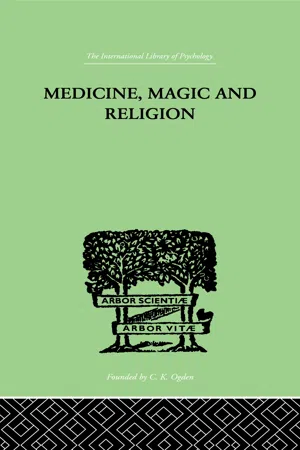
Medicine, Magic and Religion
The FitzPatrick Lectures delivered before The Royal College of Physicians in London in 1915-1916
- 156 pages
- English
- ePUB (mobile friendly)
- Available on iOS & Android
eBook - ePub
Medicine, Magic and Religion
The FitzPatrick Lectures delivered before The Royal College of Physicians in London in 1915-1916
About this book
This is Volume IV of six in a series in the International Library of Psychology on Anthropology and Psychology. Originally published in 1924, this is a collection of the Fitzpatrick Lectures delivered before the Royal College of Physicians of London in 1915 and 1916 and it represents perhaps the first attempt to interpret with real knowledge and sympathetic insight the thoughts and ideas that find expression in Primitive Medicine.
Information
MEDICINE, MAGIC, AND RELIGION CHAPTER I
MEDICINE, magic, and religion are abstract-terms, each of which connotes a large group of social processes, processes by means of which mankind has come to regulate his behaviour towards the world around him. Among ourselves these three groups of process are more or less sharply marked off from one another. One has gone altogether into the background of our social life, while the other two form distinct social categories widely different from one another, and having few elements in common. If we survey mankind widely this distinction and separation do not exist. There are many peoples among whom the three sets of social process are so closely inter-related that the disentanglement of each from the rest is difficult or impossible; while there are yet other peoples among whom the social processes to which we give the name of Medicine can hardly be said to exist, so closely is man’s attitude towards disease identical with that which he adopts towards other classes of natural phenomena.
METHODS OF INQUIRY
In any attempt to study a social institution there are three chief lines of approach and methods of inquiry. We may examine the institution historically, seeking to learn how it has been built up, how this advance has taken placc here and that there; we may study the social conditions under which it has progressed in one place, been stationary in another, and degenerated in a third; and we may attempt to go back to its origin, and ascertain the steps by which it has become differentiated from other institutions, and has acquired an independent existence.
A second method is the psychological. We may attempt to study the states of mind, individual and collective, which underlie the acts, again individual and collective, the sum of which make up the institution in question.
The third method, which may be called the sociological method, is the inquiry into the relations of the social processes which we are attempting to study to other social processes, in order to determine the interactions between the two.
Since the object of the FitzPatrick Lectures is the study of the history of medicine, it might seem that the first of these three lines of inquiry should form their subject. This would certainly be so if medicine were everywhere the independent and self-contained institution which it is among ourselves; but if my opening statement is correct this is very far from being the case. A necessary preliminary to any knowledge of its history must be the study of its relations to those other social processes with which it is associated. This preliminary task will occupy us in these lectures, which will deal with certain prolegomena to the early history of medicine, rather than with the history of medicine itself.
It would be quite impossible within the scope of this book to deal with the subject exhaustively. My object will be rather to consider lines of inquiry by which the subject may be studied; and for this purpose I shall limit myself as far as possible to one part of the world, viz. Melanesia and New Guinea, which have been especially the field of my own researches, with occasional references to the allied culture of Australia. The time has gone by in sociology when we tried to understand human institutions by comparing examples taken at randon from every part of the world. The present trend1 in the science which deals with these matters is to limit inquiries to a series of related peoples. If we reach conclusions by means of such inquiries, we can then proceed to see if they will apply in other parts of the world.
DEFINITION OF THE SOCIAL PROCESSES
I must begin by defining the three kinds of social process which are to be the subject of our study. The distinction between magic and religion is one which has long tried the ingenuity of students of human society. Among many peoples, including those with whom this book will especially deal, it is far from easy to draw any definite line between the two, and we need a term which will include both. A word which is sometimes used in this sense in English is magico-religious, and, in default of a better, I shall use it occasionally in this book. The use of this word will imply a certain attitude towards the world. If the matter be looked at from our point of view, this attitude would be one in which phenomena are dealt with by supernatural means. I say if regarded from our point of view because, of course, the use of the word supernatural implies the existence of the concept of the natural, and it is just this concept, as we have it, which is lacking among the people with whom I shall deal. The essence of medicine, as we now understand it, is that it regards disease as a phenomenon subject to natural laws, to be treated as we treat any other department of nature. The distinction between the attitude of the modern practitioner of medicine and the magico-religious attitude depends on the difference in the concept of disease in the two cases. One chief object of this book will be to discover what is the nature of the concept of disease among whose who fail to distinguish medicine from magic and religion.
While the main topic will thus be the nature of the concept of disease among certain peoples of rude culture, and the relation of this concept to those underlying magic and religion, it will be interesting to pay attention to the distinction between these two groups of social process. A full study of this distinction would take us too far from our main subject, and I must be content to use a provisional distinction, which will be useful for descriptive purposes. When I speak of magic, I shall mean a group of processes in which man uses rites which depend for their efficacy on his own power, or on powers believed to be inherent in, or the attributes of, certain objects and processes which are used in these rites. Religion, on the other hand, will comprise a group of processes, the efficacy of which depends on the will of some higher power, some power whose intervention is sought by rites of supplication and propitiation. Religion differs from magic in that it involves the belief in some power in the universe greater than that of man himself.
Magic and religion are thus differentiated from one another by their attitude towards the means by which man seeks to influence the universe around him. Medicine, on the other hand, is a term for a set of social practices by which man seeks to direct and control a specific group of natural phenomena—viz. those especially affecting man himself, which so influence his behaviour as to unfit him for the normal accomplishment of his physical and social functions—phenomena which lower his vitality and tend towards death. By a process of generalization, society has come to classify these phenomena together, and has distinguished them from other groups of natural phenomena under the name of disease. As I have already said, one of the chief tasks of this book will be to ascertain how far this notion of disease, this category of the morbid, exists among the peoples included in our field of study; and we shall do this mainly by means of an inquiry into the processes by which man reacts to those phenomena we call morbid.
CONCEPT OF DISEASE BY VARIOUS PEOPLES
One way of approaching the problem will be to inquire how far different groups of mankind have set apart certain members of the community to deal with the morbid. When we have evidence of such division and specialization of social functions, we shall have at the same time definite evidence that those who have reached this specialization of function have also reached a stage of thought in which they separate morbid from other natural phenomena. One point of nomenclature may be considered here. In dealing with the subject of medicine from the comparative point of view, and among peoples of rude culture, we are met by a difficulty arising out of the wealth of the English language in terms for practitioners of the healing art. When in this book I am to speak of those members of the community whose special business it is to deal with disease, am I to call them doctors, medical-men, medicine-men, physicians, or what? Medicine-men might seem the most appropriate of these, in that it is not a term used of our own practitioners, and will thus carry with it no connotation derived from our civilization. It suffers, however, from the disadvantage that it comes to be widely used in anthropological literature for sorcerers and dealers in various forms of magic, who may have no dealing with the morbid, and certainly exercise no-therapeutical activities. I propose therefore, to use the old English term “leech”. When I speak of a leech I shall mean a member of society whose special function it is to deal with the cure of disease. He may have other functions, such as the formation of rain, the promotion of vegetation, or even the production of disease itself; but in so far as he is dealing with the cure of disease he will be, in the nomenclature I shall use, a leech.
One of the methods, then, by which we may seek to ascertain how far different peoples of the world distinguish morbid from other natural phenomena is by inquiring how far they distinguish the leech from the sorcerer or the priest. The chief line of inquiry, however, will be an examination of the processes by which man at different stages of culture deals with disease. We shall find that, even when there is no clear differentiation of the leech from other members of society, mankind has theories of the causation of disease, carries out proceedings which correspond with those we call diagnosis and prognosis, and finally has modes of treatment which, even if they have little in common with our own remedies, nevertheless may be regarded as making up a definite system of therapeutics.
I have said that one of my chief objects will be an attempt to discover the nature of the concept of disease held by different peoples. I must first say a word about what we mean when we speak of a people possessing and acting on such a concept. I do not mean such a clear concept as is held, say, by the writer of an European textbook of medicine, a concept capable of being expressed by the formula we call a definition. Such a concept is the result of a very advanced process of generalization and abstraction, and we all know how difficult it is to frame such a definition, even with the large system of exact knowledge which we possess. It is evident that when we speak of the concept of disease held by such a people as the Melanesians we mean no exactly formulated definition, but a more or less vague system of ideas, which, though not distinctly formulated by a people, yet directs their behaviour—their reactions towards those features of the environment which we have classified together under the category of disease.
BELIEFS AS TO CAUSATION OF DISEASE
One element of the concept of disease, and perhaps the most important, is that it includes within its scope the factor of causation. There are usually clear-cut ideas concerning the immediate conditions which lead to the appearance of disease. One happy result of this fact is that we are able to approach our subject by way of etiology, and are thus led to deal with the medicine of savage peoples from the same standpoint as that of modern medicine, which rests, or should rest, entirely upon the foundation of etiology. By starting from etiology we shall find ourselves led on as naturally to diagnosis and treatment, as is the case in our own system of medicine.
If we examine the beliefs of mankind in general concerning the causation of disease, we find that the causes may be grouped in three chief classes: (1) human agency, in which it is believed that disease is directly due to action on the part of some human being; (2) the action of some spiritual or supernatural being or, more exactly, the action of some agent who is not human, but is yet more or less definitely personified; and (3) what we ordinarily call natural causes.
Among ourselves there are indications of the presence of all three kinds of belief, and this was certainly so in the not very remote past. We now only think of human agency in cases of poison and injury, and then only as the means by which the action of natural causes has been directed. The second category still exists in the “hand of God” of our statutes, and in the oral rites of our religion, but has ceased to take any part in orthodox medicine, though it still plays some part in the behaviour of the laity towards disease. In the professional art of medicine, and in the practice of the majority of the laity, the attitude towards disease is directed by the belief in its production by natural causes, meaning by this a body of beliefs according to which disease comes into being as the inevitable result of changes in our environment quite independent of human or superhuman agency.
If, on the other hand, we examine the culture of any savage or barbarous people, we find that their beliefs concerning the causation of disease fall in the main into one or other or both of the first two categories, while in many cases the third category can hardly be said to exist, and even then we cannot assign the beliefs to the category of natural causation. I shall deal with these cases more fully in the second chapter. For the present I shall confine my attention to those cases in which the native ideas concerning causation bring them within the realm of magic or religion. In this chapter I shall deal with cases which must either be definitely classed with magic, or belong more nearly to this category than to that of religion.
It would greatly simplify the treatment of our subject if the line of cleavage between the cases of causation of disease by human and non-human agency corresponded with the distinction between magic and religion. When writing this book I was at one time inclined to throw the distinction between magic and religion on one side, and describe the facts with which I shall have...
Table of contents
- ANTHROPOLOGY AND PSYCHOLOGY
- PREFACE
- MEDICINE, MAGIC, AND RELIGION CHAPTER I
- CHAPTER II
- CHAPTER III
- CHAPTER IV
- CHAPTER V MIND AND MEDICINE1
- INDEX
Trusted by 375,005 students
Access to over 1.5 million titles for a fair monthly price.
Study more efficiently using our study tools.
Frequently asked questions
Yes, you can cancel anytime from the Subscription tab in your account settings on the Perlego website. Your subscription will stay active until the end of your current billing period. Learn how to cancel your subscription
No, books cannot be downloaded as external files, such as PDFs, for use outside of Perlego. However, you can download books within the Perlego app for offline reading on mobile or tablet. Learn how to download books offline
Perlego offers two plans: Essential and Complete
- Essential is ideal for learners and professionals who enjoy exploring a wide range of subjects. Access the Essential Library with 800,000+ trusted titles and best-sellers across business, personal growth, and the humanities. Includes unlimited reading time and Standard Read Aloud voice.
- Complete: Perfect for advanced learners and researchers needing full, unrestricted access. Unlock 1.5M+ books across hundreds of subjects, including academic and specialized titles. The Complete Plan also includes advanced features like Premium Read Aloud and Research Assistant.
We are an online textbook subscription service, where you can get access to an entire online library for less than the price of a single book per month. With over 1.5 million books across 990+ topics, we’ve got you covered! Learn about our mission
Look out for the read-aloud symbol on your next book to see if you can listen to it. The read-aloud tool reads text aloud for you, highlighting the text as it is being read. You can pause it, speed it up and slow it down. Learn more about Read Aloud
Yes! You can use the Perlego app on both iOS and Android devices to read anytime, anywhere — even offline. Perfect for commutes or when you’re on the go.
Please note we cannot support devices running on iOS 13 and Android 7 or earlier. Learn more about using the app
Please note we cannot support devices running on iOS 13 and Android 7 or earlier. Learn more about using the app
Yes, you can access Medicine, Magic and Religion by W. H. R. Rivers in PDF and/or ePUB format, as well as other popular books in Medicine & Health Care Delivery. We have over 1.5 million books available in our catalogue for you to explore.