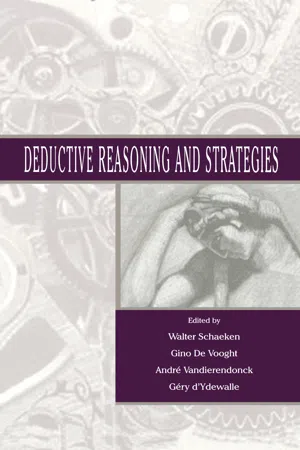
This book brings together both theoretical and empirical research directed toward the role of strategies in deductive reasoning. It offers the first systematic attempt to discuss the role of strategies for deductive reasoning. The empirical chapters correspond well with the main issues in the study of deduction, namely propositional reasoning, spatial reasoning, and syllogistic reasoning. In addition, several chapters present a theoretical analysis of deduction, related to the concept strategy. The book also presents data about the role of strategies for statistical and social reasoning.
This book will be of interest to researchers and students of cognitive psychology. It will also be of value to people working in Artificial Intelligence, because it highlights results on how humans use strategies while tackling deductive puzzles.
eBook - ePub
Deductive Reasoning and Strategies
- 336 pages
- English
- ePUB (mobile friendly)
- Available on iOS & Android
eBook - ePub
About this book
Information
1
What Could and Could Not Be a Strategy in Reasoning
The term “strategy” is discussed with reference to Evans and Over’s (1996) distinction between implicit and explicit thought processes. A strategy is used to refer to processes which are relatively slow, goal-directed, systematic, and under explicit conscious control. The remainder of the chapter concerns the theoretical accounts that have been given of reasoning in three domains: transitive inference, syllogistic reasoning, and prepositional reasoning. It is argued that many descriptions of the processes involved in reasoning refer to tacit processes which could not—by the above definition—be strategic. These include pragmatic comprehension processes and nonlogical heuristics. However, it is also argued that to reason deductively rather than inductively does require a conscious effort at deduction and only occurs in response to specific instructions. Thus deduction is seen as a strategy. An account of strategic deductive reasoning with the mental models framework is preferred.
To start with let us consider some examples of what we mean by the term strategy when we talk of people employing strategies in reasoning, problem solving, and decision making. It seems to me that we would not talk of strategies when people are making quick decisions with little time for conscious reflective thought. Thus we would not talk of a footballer employing a strategy when receiving and releasing the ball in a couple of seconds, but we might consider that a golfer could employ strategies in choosing the kind of shot to play. Similarly, we would not consider strategic thinking to be implicated in how a car driver reacts to a sudden emergency on the road, but might we believe that it is involved in how the manager of small company deals with a crisis in the company’s performance.
Of course, the employment of slow thought processes is hardly sufficient to justify the term strategy. We might think that the golfer is playing mechanically without thinking about the best way to play the course, or that the manager is blundering along without any clear ideas about how to deal with her crisis. Thus another facet of the term strategy is that some kind of systematic planning or goal-directed thought is involved. Strategic thinking thus involves the development and application of methods. Still, this does not sufficiently define the term. For example, the skilled footballer has method in the quick decisions involved in passing the ball, developed by years of experience. One could analyze patterns of play and show that good players make more appropriate choices to the context, taking into account the state of the play when the ball is received. Experts refer to this as “vision.”
Why should fast-process but nevertheless systematic and goal-directed decision making not appear to be strategic? Perhaps because it is intuitive or unconscious in nature. However, if we examine the notion of conscious thinking a little more carefully, we can see that it involves two important and distinct facets: awareness and intentionality. If a process is expert but implicit and the person concerned cannot verbalize the expertise in any clear way we may be reluctant to ascribe the expertise to a strategy. That is the awareness aspect. The intentionality aspect arises because we think that a person employing a strategy has some choice and conscious control over what is to be done. For example, we think that the person could try out one strategy and if it did not work, try another. Or we think that strategies are things that can be explicitly taught to people. Certainly, in cognitive psychology, researchers interested in strategies frequently manipulate their use by verbal instruction. This implies that strategies are methods that can be described and understood verbally and then adopted consciously.
In short, we use the term strategy to refer to thought processes that are elaborated in time, systematic, goal-directed, and under explicit conscious control. We also assume that strategic thinking is active and flexible: Individuals can choose to operate one strategy rather than another when faced with a given type of problem. They are not operating under the passive constraints of past learning. The nature of strategic thinking as defined earlier has close connections with what some researchers describe as explicit as opposed to implicit cognition. We examine this distinction before proceeding to consider reasoning strategies as such.
IMPLICIT AND EXPLICIT COGNITION
Dual Processes in Thinking
In the field of implicit learning, some researchers believe there is evidence for two distinct cognitive systems, one implicit and the other explicit (Berry & Dienes, 1993; Reber, 1993). I have discussed this work and its implications for the psychology of thinking elsewhere (Evans, 1995) and will describe it only briefly here. The implicit system is characterized as being evolutionarily primary, shared with other animals, inaccessible to verbal report, distributed and robust in the face of neurological insult. The explicit system on the other hand is uniquely human, associated with language and consciousness, and localized in the brain. Another important distinction is that knowledge acquired implicitly tends to be context specific whereas explicit knowledge can be transferred much more readily to contexts other than those in which it was acquired. Although this dichotomy makes perfect sense to me in the light of research on the psychology of thinking and reasoning, it should be noted that it is somewhat controversial in the current literature (see, e.g., Stevenson, 1997).
Evans and Over (1996) have elaborated a similar distinction as applied to human thinking, reasoning, and decision making. This is linked—though not one to one—with a distinction between two kinds of rationality as follows:
| Rationality1: | Thinking, speaking, reasoning, making a decision, or acting in a way that is generally reliable and efficient for achieving one’s goals. |
| Rationality2: | Thinking, speaking, reasoning, making a decision, or acting when one has a reason for what one does sanctioned by a normative theory. |
This distinction was originally introduced by Evans (1993; a similar distinction between adaptive and normative rationality was proposed by Anderson, 1990) to account for a paradox in the psychology of thinking: Why is it that members of such an intelligent and well adapted species as human beings produce so many errors and fallacies in experimental studies of reasoning and judgement? The proposed answer is that normative theories such as logic and decision theory may not provide appropriate criteria for rational action in a complex world of poorly defined information, and that normally adaptive mechanisms may not easily be adapted to meet the instructional requirements of an artificial experiment. As an example of the latter, the belief bias effect in syllogistic reasoning may be cited as evidence of irrational2 reasoning: This is the tendency to be influenced by the a priori believability of conclusions when assessing the validity of logical arguments (see Evans, Newstead, & Byrne, 1993, chap. 8 for a review). However, Evans and Over (1996) argue that it is adaptive in everyday life to reason from all relevant belief, and this tendency is automatically transferred to the syllogistic reasoning experiment, despite instructions to draw conclusions on the basis of the information given.
The distinction between implicit and explicit thought is critical to arguments such as the above. If the influence of belief in reasoning is “automatic” and resistant to instructions, then this implies the operation of implicit processes, beyond conscious control. On the other hand, as we see later, people can adapt their reasoning processes to an extent when instructed to base conclusions on necessity rather than belief (Evans et al, 1994; George, 1995; Stevenson & Over, 1995). This in turn implies the operation of an explicit thinking system. The two systems can almost be seen as competing with one another, as in the study of Evans, Barston, and Pollard (1983) where participants appeared to adopt an unstable mixture of logical and belief based reasoning.
Evans and Over (1996) developed a distinction between explicit and implicit thinking systems similar to that of implicit reasoning researchers, described earlier. They argued that much of our capacity to be rational1 is derived from implicit processes either acquired by implicit learning or already present in innate modules. They further suggested that connectionist systems are appropriate for modeling these kinds of processes. To achieve rationality2—for example to be able to formulate a mathematical proof, or more prosaically to understand how to fill in a tax form—generally requires use of the explicit system. This system is by contrast to the implicit system, slow, sequential, and limited in processing capacity. However, the access to language and reflective consciousness permits an important facility which Evans and Over described as hypothetical thinking, Hypothetical thinking allows us to represent (as mental models) possible states of the world. This in turn permits us to draw deductions, to make forecasts, and to base our decisions on analysis of future possibilities rather than simply responding on the basis of past success. It is important to realize, however, that no act of thought is purely explicit. At the very least, implicit pragmatic processes select information as relevant and determine the locus of attention of the explicit system. Thus biases in reasoning and judgment (judged by rational2 criteria) often arise because the wrong information is encoded as relevant by the implicit system (Evans, 1989).
Methodological Issues—Use of Verbal Reports and Verbal Instruction
How can we tell if a process is explicit and learn of its nature? I have been for many years—and remain—sceptical of the value of introspective reporting, but sympathetic to use of verbal protocol analysis (see Evans, 1989, chap. 5). Some authors treat these alike, although to me the distinction is critic...
Table of contents
- List of Contributors
- Contents
- Preface
- 1 What Could and Could Not Be a Strategy in Reasoning
- 2 Individual Differences in Reasoning Strategies: A Problem to Solve or an Opportunity to Seize?
- 3 Task, Premise Order, and Strategies in Rips’s Conjunction-Disjunction and Conditionals Problems
- 4 Preferred Premise Order in Prepositional Reasoning: Semantic Informativeness and Co-Reference
- 5 Counterexample Availability
- 6 Pragmatics and Strategies for Practical Reasoning
- 7 Mechanisms and Strategies for Rephrasing
- 8 Spatial Strategies in Reasoning
- 9 Strategies of Constructing Preferred Mental Models in Spatial Relational Inference
- 10 Model Construction and Elaboration in Spatial Linear Syllogisms
- 11 Strategies and Tactics in Reasoning
- 12 Individual Differences and the Search for Counterexamples in Syllogistic Reasoning
- 13 Strategies and Models in Statistical Reasoning
- 14 Focusing Strategies in Reasoning About Games
- 15 Strategies and Tactics in Deductive Reasoning
- AUTHOR INDEX
- SUBJECT INDEX
Trusted by 375,005 students
Access to over 1.5 million titles for a fair monthly price.
Study more efficiently using our study tools.
Frequently asked questions
Yes, you can cancel anytime from the Subscription tab in your account settings on the Perlego website. Your subscription will stay active until the end of your current billing period. Learn how to cancel your subscription
No, books cannot be downloaded as external files, such as PDFs, for use outside of Perlego. However, you can download books within the Perlego app for offline reading on mobile or tablet. Learn how to download books offline
Perlego offers two plans: Essential and Complete
- Essential is ideal for learners and professionals who enjoy exploring a wide range of subjects. Access the Essential Library with 800,000+ trusted titles and best-sellers across business, personal growth, and the humanities. Includes unlimited reading time and Standard Read Aloud voice.
- Complete: Perfect for advanced learners and researchers needing full, unrestricted access. Unlock 1.5M+ books across hundreds of subjects, including academic and specialized titles. The Complete Plan also includes advanced features like Premium Read Aloud and Research Assistant.
We are an online textbook subscription service, where you can get access to an entire online library for less than the price of a single book per month. With over 1.5 million books across 990+ topics, we’ve got you covered! Learn about our mission
Look out for the read-aloud symbol on your next book to see if you can listen to it. The read-aloud tool reads text aloud for you, highlighting the text as it is being read. You can pause it, speed it up and slow it down. Learn more about Read Aloud
Yes! You can use the Perlego app on both iOS and Android devices to read anytime, anywhere — even offline. Perfect for commutes or when you’re on the go.
Please note we cannot support devices running on iOS 13 and Android 7 or earlier. Learn more about using the app
Please note we cannot support devices running on iOS 13 and Android 7 or earlier. Learn more about using the app
Yes, you can access Deductive Reasoning and Strategies by Walter Schaeken, Gino De Vooght, Andr' Vandierendonck, G'ry d'Ydewalle, Gery d'Ydewalle, Walter Schaeken,Gino De Vooght,Andr' Vandierendonck,G'ry d'Ydewalle,Gery d'Ydewalle,Andr‚ Vandierendonck,G‚ry d'Ydewalle in PDF and/or ePUB format, as well as other popular books in Education & Education Theory & Practice. We have over 1.5 million books available in our catalogue for you to explore.