The Reader's Guide to Women's Studies is a searching and analytical description of the most prominent and influential works written in the now universal field of women's studies. Some 200 scholars have contributed to the project which adopts a multi-layered approach allowing for comprehensive treatment of its subject matter. Entries range from very broad themes such as "Health: General Works" to entries on specific individuals or more focused topics such as "Doctors."
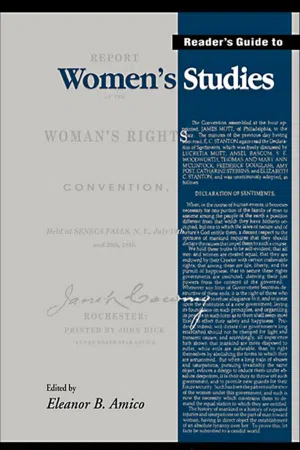
- 762 pages
- English
- ePUB (mobile friendly)
- Available on iOS & Android
eBook - ePub
Reader's Guide to Women's Studies
S
Sacagawea 1784?–1812
American Guide
Clark, Ella E., and Margot Edmonds, Sacagawea of the Lewis and Clark Expedition, Berkeley: University of California Press, 1979
Hebard, Grace Raymond, Sacajawea: A Guide and Interpreter of the Lewis and Clark Expedition, with an Account of the Travels of Toussaint Charbonneau, and of Jean Baptiste, the Expedition Papoose, Glendale, California: Arthur H. Clark, 1933
Howard, Harold P., Sacajawea, Norman: University of Oklahoma Press, 1971
Kessler, Donna J., The Making of Sacagawea: A Euro-American Legend, Tuscaloosa: University of Alabama Press, 1996
Schultz, James Willard, Bird Woman (Sacajawea): The Guide of Lewis and Clark: Her Own Story First Given to the World, Boston: Houghton Mifflin, 1918
Sundquist, Asebrit, Sacajawea and Co.: The Twentieth-Century Fictional American Indian Woman and Fellow Characters: A Study of Gender and Race, Oslo: Solum Forlag, and Atlantic Highlands, New Jersey: Humanities Press, 1991
Waldo, Anna Lee, Sacajawea, New York: Avon, 1978
Sacagawea, according to legend and brief mention in records of the Lewis and Clark expedition of 1803–6, which explored the western lands newly purchased by the United States, was a young Shoshone woman who served as guide to the expedition, her infant son on her back. Sacagawea became a popular American cultural subject in both scholarly and popular writings and was elevated to heroic stature and legend during the Progressive Era. Her image has changed over time to reflect the shifting desires and interests of American culture, but her story has been consistently used to validate the U.S. policy of manifest destiny and to point up the dichotomy between “savagery” and “civilization” (although there have been dissenting portrayals since World War II that question frontier policy and the resultant myths). The most important literary treatments of Sacagawea concern the scope and value of her actual participation in the Lewis and Clark expedition, her autonomy during that period, her position between the white and the Native American worlds, and her life, its length, and its meaning after her death.
KESSLER investigates how the Sacagawea story was elevated to the status of both popular and scholarly legend, why her story has endured, and how it has served American policy and ideology, as well as the opposition to these concerns.
In an early, folksy narrative version, SCHULTZ relates the story of Bird Woman (Sacagawea) as told to Hugh Monroe (Rising Wolf), as then told to Schultz (partially Native American himself). Sacagawea is portrayed as the proverbially “good” woman who would do anything to serve the “kind good [white] chiefs.”
Although some historians of the period disputed HEBARD’s scholarship and findings, her book became the definitive historical text of Sacagawea’s life. Hebard was the first historian to take Sacagawea’s story beyond the expedition, arguing that she did not die in her early twenties, as was commonly believed, but lived until she was nearly one hundred years old, during which time she demonstrated her esteem for white civilization by arguing for acceptance of their ways by her Shoshone people.
HOWARD attempts to set straight the historical record about Sacagawea by reviewing what has been learned and conjecturing about her life before, during, and after the expedition in order to accord her a realistic (but not necessarily diminished) place in the westward expansion history of the United States. In an attempt to resolve the controversy over her later life, Howard provides evidence that she died shortly after the expedition had gotten back to South Dakota, at a fairly early age, thus eliminating her need to “choose” between the white world and her own.
SUNDQUIST analyzes Sacagawea (and 164 other female Native American characters) as portrayed in twentieth-century imaginative literature from 1911 to 1980, relating those portrayals to comparative gender variables and race. Sacagawea is most often and most strongly portrayed as an angel, but also as a drudge and a strong woman.
CLARK and EDMONDS examine how the legends, “the fog of idolatry” surrounding Sacagawea, have obscured both the person and her very real contributions to the Lewis and Clark expedition, as well as her character and her life after the expedition, which has been little examined.
WALDO writes the modern romantic version of the Sacagawea story, portraying her both as an Indian princess and as an emblem of modern feminism, a heroine of remarkable power and intelligence who resisted dependence on and violence from men, especially Native American men. While lauding Sacagawea as a kind of everywoman, Waldo repeatedly emphasizes racial stereotypes by depicting Native Americans as savages who subordinate women. In Waldo’s account, Sacagawea learned to value civilization because it allowed her female independence and white male companionship, a theme found in many versions of the Sacagawea legend.
—JANET M.LaBRIE
Saints
Ahlgren, Gillian T.W., Teresa of Avila and the Politics of Sanctity, Ithaca, New York, and London: Cornell University Press, 1996
Chittister, Joan D., A Passion for Life: Fragments of the Face of God, Maryknoll, New York: Orbis, 1996
Duby, Georges, Michelle Perrot, Pauline Schmitt Pantel, and Arthur Goldhammer, A History of Women in the West: From Ancient Goddesses to Christian Saints, 5 vols. Cambridge, Massachusetts, and London: Harvard University Press, 1992
Flinders, Carol Lee, Enduring Grace: Living Portraits of Seven Women Mystics, San Francisco: Harper San Francisco, 1993
Stuart, Elizabeth, Spitting at Dragons: Towards a Feminist Theology of Sainthood, New York and London: Mowbray, 1996
Throughout Christian history, certain women have been singled out as especially holy and have thus been canonized, or named as saints, by the Roman Catholic Church. The feelings and actions of female saints are explored by FLINDERS in her study of the western mystical tradition. She relates the lives of Saint Clare of Assisi, Mechthild of Magdeburg, Saint Catherine of Genoa, Saint Theresa of Lisieux, and several others. The account of Mechthild of Magdeburg is particularly interesting, because Mechthild’s mode of discourse is described as a different voice, which is extremely feminine. Her life sparks interest for contemporary women because she affiliated herself with the extraordinary women’s movement of her day, the Beguines. There was a genuine spiritual nature of this movement in 1210, which sought no authorization from Rome. Mechthild wrote seven poetic books and speaks with assertion, with a preference for the concrete and contextual thinking, for modes of relationship that are connective rather than hierarchical, and with an insistance on embodiedness—a wholistic spirituality. The humanness of other female saints in this work shows their real flesh and blood, which makes it easy for contemporary women to identify with them.
In a most comprehensive study, the editors DUBY and PERROT seek to show an understanding of women’s place in the world, the roles they played, and the powers and influence they possessed. The entire study is five volumes and explores those aspects of mythology, philosophy, law, and art that shed light on practices in women’s lives associated with sexuality and reproduction, property, and religious ritual and priesthood. Texts written by the Christian Saint Perpetua are discussed in Volume I as an example of an authentic expression of women’s feelings.
AHLGREN describes the sainthood of Teresa of Avila within the Counter-Reformation agenda by exploring the complex and conflicting notions of female sanctity in Spain during the sixteenth century. The humanness of Teresa is brought out by noting that during her day she was criticized as either a fraud or an unbearably arrogant woman. However, she shows herself fully as an indomitable woman who struggled for theological authority and the right to write. It was her rugged determination to overcome patriarchal control that enabled her to survive her era and that keeps her story alive today.
Contemporary authors write about saints as everyday people who point the way to God although their own lives may be viewed as far from perfect. This approach differs from the past canonization process, which sought the heroic and pious and wanted miracles as well as a holy life to qualify a person for sainthood. CHITTISTER asks a central question of what qualities are necessary to live a life of integrity and holiness in the twenty-first century. She looks at Eve, Hildegard of Bingen, Catherine of Siena, Joan of Arc, Dorothy Day, and a number of other figures. The humanness of each figure is portrayed.
Rather than discuss specific female saints, STUART develops a feminist reflection on the theology of sainthood itself. She begins by noting all the reasons why feminists have been suspicious of the doctrine of sainthood: stories of female saints may overly emphasize stereotypical virtues of purity and chastity, which could denigrate female sexuality and embodiment, and in other ways reinforce patriarchal stereotypes; they sometimes feature horrid forms of asceticism; they may stress the role of suffering as the price of redemption and in that way foster the sense of a sado-masochistic relationship with God. After this feministic critique of past interpretations of sainthood, Stuart reclaims and reforms a theology of sainthood using a “Sophia/Wisdom” model, in which revelation of God is not handed down from on high, but comes from below emerging as a mist from the ground, not from angels in the heavens but from the ordinary here on earth. Female saints of the past are shown not to reflect stereotypical ideals of submission and obedience, rather they are presented as examples of strong self-assertion and confidence. Stories of female martyrs are discussed as not a simple affirmation of the value of chastity, but as showing the power of women to affirm their own integrity and self-worth. The lives of female saints are portrayed as a challenge for women of today.
—BILLIE SALISBURY BALADOUNI
Sampson, Deborah see American Revolutionary Era
Sand, George 1804–1876
French Writer
Barry, Joseph, Infamous Woman: The Life of George Sand, New York: Doubleday, 1964
Crecelius, Kathryn J., Family Romances: George Sand’s Early Novels, Bloomington: Indiana University Press, 1987
Datlof, Natalie, Jeanne Fuchs, and David A.Powell (eds.), The World of George Sand, New York and London: Greenwood, 1991
Dickenson, Donna, George Sand: A Brave Man, the Most Womanly Woman, Oxford and New York: Berg, 1988
Glasgow, Janis (ed.), George Sand: Collected Essays, Troy, New York: Whitston, 1985
Godwin-Jones, Robert, Romantic Vision: The Novels of George Sand, Birmingham, Alabama: Summa, 1995
Lukacher, Maryline, Maternal Fictions: Stendhal, Sand, Rachilde, and Bataille, Durham, North Carolina: Duke University Press, 1994
Manifold, Gay, George Sand’s Theatre Career, Ann Arbor, Michigan: UMI Research Press, 1985
Naginski, Isabelle Hoog, George Sand: Writing for Her Life, New Brunswick, New Jersey and London: Rutgers University Press, 1991
Powell, David, George Sand, Boston: Twayne, 1990
Schor, Naomi, George Sand and Idealism, New York: Columbia University Press, 1993
Thomson, Patricia, George Sand and the Victorians: Her Influence and Reputation in Nineteenth-Century England, London: Macmillan, and New York: Columbia University Press, 1977
George Sand is a quasi-canonical yet marginal figure. Neither the well-documented misogyny of her literary peers nor the contestatory elements of her writing kept her from achieving critical acclaim, international popularity, and posthumous recognition, albeit narrowly defined, in French literature manuals. However, few twentieth-century scholars gave her work serious attention until Georges Lubin’s edition of her correspondence and an increased interest in women’s writing in the 1970s highlighted her contribution to postrevolutionary literature. Many articles, book chapters, and conference proceedings have appeared in recent years, but there are still relatively few book-length studies on George Sand in English.
Even as emphasis has shifted from Sand’s life back to the works that ensured her fame, biographers continue to study her and interpret the nineteenth century itself through its reactions to this very public figure. In the absence of a life history that would accentuate this author’s intellectual and literary evolution, rather than find its organizing principle in her various romantic liaisons, BARRY’s volume remains a readily accessible and well-documented biography. Drawing heavily on her voluminous correspondence, it pays noteworthy attention to Sand’s early career and her participation in the 1848 Revolution, but its presentation of the last 20 years of her life is weak.
DICKENSON attempts to fill this analytical void in a compact, relatively conversational work that rehearses Sand’s biography, while subsuming the chronology to a chapter-by-chapter discussion of several clichés associated with her, notably those of the French Byron, a feminist, a maternal lover, an inveterate autobiographical writer, and a second-rate novelist. Although many Sandian critics contest the conclusions that Dickenson draws a little quickly, the wide-ranging inquiry and frequent comparisons with British authors are informative and suggestive.
THOMSON’s book is now critically dated; however, it remains a gold mine for readers interested in tracing the complicated intersections between Sand and Victorian England. References to published letters, critical reviews, and fictional works by lesser-known and famous British authors including Elizabeth Browning, the Brontë sisters, Matthew Arnold, Clough, George Eliot, and Hardy, chart the paths of exchange between this French author and her British peers.
POWELL directs attention more closely to the rich Sandian literary corpus. He introduces almost all of Sand’s writings in a series of chapters devoted to her early novels, travel narratives, and texts using her native province, Berry, as their geographical setting. The central chapters are most helpful in presenting works in relation to the ideologically bound questions of social justice and reform, religion, and feminism, and they include a rare discussion concerning the function of music and art in this melomane’s fictional writings. Final chapters aid readers by grouping autobiographical writings, plays, and short stories separately by genre.
MANIFOLD’s book provides an excellent starting point for those particularly interested in Sand’s theatrical productions. Consideration of Sand’s basic source material, the evolving manuscript versions of her plays, epistolary records of her dealings with theater owners and actors, and the press reception afforded her performed and published works demonstrate their originality as well as that of Sand as a director. GODWIN-JONES uses genre, narrative, and reader response theories to analyze Sand’s attempt to reshape the world through art. His chapter-length studies of paired complimentary novels constitute an intelligent introduction to almost two dozen novels,...
Table of contents
- Cover Page
- Title Page
- Copyright Page
- Editor’s Note
- Advisers
- Contributors
- Alphabetical List of Entries
- Thematic List: Entries By Category
- A
- B
- C
- D
- E
- F
- G
- H
- I
- J
- K
- L
- M
- N
- O
- P
- Q
- R
- S
- T
- U
- V
- W
- Y
- Z
- Notes On Contributors
Trusted by 375,005 students
Access to over 1.5 million titles for a fair monthly price.
Study more efficiently using our study tools.
Frequently asked questions
Yes, you can cancel anytime from the Subscription tab in your account settings on the Perlego website. Your subscription will stay active until the end of your current billing period. Learn how to cancel your subscription
No, books cannot be downloaded as external files, such as PDFs, for use outside of Perlego. However, you can download books within the Perlego app for offline reading on mobile or tablet. Learn how to download books offline
Perlego offers two plans: Essential and Complete
- Essential is ideal for learners and professionals who enjoy exploring a wide range of subjects. Access the Essential Library with 800,000+ trusted titles and best-sellers across business, personal growth, and the humanities. Includes unlimited reading time and Standard Read Aloud voice.
- Complete: Perfect for advanced learners and researchers needing full, unrestricted access. Unlock 1.5M+ books across hundreds of subjects, including academic and specialized titles. The Complete Plan also includes advanced features like Premium Read Aloud and Research Assistant.
We are an online textbook subscription service, where you can get access to an entire online library for less than the price of a single book per month. With over 1.5 million books across 990+ topics, we’ve got you covered! Learn about our mission
Look out for the read-aloud symbol on your next book to see if you can listen to it. The read-aloud tool reads text aloud for you, highlighting the text as it is being read. You can pause it, speed it up and slow it down. Learn more about Read Aloud
Yes! You can use the Perlego app on both iOS and Android devices to read anytime, anywhere — even offline. Perfect for commutes or when you’re on the go.
Please note we cannot support devices running on iOS 13 and Android 7 or earlier. Learn more about using the app
Please note we cannot support devices running on iOS 13 and Android 7 or earlier. Learn more about using the app
Yes, you can access Reader's Guide to Women's Studies by Eleanor Amico in PDF and/or ePUB format. We have over 1.5 million books available in our catalogue for you to explore.