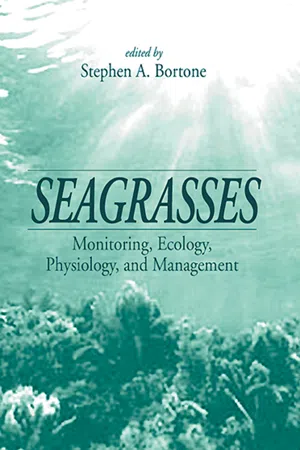
Seagrasses are becoming widely used as in situ indicators of the relative health and condition of subtropical and tropical estuarine ecosystems. To permit meaningful management of our estuaries, there is clearly a need to develop and refine ways of effectively monitoring and assessing seagrasses.
Seagrasses: Monitoring, Ecology, Physiology, and
- 338 pages
- English
- PDF
- Available on iOS & Android
eBook - PDF
About this book
Information
Table of contents
- Front cover
- Back cover
- Preface
- Acknowledgments
- Editor
- Contributors
- Table of Contents
- Chapter 1. Seagrass Ecology and Management: An Introduction
- Chapter 2. Establishing Light Requirements for the Seagrass Thalassia testudinum: An example from Tampa Bay, Florida
- Chapter 3. Somatic, Respiratory, and Photosynthetic Responses of the Seagrass Halodule wrightii to Light Reduction in Tampa Bay, Florida Including a Whole Plant Carbon Budget
- Chapter 4. The Effects of Dock Height on Light Irradiance (PAR) and Seagrass (Halodule wrightii and Syringodium filiforme) Cover
- Chapter 5. Tape Grass Life History Metrics Associated with Environmental Variables in a Controlled Estuary
- Chapter 6. Experimental Studies on the Salinity Tolerance of Turtle Grass, Thalassia testudinum
- Chapter 7. Effects of the Disposal of Reverse Osmosis Seawater Desalination Discharges on a Seagrass Meadow (Thalassia testudinum) Offshore of Antigua, West Indies
- Chapter 8. Development and Use of an Epiphyte Photo-Index (EPI) for Assessing Epiphyte Loadings on the Seagrass Halodule wrightii
- Chapter 9. Establishing Baseline Seagrass Parameters in a Small Estuarine Bay
- Chapter 10. Monitoring Submerged Aquatic Vegetation in Hillsborough Bay, Florida
- Chapter 11. Monitoring the Effects of Construction and Operation of a Marina on the Seagrass Halophila decipiens in Fort Lauderdale, Florida
- Chapter 12. Recent Trends in Seagrass Distributions in Southwest Florida Coastal Waters
- Chapter 13. Monitoring Seagrass Changes in Indian River Lagoon, Florida Using Fixed Transects
- Chapter 14. Long-Term Trends in Seagrass Beds in the Mosquito Lagoon and Northern Banana River, Florida
- Chapter 15. Reciprocal Transplanting of the Threatened Seagrass Halophila johnsonii (Johnson's Seagrass) in the Indian RIver Lagoon, Florida
- Chapter 16. Setting Seagrass Targets for the Indian River Lagoon, Florida
- Chapter 17. Seagrass Bed Recovery after Hydrological Restoration in a Coastal Lagoon with Groundwater Discharges in the North of Yucatan (Southeastern Mexico)
- Chapter 18. Observations on the Regrowth of Subaquatic Vegetation Following Transplantation: A Potential Method to Assess Environmental Health of Coastal Habitats
- Chapter 19. Scaling Submersed Plant Community Responses to Experimental Nutrient Enrichment
- Chapter 20. Seagrass Ecosystem Characteristics, Research, and Management Needs in the Florida Big Bend
- Chapter 21. Seagrass Restoration in Tampa Bay: A Resource-Based Approach to Estuarine Management
- Chapter 22. Matching Salinity Metrics to Estuarine Seagrasses for Freshwater Inflow Management
- Index
Trusted by 375,005 students
Access to over 1.5 million titles for a fair monthly price.
Study more efficiently using our study tools.
Frequently asked questions
Yes, you can cancel anytime from the Subscription tab in your account settings on the Perlego website. Your subscription will stay active until the end of your current billing period. Learn how to cancel your subscription
No, books cannot be downloaded as external files, such as PDFs, for use outside of Perlego. However, you can download books within the Perlego app for offline reading on mobile or tablet. Learn how to download books offline
Perlego offers two plans: Essential and Complete
- Essential is ideal for learners and professionals who enjoy exploring a wide range of subjects. Access the Essential Library with 800,000+ trusted titles and best-sellers across business, personal growth, and the humanities. Includes unlimited reading time and Standard Read Aloud voice.
- Complete: Perfect for advanced learners and researchers needing full, unrestricted access. Unlock 1.5M+ books across hundreds of subjects, including academic and specialized titles. The Complete Plan also includes advanced features like Premium Read Aloud and Research Assistant.
We are an online textbook subscription service, where you can get access to an entire online library for less than the price of a single book per month. With over 1.5 million books across 990+ topics, we’ve got you covered! Learn about our mission
Look out for the read-aloud symbol on your next book to see if you can listen to it. The read-aloud tool reads text aloud for you, highlighting the text as it is being read. You can pause it, speed it up and slow it down. Learn more about Read Aloud
Yes! You can use the Perlego app on both iOS and Android devices to read anytime, anywhere — even offline. Perfect for commutes or when you’re on the go.
Please note we cannot support devices running on iOS 13 and Android 7 or earlier. Learn more about using the app
Please note we cannot support devices running on iOS 13 and Android 7 or earlier. Learn more about using the app
Yes, you can access Seagrasses by Stephen A. Bortone in PDF and/or ePUB format, as well as other popular books in Biological Sciences & Ecology. We have over 1.5 million books available in our catalogue for you to explore.