- 192 pages
- English
- ePUB (mobile friendly)
- Available on iOS & Android
eBook - ePub
Decommissioning the Brent Spar
About this book
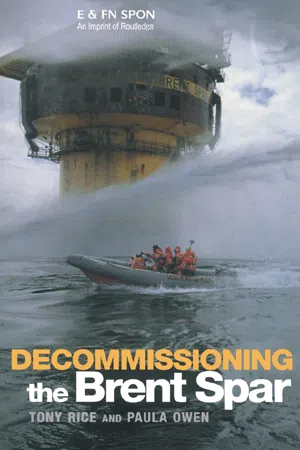
Decommissioning the Brent Spar chronicles the events leading up to the recent decision to recycle the offshore installation in a Norwegian fjord; the Greenpeace campaign to stop it being dumped at sea; the repercussions of Shell's decision to abort the decommissioning at the eleventh hour; and the dialogue processes that have occurred to attempt to resolve the issue.
This book will give a balanced, impartial account of the whole situation to its present day, its key aim being to inform the reader about the facts and mechanisms of the dialogue process and the need to approach decisions in a different way.
Readers will benefit from an account of the mistakes made by both sides, the input from government, the scientific community, the press and public, and can apply this knowledge to future environmental issues.
Information
Chapter 1: What was the Brent Spar?
THE NORTH SEA OIL INDUSTRY—A BRIEF REVIEW
Before discussing exactly what the Brent Spar was, and more emphatically what it was not, it would be prudent to sketch out the background to the development of North Sea oil and gas, to put the Spar's existence and raison d’être into context.
During the late 1960s and throughout the 1970s, the North Sea province became increasingly attractive to oil and gas exploration companies in their quest for new and politically stable offshore reserves. Until this time, interest in offshore exploration in the North Sea developed sluggishly as a consequence of the vast quantities of low-cost oil available from the Middle East, North Africa and other parts of the world. These areas seemed to offer a stable long-term supply of oil to satisfy the world's rapidly increasing demand for fossil fuels.
However, by the late 1960s political and economic activities in the oil world were beginning to concern oil companies, convincing them to reassess the potential importance of western offshore oil deposits. The Organisation of Petroleum Exporting Countries (OPEC), formed in 1960 to safeguard the interests of the oil producing nations, comprised thirteen of the leading oil exporting countries by the early 1970s. The combined output of OPEC members represented 90 per cent of the oil traded internationally at that time. From 1971, the breakdown of the traditional oil system organised by the multinational oil companies and the gradual takeover of power by OPEC, resulted in the two world oil crises that saw oil prices escalate.
The first crisis began in 1973, when events in the Middle East, combined with changes in the international oil community, necessitated a complete overhaul of the security of important oil supplies. In 1973, oil constituted nearly half of the world's annual use of ‘industrial’ energy forms (as opposed to ‘traditional’ energy forms such as crop wastes, fuelwood and dung) and the sudden rise in price doubled the real price of oil on the world market. The crisis had a greater effect than expected on the energy market as a whole, as there had previously been decades of constant or declining monetary costs of energy. These issues added incentive to the oil companies’ quest for new North Sea reserves, and substantial quantities were indeed discovered and exploited throughout the 1970s, albeit in very challenging and tempestuous conditions. Within a decade the North Sea oil industry was constructing production installations that ten years previously had been considered impossibly ambitious. By the late 1970s, London and Aberdeen were becoming oil centres of excellence, and companies such as Shell, Exxon and BP were heavily invested in the North Sea sector.
In 1971, Shell/Esso discovered the Brent field in water depths of about 450ft, whilst drilling in the most northerly offshore well in the world at that date. With this significant find, and the discovery of the Forties field off Aberdeen in 1970, the status of the North Sea as a major oil and gas province was firmly established. These two biggest fields were estimated to provide enough oil to meet total UK demand for nearly five years (Taylor and Turnbull 1992). Although it was not technically feasible to recover Forties and Brent oil at a rate fast enough to cover more than about half of the daily UK demand, other established commercial finds during the first few years of northern North Sea exploration offered the prospect of UK self-sufficiency in oil. In fact, by 1980 the UK was quantitatively self-sufficient in oil, and by 1981 UK oil production exceeded consumption for the first time.
The North Sea now ranks as a mature oil province with a network of production facilities in place. It has been one of the most prolific oil basins outside of the Middle East. More oil remains to be found in the North Sea, although it is doubtful whether there are more large fields such as Forties and Brent to be discovered. Finds are more likely to be made in the smaller, marginal fields, and the search for these hard-to-find fields is well under way. It is thought that future oil finds are likely to be in the 50 to 100 million barrel range (Brent and Forties are both 2×10⁹ barrel fields) but the state of knowledge is such that larger oilfield finds cannot be categorically ruled out.
Over the thirty years of North Sea operations, operating costs have varied from approximately US$10 to $16 per barrel of oil, compared to about $2 a barrel for certain types of Middle Eastern oil. Recent history and events in the world energy market over the last twenty-five years, however, have borne out the tremendous economic and technical risks that the oil industry undertook with the development of North Sea reserves. In the first year of production, the North Sea was averaging less than 250,000 barrels a day. By 1976, it was producing 1 million barrels a day and by 1985 it was producing its peak output of 2.6 million barrels per day.
THE BRENT SPAR
Once the presence of oil in sufficient quantity has been discovered, there are a number of onshore and offshore activities that need to be undertaken to allow exploitation and supply of that reserve. As soon as the field is declared commercially viable, the provision of concrete and steel production platforms, storage facilities for the oil, terminal facilities for the landing and primary processing of oil and gas and onward transmission have to be considered and implemented. The first offshore platform for the exploitation of hydrocarbons, installed out of sight of land, was developed in the Gulf of Mexico during the 1940s; since that time hundreds of offshore installations have been commissioned to facilitate the exploitation of oil and gas reserves.
The North Sea, in particular, introduced some interesting problems as far as offshore operations were concerned. The area is infamous for unpredictable and particularly harsh weather conditions. Violent storms can blow up within an hour and can last for days. Even in the shallower waters of the southern North Sea, the industry realised the need to be prepared to ride out storms that could create freak conditions of waves rising to 30m and wind gusts up to 150 knots—a phenomenon known as the ‘hundred year storm’. Northwards, the conditions were even more unpredictable, and these weather uncertainties added to the already significant risk of placing rigs into an area with no established oil or gas prospects at the time.
Whatever the perceived difficulties of installing offshore equipment, offshore operators lost no time in looking into ways through which the oil and gas reserves could be developed. The complexities of operating offshore at the deepest locations in the North Sea involved investment in some of the most expensive projects the industry had yet undertaken. The development of the Brent field complex and its associated share of pipelines and terminals cost over £3 billion, comparable to the cost of a moon expedition at the time (Taylor and Turnbull 1992).
The two main types of structure suitable for offshore developments are steel platforms and concrete platforms. In the case of steel platforms, the main structure (or ‘jacket’) is built on shore, towed out to the field in a horizontal position, up-ended on location and secured by piles driven into the seabed. The concrete or gravity-type platforms are kept in position by their own weight and settle firmly into the seabed and, since they need a large base, have ample room for storing the recovered oil. As no piling is required they can be installed much more quickly than steel structures. The concrete structure, with its inbuilt storage, may then seem to have a distinct advantage over the steel structure. However, the feasibility of combining storage with an offshore loading facility in a steel-based installation, was proved by the novel approach taken by Shell in the use of the Spar floating oil storage and loading facility in the Brent field.
When the development of the Brent field was first being considered, Shell was looking for a relatively deep-water floating installation which would have sufficient storage to sustain output from the initial Alpha wells, which had no storage capacity. The intended capacity would also eliminate potential shutdowns caused by delivery interruptions each time a tanker left its mooring when full, or as a result of deteriorating weather. The storage capacity chosen for the installation was to be the equivalent of three days’ production, or 41,000 tonnes of oil. A ‘spar’ floating buoy was conceived and designed to serve this purpose (North Sea Fields 1987). It was installed in the Brent field in the summer of 1976 (figure 1). Interestingly, an alternative and more conventional solution, favoured by Shell's partner Esso, was to use a more-or-less customary tanker attached permanently to a single-buoy mooring (Howarth 1997). Esso's solution was considered to be much the cheaper, both in the short and long term, partly because a conventional tanker could be used for other purposes whereas a spar buoy was assumed, correctly as it turned out, to have no salvage value. Nevertheless, Shell's more expensive (total cost was in the region of £24 million) and revolutionary idea was ultimately selected mainly because it would result in less pollution from oil spills. This at a time when the government pollution regulations were extremely unclear and certainly did not oblige the industry to take this sort of decision.
The ‘Brent Spar’ was, and still is, frequently referred to as an ‘oil rig’. To most people an oil rig is a structure used to drill into the earth to reach and extract oil. This general term covers a multiplicity of structures and an enormous range of size and complexity. It also covers the vast majority of the structures in the North Sea offshore oil and gas fields. But the Brent Spar was emphatically not one of these. It had nothing to do with the extraction of oil from beneath the sea, but only with storing it.
The Spar is therefore basically an enormous oil tank, or rather six separate tanks clustered around a central core rather like the segments of a divided orange. Technically, it was a spar buoy designed to float vertically, like a huge fishing float. It was originally built as a specific solution to a particular problem. So the Spar was extremely unusual, if not unique, both in the sense that there is no other structure exactly or even reasonably similar to it, but also because there are probably no more than two or three others in the North Sea that are based even vaguely on the same principles.
Under normal circumstances the bulk of the Spar, including the whole of the oil storage facility, was submerged and therefore invisible (figure 2). But in its entirety it resembled a vast bottle with a rather large cap, with the surface of the sea about halfway up its relatively narrow ‘neck’ (see figure 3).
With its tanks empty, the Spar weighed 14,500 tonnes, about the same as 2,000 double-decker buses or a modern, large cross-channel ferry. The Stena Fantasia, for example, weighs a little more than the Spar at 15,710 tonnes. Again, comparable with the Stena Fantasia at 163m long, the Spar's total length was 137m, of which only the upper 28m protruded above the water surface in its working condition. This part, with which we all became familiar as a result of the endless media coverage, consisted of a 26m-diameter superstructure made up of a machinery deck, a diving deck and an accommodation deck surmounted by a turntable with a helicopter landing pad, cargo crane, loading boom, mooring hawser and hydraulic power pack. Beneath the machinery deck the Spar narrowed to a column (the bottle's neck in our analogy) 17m in diameter and 32m high, half above the water and half below. Like the superstructure, the column was divided into a series of decks for specific purposes including metering the flow of oil in and out of the Spar, anchoring procedures, equipment storage and, immediately above the water level, housing for the main pumps.
Below this relatively narrow neck, and beginning therefore 16m beneath the sea surface, the main body of the Spar was a 93m-long cylinder, 29m in diameter. The bulk of the body was made up of the oil storage tanks weighted with ballast at the bottom, and buoyancy tanks at the top.
The ballast consisted of 6,800 tonnes of haematite, or iron ore, held together in concrete and housed in twenty-four separate compartments occupying the lower 3.5m of the Spar. At the other end of the main body, the upper 13.8m housed two series of six air-filled buoyancy tanks, the inner series within an extension of the column into the main body.
Finally, between the ballast and the buoyancy, the main body was made up of six oil storage tanks arranged radially around the central shaft, a circular space running up through the entire structure. The oil arrived from the production rigs through pipes, or risers, in the central shaft and was then pumped through the Spar's own pipework into the various tanks. The structure of this lower part of the Spar was very similar to that of a ship, with a thin outer skin of 20mm-thick steel plate stiffened by ribs and bulkheads. Each tank was 75.95m high and had a capacity of 50,000 barrels (7,900m3), giving the Spar a total capacity of 300,000 barrels (47,400m3). If the Spar, tanks entirely filled, could have been hung from a giant spring balance it would have weighed in at about 65,500 tonnes. Even given a big enough balance, the Spar could never be weighed in this way because the thin walls of its tanks could not contain the contents without bursting unless supported by the pressure of the surrounding water. In any case, although this figure appeared in many media accounts at the height of the Greenpeace occupation, it is entirely misleading since the contents of the tanks, mainly seawater in its decommissioned state, are irrelevant to its size as far as disposal is concerned.
But the total oil capacity of the Spar was, in any case, never used for its intended purpose because two of the tanks were damaged after less than one year of operation. In fact the Spar was damaged prior to beginning its working life. Before it was installed in the Brent field, the Spar had to be gradually up-ended to the vertical by slowly ballasting the storage tanks; this nine-day operation took place in a Norwegian fjord. During the operation, the Spar buoy was found to be overstressed by the pressures it experienced. To compound matters, in January 1977, just one month after it commenced operations, two of the storage tanks were ruptured during a build-up of differential pressures which were in excess of the design limits. The repairs only went as far as maintaining the structural integrity of the buoy, i.e. they were not made watertight. As a result, these tanks were left open to the sea and were used only to balance the pressure in the other tanks as they were filled and emptied of oil, and for the temporary storage of the water separated from the crude oil as it was received from the drilling rigs.
To fill and empty the storage tanks, and to transfer oil and water from one tank to another, the Spar had a complex network of piping connected to the pumping system. In addition, each of the storage tanks was fitted with a 6in-diameter vent pipe extending to A deck some 32m above them. These vent pipes played an important role as the public saga developed because they were used by both Greenpeace and Det Norske Veritas to provide access to the storage tanks to obtain estimates of the amounts of oil remaining in them.
During its working life the Spar was anchored firmly in position by a six-leg ‘catenary’ mooring system. Catenary simply means the curve adopted by a chain or wire suspended from two separate points. The cables of a suspension bridge, for example, adopt a ‘catenary’.
Having been built rather like a ship, the bulk of the weight of the Spar, apart from the 6,800 tonnes of ballast, was made up of about 6,700 tonnes of structural steel. The remaining 1,000 tonnes or so consisted of electrical wiring, the sacrificial anodes, of which more than a thousand were bolted onto various parts of the underwater sections of the Spar to reduce corrosion, several tonnes of paint, and the equipment that had been left aboard. When the Spar was taken out of service, much of the equipment with which it had been fitted during its working life was removed, particularly those items that could be removed relatively easily or had some significant re-use value. But a good deal was left in place, including the main pumps and some of the large items of fixed equipment such as transformers, fire pumps, emergency generator, transformer and gas turbines. At the time of the Greenpeace occupation it also contained a variety of materials that it had picked up during its working life. Some of these, such as the oil residues and sludge, and the radioactive scale lining the tanks and pipework, were measured in tonnes, and we will come to them when we look at the Spar's detailed make-up as subsequently determined in an independent survey. Others revealed by the on-the-spot television pictures included the debris left by the last workforce to occupy it, ranging from discarded bedding and books to cooking utensils and tins of baked beans. Although these were pretty irrelevant in a global sense, and while Shell may have intended to clean it up before its final journey to the bottom of the ocean, the impression was that it was a sort of Marie Céléste rubbish tip.
Before the Greenpeace occupation of the Spar, and particularly as part of the licensing documentation, Shell released detailed inventories of what materials it claimed were in the buoy. In addition to the major structural steel and ballast components, Shell listed various additional materials, including ‘contaminants’, ranging from about 50 tonnes of oil residues, almost 30 tonnes of aluminium and 13.5 tonnes of copper, down to 0.3kg each of arsenic and mercury and about 19ml of PCBs. Greenpeace used these same figures in their own publicity releases, but questioned their accuracy since many of the figures were, on Shell's admission, based on estimates rather than accurate measurements. Greenpeace therefore argued that many of the more toxic components, particularly, had been ‘grossly underestimated’. In addition, Greenpeace claimed to have evidence that unspecified materials had been secreted in the Spar, while from its own sampling of the tanks during the occupation it maintained that these contained some 5,500 tonnes of oil and sludge rather than the 50 tonnes suggested by the Shell figures. If the planned deep-sea disposal of the Spar had gone ahead, of course, these disagreements would never have been resolved. As things turned out, however, they could be.
In July 1995, following the decision to postpone the disposal of the Spar and to tow it instead to Erfjord in Norway, Shell commissioned the Norwegian organisation Det Norske Veritas Industry AS (DNV) to undertake an independent inventory of the structural components and contents of the Spar, particularly in relation to the conflicting views that had been expressed.
As the Norwegian equivalent of Lloyds, and with its own expert and highly experienced staff, DNV was well qualified to carry out such an inventory. DNV began the inventory investigation at the beginning of August 1995, and it was completed when the results were presented to Shell and the UK authorities on 16 October 1995 and made public at a press conference two days later (see DNV Reports 1995). To ensure the independence of the work, none of the results were disclosed to anyone, including Shell, prior to the presentation. Responsibility for the safety of the Spar and of all personnel aboard remained with Shell throughout the work and a Shell safety representative had to be on board every time the project team visited the structure. But the representatives took no part in any sampling or inspection procedures, nor were they included in any discussions of the findings.
DNV had three main tasks. First, to check the figures given by Shell for what the Spar was actually made of, and particularly the non-structural metals in the sacrificial anodes, batteries, electrics, paint and so on; second, to check on the ‘contaminants’ such as oil residues and radioactive scale that had accumulated in the Spar during the course of its working life; and third, to ascertain whether any additional unlisted ‘nasties’ had somehow got into the Spar.
The DNV Report broadly confirmed Shell's figures for the Spar's make-up as far as metals were concerned, with the Shell estimates generally falling within the ranges determined by DNV. There were a few minor exceptions that no-one seemed to think were particularly important. For example, the DNV estimates for amounts of aluminium in the Spar were rather higher than Shell's, while those for zinc were significantly lower. This discrepancy seems to have arisen because while Shell had assumed that the sacrificial anodes were zinc-based, DNV assumed that they were aluminium-based as specified on the maker's original drawings.
The single significant contrast with the Shell figures in this part of the DNV Report was for PCBs, or polychlorinated biphenols. These chemicals...
Table of contents
- Cover Page
- Title Page
- Copyright Page
- Illustrations
- Acknowledgements
- Introduction: Why write a book about the Brent Spar?
- Chapter 1: What was the Brent Spar?
- Chapter 2: Decommissioning and the BPEO process
- Chapter 3: The scientific debate
- Chapter 4: The use and abuse of precedent
- Chapter 5: The siege
- Chapter 6: The capitulation
- Chapter 7: The aftermath: July-August 1995
- Chapter 8: The way forward The search for a solution
- Chapter 9: The Brent Spar legacy
- Chapter 10: Epilogue: Was the Brent Spar a ‘good’ or a ‘bad’ thing?
- Appendix 1: International law and agreements: Did the UK Government have the right to issue a licence for the deep-sea disposal of the Brent Spar?
- Appendix 2: The long list
- Notes
- Bibliography
Trusted by 375,005 students
Access to over 1.5 million titles for a fair monthly price.
Study more efficiently using our study tools.
Frequently asked questions
Yes, you can cancel anytime from the Subscription tab in your account settings on the Perlego website. Your subscription will stay active until the end of your current billing period. Learn how to cancel your subscription
No, books cannot be downloaded as external files, such as PDFs, for use outside of Perlego. However, you can download books within the Perlego app for offline reading on mobile or tablet. Learn how to download books offline
Perlego offers two plans: Essential and Complete
- Essential is ideal for learners and professionals who enjoy exploring a wide range of subjects. Access the Essential Library with 800,000+ trusted titles and best-sellers across business, personal growth, and the humanities. Includes unlimited reading time and Standard Read Aloud voice.
- Complete: Perfect for advanced learners and researchers needing full, unrestricted access. Unlock 1.5M+ books across hundreds of subjects, including academic and specialized titles. The Complete Plan also includes advanced features like Premium Read Aloud and Research Assistant.
We are an online textbook subscription service, where you can get access to an entire online library for less than the price of a single book per month. With over 1.5 million books across 990+ topics, we’ve got you covered! Learn about our mission
Look out for the read-aloud symbol on your next book to see if you can listen to it. The read-aloud tool reads text aloud for you, highlighting the text as it is being read. You can pause it, speed it up and slow it down. Learn more about Read Aloud
Yes! You can use the Perlego app on both iOS and Android devices to read anytime, anywhere — even offline. Perfect for commutes or when you’re on the go.
Please note we cannot support devices running on iOS 13 and Android 7 or earlier. Learn more about using the app
Please note we cannot support devices running on iOS 13 and Android 7 or earlier. Learn more about using the app
Yes, you can access Decommissioning the Brent Spar by Paula Owen,Tony Rice in PDF and/or ePUB format, as well as other popular books in Politics & International Relations & Environment & Energy Policy. We have over 1.5 million books available in our catalogue for you to explore.