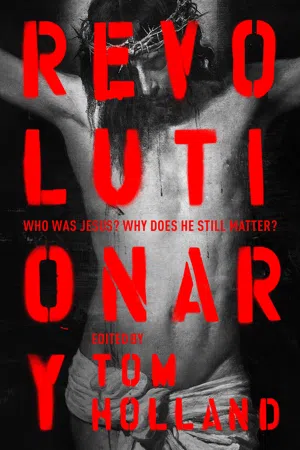
In October 2011 something remarkable happened down the street from where I work in London, in a place where I least expected. As a teacher of Christian Origins at King’s College London, I had often asked my students to be alert to anything in the public sphere, especially in the media, that might have relevance for their studies, because in looking at Jesus and the Bible as a whole there are innumerable resonances in current culture and politics. I said this regularly to my Masters class focusing on the Passion narratives in the Gospels, a class in which we considered the final week of Jesus’ life, including his dramatic overturning of the money changers’ tables in the Jerusalem Temple. Jesus stated that the ‘house of prayer for all nations’ had been turned into ‘a cave of brigands’.1
Protesters occupied the area in front of St. Paul’s Cathedral, calling for an end to the culture of corporate greed and banking immorality, and Jesus’ action suddenly took on a striking contemporary relevance. As some among the cathedral authorities fretted at the presence of protesters on their doorstep and worried about health and safety issues, debate ignited on which side of the stand-off Jesus would have stood. The cathedral authorities teetered on the boundary, being ethically on the side of the protesters in their critiques and yet concerned about the heritage site of the building and the orderly running of its services. Television news showed St. Paul’s dramatically closing its doors, for the first time since the Second World War. That image was crushing to many Christians both inside the cathedral and worldwide, prompting serious questions to be asked. The protesters put up a banner in front of the cathedral: ‘What would Jesus do?’ It was photographed and printed in hundreds of newspapers and circulated via internet sites.
The ensuing debate was both illuminating and depressing. Either side, it seemed, could claim Jesus. On the one hand, it was clear that the Gospels showed that Jesus was not exactly pleased with those who heartlessly hoarded money, but on the other, it was said that Jesus’ concerns were other-worldly: I heard a cleric on the radio state that his kingdom was ‘not of this world’ and he did not take sides, seeking only reconciliation of sinful humanity with God through his sacrificial death.
But perhaps what was remarkable was that it was considered important at all to ask the question about what Jesus would do, given that modern Britain is renowned for being a very secular (if not growingly atheistic) society, in which such religious questions were not really expected to come up. Christianity, to many people, is a bunch of myths wrapped around a core that would have you feeling bad about yourself. It is an ideological system of oppression furthering anti-scientific agendas, in cahoots with global capitalism and climate deniers, advocating discrimination against female and LGBTQ+ people.
However, the banner goes to show something. Regardless of your beliefs, and regardless of what so-called Christianity can be about now, Jesus is remembered as being in some way a figure owned by the protesters as much as by the church authorities. His message has sung out over the centuries, no matter what the packaging has been and is. There are still people out there who get it.
In my view, Jesus was quite fierce in speaking out against those in power, and very much of this world and concerned with it. He was a man of his time, using a worldview and beliefs his community held in a way that galvanized people into action. His was a message of transformation on earth. What he did and said empowered himself and others, by means of key, practical steps, so that he and his disciples could speak to the powerful. And he did take sides.
Being me
Before I go on though I would like to introduce myself briefly, since I am of the school that thinks that our interpretation of things biblical and historical is partly indebted to where we are in terms of our own worldviews. I am God-trusting, as long as ‘God’ is defined along the lines of Being and not Old Man up in the Sky. I map this concept on to the ultimate in other religious and philosophical systems, from Allah to Brahman to Ultimate Reality. I prefer to talk about ‘trust’ rather than ‘faith’ or ‘belief’, because the Greek word for both, pistis, indicates a fundamental trust in something real, rather than a ‘belief’, say, in fairies. I consider Jesus to be ‘Christ’, since the word ‘Christ’ (Messiah, literally ‘anointed one’) means ‘King’, and I see him as the king of all prophets.2 He was a visionary empowered by God, though he lived in very different times and his belief system needs translating. I also have a sense of his continuing “livingness”, experientially, and that’s just a total mystery.
To call Jesus ‘Saviour’ is for me to say he rescues people from a life of meaninglessness. My type of ‘Christianity’ is therefore existentialist and humanistic. When I participate in worship that uses traditional Christian terms and rituals, I translate them, and it opens up a reality that can be profoundly moving and important. I find meaning in the symbolism of the Church’s creeds and liturgies because they say something meaningful about God, humanity and community, and what the disciples of Jesus should be doing in the world. Usually, though, I prefer to sit in mindful, silent contemplation in Quaker meetings.
I think we live at a critical time when our religious systems, once integrated within different cultures, have been brought together in a global soup, and are faltering or becoming extreme and sectarian. This is not true for every part of the world, because the old systems can still have much meaning (partly dependent on the integrity of cultures or subcultures), but everywhere I go I meet people who say they have ‘spiritual’ understandings, but they do not participate institutionally, and feel annoyed with or removed from organized religion. Yet people have this sense that Jesus was important, and inspirational, and on the side of the marginalized and powerless, which is why that banner was raised in the London protests of 2011. The Church might not matter so much, to many, but Jesus still does. He can be claimed by people who want to change the world.
This understanding is founded on the teaching of Jesus, rather than on the teaching about Jesus. And I really think his was a profound message.
Being Jesus
In a nutshell, Jesus was a Jewish man who lived in Galilee, in what is now Israel, in the first century. Galilee at this time was part of the Roman Empire, ruled by a client ruler Herod Antipas. The Gospels tell us that Jesus went out to be immersed in the River Jordan by someone called John, known as ‘the Baptist’, who attracted huge crowds when he proclaimed an imminent transformation of the world order and called Jews to a radically ethical lifestyle, repentance and purification in preparation for the change. After John was arrested by Antipas (around 28-30 CE), Jesus spread his own message of this coming transformation, the ‘Kingdom of God’. Jesus combined his teaching with astonishing healings and miraculous actions. Huge crowds gathered to hear him and be healed. He travelled around Galilee with a band of disciples, both men and women, taught them how to live according to his ideal, and sent out a ...