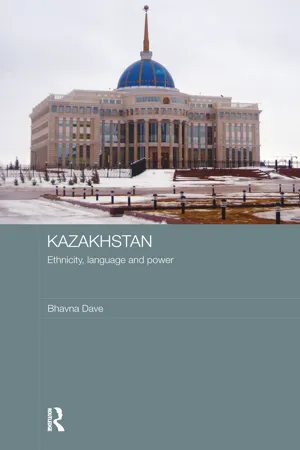
Kazakhstan is emerging as the most dynamic economic and political actor in Central Asia. It is the second largest country of the former Soviet Union, after the Russian Federation, and has rich natural resources, particularly oil, which is being exploited through massive US investment. Kazakhstan has an impressive record of economic growth under the leadership of President Nursultan Nazarbaev, and has ambitions to project itself as a modern, wealthy civic state, with a developed market economy. At the same time, Kazakhstan is one of the most ethnically diverse countries in the region, with very substantial non-Kazakh and non-Muslim minorities. Its political regime has used elements of political clientelism and neo-traditional practices to bolster its rule. Drawing from extensive ethnographic research, interviews, and archival materials this book traces the development of national identity and statehood in Kazakhstan, focusing in particular on the attempts to build a national state. It argues that Russification and Sovietization were not simply 'top-down' processes, that they provide considerable scope for local initiatives, and that Soviet ethnically-based affirmative action policies have had a lasting impact on ethnic élite formation and the rise of a distinct brand of national consciousness.
- 256 pages
- English
- ePUB (mobile friendly)
- Available on iOS & Android
eBook - ePub
Kazakhstan - Ethnicity, Language and Power
1
Empire, collaboration and transition
[N]o discourse can oppose a genuinely uncompromising critique to a ruling culture so long as its ideological parameters are the same as those of that very culture.
(Ranajit Guha, Dominance without Hegemony, 1998)
The condition then prevailing in Kazakh and Russian society did not present us with any other alternative way of forging the Kazakh-Russian Union besides a colonial dependence for the Kazakhs and a metropolitan role for Russia.
(Olzhas Suleimenov, 1993)
Other states may have other claims to legitimacy; the USSR had nothing but progress and modernity.
(Yuri Slezkine, 2000)
Sovietologists and many Cold War era commentators hailed the collapse of the Soviet multinational state as the ultimate triumph of nationalism over communism, heralding the beginning of a fourth wave of decolonization. Nowhere was Soviet rule depicted as more alien, imposed and destructive of pre-existing cultures and traditions than in the Muslim republics of Central Asia.1 Hélène Carrère d’Encausse, a leading scholar on Central Asia, reported an unequivocal sense of jubilation among the Kazakhs upon becoming independent, ‘all the humiliation vanished in favour of an idea: Kazakhstan was again becoming Kazakh and must return to the Kazakhs.’2 In contrast to the upbeat picture painted by d’Encausse, the reality I encountered during my first visit there as a doctoral student in 1992 was very mixed, with disorientation widespread. A vast majority of my informants, irrespective of their ethnic, class or educational background, expressed a deep sense of incredulity at the collapse of the Soviet state and immense anxiety about the future: ‘We were shocked and wept: We feared the outbreak of a civil war and inter-ethnic conflict,’ said a Kazakh couple, then in their late forties, living in the predominantly Kazakh city of Qyzylorda.
Kazakhstan’s long-term observer Martha Brill Olcott captured this profound confusion among the elites and masses in Central Asia in 1992, when she described Kazakhstan as an ‘accidental state’.3 It was no surprise then that Kazakhstan, under its Moscow-installed leader Nursultan Nazarbaev, was the last union republic to proclaim independence on 16 December 1991, after the Belavezha accord signed by Russia, Ukraine and Belarus on 8 December 1991 declared the Soviet Union to be defunct.4 Nazarbaev’s ambivalence over asserting Kazakhstan’s sovereignty reflected the widespread desire of the inhabitants of the republic to remain part of a broad Slavic or Eurasian entity. Indeed, Russia unambiguously represented Europe and ‘modernity’ to the former nomads, whose elites had pledged their allegiance to the tsarist rulers in the nineteenth century and acquiesced to Soviet rule in the early twentieth century. The near colonial dependency of its incumbent communist elites on the metropole manifested their anxieties about their personal survival and about holding together a multi-ethnic society described as among the most ‘international’ of all Soviet republics, without the support and protection of Moscow.
From Soviet nationalities theory to postcolonialism and transition studies
Until very recently, Central Asia’s experience of modernity and nation-development under Soviet rule had been analysed almost entirely within the field of ‘Soviet nationalities studies’ and the subfield of ‘Central Asian studies’. The majority of Western works on Soviet Central Asia fall into two broad categories: One group of scholars depicted Soviet policy in the region as guided by the classical imperial objective of ‘divide and rule’, which they held accountable for aborting the development of a common national or social imagination on the basis of shared cultural and religious attitudes.5 For the other group, Soviet rule in Central Asia was merely a continuation of tsarist colonization, which together had devastating effects on indigenous cultures, identities and institutions.6 If few scholars of Central Asia saw an affinity between Soviet colonial or imperial rule and the policies of European empires, the field of postcolonial studies as a whole had also failed to incorporate a discussion of Central Asia and the post-Soviet region within its disciplinary and empirical ambit.7
The collapse of the Soviet Union set in motion the dissolution of the old Cold War era categories, producing a paradigm shift in the conceptualization of the Soviet state.8 The post-1991 Western scholarship on the formation of the Soviet Union has made a decisive break from the Cold War era historiography. The last decade has generated a vibrant discussion among historians of the late tsarist and early Soviet periods on the meaning of the transformation of the various non-Russian populations, territories and institutions within the new Soviet state. A renewed debate on the nature of Soviet nationalities and on the Soviet Union as an ‘empire’, which first surfaced in the journal Russian Review in the year 2000, has brought Central Asia into sharp focus.9 Key to these debates are questions such as how best to characterize the Soviet Union; as an atypical entity, a modernizing state, or a colonial empire? Terry Martin and Yuri Slezkine take seriously the ideology, political rhetoric and policies of the Soviet state in defining itself as an anti-imperial and anticolonial state that put forth significant effort to create nations among its so-called backward and oppressed peoples. Francine Hirsch points to the ‘state-sponsored evolutionism’ of Soviet nationalities’ policies to provide vital clues to understanding not just how the Soviet Union was forged ‘on the ground’ among different non-Russian groups, but also why it fell apart and how it endured for more than 70 years.10 Offering a perspective from below, Adrienne Edgar details the skilful appropriation of Leninist categories of nation by Turkmen elites in what she sees as a ‘textbook case’ of transformation from a tribal people to a Soviet nation.11 Rejecting categorizations of Soviet policies as ‘imperial’ or ‘colonial’, Edgar identifies the important difference between metropole and periphery produced by Soviet nationality policy, which sharpened the difference between how the Russians and Central Asians experienced Soviet rule.12
The paradigm shift from Sovietology to comparative studies of Soviet rule has contributed to bridging the prolonged mutual isolation between Soviet nationality studies and postcolonial studies. A number of recent works have taken the experience of modernization and nation-building in Central Asia outside the traditional domain of Soviet nationalities studies to initiate a comparison with similar processes in the Middle East, Turkey and Africa.13 In one of these pioneering works, Juan Cole and Deniz Kandiyoti delve into the character of nationalism in the Middle East and Central Asia by analysing their contrasting experience of colonialism under Western capitalist and Soviet socialist rule, as well as their divergent encounters with modernity.14 Mark Beissinger and Crawford Young explore the similarities and divergence in the legacy of colonialism in African states and the consequences of Soviet rule in the new states of Eurasia to assess the strengths and weaknesses of the new states, institutions and identities in both regions.15 More recently, Adeeb Khalid compares Soviet modernization in Central Asia with the reforms of the early republic in Turkey.16
While the emphasis on the mutually constitutive role of the centre and nationalities in the peripheries in the forging of the Soviet Union has yielded vital insights into understanding the nature of the Soviet state in its formative phase, there are very few empirically grounded works which illuminate these processes beyond the 1940s. How was the Soviet Union able to widen the scope of ethnic entitlements and, at the same time, produce a denationalized ethnic identity, as stipulated in Marxist–Leninist and Stalinist interpretations? While the early Soviet state promoted both ‘ethnic and statist idioms of nationhood’, as Slezkine notes, the ethnic idiom turned out to be much more vital and powerful than the statist one.17 Rogers Brubaker arrives at a similar conclusion by looking at the enduring effects of institutions and ideological practices established by the Bolsheviks.18 But Kazakhstan, as I elaborate below, was one such site, where both idioms were congruous and a distinction between the two crystallized much later in the post-Stalin period.
The new Western historiography has revolutionized our understanding of how the Soviet Union was forged. Also insightful are various ethnographic studies of post-socialist transition that highlight the fluidity of the categories ‘Soviet’ and ‘post-Soviet’ in examining the practices and actions of ordinary citizens. The latter works have questioned the rigid formulations of identities and institutions created under the socialist system.19 On the other hand, political science as a discipline, with its focus on formal institutions, policies, elites, and regime types, has struggled to understand how cognitive frames, informal processes and the actions and choices of ordinary people have shaped Soviet-era institutions and identities, and how these now guide the post-Soviet transition.
In an investigation of the role of informal institutions such as ‘clans’, Kathleen Collins assumes a clear distinction between formal and informal institutions. She describes Central Asian societies as ‘clan-based’ societies, a definition that places a variety of personal and informal exchanges under the rubric of ‘clans’. This perpetuates an image of Central Asia as a ‘traditional’ society, in contrast to the particular ‘modernity’ represented by Soviet rule, as well as to an assumed universal trajectory of modernization.20 Valerie Bunce notes that ‘countries which have experienced a decisive political break with the past have seen the development of democratization, political stability, economic reforms and economic growth.’21 She implies that a break from the past, symbolized by a fundamental regime and leadership change as well as a reshaping of institutions, as has been the case in much of East and Central Europe, are crucial for democratization. This point appears valid at face value. But in the contexts where transition to market economy and wide-ranging economic reforms have been initiated without a split, we need to pay closer attention to the role of culture, historical framework and cognitive frames. They have outlived the rupture of old institutions and conferred a very different meaning to institutions that have evidently been introduced upon the recommendation of Western donors and experts.
On the whole, these transition-centred approaches have not found a way of looking at historical context and culture as constitutive and dynamic forces in the understanding of transition. In their re-conceptualization of the post-Soviet state, Anna Gryzymala-Busse and Pauline Jones Luong call for a focus on the process of ‘state formation’ and ‘elite competition’ by highlighting the role of formal and informal institutions and international factors. However, they see ‘state formation’ and ‘regime change’ as simultaneous and possibly convergent processes.22 On the contrary, state formation in Kazakhstan, as well as Uzbekistan and Turkmenistan, has proceeded alongside the consolidation of the Soviet-erected regimes.
The ethnographies of post-Soviet transition serve as correctives to the propensity among numerous self-styled advocates of transition to assume that all non-Western economies and politics are fundamentally similar, and thus to unselfconsciously apply the categories and methods employed in analysing developing countries to post-socialist societies. The preoccupation with future trajectories among several transitologists has not only drawn attention away from an in-depth exploration of the specificity of the Soviet socialist experiment legacy, but has also hampered an analysis of the dynamic unfolding of this legacy.23
To summarize, this book draws upon three streams of intellectual enquiry: the new Western historiography of the Soviet era, the postcolonial theory and the ethnographies of post-socialist transition. The new historiography of the Soviet era highlights the active participation of all strata of society in the forging of the Soviet Union; postcolonial theory illuminates the constitutive and enduring effects of the Soviet legacy; and studies of post-socialist transition highlight the importance of pathways, innovations and the reconfiguration of the existing categories. By interweaving these three streams, this book attempts to uncover the different layers of identity – pre-Soviet, Soviet and post-Soviet – and thus bring into focus the hybridity of each of these layers.24
Scholarship in Central Asia: from Soviet to nationalist historiography
If several recent Western studies of Central Asia and the post-Soviet region as a whole are establishing a separate niche by breaking out of the Sovietological mould, scholarship in the Central Asian states still remains under both the formal and implicit control of the state. Nationalist and primordialist paradigms have substituted the dominant frame of Soviet Marxist historiography and theories of ethnos.25 Although cursory references to Soviet colonial and imperial rule abound in several scholarly works and in popular discourse, they are yet to inspire attempts to unpack these categories, or to place Central Asia within a broader comparative framework.
On the contrary, any foreign scholar engaged in research in the post-Soviet region is cognizant of the reflexive disapproval that attempts to compare the post-Soviet world with the ‘Third World’, especially Africa, evoke among former Soviet citizens. Fur...
Table of contents
- Central Asian studies series
- Contents
- Preface and acknowledgements
- Note on transliteration
- Introduction
- 1 Empire, collaboration and transition
- 2 From nomadism to national consciousness
- 3 Becoming mankurts?
- 4 Ethnic entitlements and compliance
- 5 Enshrining Kazakh as the state language
- 6 Disempowered minorities
- 7 The nationalizing state
- Conclusions
- Appendix
- Notes
- Bibliography
- Index
Trusted by 375,005 students
Access to over 1.5 million titles for a fair monthly price.
Study more efficiently using our study tools.
Frequently asked questions
Yes, you can cancel anytime from the Subscription tab in your account settings on the Perlego website. Your subscription will stay active until the end of your current billing period. Learn how to cancel your subscription
No, books cannot be downloaded as external files, such as PDFs, for use outside of Perlego. However, you can download books within the Perlego app for offline reading on mobile or tablet. Learn how to download books offline
Perlego offers two plans: Essential and Complete
- Essential is ideal for learners and professionals who enjoy exploring a wide range of subjects. Access the Essential Library with 800,000+ trusted titles and best-sellers across business, personal growth, and the humanities. Includes unlimited reading time and Standard Read Aloud voice.
- Complete: Perfect for advanced learners and researchers needing full, unrestricted access. Unlock 1.5M+ books across hundreds of subjects, including academic and specialized titles. The Complete Plan also includes advanced features like Premium Read Aloud and Research Assistant.
We are an online textbook subscription service, where you can get access to an entire online library for less than the price of a single book per month. With over 1.5 million books across 990+ topics, we’ve got you covered! Learn about our mission
Look out for the read-aloud symbol on your next book to see if you can listen to it. The read-aloud tool reads text aloud for you, highlighting the text as it is being read. You can pause it, speed it up and slow it down. Learn more about Read Aloud
Yes! You can use the Perlego app on both iOS and Android devices to read anytime, anywhere — even offline. Perfect for commutes or when you’re on the go.
Please note we cannot support devices running on iOS 13 and Android 7 or earlier. Learn more about using the app
Please note we cannot support devices running on iOS 13 and Android 7 or earlier. Learn more about using the app
Yes, you can access Kazakhstan - Ethnicity, Language and Power by Bhavna Dave in PDF and/or ePUB format, as well as other popular books in History & Asian History. We have over 1.5 million books available in our catalogue for you to explore.