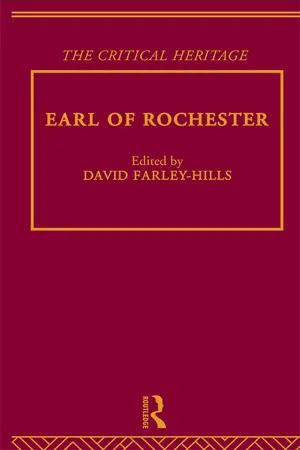
The Critical Heritage gathers together a large body of critical sources on major figures in literature. Each volume presents contemporary repsonses to a writer's work, enabling student and researcher to read the material themselves.
- 288 pages
- English
- ePUB (mobile friendly)
- Available on iOS & Android
eBook - ePub
About this book
Information
ELEGIES ON ROCHESTER’S DEATH
1680
12.
John Oldham, Bion, A Pastoral, in Imitation of the Greek of Moschus, bewailing the Death of the Earl of Rochester
Works of John Oldham (1684) pp. 73–87.
John Oldham (1653–83), the most talented of Rochester’s literary disciples, admired him as much as a poet as he disliked his immoral conduct as a man. Although first brought to general notice by Rochester and his friends, Oldham was too independent a man to accept open patronage. The following poem acknowledges the debt Oldham owed Rochester poetically. Bion was the name of the Greek poet mourned in an elegy attributed to Moschus.
Bion.
- A Pastoral, in Imitation of the Greek of Moschus,
bewailing the Death of the Earl of Rochester.
Mourn all ye Groves, in darker shades be seen,
Let Groans be heard, where gentle Winds have been:
Ye Albion Rivers, weep your Fountains dry,
And all ye Plants your moisture spend, and die;
Ye melancholy Flowers, which once were Men,
Lament, until you be transform’d agen:
Let every Rose pale as the Lilly be,
And Winter Frost seize the Anemone:
But thou, O Hyacinth, more vigorous grow
In mournful Letters thy sad glory show,
Enlarge thy grief, and flourish in thy wo:
For Bion, the beloved Bion’s dead,
His voice is gone, his tuneful breath is fled.
Come all ye Muses, come, adorn the Shepherd’s Herse
With never-fading Garlands, never-dying Verse.
Mourn ye sweet Nightingales in the thick Woods,
Tell the sad news to all the British Floods:
See it to Isis, and to Cham convey’d,
To Thames, to Humber, and to utmost Tweed:
And bid them waft the bitter tidings on,
How Bion’s dead, how the lov’d Swain is gone,
And with him all the Art of graceful Song.
Come all ye Muses, come, adorn the Shepherd’s Herse
With never-fading Garlands, never-dying Verse.
Ye gentle Swans, that haunt the Brooks, and Springs,
Pine with sad grief, and droop your sickly Wings:
In doleful notes the heavy loss bewail,
Such as you sing at your own Funeral,
Such as you sung when your lov’d Orpheus fell.
Tell it to all the Rivers, Hills, and Plains,
Tell it to all the British Nymphs and Swains,
And bid them too the dismal tydings spread
Of Bion’s fate, of England’s Orpheus dead,
Come all ye Muses, come, adorn the Shepherd’s Herse
With never-fading Garlands, never-dying Verse.
No more, alas! no more that lovely Swain
Charms with his tuneful Pipe the wondring Plain:
Ceast are those Lays, ceast are those sprightly airs,
That woo’d our Souls into our ravish’d Ears:
For which the list’ning streams forgot to run,
And Trees lean’d their attentive branches down:
While the glad Hills, loth the sweet sounds to lose,
Lengthen’d in Echoes every heav’nly close.
Down to the melancholy Shades he’s gone,
And there to Lethe’s Banks reports his moan:
Nothing is heard upon the Mountains now
But pensive Herds that for their Master low:
Stragling and comfortless about they rove,
Unmindful of their Pasture, and their Love.
Come all ye Muses, come, adorn the Shepherd’s Herse
With never-fading Garlands, never-dying Verse.
For thee, dear Swain, for thee, his much lov’d Son,
Does Phæbus Clouds of mourning black put on:
For thee the Satyrs and the rustick Fauns
Sigh and lament through all the Woods and Lawns
For thee the Fairies grieve, and cease to dance
In sportful Rings by night upon the Plains:
The water Nymphs alike thy absence mourn,
And all their Springs to tears and sorrow turn:
Sad Eccho too does in deep silence moan,
Since thou art mute, since thou art speechless grown:
She finds nought worth her pains to imitate,
Now thy sweet breath’s stopt by untimely fate:
Trees drop their Leaves to dress thy Funeral,
And all their Fruit before its Autumn fall:
Each Flower fades, and hangs its wither’d head,
And scorns to thrive, or live, now thou art dead:
Their bleating Flocks no more their Udders fill,
The painful Bees neglect their wonted toil:
Alas! what boots it now their Hives to store
With the rich spoils of every plunder’d Flower,
When thou, that wast all sweetness, art no more?
Come, all ye Muses, come, adorn the Shepherd’s Herse
With never-fading Garlands, never-dying Verse.
Ne’r did the Dolphins on the lonely Shore
In such loud plaints utter their grief before:
Never in such sad Notes did Philomel
To the relenting Rocks her sorrow tell:
Ne’r on the Beech did poor Alcyone
So weep, when she her floating Lover saw:
Nor that dead Lover, to a Sea-fowl turn’d,
Upon those Waves, where he was drown’d, so mourn’d:
Nor did the Bird of Memnon with such grief
Bedew those Ashes, which late gave him life:
As they did now with vying grief bewail,
As they did all lament dear Bion’s fall.
Come all ye Muses, come, adorn the Shepherd’s Herse
With never-fading Garlands, never-dying Verse.
In every Wood, on every Tree, and Bush
The Lark, the Linnet, Nightingale, and Thrush,
And all the feather’d Choir, that us’d to throng
In list’ning Flocks to learn his well-tun’d Song;
Now each in the sad Confort bear a part,
And with kind Notes repay their Teachers Art:
Ye Turtles too (I charge you) here assist,
Let not your murmurs in the crowd be mist:
To the dear Swain do not ungrateful prove,
That taught you how to sing, and how to love.
Come all ye Muses, come, adorn the Shepherd’s Herse
With never-fading Garlands, never-dying Verse,
Whom hast thou left behind thee, skilful Swain,
That dares aspire to reach thy matchless strain?
Who is there after thee, that dares pretend
Rashly to take thy warbling Pipe in hand?
Thy Notes remain yet fresh in every ear,
And give us all delight, and all despair:
Pleas’d Eccho still does on them meditate,
And to the whistling Reeds their sounds repeat.
Pan only e’re can equal thee in Song,
That task does only to great Pan belong:
But Pan himself perhaps will fear to try,
Will fear perhaps to be out-done by thee.
Come all ye Muses, come, adorn the Shepherd’s Herse
With never-fading Garlands, never-dying Verse.
Fair Galatea too laments thy death,
Laments the ceasing of thy tuneful breath:
Oft she, kind Nymph, resorted heretofore
To hear thy artful measures from the shore:
Not harsh like the rude Cyclops were thy lays,
Whose grating sounds did her soft ears displease:
Such was the force of thy enchanting tongue,
That she for ever could have heard thy Song,
And chid the hours, that did so swiftly run,
And thought the Sun too hasty to go down,
Now does that lovely Nereid for thy sake
The Sea, and all her fellow Nymphs forsake:
Pensive upon the Beach, she sits alone,
And kindly tends the Flocks from which thou’rt gone.
Come all ye Muses, come, adorn the Shepherd’s Herse
With never-fading Garlands, never-dying Verse.
With thee, sweet Bion, all the grace of Song, And all the Muses boasted Art is gone:
Mute is thy Voice, which could all hearts command,
Whose pow’r no Shepherdess could e’re withstand:
All the soft weeping Loves about thee moan,
At once their Mothers darling, and their own:
Dearer wast thou to Venus than her Loves,
Than her charm’d Girdle, than her faithful Doves,
Than the last gasping Kisses, which in death
Adonis gave, and with them gave his breath.
This, Thames, ah! this is now the second loss,
For which in tears thy weeping Current flows:
Spencer, the Muses glory, went before,
He pass’d long since to the Elysian shore:
For him (they say) for him, thy dear-lov’d Son,
Thy Waves did long in sobbing murmurs groan,
Long fill’d the Sea with their complaint, and moan:
But now, alas! thou do’st afresh bewail,
Another Son does now thy sorrow call:
To part with either thou alike wast loth,
Both dear to Thee, dear to the Fountains both:
He largely drank the Rills of sacred Cham,
And this no less of Isis nobler stream:
He sung of Hero’s, and of hardy Knights
Far-fam’d in Battels, and renown’d Exploits:
This meddled not with bloudy Fights, and Wars,
Pan was his Song, and Shepherds harmless jars,
Loves peaceful combats, and its gentle cares.
Love ever was the subject of his Lays,
And his soft Lays did Venus ever please.
Come all ye Muses, come, adorn the Shepherd’s Herse
With never-fading Garlands, never-dying Verse.
Thou, sacred Bion, art lamented more
Than all our tuneful Bards, that dy’d before:
Old Chaucer, who first taught the use of Verse,
No longer has the tribute of our tears:
Milton, whose Muse with such a daring flight
Led out the warring Seraphims to fight:
Blest Cowley too, who on the banks of Cham
So sweetly sigh’d his wrongs, and told his flame:
And He, whose Song rais’d Cooper’s Hill so high,
As made its glory with Parnassus vie:
And soft Orinda, whose bright shining name
Stands next great Sappho’s in the ranks of fame:
All now unwept, and unrelented pass,
And in our grief no longer share a place:
Bion alone does all our tears engross,
Our tears are all too few for Bion’s loss.
Come all ye Muses, come, adorn the Shepherd’s Herse
With never-fading Garlands, never-dying Verse.
Thee all the Herdsmen mourn in gentlest Lays,
And rival one another in thy praise:
In spreading Letters they engrave thy Name
On every Bark, that’s worthy of the fame:
Thy Name is warbled forth by every tongue,
Thy Name the Burthen of each Shepherd’s Song:
Waller, the sweet’st of living Bards, prepares
For thee his tender’st, and his mournfull’st airs,1
And I, the meanest of the British Swains,
Amongst the rest offer these humble strains:
If I am reckon’d not unblest in Song,
’Tis what I ow to thy all-teaching tongue:
Some of thy Art, some of thy tuneful breath
Thou didst by Will to worthless me bequeath:
Others thy Flocks, thy Lands, thy Riches have,
To me thou didst thy Pipe, and Skill vouchsafe.
Come all ye Muses,...
Table of contents
- Cover Page
- Title Page
- Copyright Page
- General Editor’s Preface
- Acknowledgments
- Note on the Text
- Introduction
- Contemporary Comments 1672–80
- Comment At Rochester’S Death 1680–1700
- Elegies On Rochester’s Death 1680
- Rochester Acclaimed 1700–50
- Growing Disapproval 1750–1800
- Rochester In Eclipse: Criticism 1800–50
- The Beginnings Of Reassessment 1850–1903
- Bibliography
Trusted by 375,005 students
Access to over 1.5 million titles for a fair monthly price.
Study more efficiently using our study tools.
Frequently asked questions
Yes, you can cancel anytime from the Subscription tab in your account settings on the Perlego website. Your subscription will stay active until the end of your current billing period. Learn how to cancel your subscription
No, books cannot be downloaded as external files, such as PDFs, for use outside of Perlego. However, you can download books within the Perlego app for offline reading on mobile or tablet. Learn how to download books offline
Perlego offers two plans: Essential and Complete
- Essential is ideal for learners and professionals who enjoy exploring a wide range of subjects. Access the Essential Library with 800,000+ trusted titles and best-sellers across business, personal growth, and the humanities. Includes unlimited reading time and Standard Read Aloud voice.
- Complete: Perfect for advanced learners and researchers needing full, unrestricted access. Unlock 1.5M+ books across hundreds of subjects, including academic and specialized titles. The Complete Plan also includes advanced features like Premium Read Aloud and Research Assistant.
We are an online textbook subscription service, where you can get access to an entire online library for less than the price of a single book per month. With over 1.5 million books across 990+ topics, we’ve got you covered! Learn about our mission
Look out for the read-aloud symbol on your next book to see if you can listen to it. The read-aloud tool reads text aloud for you, highlighting the text as it is being read. You can pause it, speed it up and slow it down. Learn more about Read Aloud
Yes! You can use the Perlego app on both iOS and Android devices to read anytime, anywhere — even offline. Perfect for commutes or when you’re on the go.
Please note we cannot support devices running on iOS 13 and Android 7 or earlier. Learn more about using the app
Please note we cannot support devices running on iOS 13 and Android 7 or earlier. Learn more about using the app
Yes, you can access Earl of Rochester by David Farley-Hills in PDF and/or ePUB format, as well as other popular books in Literature & Literary Criticism. We have over 1.5 million books available in our catalogue for you to explore.